

Most new attendings sign their first contract without actually understanding how they get paid. That is a very expensive mistake.
If you do not understand panel size, wRVUs, and quality bonuses, you have no business signing a productivity-based contract. That is the blunt truth. Hospitals and large groups track these numbers obsessively. You should too.
Let me break this down specifically, the way I would for a chief resident about to sign their first primary care or outpatient subspecialty job.
1. The Three Pillars of Outpatient Productivity
There are three levers your employer will pull to justify your compensation in clinic:
- Panel size
- wRVUs (work Relative Value Units)
- Quality / value-based bonuses
They might only put one or two of these into your contract formula, but behind the curtain, all three are being watched.
Panel Size: The “How Many Humans Are Yours?” Metric
Panel size is simply the number of unique patients who consider you their PCP (or primary cardiologist, endocrinologist, etc.), usually defined by:
- Being assigned to you in the EMR or payer attribution lists
- Having at least one visit in a certain time window (often 18–24 months)
The problem: every system defines “panel” differently, and that definition matters a lot for your workload and your leverage.
Common definitions:
- Attribution by last visit: The clinician who saw the patient most recently.
- Attribution by primary care designation in the insurance database.
- Attribution by practice rules (e.g., first visit with a PCP locks assignment unless changed).
Why systems love panel size:
- Easy number to show to administrators and payers.
- More panel = more future visits, more referrals, more tests.
- Ties directly into value-based contracts (ACO, Medicare Advantage).
Why you should care:
- It silently dictates your schedule density, inbox volume, and burnout risk.
- It is often used to decide when your panel is “full” (i.e., when they stop new patient access or force more double-booking).
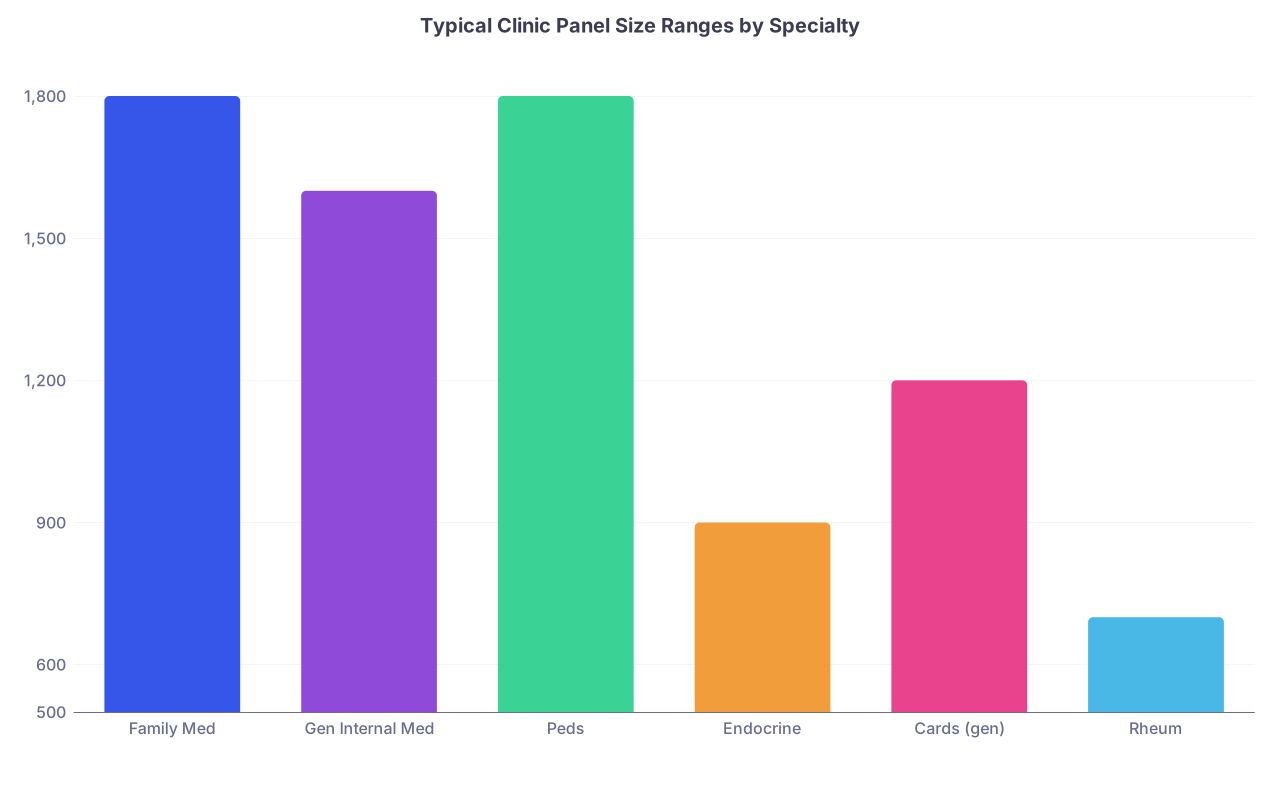
| Category | Value |
|---|---|
| Family Med | 1800 |
| Gen Internal Med | 1600 |
| Peds | 1800 |
| Endocrine | 900 |
| Cards (gen) | 1200 |
| Rheum | 700 |
Are these numbers universal? No. But they are the ballpark ranges I keep seeing in large systems.
wRVUs: The “How Much Billable Work Did You Do?” Metric
wRVUs are the currency of physician productivity. Payers pay CPT codes. Each CPT code has an assigned wRVU value. Your total wRVUs = sum of all codes you bill (properly).
Key points:
- 99213 (level 3 established visit): ~0.97 wRVUs
- 99214 (level 4 established): ~1.50 wRVUs
- 99204 (new level 4): ~2.60 wRVUs
The exact values change with CMS updates, but the relationship stays: more complex visits and procedures generate more wRVUs.
Why employers love wRVUs:
- Ties directly to revenue.
- Easy to benchmark across regions and specialties.
- Neatly plugs into compensation formulas:
“We pay $XX per wRVU above your threshold.”
Why you must understand them:
- 90% of “productivity-based” outpatient contracts either:
- Pay directly per wRVU, or
- Use wRVUs to justify your salary and bonus.
If you do not know your specialty’s typical annual wRVU range, you are negotiating in the dark.
Quality / Value-Based Bonuses: The “Behavior-Shaping” Money
Quality bonuses are not fluffy side money anymore. In many systems, they are 5–20% of total compensation if you hit all targets.
Common quality metrics tied to bonuses:
- Diabetes control: % of diabetics with A1c < 9.0 (or < 8.0)
- Hypertension control: % with BP < 140/90
- Cancer screening rates: colon, breast, cervical
- Access metrics: time to third next available appointment
- Patient satisfaction scores (CG-CAHPS)
- ED utilization, readmissions, hospitalizations per 1,000 panel members
You might ignore these in residency. Admins do not. Insurers do not. Your contract probably will not.
2. How These Metrics Show Up in Real Contracts
Let’s look at what you are actually going to see on paper.
Common Outpatient Compensation Structures
In post-residency outpatient jobs (primary care, outpatient IM subspecialties), I keep seeing variations of these three models:
| Model Type | Key Features |
|---|---|
| Straight Salary | Fixed base, minimal or no productivity tie |
| Salary + wRVU Bonus | Guaranteed base + variable pay per wRVU above threshold |
| Panel + Quality + wRVU Hybrid | Base plus separate incentives for panel, wRVUs, and quality |
1. Straight Salary (Less Common Over Time)
Example:
- $230,000 per year, 1.0 FTE
- Simple panel expectations and modest quality targets
- No wRVU incentives or only token bonus
Pros: predictability. Cons: limited upside, and often you are still pushed to be productive, just without extra pay.
2. Salary + wRVU Bonus (Very Common)
Example typical language:
- Base: $220,000
- wRVU threshold: 4,500 wRVUs/year
- Conversion factor: $45 per wRVU over threshold
So if you generate 5,200 wRVUs:
- Excess = 5,200 – 4,500 = 700 wRVUs
- Bonus = 700 × $45 = $31,500
Total comp that year: $220,000 + $31,500 = $251,500.
The questions you must ask:
- How realistic is 4,500 wRVUs in my clinic template?
- What is the median wRVU production of current physicians (same specialty, same FTE)?
- Are they hitting threshold comfortably, barely, or not at all?
3. Panel + Quality + wRVU Hybrid (Primary Care Heavy)
This is where panel size and quality metrics start to bite.
Example structure:
- Base: $210,000
- wRVU bonus: $40/wRVU above 4,000
- Panel bonus: up to $15,000 based on panel size tiers
- Quality bonus: up to $15,000 based on meeting clinic-wide and individual metrics
So the max theoretical comp = $210k + wRVU bonus + $30k in incentives. Most physicians do not hit the max. That is by design.
3. Panel Size: What You Must Clarify Before Signing
Panel size is not just a number for a dashboard. It is your life. Inbox messages, refills, prior auths, care gaps, late-day add-ons—the panel drives all of it.
Ask These Questions Like a Hawk
How is my panel defined here?
- Time window (12, 18, 24 months)?
- Is it based on last visit, assignment in EMR, or payer attribution?
What is the expected panel for 1.0 FTE in my specialty?
What is considered a “full” panel? When will they stop assigning new patients?
How quickly do you expect me to reach full panel?
- Day 1 inherit 1,000 patients from a departing doc?
- Build from near zero over 1–2 years?
Does panel size directly affect my pay (panel bonuses, quality metrics denominators)?
Here is where physicians get burned:
- They inherit a large, complex panel from a retiring doc.
- They are held to aggressive quality metrics from day 1, with a sicker panel than their peers.
- Their panel is “full” on paper, but they continue to get forced new patients because access metrics are bad.
Panel-Based Bonus Structures
Common example:
- Panel size measured as “attributed adult lives” as of year-end.
- Bonus tiers:
- 1,200–1,399: $5,000
- 1,400–1,599: $10,000
- ≥1,600: $15,000
On paper, looks nice. In reality:
- If you are at 1,380, they will push you to squeeze in more new patients to cross 1,400.
- Once you are over 1,600, you have a full inbox and very limited control over the complexity of that panel.
Your negotiation move:
- Tie panel expectations to visit template and support staff.
- Full panel with a nurse care manager, embedded pharmacist, and panel manager is manageable.
- Full panel with a single MA and no RN support is punishment.
4. wRVUs: How Your Daily Schedule Turns Into Money
This is where you stop thinking “I see 18 patients a day” and start thinking “What wRVUs do I generate per clinical day?”
Typical Outpatient wRVU Benchmarks
These are rough, but they line up with MGMA / AMGA data and what I see in contracts.
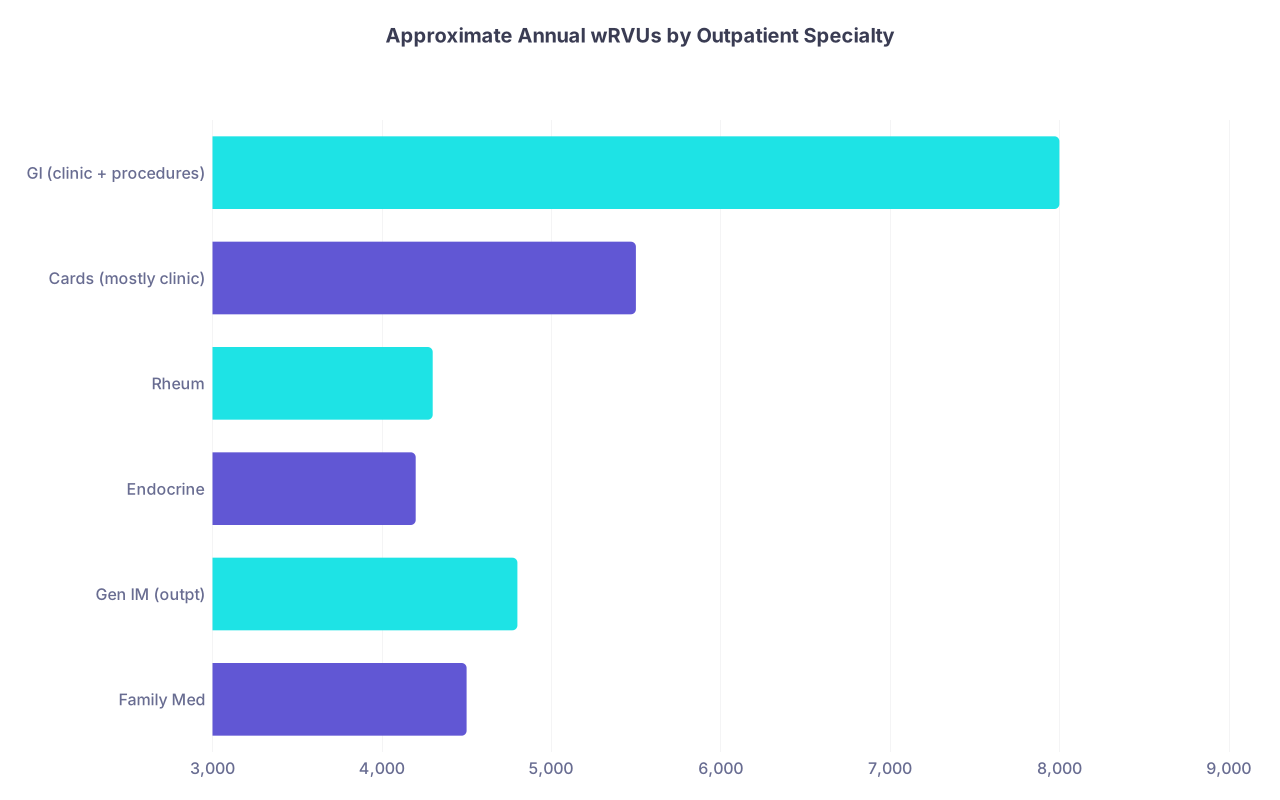
| Category | Value |
|---|---|
| Family Med | 4500 |
| Gen IM (outpt) | 4800 |
| Endocrine | 4200 |
| Rheum | 4300 |
| Cards (mostly clinic) | 5500 |
| GI (clinic + procedures) | 8000 |
Again—not universal, but if someone is telling you the “expected” is 7,000 wRVUs in full-time primary care clinic, that is aggressive and you should be suspicious.
Back-of-the-Envelope wRVU Math
Say you are full-time primary care:
- 36 clinical hours per week
- 18 patients per day, 4.5 days per week, 48 weeks per year → ~3,888 visits/year
If your mix is:
- 60% 99214 (1.50 wRVUs)
- 30% 99213 (0.97 wRVUs)
- 10% 99204/99203 new visits averaging ~2.1 wRVUs
Estimated wRVUs:
- 0.60 × 3,888 × 1.50 ≈ 3,499
- 0.30 × 3,888 × 0.97 ≈ 1,132
- 0.10 × 3,888 × 2.1 ≈ 816
Total ≈ 5,447 wRVUs.
Does that match reality? Sometimes. If the templates are truly 18 pts/day, you are allowed to code accurately, and you have enough support not to sink in paperwork.
Now pair that with a contract:
- Threshold: 4,500 wRVUs
- Conversion factor: $45/wRVU above threshold
Bonus = (5,447 – 4,500) × $45 ≈ 947 × 45 ≈ $42,615.
If the same clinic tells you “no double booking” but then silently increases your visit slots to 22/day, you can see how they can push productivity without touching your base salary line.
The Dark Side: Thresholds That Nobody Hits
One of the worst patterns:
- High-sounding conversion factor ($55/wRVU! Wow!)
- But equally high threshold (e.g., 6,000 wRVUs for full-time primary care).
If the current docs are averaging 4,800–5,200, that conversion factor is fake money. It costs the employer nothing.
You must explicitly ask:
- “What is the average and 75th percentile wRVU production for current physicians in my specialty here?”
- “How many of them actually hit the wRVU bonus threshold last year?”
If they dodge, that is your answer.
5. Quality Bonuses: Where Good Intentions Meet Perverse Incentives
Quality bonuses sound noble. Preventive care, chronic disease control, patient experience. In practice, they are often:
- Underfunded relative to the work required
- Tied to metrics you only partially control
- Strongly affected by panel complexity and social determinants
Typical Quality Bonus Structure
Example:
- Total potential quality bonus: $15,000
- Components:
- Diabetes (A1c < 9 in ≥85% of diabetics): $4,000
- HTN control (BP <140/90 in ≥80%): $3,000
- Cancer screening composite: $3,000
- ED utilization and hospitalizations: $3,000
- Patient satisfaction scores: $2,000
Scoring:
- Each metric: 0–100% achievement.
- Payout often prorated: 80% achievement → 80% of that metric’s dollars.
Now the catch:
- You inherit 300 complex diabetics, many with food insecurity, housing instability, or poor health literacy.
- Your colleague has 150 relatively healthy, tech-savvy patients who respond to portal reminders.
- You are judged on the same <9% A1c threshold and the same absolute percentages.
Unless the bonus is risk-adjusted for panel complexity, the sick-panel doc is punished.
How This Affects Negotiation
Do not accept fuzzy “we have a quality bonus up to X%” without:
- The exact metrics.
- The performance thresholds (e.g., clinic average, percentile targets, absolute percentages).
- How the bonus is calculated (individual vs group vs system-level).
- Whether there is any risk adjustment for panel complexity or socioeconomic status.
You should also ask very directly:
- “What percentage of physicians actually earned ≥80% of the quality bonus last year?”
If the answer is “about 20%,” treat most of that bonus as theoretical, not guaranteed.
6. Negotiating Around These Metrics Without Getting Steamrolled
You are not going to rewrite an entire health system’s compensation model. But you can absolutely negotiate your position within it.
Strategy 1: Protect Your First 1–2 Years
Post-residency, you are new to the town, new to coding as an attending, building a panel from scratch or inheriting chaos from a departed doc.
Reasonable asks:
- Guarantee: pure base salary for year 1 (maybe year 2), with productivity formula not applied until later.
- Or: lower wRVU threshold for year 1 (e.g., 80% of eventual target).
- Or: floor guarantee of total compensation for the ramp-up period.
Typical language I like to see:
- “Physician will receive a guaranteed base salary of $X for year 1. wRVU productivity formula will be tracked but not used to decrease compensation below this base during year 1.”
and
- “Year 2 threshold will be 90% of standard threshold, with full threshold applied beginning year 3.”
Strategy 2: Make Panel Size and Support Match
If they are pushing aggressive panel and quality metrics, you ask for concrete support:
- RN or LPN per X providers
- Care manager / panel manager shared ratio
- Pharmacist support for chronic disease (where available)
- Protected time for outreach and quality work (not weekends from your couch)
Tie it explicitly:
- “If panel expectations exceed 1,600 adult lives, physician will have access to dedicated RN care manager support at least 0.5 FTE.”
You will not always get that in writing, but you should try. At minimum, you get a sense of whether the group is serious about resourcing quality care or just chasing metrics.
Strategy 3: Do Not Let Them Hide the Benchmarks
You want three numbers before you sign:
- Median and 75th percentile wRVUs for current physicians in your specialty at that site or system
- Average panel size per 1.0 FTE, and the distribution (not just “some are large, some smaller”)
- Historical quality bonus payout distribution: what percentage of physicians earned at least 50%, 75%, 90% of the available bonus
If they “cannot share that” or “do not have that data,” you are either dealing with incompetence or obfuscation. Neither is good.
7. Practical Workflow Choices That Quietly Change Your Metrics
This is where your day-to-day clinic habits intersect with your contract.
Coding Accuracy and wRVUs
In residency, many residents undercode. Out of habit, fear, or lack of training. As an attending on a wRVU model, undercoding is just working for free.
You should:
- Get one or two dedicated sessions with a coder or documentation specialist early on.
- Review 20–30 of your charts with them.
- Learn what consistently differentiates a 99213 from 99214 in your group’s eyes.
If your entire clinic is chronically undercoding, you are all losing money while the system quietly benefits.
Message-Based and Telehealth Work
Check whether:
- Portal messages, telephone visits, and asynchronous care are billable and counted toward wRVUs (using G-codes, e-visits, etc.).
- You are set up to actually bill them (templates, workflows, staff support).
If your contract is wRVU-heavy but 30% of your work is unpaid messaging, you will be perpetually behind threshold.
Template Control
Your wRVUs and panel capacity are chained to your template.
Clarify:
- Who controls your visit length and slots? You, or a central scheduler?
- New vs return visit ratios?
- Same-day access slots and how they are counted (do they replace other visits or get added on top)?
If your employer expects 5,000–6,000 wRVUs but refuses to let you control template design, that mismatch will fall on you alone.
8. Putting It All Together: What Good vs Bad Looks Like
Let me contrast two simplified scenarios. I have seen versions of both.
Scenario A: Reasonable, Transparent Primary Care Offer
- Base: $225,000 (1.0 FTE)
- Year 1: base guaranteed, wRVUs tracked but not penalizing
- Year 2+: wRVU threshold = 4,300; conversion factor = $45/wRVU above
- Average current FM physicians: 4,800–5,200 wRVUs, ~1,700 panels
- Panel bonus: up to $10,000 annually for ≥1,600 patients
- Quality bonus: up to $10,000; last year 60% of physicians earned at least $7,000
- Support: 1 RN for every 3 PCPs, embedded pharmacist, 0.2 FTE MA support per PCP for outreach
- Panel considered “full” at 1,800; you can close to new patients
This is not perfect, but it is at least coherent and honest. You can model your likely pay. You can see how to reach thresholds without wrecking yourself.
Scenario B: Opaque, Overly Aggressive Offer
- Base: $210,000
- Year 1: full productivity model applied from day 1
- wRVU threshold: 6,000; conversion factor: $55/wRVU
- “Average wRVUs are strong here” (no data provided)
- Panel bonus: up to $15,000 for ≥1,800 patients (no risk adjustment)
- Quality bonus: up to 15% of salary “based on organizational goals” (no specific metrics listed)
- Support: “Shared MA pool; nursing support as available”
- Panel “fullness” left undefined
This is how new attendings end up working 55–60 hours per week for $210k while administrators brag about “alignment with productivity.”
9. Quick Visual: How These Levers Interact

| Step | Description |
|---|---|
| Step 1 | Panel Size |
| Step 2 | Visit Volume |
| Step 3 | wRVUs |
| Step 4 | Quality Metrics |
| Step 5 | Quality Bonus |
| Step 6 | wRVU Bonus |
| Step 7 | Inbox Workload |
| Step 8 | Burnout Risk |
Panel size drives visit volume and inbox chaos. Visit volume drives wRVUs. Panel composition drives your quality metrics. Bonuses sit on top of this mess. Your wellbeing sits underneath it.
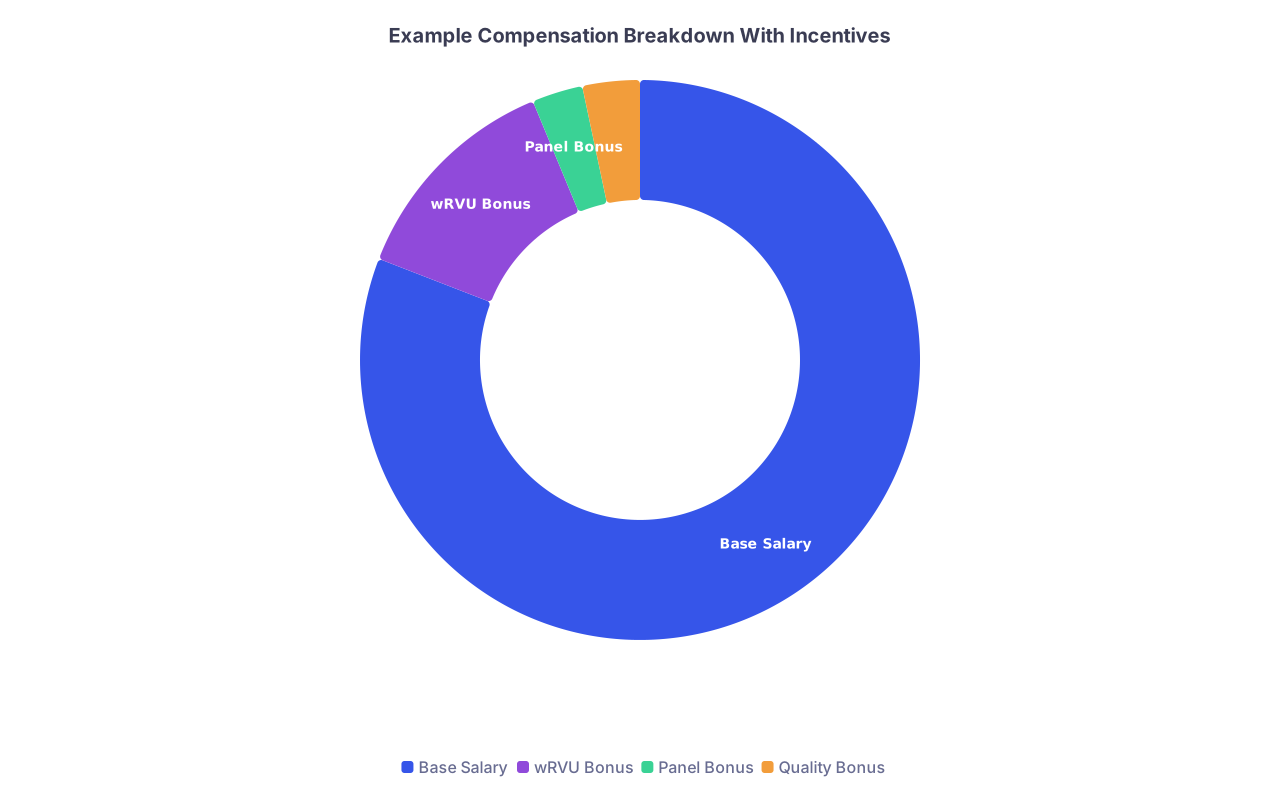
| Category | Value |
|---|---|
| Base Salary | 220000 |
| wRVU Bonus | 35000 |
| Panel Bonus | 8000 |
| Quality Bonus | 9000 |
That chart is what many large groups want to see: base compressed over time, more at-risk compensation tied to productivity and “value.”
FAQ (Exactly 6 Questions)
1. What is a “good” wRVU target for a new outpatient primary care job?
For full-time adult primary care (36–40 clinical hours/week), a reasonable annual target is usually in the 4,000–5,000 wRVU range. Above 5,500, I start asking hard questions about template intensity, documentation burden, and support staff. If someone is pushing a 6,000+ threshold for standard primary care clinic, that is aggressive and you should push back or demand excellent data that their current physicians can genuinely hit it without burning out.
2. Is panel size or wRVUs more important for my negotiation?
For compensation, wRVUs typically drive more dollars directly, because they tie to revenue. For your life, panel size is more important. A bloated, complex panel with modest wRVUs can still destroy your inbox and quality metrics. In negotiation, you use wRVU data to argue for realistic thresholds and use panel size to argue for adequate staffing, template control, and panel caps. They are different levers; both matter.
3. Should I ever accept a contract where my entire bonus is quality-based, not wRVU-based?
I would be cautious. Purely quality-based models sound virtuous but often leave physicians exposed to factors they cannot control: panel complexity, social determinants, hospital policies, and system-level failures. A mixed model (base + wRVU + quality) is usually more balanced. If someone offers a large quality bonus, insist on written specifics: exact metrics, thresholds, risk adjustment, and historical payout data. Otherwise you are signing up for theoretical money.
4. How fast should I expect to reach a “full” panel as a new attending?
Depends entirely on the practice. In high-demand areas with retiring physicians, you might inherit 800–1,200 patients on day 1 and hit a “full” panel within 6–12 months. In slower markets or new clinics, it can take 2–3 years to reach desired panel size. This is exactly why your first 1–2 years should have income guarantees or reduced thresholds. If they expect a full panel by month 6, get clarity on exactly how many patients you are inheriting and from whom.
5. Do telehealth and e-visits count toward wRVUs and panel metrics?
They can, but not automatically. If your system properly codes telephone visits, telehealth video visits, and portal e-visits with the right CPT and G-codes, they contribute wRVUs. If they are treated as “just messages” or “courtesy calls,” you are doing unpaid work. Panel metrics usually do not care about visit modality; attribution is based on being listed as the PCP and having at least one qualifying encounter. Clarify how your group bills and credits virtual care before you sign.
6. What red flags in a productivity contract should make me walk away?
A few big ones:
- wRVU thresholds that are well above national benchmarks without transparent data showing current docs actually hit them.
- Vague quality bonus language without concrete metrics, thresholds, or payout history.
- Heavy reliance on panel and quality metrics with no mention of support staff, care managers, or protected time.
- Refusal to share median and 75th percentile wRVUs, typical panel sizes, and actual bonus payout rates.
- Full productivity model applied from day 1 with no ramp-up protection.
If you see three or more of these in one offer, you probably have better options elsewhere.
Key takeaways:
- Panel size, wRVUs, and quality bonuses are not abstract admin games; they are the mechanisms that will control both your income and your day-to-day sanity.
- You should never accept a productivity-based contract without concrete data on current physician performance, explicit definitions of panel and metrics, and a protected ramp-up period.
- Use these metrics as negotiation tools: tie realistic wRVU thresholds to actual templates, tie panel expectations to staffing, and treat quality bonuses as real only if they are defined, risk-adjusted, and historically paid.


