

The most dangerous telemedicine contracts are the ones physicians sign after skimming the malpractice paragraph and assuming “it’s all standard.”
It is not standard. And if you are doing cross‑state telemedicine and you do not understand licensure and malpractice allocation in your contract, you are gambling with your license, your coverage, and in some cases your personal assets.
Let me break this down specifically.
1. How Telemedicine Changes the Risk Equation
Telemedicine is not “clinic, but on Zoom.” Legally, it is a different animal.
Three core differences matter for contracts:
The patient’s location defines the practice site
Most states treat the encounter as occurring where the patient sits, not where you sit. So if you are in Illinois and the patient is in Texas, you are practicing medicine in Texas for licensure and many liability purposes.Multiple states = multiple regulatory regimes
Every state medical board has its own rules on:- Telemedicine standard of care
- Prescribing (especially controlled substances)
- Informed consent format and content
- Documentation and record retention
- Supervision of APPs by telehealth
Claims can be filed in multiple forums
A bad outcome with a patient in Florida might trigger:- A lawsuit in Florida
- A board complaint in Florida
- A follow‑on board action in your home state
Your contract has to anticipate this multi‑front risk.
Telemedicine companies tend to optimize for speed and scale, not for your individual malpractice and licensure safety. That tension shows up in the contract language.
2. Core Cross‑State Licensure Concepts You Must Grasp
If you treat one patient in a state, you must assume that state’s board and laws apply to you. There is no “it was just a quick call so it doesn’t count.”
A. Common Licensure Frameworks Used in Telemedicine
Here is how telemedicine employers usually approach multi‑state practice.
| Model | Who Holds the License | Typical Use Case |
|---|---|---|
| Single-State Only | You, one state | Local telehealth add-on to clinic |
| IMLC Multistate | You, multiple states via compact | Regional telehealth groups |
| Full 50-State | You, many states + rotating panel | Large national telemedicine platforms |
| Employer License Bank | Employer holds some institutional/state-specific status | Academic/health systems with limited states |
If a contract just says “Physician shall maintain all licenses required to perform services” without saying who pays, who manages, and which states, that is lazy drafting. It is also a red flag.
You want three things clearly spelled out:
- Which states you are expected to be licensed in (now and in the future).
- Who pays initial and renewal fees, and covers fingerprints, background checks, and DEA fees.
- Who handles tracking, renewals, and CME that is license‑related.
B. Interstate Medical Licensure Compact (IMLC) – Good, but Not Magic
The IMLC is heavily used in telemedicine. It speeds up obtaining additional licenses if you meet certain “State of Principal License” requirements.
But your contract needs to account for IMLC realities:
- Not all states are members. California, New York, and a few others have historically lagged. You cannot “compact” your way into those.
- Compact participation changes. States join, pause, or modify rules.
- Fees multiply. You do not “buy one, get ten.” Each state license still costs money and renewals.
What I like to see in a sane telemedicine contract:
A list or schedule of target states with a cap.
Example: “Physician will maintain active licenses in up to 8 states as mutually agreed.”Explicit expense coverage.
Example: “Employer shall pay all fees associated with obtaining and maintaining such licenses, including but not limited to state licensing fees, IMLC fees, background checks, and DEA registrations where required.”Clarity on your obligations.
Example: “Physician agrees to timely complete applications and provide requested documentation; delays caused by physician will not be grounds for discipline if outside physician’s control.”
If the contract says (and I have seen this language) “Physician agrees to obtain such additional state licenses as Employer may request, at Physician’s sole cost,” that is a no.
C. Telemedicine‑Specific Licensure Traps
There are a few specific patterns that create headaches:
“Occasional consult” carve‑outs
Some states allow cross‑border consultations with an in‑state physician without a license. Employers will sometimes rely on that in marketing. Your contract, however, may not track that nuance at all. Result: you think you are covered; the board disagrees.Telemedicine‑only special registrations
A handful of states have telemedicine‑only registrations or limited scopes. If the company wants you to practice there under such a registration, it must say:- That they will obtain and pay for that registration.
- Whether your malpractice insurer actually recognizes that status as a “license” within policy terms.
Supervising APPs in other states
If you are supervising NPs or PAs remotely across state lines, you may need:- A physician license in that state
- Separate, board‑filed supervisory agreements
The contract should say explicitly whether you are expected to supervise out‑of‑state APPs and how the company will maintain compliance.
3. The Malpractice Reality in Telemedicine (It Is Not One‑Size‑Fits‑All)
Most physicians glance at the malpractice section for three numbers: per‑claim limit, aggregate, and tail. That is not enough in telemedicine.
You need to know:
- Is the policy occurrence or claims‑made?
- Does it cover multiple states and telemedicine specifically?
- Who controls the defense and settlement?
- What happens when you leave?
A. Coverage Type and Limits – Do They Match the Risk?
Typical telemedicine setups use:
- Claims‑made policies
- 1M/3M or 2M/4M limit structures
- Employer‑held policy with physician named as insured
For low‑acuity urgent care telehealth, 1M/3M is often reasonable. For tele‑ICU, teleradiology, or specialty consults with high‑stakes decision making, I consider 1M/3M borderline. You want the right limit for the type of practice, not just a number copied from an outpatient clinic template.
A good contract clause will say something like:
“Employer shall provide professional liability insurance covering Physician’s services under this Agreement in the amount of no less than $1,000,000 per claim and $3,000,000 in the aggregate, with coverage for telemedicine services in all jurisdictions where Physician is assigned patients under this Agreement.”
If it just says “Employer maintains liability coverage” with no numbers, no telemedicine language, no multi‑state assurance, that is weak.
B. Telemedicine Endorsements and State Coverage
Here is where people get burned: not every malpractice policy automatically covers telemedicine in all states where you might be treating.
You want to see either:
- A policy that is explicitly nationwide in scope, or
- Confirmation that each new state license you take on will be added to the policy before you see patients there.
Telemedicine contracts should address this operationally:
“Employer shall ensure that all jurisdictions in which Physician provides services are included within the geographic coverage territory of Employer’s malpractice policy prior to assignment of patients from such jurisdictions.”
If the company asks you to “just start seeing patients in State X” before coverage is updated, you say no. On the record. In writing.
C. Who Pays for Tail Coverage (And When)?
Claims‑made coverage means you need tail when:
- You leave the job
- The company switches carriers
- The company goes out of business
Telemedicine startups are famous for both aggressive growth and sudden implosion. Tail coverage in multi‑state practice is not cheap.
Common patterns in contracts:
- Employer pays tail if they terminate without cause
- Physician pays tail if physician resigns or is terminated for cause
- Silent on what happens if company dissolves or goes bankrupt
Silence is bad. You do not want to be the one arguing with a bankruptcy trustee about malpractice tail.
You want specific language:
- “Employer shall be solely responsible for procuring and paying any extended reporting (‘tail’) coverage necessary to maintain continuous coverage for services provided by Physician under this Agreement, regardless of the reason for termination, including Employer insolvency.”
If they refuse that, you at least fight for:
- Employer pays tail for any termination not clearly due to physician misconduct that would justify loss of coverage.
- Employer provides written evidence of tail procurement upon termination.
Never accept: “Tail coverage is Physician’s responsibility.” For multi‑state telemedicine, that is a financial landmine.
4. Contract Clauses That Quietly Shift Telemedicine Risk Onto You
Here is where the games are played. The language often looks benign. It is not.
A. Indemnification – Who Bears the Cost When Things Go Bad
If you see a sweeping indemnification clause like:
“Physician shall indemnify and hold harmless Employer from any and all claims arising out of Physician’s provision of services hereunder.”
That is unacceptable. That is essentially telling you: if you get sued, the company wants you to pay for their costs, too.
Reasonable structure in telemedicine:
- Mutual indemnification. Each party is responsible for its own negligence, errors, or intentional misconduct.
- Employer indemnifies you when the claim arises from:
- Platform failure
- Scheduling errors
- Credentialing or privileging failures
- Corporate policies that conflict with standard of care
Sample reasonable language:
“Employer shall indemnify Physician for claims arising from Employer’s operations, technology platforms, and administrative processes. Physician shall indemnify Employer only for claims arising from Physician’s gross negligence or intentional misconduct, to the extent not covered by professional liability insurance.”
If they insist you indemnify them for routine malpractice claims, that is a bright red flag.
B. Unilateral Control Over State Expansion and Workload
Telemedicine companies like to say: “You can pick how many states you want.” Then the contract says:
“Physician shall obtain and maintain such additional state licenses as Employer may reasonably request.”
I have seen that used to push a physician from 3 states to 20, all at the last minute, with pressure to “help clear the queue.” The license burden, DEA complexity, and compliance exposure balloon.
You want a cap and a consent requirement:
“Physician shall not be required to maintain licenses in more than [X] states without Physician’s written consent.”
And ideally:
“Any expansion to additional states must be accompanied by written confirmation that malpractice coverage for such states is in effect.”
C. Arbitration, Venue, and Choice of Law in a Multi‑State Practice
You might be in Colorado, the company is headquartered in Delaware, the patient is in Georgia, and the contract says:
“This Agreement shall be governed by the laws of the State of Delaware, and any disputes shall be resolved exclusively by arbitration in [Company HQ City].”
That is standard corporate boilerplate. Here is the problem: medical malpractice and board complaints do not care about your arbitration clause. Plaintiffs and boards will still go where the patient is. However, employment disputes, indemnity fights, and coverage arguments will be dragged to the company’s turf.
You will rarely get them to move venue to your state. You can, however, at least:
- Limit the scope of mandatory arbitration to employment disputes, not malpractice.
- Ensure that nothing in the contract prevents you from cooperating with or defending yourself before any state medical board.
You want language such as:
“Nothing in this Agreement, including any arbitration provision, shall be construed to limit Physician’s right or obligation to respond to, participate in, or defend against any proceeding before a state medical board or other regulatory authority.”
5. Practical Red Flags in Telemedicine Contracts (Post‑Residency Edition)
Let me give you the patterns I see when new attendings sign their first or second telemedicine agreements and then call an attorney in a panic six months later.
A. Vague Role Descriptions That Hide Risky Scopes
Phrases like:
- “Physician shall provide telemedicine services as assigned.”
- “Duties may include, but are not limited to, clinical, supervisory, and administrative tasks.”
That can morph into:
- Supervising dozens of APPs in states where you barely know the rules.
- Signing off on protocols you did not draft.
- Being designated “Medical Director” without the title being highlighted in the contract, but with the liability that comes with it.
Push for specificity:
- Clinical scope (e.g., “adult urgent care telehealth, no chronic pain management, no Schedule II prescribing”).
- Whether you will be a “supervising physician” or “medical director” by title or by function.
- Cap on number of APPs you supervise across states.
B. Production Pressure + Telemedicine = Documentation Problems
Telemedicine platforms love short visit times. 4–8 minutes per encounter is typical. Your contract may have:
- RVU‑based or per‑encounter compensation
- Soft quotas that in practice are hard quotas (“most physicians complete 20–25 visits per shift”)
Your malpractice defense will live and die on documentation. Telemedicine charting needs more, not less, clarity: location, consent, limitations of remote exam, red‑flag education, return precautions.
If productivity expectations are incompatible with safe charting and informed consent, your risk skyrockets.
At minimum, your contract should not:
- Penalize you for refusing to shortcut care or documentation.
- Allow termination for “failure to meet performance metrics” if those metrics are not defined and reasonably tied to safe practice.
I have seen physicians terminated who then had their malpractice defense undermined by the employer’s own argument that “this physician failed to meet our company standards.”
6. Step‑By‑Step: How to Vet a Telemedicine Contract for Licensure and Malpractice
Here is a simple sanity‑check process you can run before you sign anything.

| Step | Description |
|---|---|
| Step 1 | Receive Contract |
| Step 2 | Identify Licensure Clauses |
| Step 3 | Request State List and Cap |
| Step 4 | Confirm Fee Responsibility |
| Step 5 | Review Malpractice Section |
| Step 6 | Request Coverage Clarification |
| Step 7 | Check Tail Coverage Terms |
| Step 8 | Review Indemnity and Supervision |
| Step 9 | Clarify Any Red Flags |
| Step 10 | Consult Attorney if Needed |
| Step 11 | Negotiate and Sign or Walk |
| Step 12 | States Listed or Capped? |
| Step 13 | Telemedicine and Multistate Explicit? |
Do this in order:
- Circle every reference to “licensure,” “license,” “state(s),” and “DEA.”
- Summarize on one sheet: which states, who pays, who manages.
- Circle every reference to “professional liability,” “malpractice,” “coverage,” “tail,” “indemnify,” and “hold harmless.”
- Summarize: limits, claims‑made vs occurrence, who pays tail, who controls defense.
- Look for unspecific duty language: “as assigned,” “as requested,” “reasonably required.”
- Ask, on email: “Please confirm whether your malpractice policy covers my telemedicine services in all states where I will be assigned patients, and whether tail coverage will be provided if our relationship ends.”
If you cannot get straight answers in writing, do not sign. That level of opacity almost always correlates with operational chaos behind the scenes.
7. Concrete Example: Comparing Two Telemedicine Offers
Let me sketch a realistic comparison.
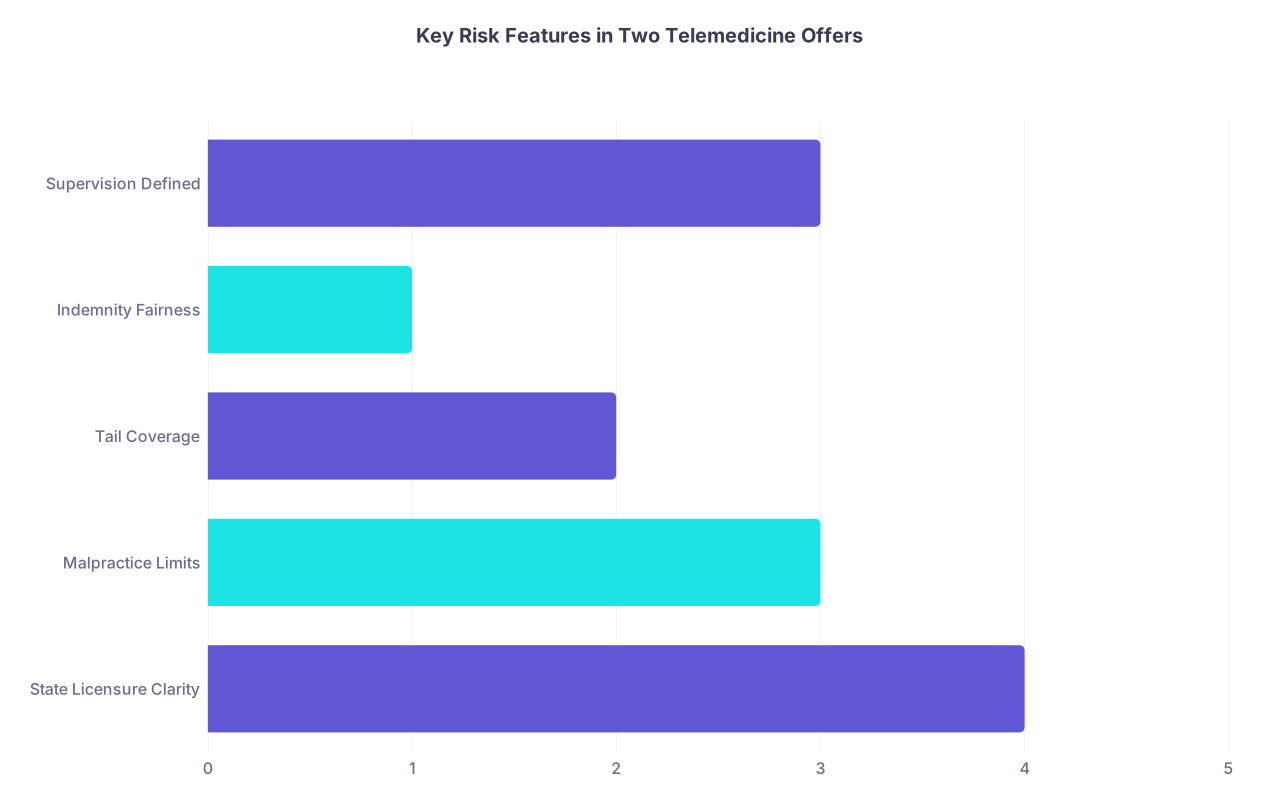
| Category | Value |
|---|---|
| State Licensure Clarity | 4 |
| Malpractice Limits | 3 |
| Tail Coverage | 2 |
| Indemnity Fairness | 1 |
| Supervision Defined | 3 |
Imagine:
Offer A – Big national tele‑urgent care platform
- Licensure: “Physician to obtain licenses as requested.” No cap. Employer pays, but vague timelines.
- Malpractice: 1M/3M, claims‑made, employer policy, silent on telemedicine explicitly.
- Tail: “Responsibility of physician if physician resigns.”
- Indemnity: You indemnify them for “all claims arising from your services.”
- Supervision: “May involve supervising advanced practice providers.”
Offer B – Regional health system telehealth extension
- Licensure: Specific list of 3 states, cap at 5 without mutual consent; employer pays all fees.
- Malpractice: 2M/4M, claims‑made, explicit nationwide telemedicine endorsement; written confirmation they will not assign you patients in a state until added to coverage.
- Tail: Employer pays tail for any termination not involving physician’s proven fraud or intentional misconduct.
- Indemnity: Mutual, limited to negligence not covered by insurance.
- Supervision: Defined ratios, states, and APP types.
Offer A will show up in online forums with comments like “the pay per visit is a little higher.” Offer B is boring but much safer. After you have paid $30–60k for tail coverage once in your career, you stop chasing those extra $5–10 per consult.
8. Special Issues: Malpractice and Tele‑Prescribing, Imaging, and High‑Risk Areas
Telemedicine malpractice does not distribute evenly. Certain patterns generate more claims.
A. Tele‑Prescribing (Especially Controlled Substances)
With the evolving Ryan Haight Act telemedicine prescribing rules and shifting DEA telemedicine flexibilities post‑COVID, your risk here is non‑trivial.
Your contract should:
- Specify whether you are expected or allowed to prescribe controlled substances via telehealth.
- Clarify who updates you on DEA and state‑specific changes.
- Ideally, tie your obligations to compliance with “applicable federal and state law,” not to vague corporate policies alone.
If the company pressures for high‑volume ADHD, pain, or anxiety prescribing across states, with minimal collateral documentation, you are volunteering to be the name on the board complaint.
B. Teleradiology, Tele‑ICU, and Specialty Consults
These are higher‑severity malpractice lines. Two extra safeguards in the contract:
- Higher policy limits (2M/4M or better).
- Confirmation that the malpractice policy is specific to teleradiology/critical care and not just a generic outpatient telehealth endorsement.
You should also confirm that you are not de facto taking responsibility for on‑site teams’ documentation or follow‑through beyond what you can reasonably control.
9. Negotiation Strategy: What to Push Hard On, What to Live With
You are post‑residency and entering the job market. Telemedicine may be a side gig or your main role. Either way, you need to prioritize.
Non‑negotiable (or nearly so):
- Malpractice coverage limits explicitly stated and appropriate to your scope.
- Written confirmation that coverage includes telemedicine and all practice states.
- Clear tail coverage allocation; avoid open‑ended personal responsibility for tail.
- Reasonable indemnity language that does not have you indemnifying the entire company for routine malpractice.
Strongly worth pushing for:
- Cap on the number of licenses or states, with your consent required to expand.
- Employer paying all licensure‑related costs and maintaining licensure tracking.
- Defined supervisory roles and APP ratios.
- Protection for your ability to participate in board proceedings without corporate interference.
Nice to have:
- Productivity expectations written with a nod to quality and documentation.
- Support for CME specifically tied to telemedicine and multi‑state compliance.
- Contract language requiring the employer to inform you of material regulatory changes that affect your practice obligations.
And remember: you do not need to “win” every point. You do need to avoid stepping on the landmines that can bankrupt you or wreck your license.

10. Quick Telemedicine Contract Checklist (Licensure & Malpractice)
Before you sign, you should be able to answer all of these, in writing:
Licensure:
- Which specific states am I required to be licensed in?
- Is there a cap on the number of state licenses?
- Who pays all license/IMLC/DEA fees?
- Who tracks renewals and alerts me?
- Will I supervise APPs in other states? Where, and under what rules?
Malpractice:
- What are the per‑claim and aggregate limits?
- Is the policy occurrence or claims‑made?
- Does it explicitly cover telemedicine and all states where I will practice?
- Who pays for tail, under which scenarios?
- Who controls defense and settlement?
- Do I have to indemnify the company for malpractice claims?
If you cannot fill that checklist from the contract and one follow‑up email, you do not understand your risk. And that is precisely where telemedicine platforms make their margins.

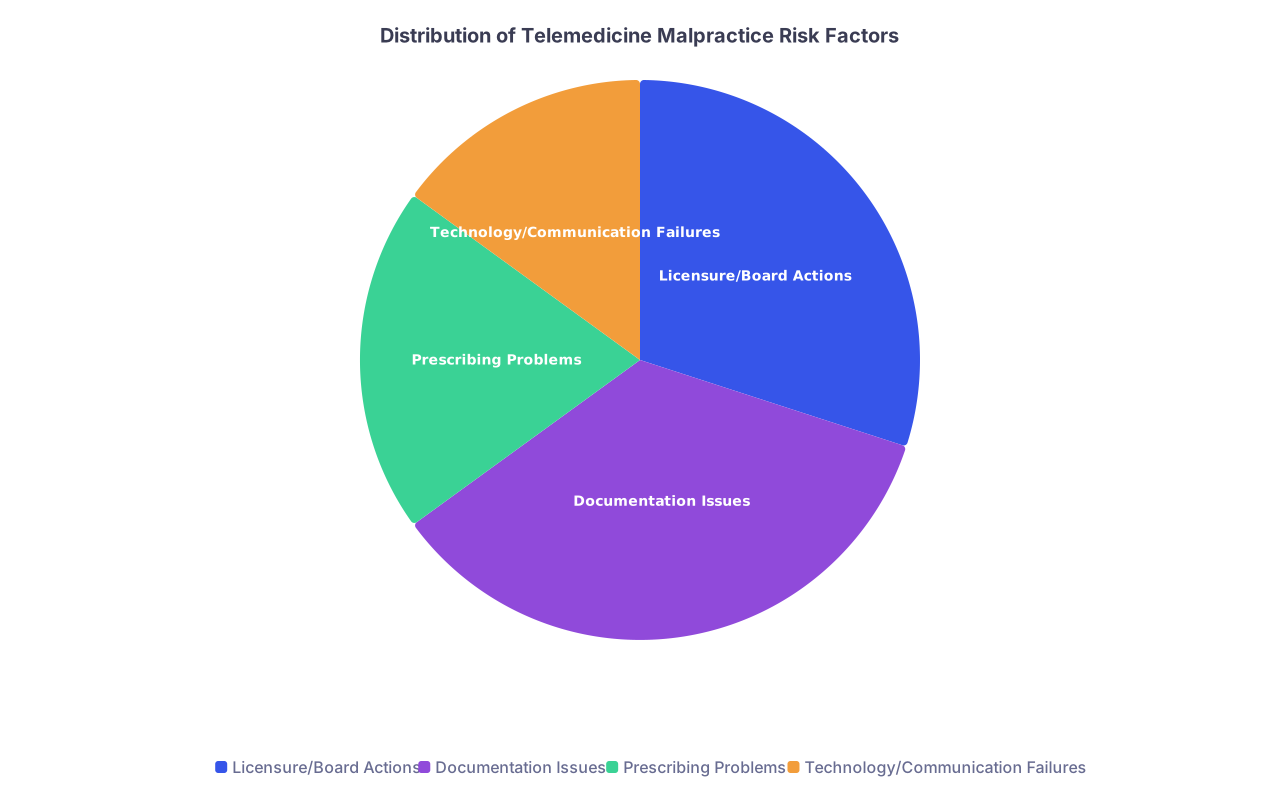
| Category | Value |
|---|---|
| Licensure/Board Actions | 30 |
| Documentation Issues | 35 |
| Prescribing Problems | 20 |
| Technology/Communication Failures | 15 |

| Step | Description |
|---|---|
| Step 1 | Telehealth Encounter |
| Step 2 | Adverse Outcome |
| Step 3 | Patient Complaint or Lawyer Contact |
| Step 4 | State Court Filing |
| Step 5 | Board Complaint Filing |
| Step 6 | Insurer Notified |
| Step 7 | Defense Assigned |
| Step 8 | Settlement or Trial |
| Step 9 | Where is Patient? |
Key Takeaways
- In telemedicine, the patient’s location drives licensure and much of your malpractice exposure; your contract must explicitly address which states you cover, who pays, and how coverage follows you.
- Malpractice clauses that are vague on telemedicine scope, state coverage, and tail allocation are not harmless boilerplate; they are where risk is quietly shifted from the company to you.
- Indemnity, supervision, and expansion‑of‑states language are the soft spots where even smart physicians get trapped; if you fix those three areas up front, you avoid most of the career‑level damage.
FAQ
1. Do I really need a separate medical license in every state where a telemedicine patient is located?
Yes. As a practical and regulatory matter, you must assume you need a full, active license in each patient’s state unless that state has a very narrow, clearly applicable exception. Your employer may talk about “consults” or “coverage,” but if your name is on the chart as the treating physician, you want a license in that state and written confirmation that your malpractice policy covers it.
2. Is it ever acceptable for me to pay my own tail coverage for a telemedicine job?
Acceptable is the wrong word. Sometimes it is unavoidable, especially if you are a 1099 independent contractor with your own policy. But if you are W‑2 and the company controls patient selection, states, and practice model, pushing tail onto you is unfair and financially dangerous. At minimum, negotiate that employer pays tail for any termination not due to your proven misconduct.
3. Can my telemedicine employer prevent me from talking to a state medical board or require their attorney to represent me?
They can try to intimidate you into channeling everything through them, but they cannot legally stop you from responding to or defending yourself in front of a board. Your contract should explicitly state that nothing in it restricts your cooperation with regulators. Using company counsel in a board matter is often a conflict of interest; you should at least have the option of your own representation.
4. If my malpractice policy is through the company, do I still need my own separate telemedicine coverage?
Not always, but you should not trust assumptions. If the employer policy clearly names you as an insured, specifies limits, includes telemedicine in all your practice states, and they commit to paying tail, separate coverage may be redundant. If any of those elements are unclear, limited, or easily changed without notice, a personal policy or supplemental coverage is worth considering, especially if telemedicine is only part of your practice mix.


