

Most new attendings leave $5,000–$15,000 a year on the table because they do not negotiate “small” line items like CME, licensing, and boards. That is a mistake.
These are not minor perks. They are recurring, predictable, and tax‑inefficient if you pay them personally. Handled correctly, they are one of the cleanest ways to increase your effective compensation without getting into a fight over base salary.
Let me break this down in a way that actually matches what you will see in real contracts and real HR conversations.
1. Why These Line Items Matter More Than You Think
Think of CME, licensing, and board fees as a separate mini‑budget attached to your contract. You either fund it with your post‑tax paycheck or you get the employer to fund it pre‑tax.
On the ground, this is what I see for most first jobs:
- CME “allowance”: $2,000–$3,000 per year
- Licensing/DEA/boards: vague phrase like “may be reimbursed”
- Time: “up to 5 days” or nothing mentioned at all
And then what happens?
You spend $3,000 on a board review course, $1,000 on your state license + DEA, $1,500 on a conference, and your employer tells you, “Your CME fund is already used up.” The rest comes out of your pocket.
That is preventable.
Your goal is threefold:
- Increase the amount of money in these buckets.
- Make the rules for using them explicit and favorable.
- Lock those rules into the written contract, not just policy handouts or emails.
You do this before you sign. After you sign, you are begging, not negotiating.
2. Know the Real Numbers: What Things Actually Cost
Before you negotiate anything, you need a realistic cost map. Otherwise you will accept a $2,000 CME fund that does not even cover your boards.
Let us quantify the big recurring items you will face in your first 3–5 years as an attending.
| Category | Low Estimate | High Estimate |
|---|---|---|
| CME conferences/courses | $2,000 | $5,000 |
| State medical license(s) | $200 | $1,000 |
| DEA registration (averaged) | $150 | $300 |
| Initial board exam (averaged) | $500 | $2,000 |
| MOC / board recert / annual fees | $300 | $1,000 |
And now a visual sense of where your money goes:
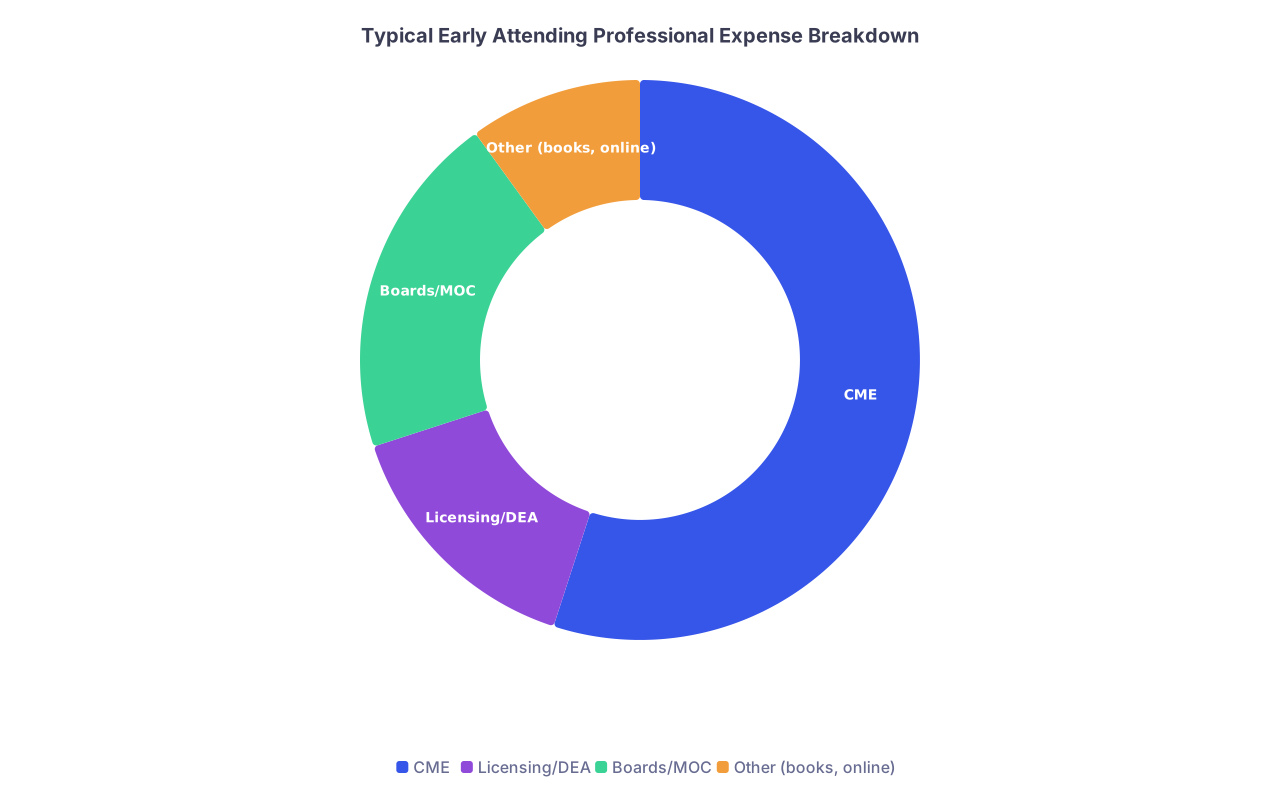
| Category | Value |
|---|---|
| CME | 55 |
| Licensing/DEA | 15 |
| Boards/MOC | 20 |
| Other (books, online) | 10 |
A few realities:
- DEA is currently over $1,000 for a 3‑year registration. Average that over 3 years.
- Many specialties have board exam fees over $2,000, plus travel and hotel for in‑person components.
- Multiple state licenses are common in telemedicine, locums, or systems spanning state lines.
Now translate that into what you actually need from your employer:
- PGY last year + Year 1–2 as attending: front‑loaded expensive years (initial boards, sometimes fellowship boards, initial license in a new state, maybe 2–3 conferences to get your name out).
- Years 3–10: license renewals, DEA renewals, MOC fees, 1–2 CME events per year, online CME.
If your employer’s standard CME is $3,000 and “no explicit board or license coverage,” you will be paying out‑of‑pocket quickly.
3. CME: Money, Time, and Rules You Actually Want
CME is the easiest and cleanest line item to negotiate. HR understands it. Other physicians have it. There is precedent.
You need to look at three elements together:
- Annual dollar amount
- Number of CME days (paid time off separate from vacation)
- Eligible uses and carryover rules
3.1. Reasonable CME Targets by Job Type
Here is what I commonly see across practice settings for full‑time physicians:
| Setting | Typical CME $ | CME Days |
|---|---|---|
| Academic (university) | $2,000–$3,500 | 5–10 |
| Large hospital employed | $3,000–$5,000 | 3–5 |
| Large private group | $2,500–$5,000 | 3–5 |
| Highly competitive subspec | $4,000–$7,500+ | 5–10 |
Rule of thumb: below $3,000 is weak in 2024+ unless you are part‑time or very low‑pay specialty with heavy in‑house CME.
3.2. How to Read and Fix the CME Clause
A typical mediocre clause:
“Employer will provide Physician with an annual CME allowance of $2,000, subject to Employer’s policies, to cover expenses for conferences, courses, and related materials. CME time will be arranged with the practice as operationally feasible.”
Red flags:
- “Subject to Employer’s policies” with no attached policy document.
- No number of CME days.
- No carryover language.
Here is what you actually want to push toward:
“Employer shall provide Physician with an annual CME allowance of $4,000, to be used for CME‑related expenses including but not limited to registration fees, travel, lodging, educational materials, and specialty board review courses. Physician shall receive 5 paid CME days per contract year, separate from vacation and holiday time. Unused CME funds may be carried over for one additional year (maximum cumulative balance $6,000).”
Breakdown of what you just improved:
- “Including but not limited to” prevents a bean‑counter from denying your board review course or online subscription because it is not an in‑person conference.
- 5 paid CME days, explicitly separate from vacation.
- Carryover helps you bank for big conferences or every‑few‑years events.
3.3. Specific Phrases to Ask For (Verbatim)
In actual negotiation emails or calls, you can say:
- “Given current CME costs in [specialty], I would like to see the CME fund at $4,000 per year with 5 protected CME days.”
- “Can we clarify that CME days are separate from vacation/PTO?”
- “I recommend we add ‘including but not limited to registration fees, travel, lodging, educational materials, and board review courses’ so finance does not end up nitpicking each receipt.”
You do not have to sound like a lawyer. You just need the concepts in writing.
4. Licensing, DEA, and Credentialing: Make Them the Employer’s Problem
If the hospital needs you licensed and credentialed to bill, then those are business expenses. They should not be coming out of your net pay.
This is one of the easiest areas to win if you ask explicitly. Many employers simply never offer it because residents do not ask.
4.1. What Should Be Covered
You want the contract to clearly state that the employer will pay or reimburse for:
- State medical license fees (for all states they require you to work in)
- DEA registration (if your role requires it)
- Hospital medical staff membership and privilege fees
- Any mandatory hospital or system application fees
Common language you can push for:
“Employer shall pay or reimburse Physician for all fees associated with obtaining and maintaining an active medical license in the state(s) required for Physician’s duties under this Agreement, including but not limited to state licensing fees, DEA registration fees, and hospital medical staff membership and privileging fees.”
The “required for Physician’s duties” phrase is helpful if the group spans multiple states. If they want you to cover a second license for their convenience, you can negotiate extra or clarify that additional optional licenses are on you.
4.2. Timing: Initial vs Renewal
Pay attention to when coverage starts.
Problem scenario I see all the time:
- You pay $900 for state license, $1,000+ for DEA to get ready for a job.
- Contract start date is July 1. Reimbursement clause says, “Employer will pay for renewal fees during the term of employment.”
- Result: They refuse to reimburse your initial costs because they were pre‑employment.
Fix it by adding:
“Employer will reimburse Physician for reasonable costs associated with obtaining initial state license(s), DEA registration, and hospital privileges necessary for Physician to commence employment, provided Physician remains employed for at least 12 months.”
You can accept a clawback if you leave in under 12 months. That is fair and very standard.
5. Board Exams, MOC, and Recertification: Front‑Load This in Your First Contract
Board exam fees are lumpy and expensive. If you avoid the conversation, you will pay them yourself.
Most first‑year attendings are facing one of:
- Initial specialty boards right around or shortly after starting
- Subspecialty boards after fellowship
- Oral components requiring travel, hotel, time off
5.1. How Employers Typically Handle Board Costs
Common patterns:
- Academic centers: often have a policy to cover at least one board attempt per specialty or a fixed dollar amount.
- Large hospital systems: wildly variable; some cover initial boards, many do not unless you ask.
- Private groups: often “we’ll see what we can do,” which means no, unless it is in writing.
And most contracts simply say you need to be board eligible or board certified by X date, with zero mention of who pays.
You want the clause to say explicitly that the employer:
- Pays or reimburses the exam fee
- Covers reasonable travel and lodging if exams require in‑person attendance
- Allows paid days off to sit for the exam
5.2. Sample Contract Language That Actually Works
You can propose something in this ballpark:
“Employer shall reimburse Physician for the registration fee for one initial attempt at the American Board of [Specialty] certification examination, as well as reasonable travel and lodging expenses if in‑person attendance is required. Employer shall also provide up to 3 days of paid time off for the purpose of taking the examination. Reimbursement shall be contingent on Physician remaining employed for 12 months following the examination date.”
You just moved a $2,000–$4,000 hit (exam + travel + hotel + days off) from your wallet to theirs.
5.3. Maintenance of Certification (MOC) and Ongoing Fees
Longer term, you also care about:
- Annual or biennial MOC “program fees”
- 10‑year recertification exams (if applicable)
- Required MOC CME modules
Many employers will at least consider:
“Employer shall reimburse Physician for the annual Maintenance of Certification program fee charged by the American Board of [Specialty], as well as the registration fee for required recertification examinations, provided these are required to maintain active hospital privileges and participation in payer networks.”
This especially flies in high‑compliance systems that obsess over “board certification” in marketing.
Do not expect every private group to cover full MOC forever, but you should at least ask for exam fees when due during your contract term.
6. Time Off vs Money: CME Days, Exam Days, and PTO Cannibalization
Money is only half the equation. If all of your CME conferences and board exams come out of your “vacation,” you are effectively taking a pay cut in quality of life.
You want separate buckets:
- Vacation / PTO
- CME days
- Exam days (if possible, folded into CME or treated as admin time)
6.1. CME Days: What Is Reasonable
Benchmarks I see:
- 3–5 days per year in most hospital and large group settings
- 5–10 in academic medicine or high‑end subspecialties
- 0 in bare‑bones private practices (and they wonder why people leave)
The key is explicit separation from vacation:
“Physician shall receive 5 days per contract year of paid CME leave, separate from Physician’s vacation or general PTO, to be used for attendance at conferences, courses, or board review activities.”
If they push back, you can compromise to 3 days but keep the separation.
6.2. Board Exam Days
You do not want to burn your vacation days sitting in a testing center.
Option 1: Treat exam days as CME days:
“Board examination days may be counted as CME leave.”
Option 2: Stand‑alone exam leave:
“Employer shall provide up to 3 days of paid examination leave for sitting for initial board certification examinations, separate from vacation and CME leave.”
Some systems will not give you this cleanly. Then your backup is: 1–2 exam days come from CME bucket, rest from PTO.
7. How to Actually Negotiate This: Step‑By‑Step
You are not walking into the CEO’s office and flipping a table over $1,000 in CME funds. You are doing quiet, precise, line‑item negotiation with HR or the recruiter.
Here is a clean process.

| Step | Description |
|---|---|
| Step 1 | Receive Draft Contract |
| Step 2 | Identify CME and Fee Clauses |
| Step 3 | Benchmark Against Market |
| Step 4 | Prioritize Changes |
| Step 5 | Send Targeted Redline or Email |
| Step 6 | Discuss on Call |
| Step 7 | Confirm in Final Contract |
| Step 8 | Decide - Push or Trade |
| Step 9 | Adjust Expectations or Walk |
| Step 10 | Employer Response |
7.1. Step 1: Extract All Related Clauses
Do not just search for “CME.” Also look for:
- “Continuing Medical Education”
- “Professional development”
- “License” / “Licensing”
- “DEA”
- “Board certified” / “Board eligibility”
- “Professional fees”
- “Benefits summary” attachment or handbook references
Make a short list of what the contract actually says in each area.
7.2. Step 2: Benchmark and Set Targets
Use:
- Colleagues in same specialty, same region
- Specialty societies’ early career resources
- Recruiters who place in your field (they know what is standard)
Then you set concrete targets before you ask. For example:
- CME: “I want $4,000 + 5 days; I will settle at $3,000 + 3 days if needed.”
- Licensing/DEA: “100% coverage initial + renewals; minimum I accept is initial + one full renewal cycle.”
- Boards: “Full coverage for first attempt; I can flex on travel if they resist.”
7.3. Step 3: Package Your Ask Professionally
You are not whining. You are aligning professional requirements with employer benefits.
Sample email language:
After reviewing the draft, I had a few requests related to CME and professional expenses. Given that maintaining board certification, licensure, and CME is central to my role (and required for hospital and payer participation), I would like to propose the following adjustments:
- Increase CME allowance to $4,000 per year with 5 days of CME leave, separate from vacation, with expenses including conferences, board review, and associated travel.
- Clarify that the employer will cover initial and renewal costs for state licensing, DEA, and hospital staff/privileging fees required for my clinical duties.
- Add coverage for the first attempt at my [Specialty] board certification exam, including exam fee and reasonable travel, with reimbursement contingent on 12 months of continued employment after the exam.
These are pretty standard in [specialty] positions I have reviewed, and they will support both clinical quality and recruitment/retention. I am happy to discuss details.
Polite. Specific. Non‑emotional. Ties your request to patient care and compliance.
7.4. Step 4: Know What to Trade
If they push back, you have options:
- Accept slightly lower CME dollars in exchange for better time (e.g., $3,000 + 5 days).
- Accept full coverage of licensing and boards but keep their original CME number.
- Push harder on one bucket that matters most in the first 3 years (often boards + initial licensing).
Do not give up all three: money, time, and fee coverage. At least win 2 of 3.
8. Special Scenarios: Hospital Employed, Private Group, Telemed/Locums
Different employers play this game differently. Let me draw some quick lines.
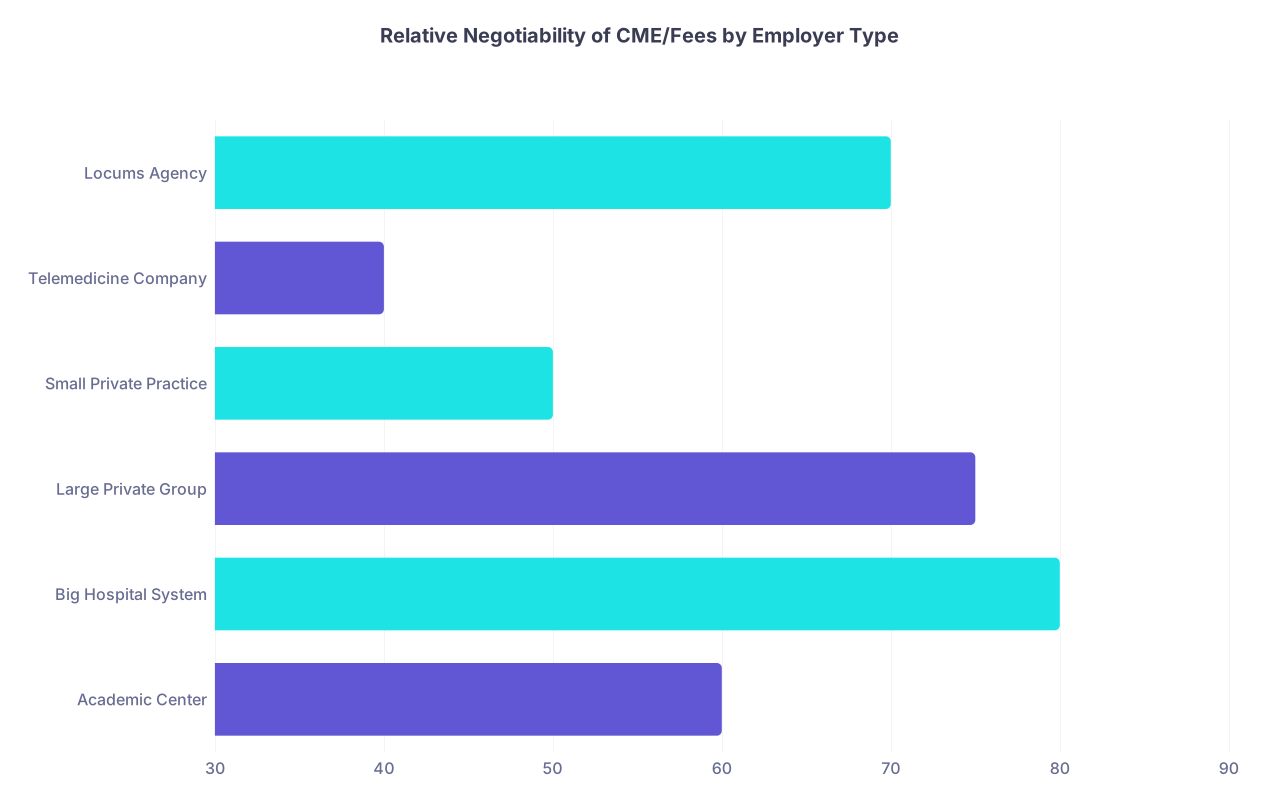
| Category | Value |
|---|---|
| Academic Center | 60 |
| Big Hospital System | 80 |
| Large Private Group | 75 |
| Small Private Practice | 50 |
| Telemedicine Company | 40 |
| Locums Agency | 70 |
(Values are “how much they will move on line items” out of 100 – not scientific, but matches what I see.)
8.1. Large Hospital Systems
Pros:
- Usually have a formal CME policy you can see.
- Often already cover licensing and DEA; they just forget to say it clearly in the contract.
Cons:
- HR is rigid. They will say, “This is our standard CME package.”
Strategy:
- Do not try to reinvent their entire benefits policy.
- Focus on clarifying language and small numeric bumps.
- Ask for at least coverage of initial boards and initial licensing as a recruitment incentive.
8.2. Private Groups (Single or Multi‑Specialty)
Pros:
- More flexible; partner physicians understand your pain points.
- They can trade line items instead of changing system‑wide policy.
Cons:
- They pay out of their pockets, so they are stingier if margins are thin.
Strategy:
- Tie your ask to fairness: “This is what similar groups offer for early career hires.”
- Be willing to accept slightly lower base in exchange for strong pre‑tax benefits if their base is already above market.
8.3. Telemedicine and Locums
Telemedicine:
- Many telemed companies pay for additional state licenses because it directly increases their revenue.
- CME and boards are often ignored.
Locums:
- Agencies will often pay for licenses and some CME‑like expenses if it helps them place you.
- But you are a 1099 contractor often, which changes tax treatment.
Strategy:
- If 1099: you can deduct these expenses as business expenses, but you still want the agency or company to pay directly for any state licenses they insist on.
- Negotiate per‑license bonuses or direct payment for each new state license they require.
9. Long‑Term View: These “Tiny” Wins Compound
Let us be brutally concrete for a second.
Imagine two otherwise identical jobs:
Job A:
- CME $2,000, 0 CME days
- No license/DEA/board coverage
- Exam days taken from PTO
Job B:
- CME $4,000, 5 CME days
- Full license/DEA coverage, initial board exam and travel covered
- 3 days exam leave, separate from vacation
Over a 3‑year contract, realistic difference:
- Extra CME dollars: ~$6,000
- License/DEA/board fees you did not pay: $3,000–$6,000
- Extra paid days off for CME/exams: 10–15 days
You are talking about five figures and meaningful time.
Here is a rough 3‑year illustration:
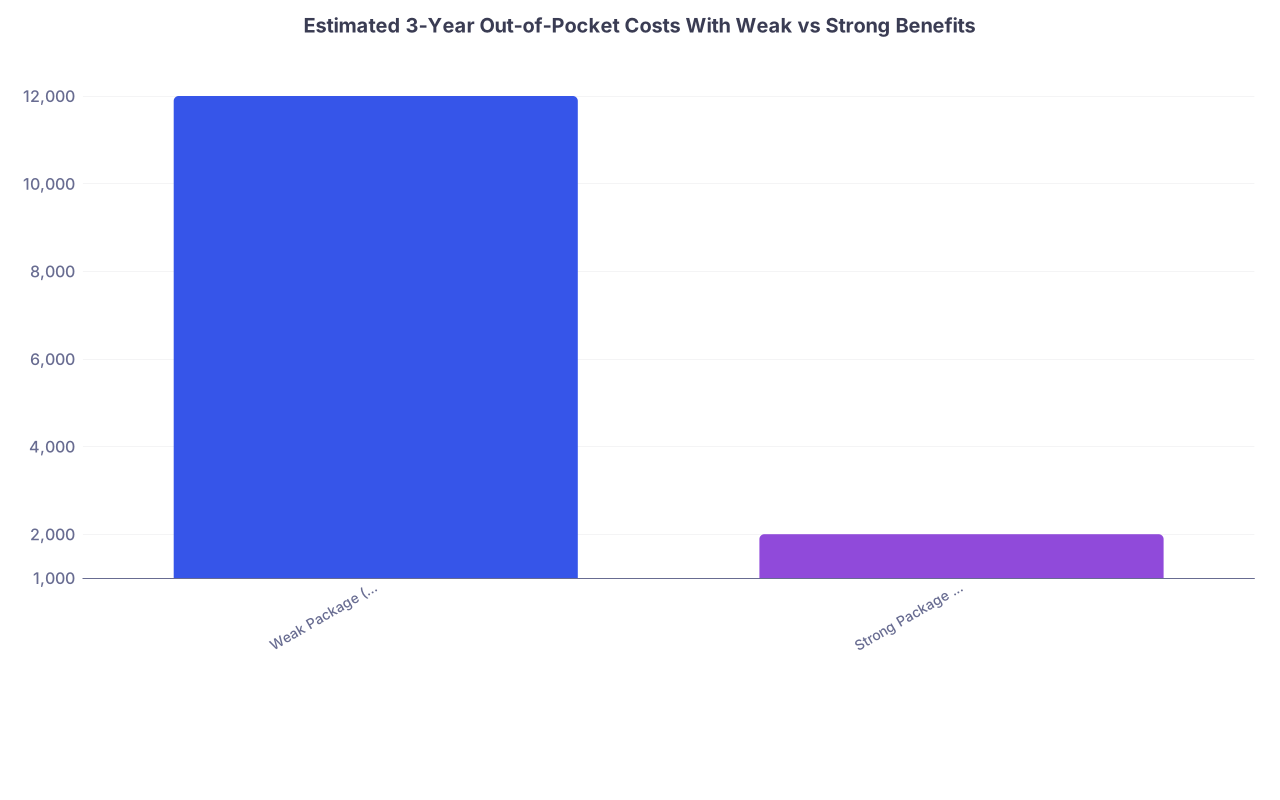
| Category | Value |
|---|---|
| Weak Package (Job A) | 12000 |
| Strong Package (Job B) | 2000 |
That is why this matters.
FAQ (Exactly 5 Questions)
1. I already signed my contract. Can I still negotiate CME and fee coverage later?
You will not “negotiate” in the strict sense, but you can sometimes improve things at renewal or during annual reviews. Framing it as, “Other institutions in the area are covering initial boards and licensing for new hires; this would help retention and recruitment here,” can move the needle. But do not expect major changes mid‑term unless the employer is uniquely motivated.
2. How hard should I push on CME and fees compared to base salary?
Base salary is still your primary lever, but CME/licensing/boards is an under‑used secondary lever that is less emotionally charged for employers. I usually advise: push clearly on base once, then put a lot of your negotiation energy into these line items because administrators see them as “professional expenses” rather than “pay raises,” which are politically harder.
3. Should I prefer higher CME money or more CME days?
If you are early attending with board exams looming, I would take money first, time second. In practical use, $2,000 vs $4,000 CME matters more than 3 vs 5 CME days if your PTO bank is decent. However, if your PTO is stingy (e.g., 3 weeks total), then protecting CME days from being cannibalized is crucial.
4. What if the employer says their policy cannot be changed for one physician?
Then you aim for exceptions, not policy rewrite. For example: “I understand the standard CME is $3,000. Could we add a one‑time sign‑on CME bonus of $3,000 to cover initial board review and exam costs?” Or: “Can the hospital directly cover my initial state license and DEA as a recruitment cost, separate from ongoing policy?” Exceptions are often easier than rewriting the handbook.
5. Is it ever better to pay these myself for tax reasons as an independent contractor?
If you are a true 1099 contractor and have your own PLLC/PC, you can run CME, licensing, and boards as business expenses, which is tax efficient. But even then, having the hiring entity directly pay for licenses they require and contribute to CME is still money you do not have to spend. In W‑2 employed situations, there is essentially no reason not to have the employer pay these pre‑tax if you can negotiate it.
Key takeaways:
First, CME, licensing, and board fees are not “small perks”; they are recurring, predictable costs that can quietly strip tens of thousands from your early attending years if you ignore them. Second, these line items are often easier to improve than base salary, especially when you ask clearly for: higher CME dollars + defined CME days + explicit coverage of licensing, DEA, and at least one board exam attempt.


