

Only 41% of academic physicians report that their “protected time” is actually protected in day‑to‑day practice.
Let me translate that: most of what gets called “protected time” in contracts is either vague, unenforceable, or casually ignored. And the gap between what you think you are getting and what you are actually signing is largest right at the academic vs private practice divide.
You are post‑residency, staring at contracts. One says “80% clinical, 20% protected academic time.” The other says “full‑time clinical with competitive RVU bonus.” On the surface, the academic offer sounds more humane. Less grind, more breathing room. But that is only true if the “protected” part has teeth.
So let’s dissect those clauses like a path specimen. What they look like in academic vs private practice. How they get undermined. What language you must insist on. And where people routinely get burned.
1. The Fundamental Difference: What “Protected Time” Really Means in Each World
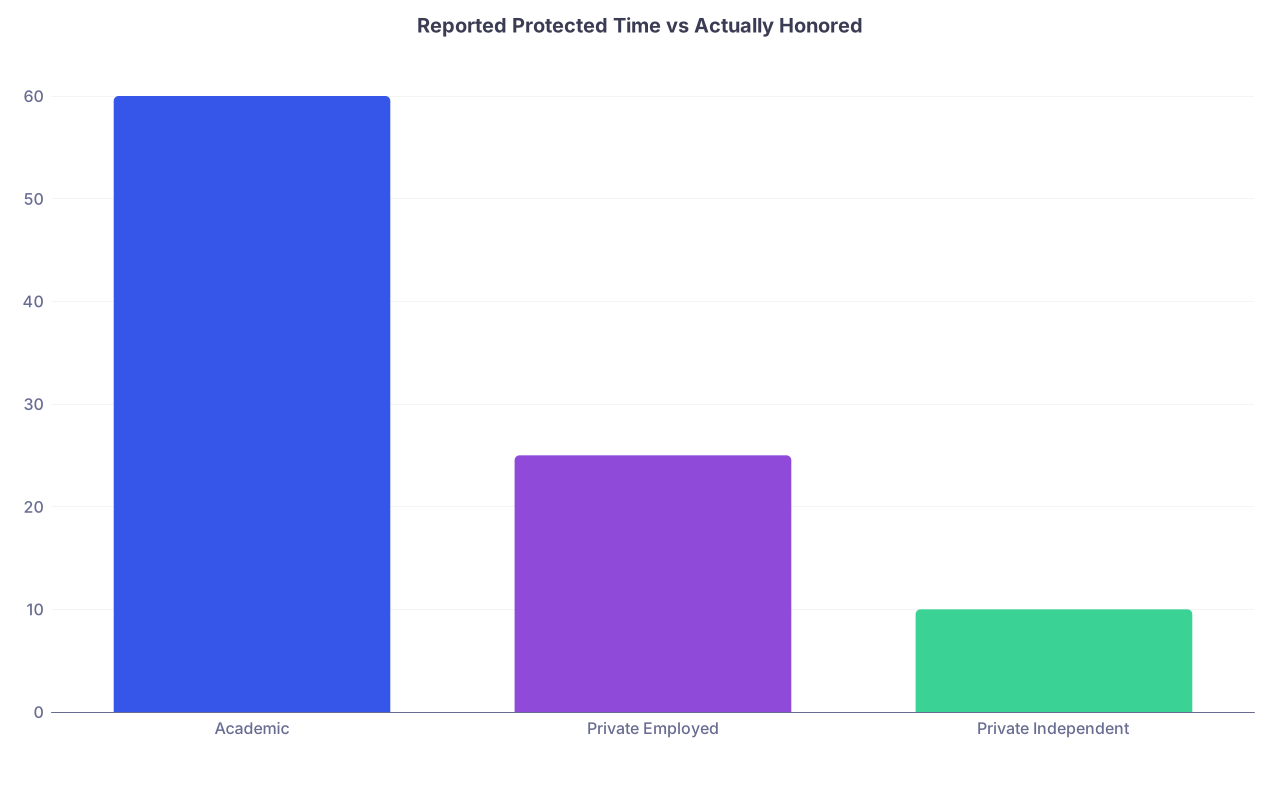
| Category | Value |
|---|---|
| Academic | 60 |
| Private Employed | 25 |
| Private Independent | 10 |
In academic medicine, “protected time” is supposed to mean: a defined portion of your FTE is carved out for non‑clinical work (research, teaching, admin, QI, leadership). Your clinical expectations are reduced accordingly. Revenue expectations are not pegged to a full‑time clinical load.
In private practice, “protected time” usually means one of three things:
- A half‑day with no patients to do admin / catch‑up
- A titled role with a small stipend and nominal reduction in clinic load
- A sales pitch more than a legal reality (“we respect work‑life balance”)
The crucial distinction:
Academic contracts often recognize protected time as part of your FTE breakdown. Private practice contracts usually ignore it in the metrics that actually drive your job: RVUs, collections, call burden, and partnership track.
If your contract does not link protected time to either:
- a lower RVU/visit/OR target, or
- explicit FTE adjustment (e.g., 0.8 clinical, 0.2 admin)
then it is not protected. It is a suggestion.
2. How Protected Time Is Structured on Paper: Academic vs Private
| Setting | How It Is Defined | Common % Range | Linked To RVUs? |
|---|---|---|---|
| Academic Research Track | FTE split + grant expectations | 20–80% | Sometimes adjusted |
| Academic Clinician-Educator | FTE split + duties list | 10–30% | Often poorly adjusted |
| Hospital-Employed (Non-Academic) | Vague admin/leadership time | 5–15% | Rarely adjusted |
| Large Private Group | Informal “block” or title role | 0–10% | Almost never |
| Small Independent Practice | Essentially none | 0% | N/A |
Academic: The FTE Game
Real academic contracts spell out FTE allocation, at least on the first pass. For example:
- 0.6 FTE clinical
- 0.3 FTE research
- 0.1 FTE teaching/administration
If the contract does not have this kind of breakdown, you are already on thin ice. What I see far too often:
“Faculty member will devote substantial efforts to research and teaching, with 60–80% clinical effort expected.”
That range—60–80%—is a trap. Because every department chair under financial pressure will quietly slide you toward the 80% side.
Key academic red flags:
- “Anticipated” or “typical” effort distribution instead of “will be”
- Percentages only in the offer letter, not the actual contract
- Protected time “subject to funding” with no time horizon or ramp‑down schedule
- “As determined by the Chair” with no appeal process
Private Practice: The Mirage Half‑Day
In hospital‑employed or large private groups, protected time looks more like:
“Physician will receive 0.5 days per week of administrative time, typically free of direct patient care responsibilities.”
Sounds nice. Then in practice:
- They backfill patients into that half‑day whenever clinic volume is high.
- Your RVU targets are still set as if you are full‑time clinical.
- Nurse messaging, refills, and inbox work still pile up into that “protected” slot.
If there is no explicit reduction in RVU expectations or in‑person visit volumes, that half‑day is just unpaid catch‑up time.
3. The Core Technical Issue: RVUs, FTE, and the Math Behind “Protected”
Let me be blunt: protected time that does not change the math of your job is theater.
Here is the underlying structure you have to force into writing:
- Your total FTE (1.0, 0.8, etc.)
- The breakdown of that FTE into clinical vs non‑clinical components
- RVU or productivity expectations that reflect the clinical fraction only
A proper clause looks like this in an academic contract:
“Physician shall be employed at 1.0 FTE, allocated as 0.6 clinical FTE and 0.4 non‑clinical FTE. Annual RVU target shall be based on 0.6 clinical FTE using the departmental benchmark of 5,500 RVUs per 1.0 clinical FTE (i.e., 3,300 RVUs per year).”
Compare that to what I routinely see:
“Physician is a full‑time employee with an annual target of 5,500 RVUs. Physician will have 0.4 FTE protected for research and academic activities.”
That is nonsense. You cannot be 100% clinical for RVU purposes and simultaneously 40% protected.
In private practice jobs with RVU‑based compensation, the problem is worse. Example:
- Target: 6,000 RVUs/year for bonus eligibility
- “Administrative half‑day” floated during recruitment
- Contract: no mention of reduced target, no FTE breakdown
So your colleagues doing 5 full days of clinic are held to 6,000 RVUs. You, doing 4.5 clinic days plus a “protected” half‑day, are held to the same number. You have less time to hit the same bar. That is not protected; it is a handicap.
4. Common Protected Time Clauses – And Why They Fail
Here is what I hear all the time in real negotiations:
“They promised me 30% research time, but the contract just says ‘some time allocated to research.’ They said it’s standard.”
That is how people get exploited. Let’s look at specific patterns.
Vague Academic Language
- “Faculty will be provided appropriate time for scholarly activity.”
- “The department supports the faculty member’s research and education endeavors with protected time as workload allows.”
- “Exact distribution of duties will be mutually agreed upon annually with the Chair.”
Why this fails:
- “Appropriate” and “as workload allows” are subjective.
- “Mutually agreed upon” usually means “here is the new expectation; please sign.”
- No enforcement mechanism if your clinic gets overloaded.
Contingent on Future Grants
- “40% protected research time will be provided for up to 2 years, after which continuation is contingent upon securing extramural funding.”
This can be fine, but only if:
- The 2‑year period is explicitly guaranteed.
- The ramp‑down after 2 years is defined (e.g., 40% → 20% → 0% over X years).
- The RVU targets/clinical FTE are adjusted in parallel.
Otherwise you wake up at year 3 with no grants, 100% clinical expectations, and a CV that is no longer competitive for the jobs you thought you were aiming for.
“Department Policy” Cop‑Out
Many contracts punt to a “Faculty Effort Policy,” “Department Guidelines,” or “Productivity Policy” that is not attached to the contract and can be changed unilaterally.
Read that again: not attached. Changeable at will.
If your protected time is defined in a separate policy that you have never seen, you do not have protected time. You have a conversation.
5. The Private Practice Twist: Titles vs True Time Protection
Private practice loves titles: Medical Director, Quality Lead, Clinic Chief. These often come with a small stipend and a vague suggestion of protected time.
Real‑world example from a hospital‑employed group:
- “Medical Director – $25,000 annual stipend, 0.1 FTE administrative effort”
Contract language:
“Physician will perform Medical Director duties, with 0.1 FTE administrative effort allocated as scheduling permits. No specific adjustment to clinical targets is guaranteed.”
So you get:
- 4–6 hours/week of extra meetings, email, and reports
- The same clinic schedule
- The same RVU target
The “0.1 FTE” is fictional. You just work more.
If a director/leadership role is supposed to come with protected time, the contract must:
- State a specific reduction in clinic sessions or OR blocks (e.g., from 8 half‑days to 7).
- Reduce RVU expectations proportionally.
- Clarify what happens if the role is removed (your FTE and RVU targets revert; your salary is adjusted accordingly).
Otherwise that stipend is hazard pay, not protected time.
6. Academic vs Private: How Enforcement Actually Plays Out
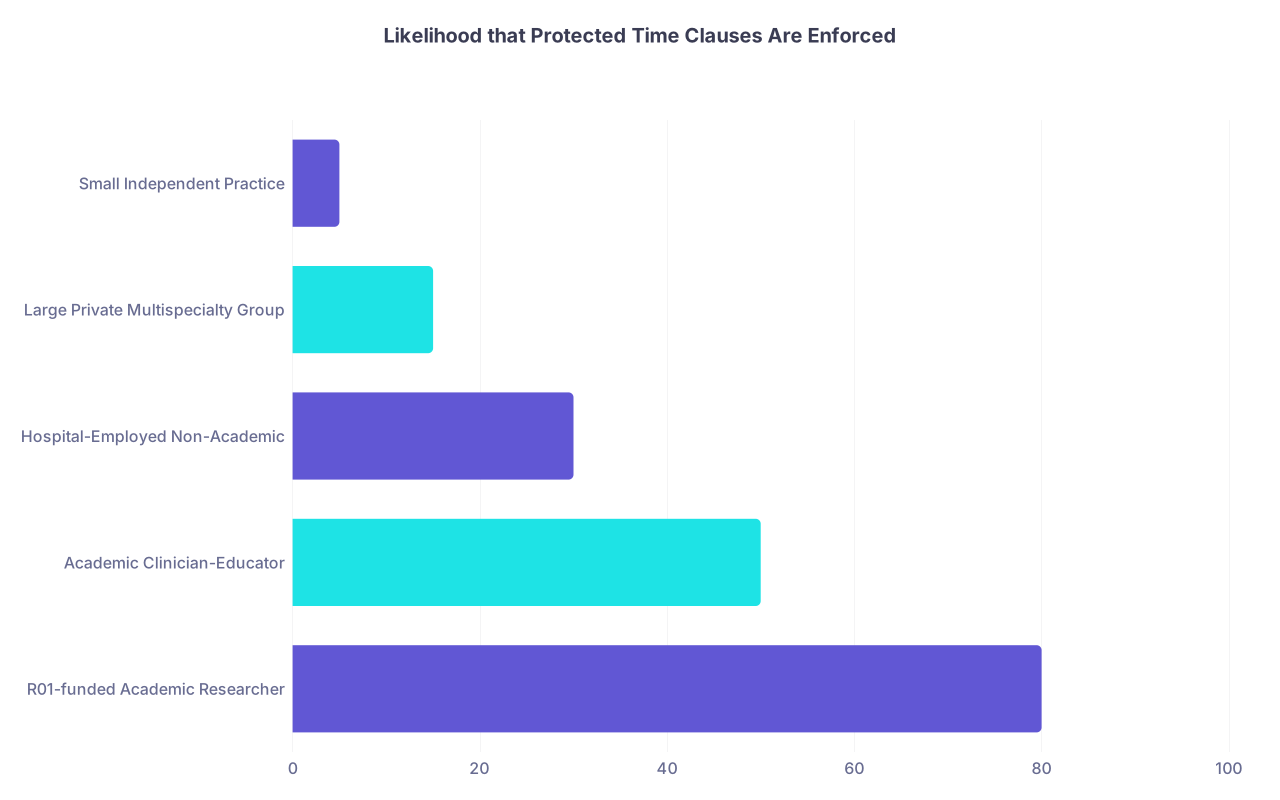
| Category | Value |
|---|---|
| R01-funded Academic Researcher | 80 |
| Academic Clinician-Educator | 50 |
| Hospital-Employed Non-Academic | 30 |
| Large Private Multispecialty Group | 15 |
| Small Independent Practice | 5 |
The single biggest mistake physicians make is assuming good faith = enforcement. Even well‑meaning chairs and CMOs will sacrifice your protected time when volumes spike.
How Academic Protected Time Gets Eroded
I have seen the same pattern in multiple institutions:
Year 1:
- You really get your 40% research time. Light clinic. Grants written. Manuscripts produced.
Year 2:
- “We are short two clinicians, can you just pick up another half‑day for a few months?”
- Protected time shrinks to 25–30%, but RVUs tick up. Usually no written amendment.
Year 3:
- New Chair. Budget shortfalls. “We need everyone closer to 0.8 clinical.”
- Your “protected” 40% becomes an aspiration, not reality.
Unless your contract requires written agreement to change FTE allocation, your protected time will die by a thousand small “temporary” adjustments.
How Private Practice Protected Time Gets Erased
In private settings, this is even simpler:
- “Your admin half‑day is flexible; we may schedule patients there in high demand periods.”
- “You are free to block it off if your RVUs are on track.”
- “We are down two partners; everyone is going to have to open up their schedules.”
And the metrics that drive your bonus, partnership vote, or retention are all clinical. The message is clear: protected time is your problem, not theirs.
7. Language You Want vs Language You Must Reject
Here is where people need concrete phrases. So let me be specific.
Clauses That Actually Protect You
These are the kinds of lines you want to see, in some form:
“Physician’s FTE shall be allocated as 0.7 clinical and 0.3 non‑clinical (research/teaching/administration). Any change to this allocation requires written agreement of both Physician and Employer.”
“Clinical productivity targets, including RVU or encounter benchmarks, shall be prorated based on the clinical FTE component only.”
“Physician shall have one half‑day per week free of scheduled patient care, which shall not be routinely used for overflow or add‑on clinics. Use of this time for clinical care requires prior written consent of Physician.”
“If Employer reduces protected non‑clinical time below 0.2 FTE, Physician may terminate this Agreement with 60 days’ notice without penalty.”
That last one is powerful. It gives you an exit if they gut your protected time.
Language That Sounds Fine But Is Useless
Reject (or heavily revise) language like:
- “Typically 20% of time will be available for academic pursuits.”
- “The Department endeavors to provide protected time consistent with institutional priorities.”
- “A half‑day per week is anticipated to be available for administration.”
- “Protected time may vary from time to time based on clinical demands.”
Those clauses give the employer all the flexibility, and you all the risk.
8. Negotiating Strategy: Academic vs Private
The leverage you have and the angle you take should differ across settings.
In Academic Jobs
Your main levers:
- Grants/funding track record or clear potential
- Subspecialty scarcity
- Competing offers (especially from better‑funded institutions)
What to push for specifically:
- Lock the FTE distribution in the actual contract, not just the offer letter.
- Get explicit RVU targets that reflect only the clinical FTE.
- Ask for a written “effort distribution” addendum that gets updated annually with your sign‑off.
- For grant‑contingent time, negotiate a minimum guaranteed period (e.g., 3 years of 40% research).
If they push back with “we never put FTE in the contract,” understand what that means. They want the ability to ratchet up your clinical load without renegotiation. Decide how much you trust them. Then assume you will change chairs at least once in your first 5–7 years.
In Private Practice / Hospital‑Employed Jobs
Here, the game is different. Most of the time they do not want to formalize protected time. Productivity is king.
So you have three realistic paths:
Trade protected time for lower RVU expectations.
“If I am going to have an admin half‑day, RVU targets need to be 10–20% lower, and that needs to be in writing.”Convert “protected time” to money instead of time.
If they will not reduce your clinical load, negotiate a clear stipend for the extra work, and stop pretending it is protected time. Call it what it is: additional labor.Walk away from fake promises.
If you want real protected time for teaching, research, or leadership, and they will not codify it, then this is not the job for that phase of your career. Do not half‑believe the sales pitch.
9. Protected Time Across Career Phases: How Much Matters When
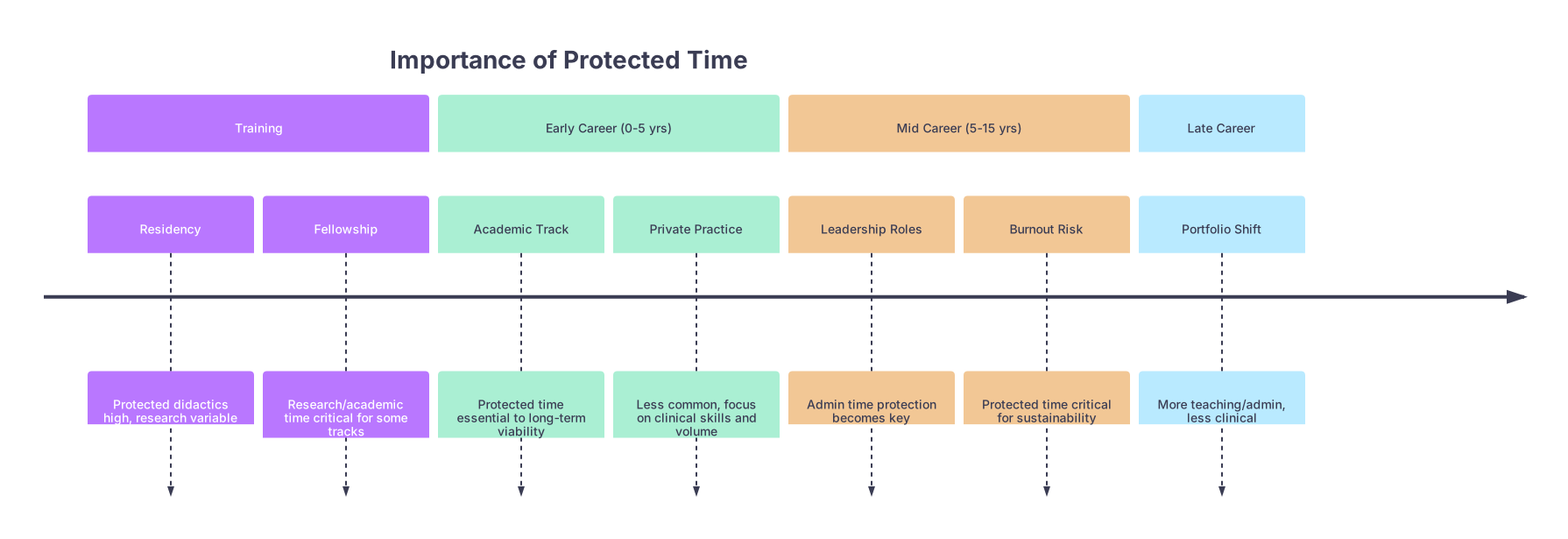
| Period | Event |
|---|---|
| Training - Residency | Protected didactics high, research variable |
| Training - Fellowship | Research/academic time critical for some tracks |
| Early Career (0-5 yrs) - Academic Track | Protected time essential to long-term viability |
| Early Career (0-5 yrs) - Private Practice | Less common, focus on clinical skills and volume |
| Mid Career (5-15 yrs) - Leadership Roles | Admin time protection becomes key |
| Mid Career (5-15 yrs) - Burnout Risk | Protected time critical for sustainability |
| Late Career - Portfolio Shift | More teaching/admin, less clinical |
Protected time means different things at different career stages.
- Early academic faculty (especially in research‑heavy fields) live or die on true protected time. If you blow your first 3–5 years drowning in clinic, your research career is over before it starts.
- Early private practice attendings may reasonably accept minimal protected time, focusing instead on learning the business, building a panel, and getting to partnership. But then do not kid yourself that you are doing “serious research” on the side.
- Mid‑career, as you take on leadership roles, protected administrative time becomes crucial. This is where private practice doctors often get stuck in endless meetings layered on top of full clinical work.
- Late career, many shift toward teaching, quality, and leadership. At that point, protected time is often the only way to reduce clinical exposure without massive income loss.
You need to be brutally honest about what phase you are in and what you are optimizing for. The academic vs private practice decision is not just about money vs prestige. It is about whether protected time is a necessity or a luxury for you right now.
10. Quick Reality Check: Academic vs Private – Which Actually Honors Protection?

| Dimension | Academic Medicine | Private Practice / Employed |
|---|---|---|
| Written FTE Breakdown | Common on paper | Rare |
| RVU Adjusted for FTE | Sometimes, must be forced | Almost never |
| Vulnerability to Volume Creep | High | Very high |
| Research/Teaching Expectation | Often explicit | Minimal or informal |
| True Enforcement Rate | Moderate, variable by chair | Low |
I will be blunt here.
- Academic jobs are the only ones where “protected time” has a serious structural foundation. Even there, you must police it aggressively.
- Hospital‑employed and large private groups will talk about protected time, but the money is tied to volume. If there is a conflict, volume wins.
- Small independent practices essentially do not do protected time in any meaningful sense. You are the revenue engine.
So if you are counting on protected time to build a research program, develop curricula, or seriously pursue leadership, academic medicine—or a very unusual hybrid job—is where that is actually feasible.
If instead you are using “protected time” as a proxy for “less burnout,” understand that a clear, honest full‑time clinical job with no pretense of protected time can be healthier than a fake academic job where your 20% “protected” time is just extra work at night.
11. How to Audit a Contract for Real Protected Time
Before you sign anything, go through this checklist ruthlessly. Ten minutes. No excuses.
Is FTE explicitly defined, with clinical vs non‑clinical percentages?
If not, ask for that language.Are RVU / productivity expectations clearly written?
If yes, are they explicitly tied only to the clinical FTE fraction?Is protected time described with specific numbers?
Percent of FTE, number of half‑days, or hours per week.Can the employer unilaterally change your effort distribution?
Look for “as assigned by Chair” or “as determined by Employer.”Is there a separate policy that controls effort distribution?
If so, demand a copy. If they refuse or hedge, assume it will not favor you.What happens to your pay if protected time changes?
Salary floor? RVU minimum? Penalties for leaving if they gut your time?For leadership roles, is clinic actually reduced?
If the answer is “we will figure it out,” that means no.
If a contract fails this audit and the employer will not modify it, you have clarity. You either accept reality (no real protected time) or you walk.
12. Final Thoughts: The Real Decision You Are Making

You are not choosing between “academic with protected time” and “private with none.” You are choosing between:
- A system (academic) that is at least structurally built to acknowledge non‑clinical work, but will constantly try to steal it back.
- A system (private/employed) that is built almost entirely around clinical revenue, where protected time is an exception that has to be purchased, codified, or fought for.
Three key points and we are done:
Protected time that does not change your RVU / clinical expectations is a lie. If the math is unchanged, the time is not protected. It is extra.
Academic contracts are the only ones where protected time is structurally coherent, but only if FTE and RVUs are explicitly tied together in writing. Push for specific percentages, targets, and change‑control language.
In private practice, assume “protected time” is marketing unless it is explicitly tied to reduced clinical sessions and/or reduced productivity targets. If they will not codify it, plan your career as if it does not exist.
You can build a good career in either environment. But only if you are honest about what “protected time” really is where you are signing.


