

The biggest mistake new attendings make with RVU compensation is signing the contract before they can do the math themselves.
If you cannot calculate your own pay from the RVU language, you are negotiating blind. And administrators love that.
Let me break this down specifically: multiplier, threshold, and bonus are just arithmetic. Once you see the pattern, you will stop being impressed by big “potential” numbers and start asking the only question that matters: “What does this realistically pay, in my specialty, with my volume?”
1. RVU Basics You Actually Need (And What You Can Ignore)
You do not need to become a practice management consultant. But you must understand three core ideas cold:
- What an RVU is.
- Which RVUs your contract uses.
- How RVUs convert into dollars.
What an RVU actually is
RVU stands for Relative Value Unit. For contracts, people are almost always talking about wRVUs — work RVUs — which are supposed to represent the physician work portion (time, intensity, training, risk).
In daily practice:
99213 has a wRVU. A colonoscopy has a wRVU. A total knee replacement has a wRVU. Add them up = your productivity.
There are three RVU “flavors” in Medicare:
- Work RVUs (wRVU) – what your contract usually keys off
- Practice expense RVUs
- Malpractice RVUs
Your contract will nearly always reference wRVUs only. If it does not say “work RVU” or “wRVU”, that is a red flag you clarify immediately.
The conversion factor myth
CMS publishes a dollar per total RVU for Medicare payments (the Medicare conversion factor). New grads routinely confuse this with their pay rate.
They are not the same thing.
- Medicare conversion factor in 2025 is around the mid-$30s per total RVU
- Your wRVU compensation rate (multiplier) might be $45, $60, $80+ per wRVU
These are different systems. Your contract is not paying you what Medicare pays. It is using wRVUs as a productivity score, then applying a separate dollar multiplier.
So:
- Do not use the CMS conversion factor to evaluate your salary.
- Do use MGMA/AMGA benchmarks for wRVU productivity and compensation in your specialty.
2. The Three Core Pieces: Base, Multiplier, Threshold
Almost every wRVU-based contract can be reduced to three levers:
- Base salary – guaranteed money
- Multiplier – dollars per wRVU over some level
- Threshold – the point where your production starts generating extra pay
The trick is that employers hide these mechanics under nice phrases: “productivity bonus,” “incentive comp,” “WRVU-based model,” etc.
The simplest model: pure wRVU from day one
This is the cleanest math and honestly the easiest to understand:
Compensation = (wRVUs produced) × (wRVU rate)
Example:
- Pay: $60 per wRVU
- You produce: 7,000 wRVUs
- Total pay = 7,000 × $60 = $420,000
No base guarantee. No threshold. Brutal in year 1 if you have to build a practice. Fantastic if you are in a high-volume setting and know your numbers.
Most new attendings are not offered this straight model. They get a hybrid.
The more common model: base + productivity over threshold
This is what you will usually see:
- You get a base salary (say $260,000)
- That base “covers” some amount of wRVU production (the threshold)
- If you produce more than that, you get paid extra on the margin
The formula is:
Total comp = Base salary
+ (Your wRVUs − Threshold wRVUs) × Multiplier
[if positive, else zero]
Everything in the contract is just wrapped around that one line of math.
Now we have to talk about those three levers individually.
3. Multiplier: The Number Everyone Lies About
The multiplier is your dollars per wRVU. Something like:
- $45 / wRVU – common in primary care, psych
- $55–$70 / wRVU – many hospital-employed non-surgical specialties
- $70–$100+ / wRVU – surgical, procedural, some subspecialties
The mistake is looking at the multiplier in isolation. A strong-looking multiplier can be paired with:
- An insane threshold
- Low or no ramp-up
- Hidden carve-outs (certain services “don’t count” or are paid differently)
Still, you need a sense of reasonable ranges. Here is a simplified comparison across specialties:
| Specialty Type | Common Multiplier Range ($/wRVU) | Notes |
|---|---|---|
| Outpatient primary care | 40–55 | Often with big base |
| Outpatient psych | 40–60 | Dependent on visit mix |
| Hospitalist | 40–60 | Sometimes shift-based, not RVU |
| Non-proc IM subspecialty | 50–70 | Cards, GI, pulm, etc vary |
| Procedural subspecialty | 60–90 | GI, cards interventions |
| Surgical specialties | 70–110 | Very center- and market-specific |
These are directional. The real sanity check is: Does total comp at realistic wRVUs fall near MGMA median/75th percentile for my specialty?
If not, I do not care how pretty the multiplier looks.
4. Threshold: Where They Quietly Win or Lose
Threshold is where people get burned.
The threshold is usually written as an annual wRVU target that your base salary is “paying you for.” Something like:
- Base: $280,000
- Threshold: 5,000 wRVUs
- Multiplier: $60 / wRVU over 5,000
Read that as:
“You get $280k whether you produce 0 or 5,000 wRVUs. After 5,000, you earn $60 per additional wRVU.”
Let me show you why the threshold is more important than the multiplier in most new-graduate offers.
Concrete threshold math example
Same specialty. Two offers.
Offer A
- Base: $260,000
- Threshold: 4,500 wRVUs
- Multiplier: $55 / wRVU
Offer B
- Base: $300,000
- Threshold: 6,000 wRVUs
- Multiplier: $70 / wRVU
At first glance, B sounds shiny: bigger base, bigger multiplier.
Now assume you realistically can produce about 6,500 wRVUs once established.
Offer A:
Bonus wRVUs = 6,500 − 4,500 = 2,000
Bonus pay = 2,000 × $55 = $110,000
Total pay = $260,000 + $110,000 = $370,000
Offer B:
Bonus wRVUs = 6,500 − 6,000 = 500
Bonus pay = 500 × $70 = $35,000
Total pay = $300,000 + $35,000 = $335,000
Offer B “feels” better on paper. Offer A pays $35k more at realistic volume.
This is the precise math you have to run before signing anything.
Where thresholds hide
Watch for these phrases:
- “Productivity bonus kicks in after 100% of wRVU target is met”
- “Base salary corresponds to XYZ annual RVUs”
- “No additional compensation until standard benchmark is achieved”
If they quote you a “target” or “goal” in wRVUs and then talk about incentive pay “after” that, they are describing your threshold.
I make people write it out like this (in an email summary at minimum):
“Just to confirm: my first dollar of productivity compensation is paid on the wRVU above ______ annually, at a rate of $______ per wRVU.”
If they cannot answer that cleanly, they either do not understand their own plan or they are stalling.
5. The Bonus Formula: Year-End RVU Math Step by Step
Let us formalize the math you need to run on every offer.
Step 1: Identify your inputs
From the contract or offer:
- Base salary: B
- Annual threshold wRVUs: T
- wRVU multiplier: M (dollars per wRVU)
- Your projected annual wRVUs once ramped: P
Your projection (P) is the only guess here. Everything else must be written.
Step 2: Write the formula
If P ≤ T:
Total comp = B
If P > T:
Total comp = B + (P − T) × M
That is it. This is the entire game.
Step 3: Run it at multiple productivity levels
You should calculate at least three scenarios:
- Conservative (e.g., 25th percentile wRVUs)
- Realistic (e.g., 50th–60th percentile for your specialty/practice style)
- Aggressive (e.g., 75th–90th percentile if you know you push volume)
Then compare to MGMA median/75th percentile comp for your specialty.
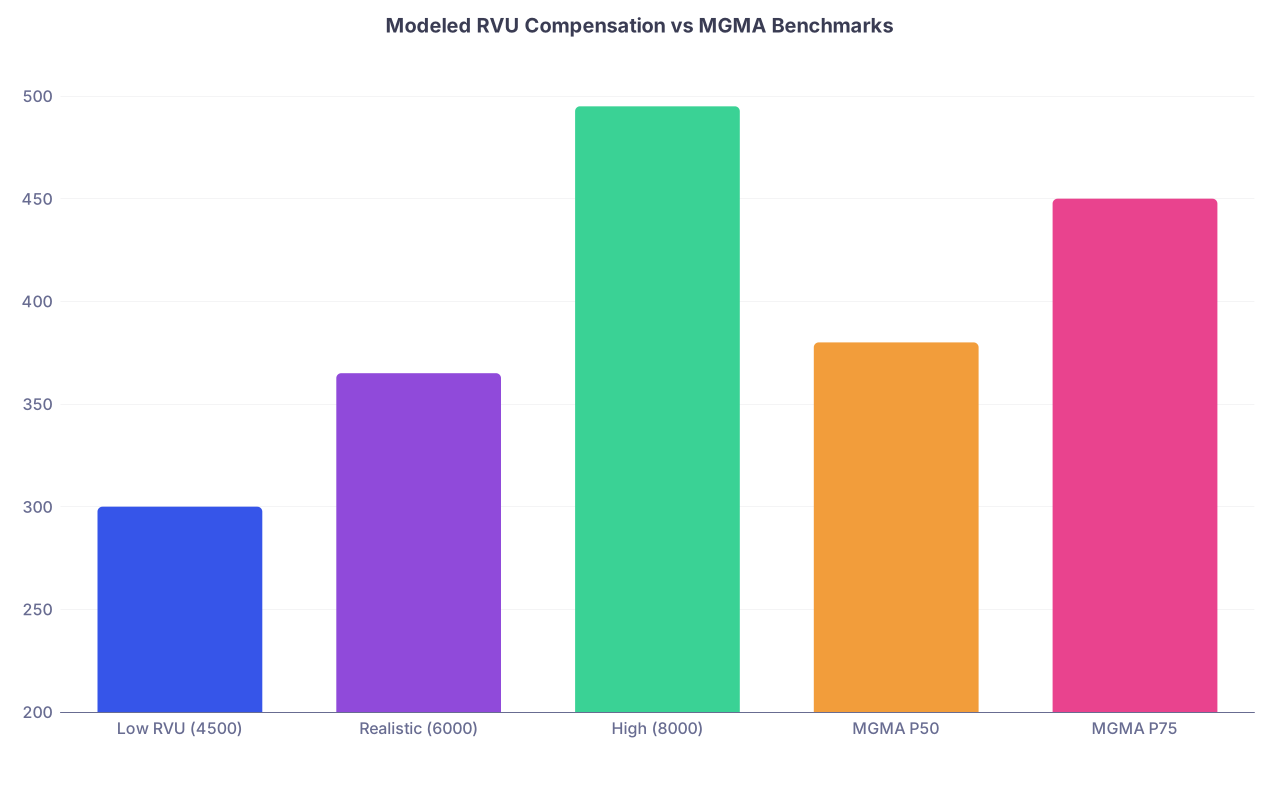
Here is a compact example for a non-procedural IM subspecialist:
- Base (B): $300,000
- Threshold (T): 5,000 wRVUs
- Multiplier (M): $65 / wRVU
Assume:
- Low: P = 4,500
- Realistic: P = 6,000
- High: P = 8,000
At 4,500: below threshold → total = $300,000
At 6,000:
Bonus = (6,000 − 5,000) × 65 = 1,000 × 65 = $65,000
Total = $365,000
At 8,000:
Bonus = (8,000 − 5,000) × 65 = 3,000 × 65 = $195,000
Total = $495,000
Now stack that up against MGMA:
| Category | Value |
|---|---|
| Low RVU (4500) | 300 |
| Realistic (6000) | 365 |
| High (8000) | 495 |
| MGMA P50 | 380 |
| MGMA P75 | 450 |
If MGMA median comp is around $380k and 75th is around $450k, this plan is:
- Weak at low volume (you are underpaid if they overload you with admin/non-RVU work)
- Fair at median
- Strong if you can really move volume to the 75th+ percentile wRVUs
Now you have something concrete to negotiate from.
6. Watch the Timers: Measurement Periods, True-Up, and Ramp
The formula above assumes a clean 12‑month look-back with an annual true-up. Employers complicate this with:
- Different measurement periods
- Lagged true-up
- “Clawbacks” if your BDV (base divided by wRVUs) is “too high”
- Multi-year changes to threshold
You have to ask very specific questions.
Annual vs quarterly measurement
Most systems calculate the bonus annually:
- January–December production
- Payment 60–90 days after year end
That is straightforward.
Some do quarterly bonuses. The trap here is if they:
- Apply the annual threshold pro-rated by quarter, but
- You ramp slowly initially (Q1, Q2), then ramp up (Q3, Q4)
In that structure, you might miss bonuses early on even though your annual volume would have exceeded the annual threshold had they calculated annually.
You need to see whether any unused wRVUs “carry over” between periods. Often they do not.
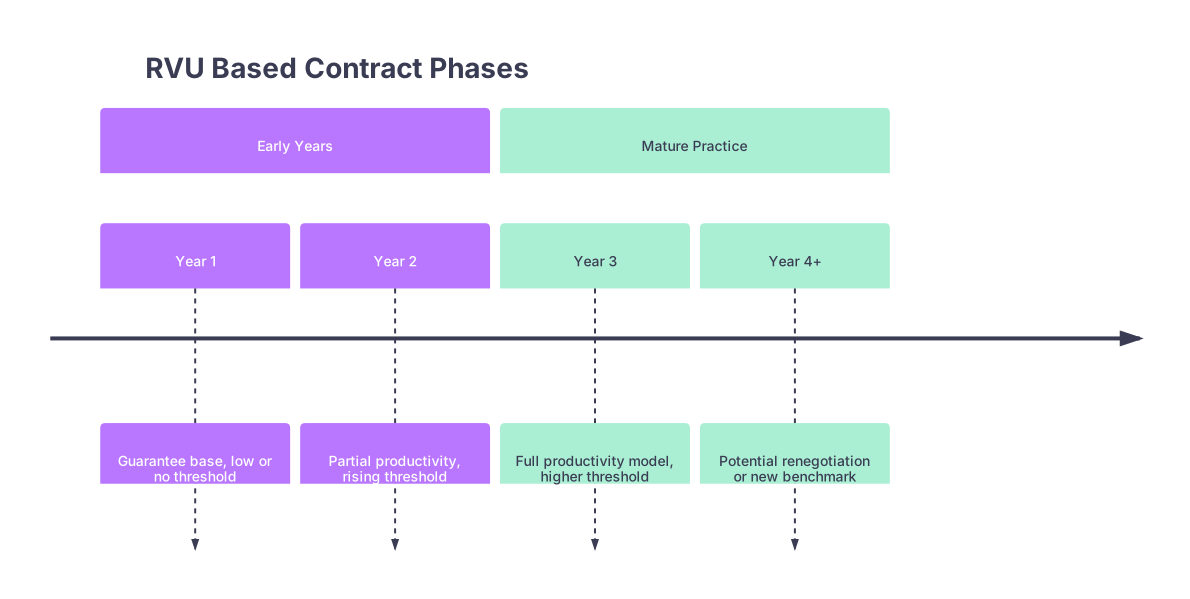
Ramp-up and guaranteed periods
For new grads, a common pattern:
- Year 1–2: Guaranteed base with or without a minimal productivity threshold
- Year 3+: You shift to “pure productivity” or a much tighter threshold
Do not ignore the post-guarantee years. That is where people suddenly see a 30–40% pay cut because:
- The base falls
- The threshold jumps
- The multiplier stays the same or barely changes
I have seen:
Year 1–2: $280k base, threshold 3,500 wRVUs, $50/wRVU over
Year 3+: $240k base, threshold 5,500 wRVUs, $55/wRVU over
For a doc doing 5,000–5,500 annually, this is a massive pay cut at year 3. You must run multi-year math.
A simple timeline view helps make this visible:
| Period | Event |
|---|---|
| Early Years - Year 1 | Guarantee base, low or no threshold |
| Early Years - Year 2 | Partial productivity, rising threshold |
| Mature Practice - Year 3 | Full productivity model, higher threshold |
| Mature Practice - Year 4+ | Potential renegotiation or new benchmark |
7. Common Contract Tricks Around RVUs
Hospitals and groups are not stupid. They know you will focus on the base and the headline multiplier.
Here are the patterns I see that undercut the math.
1. Using old CPT-to-RVU tables
RVU values change with each CMS fee schedule update. If your contract ties to “2020 CMS wRVU schedule” and your specialty gained RVUs in later updates, you are stuck being paid on the old (lower) numbers.
You want language like:
“wRVUs will be calculated based on the current-year CMS Medicare Physician Fee Schedule for wRVUs, as updated annually.”
Not some relic from three years ago that benefits them.
2. Excluding “nonproductive” work
Typical exclusions or lower pay for:
- Hospital administrative work
- Non-billable tasks (chart completion, prior auths)
- Teaching
- Call coverage (especially unassigned call)
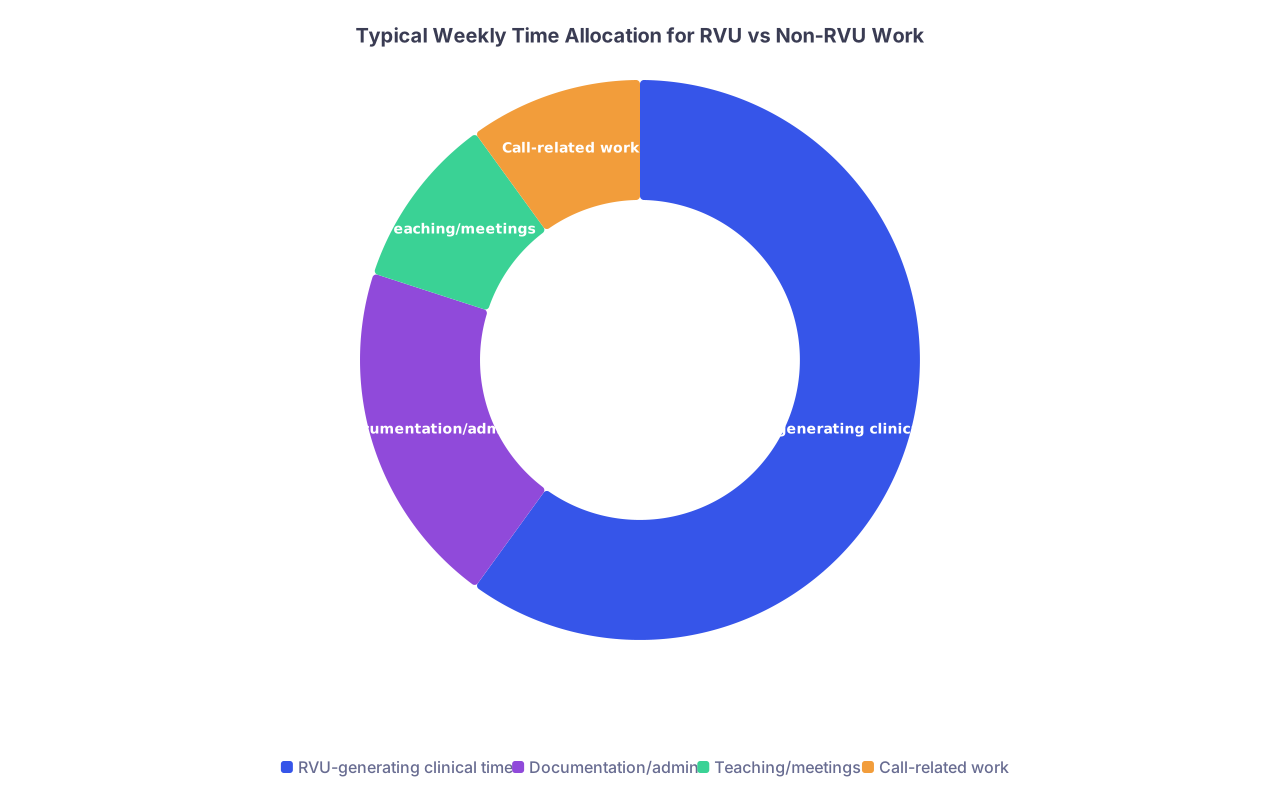
Sometimes they pay separate stipends for these. Sometimes not. Either way, if 20–30% of your time is non-wRVU work, your effective hourly rate is lower than the math suggests.
You need a rough time budget:
| Category | Value |
|---|---|
| RVU-generating clinical time | 60 |
| Documentation/admin | 20 |
| Teaching/meetings | 10 |
| Call-related work | 10 |
If your contract is 100% wRVU-based but 40% of your time is non-billable, you are structurally underpaid unless they offset that in base salary or stipends.
3. “Practice expense” taxes and collections hurdles
Some systems sneak in:
- Requirement that a certain percentage of your billed RVUs must be collected before they count
- “Bad debt” or charity RVUs not counting fully or at all
- Different wRVU treatment for capitation or value-based contracts
If the contract uses the phrase “net collections” anywhere near the word “RVU,” slow down. Those are different compensation models being mashed together.
You want RVU credit based on:
- Work RVUs assigned to CPT codes that you personally perform
- Not collections
- Not payer mix
If they tie your RVUs to collections, they have shifted payer risk onto you.
4. Midlevel and team-based production
Key questions:
- Do you get RVU credit for APP work (NP/PA) that you supervise?
- If so, how is that split? If not, who gets it?
- For “incident-to” or shared services, how are RVUs assigned?
If you are supposed to build a practice with heavy NP/PA use but you do not get their RVUs, your theoretical productivity ceiling may be lower than you assume.
8. Comparing Two RVU Offers Like an Adult
I want to walk through a structured side‑by‑side comparison. This is what I do on a scratch pad with clients.
| Component | Offer 1 | Offer 2 |
|---|---|---|
| Base salary (Year 1) | $280,000 | $320,000 |
| Threshold (Year 1) | 4,000 wRVUs | 5,500 wRVUs |
| Multiplier | $55 / wRVU | $70 / wRVU |
| Measurement period | Annual | Quarterly, no carryover |
| APP RVU credit | 100% to physician | Split 50/50 |
Now assume you reasonably expect to produce:
- Year 1: 4,500 wRVUs (ramp)
- Year 2+: 6,000 wRVUs
Run the numbers.
Year 1
Offer 1:
P = 4,500; T = 4,000; M = 55
Bonus = (4,500 − 4,000) × 55 = 500 × 55 = $27,500
Total = 280,000 + 27,500 = $307,500
Offer 2:
P = 4,500; T = 5,500; P < T
Total = base only = $320,000
Year 1, Offer 2 wins.
Year 2 (6,000 wRVUs)
Offer 1:
Bonus = (6,000 − 4,000) × 55 = 2,000 × 55 = $110,000
Total = 280,000 + 110,000 = $390,000
Offer 2:
Bonus = (6,000 − 5,500) × 70 = 500 × 70 = $35,000
Total = 320,000 + 35,000 = $355,000
Year 2 forward, Offer 1 wins by $35k+ annually.
If your long-term plan is to stay ≥3 years and you trust the volume projections, Offer 1 is the stronger deal. If you are uncertain about volume, plan to leave early, or value the extra security in year 1, you can rationally take Offer 2. But now you are deciding consciously, with math, not vibes.
9. What You Actually Say When Negotiating This Stuff
You do not walk in saying “Your offer is unfair.” You walk in with concrete, targeted asks.
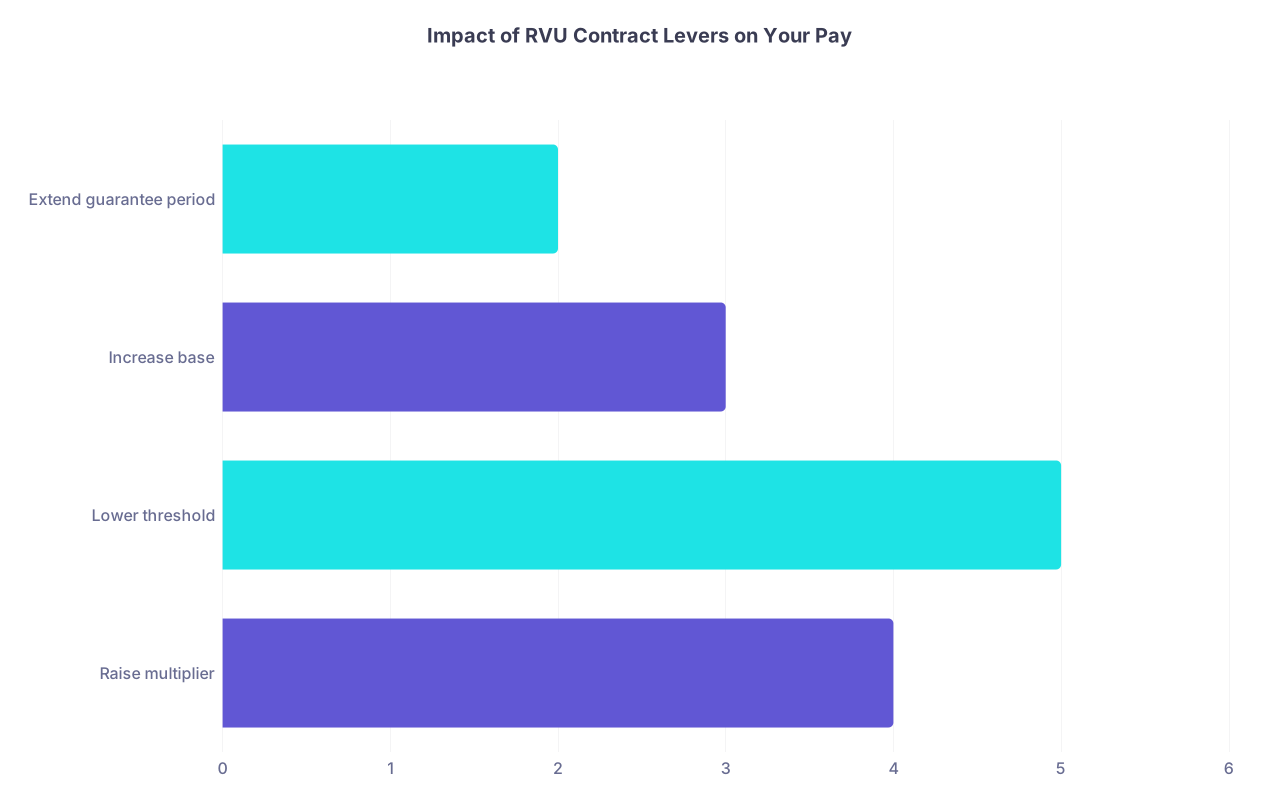
Three levers you can usually push:
- Lower the threshold
- Raise the multiplier
- Improve the ramp/guarantee period
Targeted lines you can actually use:
“Based on MGMA data for [specialty] and the RVU expectations we discussed, I would like to see the threshold set at 4,500 instead of 5,500. That still keeps total compensation near the median at expected volume but avoids penalizing me during ramp-up.”
“If the threshold has to remain at 5,500, then to stay competitive with MGMA 50th–75th percentile comp, we would need to be closer to $65 per wRVU over threshold instead of $55.”
“Given my first year will involve building a panel and establishing referral relationships, can we structure year 1 as pure base with no threshold, and then implement the RVU bonus model in year 2 with the current terms?”
Those are rational, data-based, and give them options. Administrators are used to vague complaints. They are less comfortable when you show them line-by-line how their own numbers miss the benchmark.
A visual summary of which lever affects what helps you think clearly:
| Category | Value |
|---|---|
| Raise multiplier | 4 |
| Lower threshold | 5 |
| Increase base | 3 |
| Extend guarantee period | 2 |
(Think of those numbers as “relative long-term impact” where higher is more powerful. Lowering threshold usually beats a tiny bump in base.)
10. The Minimum Due Diligence Before You Sign
Two final things most people skip:
Get actual productivity data from current physicians
Ask (and do not back off):
- “What did your last 3 hired physicians in this specialty produce in wRVUs for their first 3 years?”
- “What was their total compensation for each of those years?”
- “What is the median and 75th percentile wRVU production for your current physicians in this specialty here?”
If they “cannot share that,” interpret it as they will not share that. Then discount every rosy projection they give you.
Build a simple personal RVU model
I have seen residents sketch this on the back of a cafeteria tray liner, and that is still better than trusting the recruiter.
At minimum, estimate:
- Clinic templates (e.g., 20–24 patients per day, 4 days per week)
- Average wRVU per visit type (new vs follow-up, procedure mix)
- Expected OR/procedure blocks and typical case mix
Rough mental math example for a general cardiologist:
- 3 clinic days per week × ~20 pts/day
- New pts ~2.0–2.5 wRVUs, follow-ups ~1.3–1.5 wRVUs
- Plus stress tests, echoes, caths
It is not hard to see whether 6,000 wRVUs is realistic or pure fantasy.
If your model and their “target” differ by 30–40%, you have uncovered either:
- A scheduling / staffing problem
- Or an intentional overpromise
Key Takeaways
- Do not sign an RVU contract unless you can write your own compensation formula on one line: Total = Base + (Your RVUs − Threshold) × Multiplier and run it at realistic volumes.
- Threshold usually matters more than the shiny multiplier. A slightly lower multiplier with a much lower threshold often pays better in real life.
- Always project pay over multiple years and compare against actual MGMA/AMGA benchmarks and real productivity data from that practice—not recruiter promises—before you negotiate or agree.


