

It is June. You are three weeks from finishing residency, your credentialing packets are half-done, and your inbox has three very different “opportunities”:
- A hospital-employed position with a smooth onboarding process and a long, dense contract.
- A Professional Services Agreement (PSA) that keeps you “independent” but ties you to one hospital’s program.
- A locums agency pushing “$350/hour, no call, flexible schedule.”
They all sound reasonable. They all use different vocabulary. And if you sign the wrong thing, you will spend the next three years boxed in by RVUs you do not control, “evergreen” auto-renewals, or a non‑compete that cuts a 30‑mile circle around your entire city.
Let me break this down systematically.
The Core Question: What Problem Are You Actually Solving?
Most new attendings mix up three distinct goals:
- Income and financial upside
- Lifestyle/control over schedule
- Long‑term positioning (geography, subspecialty, leadership, partnership track)
Hospital employment, PSA, and locums are not just “different flavors” of the same job. They are structurally different ways of trading your labor for money and control.
At a high level:
- Hospital Employed = stability, benefits, less autonomy, more politics
- PSA (Professional Services Agreement) = hybrid; technically independent, functionally tethered
- Locums = maximum short‑term pay and flexibility, minimum long‑term security
If you do not line up the structure with your primary goal, you will hate a perfectly “fair” contract.
Quick Snapshot: How These Models Actually Differ
| Feature | Hospital Employed | PSA | Locums |
|---|---|---|---|
| Employer of Record | Hospital/health system | Your group or you (entity) | Agency or hospital |
| W‑2 vs 1099 | W‑2 | Often 1099 via entity | 1099 (usually) |
| Benefits | Full package | Varies / often limited | Rare / minimal |
| Income Stability | High–moderate | Moderate | Variable by assignment |
| Schedule Control | Low–moderate | Moderate | High |
| Non‑compete Risk | High | Very high if group + PSA | Lower, often assignment‑based |
Now let’s go deeper.
Hospital Employed: What You Really Sign Up For
This is the classic “you work for the hospital” scenario. The hospital (or large system) is your employer. You are on their payroll, their health plan, their retirement plan. To administration you are a “provider FTE,” not an independent business.
Compensation structure
Most hospital‑employed contracts now run on some version of:
- Base salary (usually for 1–2 years)
- Conversion to RVU‑based or productivity‑plus‑quality model
- Occasionally a guarantee with a draw and “true-up” after year 1–2
You will see:
- WRVU rates (e.g., “$52 per WRVU after 7,000 WRVUs”)
- Compensation caps (“Total comp not to exceed 75th MGMA percentile”)
- Quality/bonus pools (metrics around readmissions, throughput, patient satisfaction, documentation)
Where people get burned:
- They compare only base salary, ignoring RVU thresholds and realistic volume.
- They do not ask how long the salary guarantee lasts or what happens in the “ramp‑up” period.
- They ignore compensation caps that quietly limit upside even if they are wildly productive.
You want specific historical data:
- Average WRVUs produced by comparably situated physicians
- Average total compensation of colleagues in your specialty at that site
- Payer mix (Medicare/Medicaid/commercial/self‑pay) for that specific clinic or service line
If they “do not track that” for your exact site, take that as a red flag. They track it internally. They are simply not sharing.
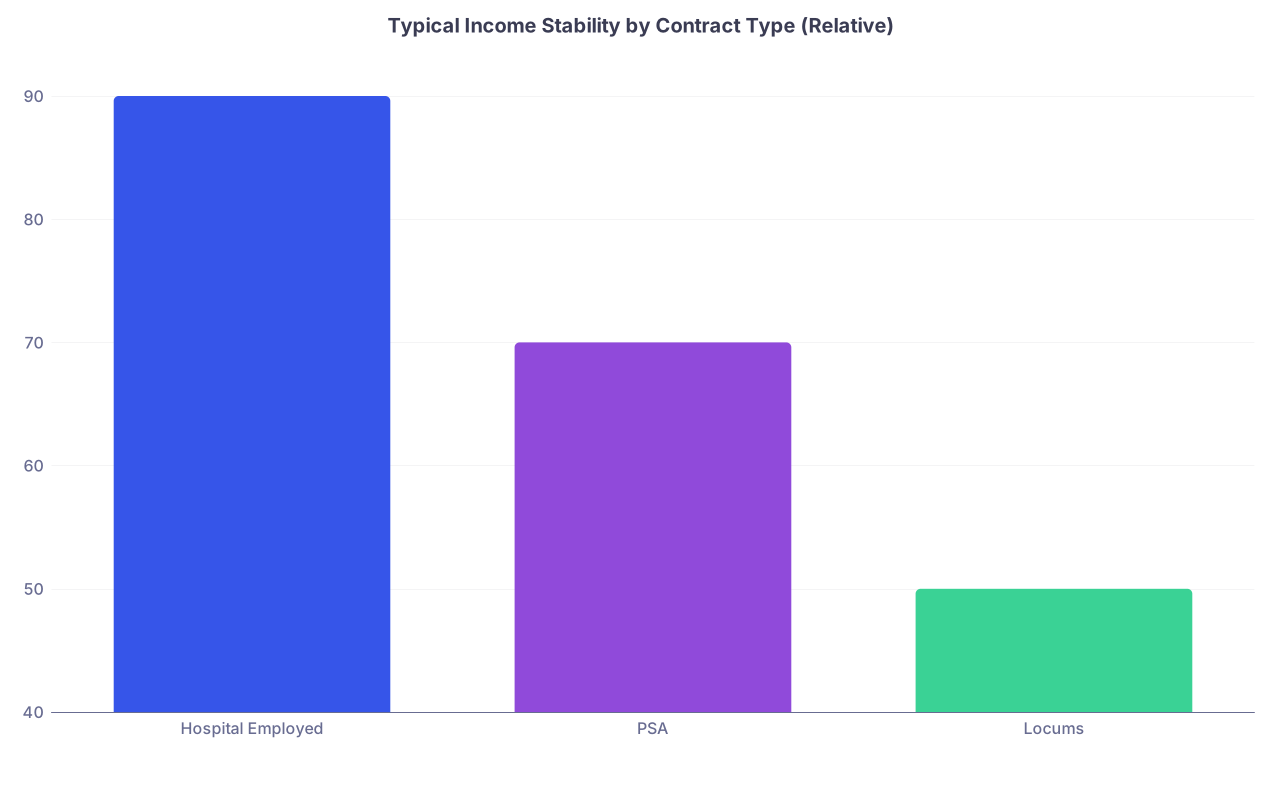
| Category | Value |
|---|---|
| Hospital Employed | 90 |
| PSA | 70 |
| Locums | 50 |
(Think of this as relative stability, not absolute dollars: 100 = very stable; 0 = very volatile.)
Benefits and “hidden compensation”
You will often see:
- Health, dental, vision
- 401(k) or 403(b) with match, plus possibly a 457(b) or 401(a)
- CME stipend ($3–$6k/year) and days
- Malpractice (claims‑made vs occurrence; tail coverage often covered if you stay X years)
- Paid vacation (3–6 weeks) and holidays
The problem: new attendings anchor on base salary and ignore benefit value. A $350k hospital job with full benefits may outcompete a “$400k independent” job where you buy everything yourself.
But that does not mean hospital employment is always better. The cost is control.
Control, autonomy, and bureaucracy
Real talk: in a hospital‑employed structure,
- You do not control major staffing decisions.
- Your clinic templates, call coverage, and often which EHR you use are decided for you.
- Service line changes can be made “for strategic reasons” whether or not you agree.
Where contracts matter:
- Call expectations. Is call mandatory? How is it defined? In‑house vs home call? Paid separately?
- Clinical duties. Specify sites (e.g., “Outpatient clinic at X Medical Center and inpatient service at Y Hospital”) rather than open‑ended “any as assigned by employer.”
- Change of duties clauses. Many contracts say the employer can change duties “at its sole discretion.” That phrase is dangerous.
If a hospital can unilaterally move you from a predominantly outpatient clinic to heavy inpatient or change your shift pattern with 30 days’ notice, you have no real leverage.
Term, termination, and restrictive covenants
These sections matter more than the salary line.
Key points:
- Term: Typically 2–3 years, often with automatic renewal.
- Without‑cause termination: You or they can terminate with X days’ notice (usually 60–180).
- With‑cause termination: Immediate or short‑notice termination for defined reasons.
You must look for:
-
- Radius (miles)
- Duration (typically 1–2 years; more than that is excessive)
- Scope (all medicine vs your specialty vs certain settings)
Non‑solicitation: Limits on recruiting staff or patients to a new practice.
Tail coverage: Who pays if the relationship ends?
I have seen contracts where the hospital:
- Could terminate the physician without cause with 60 days’ notice,
- Enforced a 20‑mile, 2‑year non‑compete, and
- Required the physician to pay their own malpractice tail, which was >$80,000.
That is the trifecta of leverage imbalance.
If you sign that, you are essentially betting that you will love the job and that administration will never change. That is naive.
PSA (Professional Services Agreement): Hybrid with Teeth
“PSA” gets thrown around loosely. You will see two dominant patterns:
- You are part of a private group that contracts with the hospital via a PSA; you then sign with the group.
- You form your own entity (e.g., PLLC) and the hospital contracts directly with your entity for your professional services.
In both cases the hospital is not your employer. They are the customer. They buy your professional services. You are technically an independent business.
In practice, for a single‑doc PSA, you function a lot like an employed doc with more paperwork.
How the money flows
Classic single‑physician PSA:
You bill and collect (or the hospital does it on your behalf under the PSA).
The hospital may pay you:
- A collections‑based model (e.g., you receive X% of collections), or
- A WRVU‑based or hybrid structure, similar to employment, but paid to your entity.
You then pay:
- Your own benefits (health insurance, disability, retirement).
- Practice overhead (or “rent”/administrative fees back to hospital).
- Malpractice premiums and tail, unless the PSA explicitly covers them.
The IRS cares that this actually functions as independent contractor work. If you have no meaningful control over schedule, methods, or staffing, your “independent contractor” status can look suspicious. That is the hospital’s problem more than yours, but it signals a sloppy structure.
Why hospitals like PSAs
Hospitals like PSAs because:
- Less regulatory exposure to Stark/AKS compensation structure if set up correctly.
- Less HR overhead.
- More flexibility to replace your group if they are unhappy.
If you are signing with a private group that holds the PSA, there is another layer: that group may be capturing a margin on your work (which is not inherently bad), and their incentives can diverge from yours.
Where PSAs beat employment
A well‑designed PSA can give you:
- More flexible tax planning (through an S‑corp or PLLC).
- More say over staffing and practice style, particularly if you control your own entity.
- Potentially more upside if you are highly productive and overhead is controlled.
But that “well‑designed” part is critical. Most PSAs handed to new grads are not written with your best interest in mind.
Where PSAs are worse
Three systematic problems:
- Risk shifting: Hospitals deliberately push financial volatility and malpractice risk onto your side of the table.
- Opaque overhead: Rent, billing fees, “management fees,” EMR access charges – these can quietly drain 20–30% of your collections.
- Two layers of restrictions: You can be bound by both a group’s restrictive covenants and the PSA’s own terms if you are a signatory.
You need to dissect:
- Who owns the AR (accounts receivable)?
- Who decides about coding, billing, and write‑offs?
- Who sets your clinic hours and call coverage?
- What exactly happens if the PSA between hospital and group is terminated?
A scenario I see too often: The hospital terminates the group’s PSA “without cause.” The group loses its anchor contract and implodes. You, as a junior associate, sit there with a non‑compete covering the county and no guarantees of being absorbed by the new group.
You want language that:
- Limits your non‑compete radius.
- Ties your restrictions to a very clear geography and defined services.
- Avoids “shadow” non‑competes hidden in the PSA that bind you indirectly.
Locums: Freedom, Risk, and the “Rate Illusion”
Locum tenens promises one compelling thing: cash per unit time. Plus the ability to walk away.
This is the model residents fantasize about when they are on their fourth consecutive night shift and see a $350/hour email pop up.
The basic structure
Typically:
- You are a 1099 contractor with an agency, or directly with a hospital.
- You are paid an hourly or daily rate; sometimes differential for nights, weekends, or call.
- The hospital covers travel, lodging, and malpractice (often via the agency).
- Assignments range from weekend coverage to 6‑month blocks.
The agency takes a cut. You will not see it, but if the hospital is paying $320/hour, you might see $220–$240. That is how they stay in business.

| Category | Value |
|---|---|
| Physician Take-home | 75 |
| Agency Margin | 25 |
(Think of the values as percent of the hospital’s total spend.)
The good part
- You can say no. To shifts, to locations, to toxic environments.
- No long‑term non‑compete in many cases (though agencies sometimes sneak in “no direct hire” clauses).
- Income can be very high if you are willing to work hard and move around.
- You gain broad clinical experience quickly in different systems.
For a gap year between fellowship and “real job,” or while relocating a spouse, locums can be excellent.
The illusions and traps
Rate illusion: $250/hour sounds amazing until you factor:
- No employer‑paid benefits.
- Unpaid time between assignments.
- Self‑employment taxes.
- Your own health, disability, and retirement contributions.
Credentialing gaps: Hospitals move slowly. A promised “start in August” can drift into November. That is three months of income you might have been counting on.
Quality of malpractice coverage:
- Is it occurrence or claims‑made?
- Is there tail coverage if claims are filed after you stop working with that agency?
Agency restrictive clauses: Some agencies insert:
- Prohibitions on you working directly for that hospital for 1–2 years without paying a large fee.
- Broad “exclusive” language that attempts to limit your ability to work for other agencies or facilities in a region.
Always remember: the agency works for the hospital client first. You are the product.
Locums vs permanent: lifestyle calculus
I see this mistake often: new grads jump into locums as a “lifestyle play” without running the numbers on time off and long‑term savings.
Let’s model something simple.

| Category | Value |
|---|---|
| Hospital Employed | 2100 |
| PSA | 2200 |
| Locums Heavy | 2400 |
| Locums Light | 1500 |
If you work “Locums Heavy” – 2400 clinical hours at $250/hour – that is $600k gross. Looks huge. Now subtract:
- 30–40% taxes (depending on how you structure it and your state).
- Full health insurance premiums.
- Lost retirement match.
- Periods of no work while credentialing.
- Travel fatigue and housing churn.
Your net may still beat a $350–400k hospital‑employed job. But you are paying in other currencies: stability, family life, and long‑term relationships with patients and colleagues.
Negotiation Priorities by Structure
You negotiate differently for each model. If you bring the same playbook to all three, you will waste leverage.
Hospital employed: what to push, what to accept
High‑yield negotiation targets:
Compensation formula clarity:
- Get the exact WRVU conversion rate, thresholds, and any caps in writing.
- Ask for documented projections that match your expected practice mix.
Call and schedule:
- Define call frequency, type, and whether it is compensated separately.
- Limit vague “other duties as assigned.”
Non‑compete and tail:
- Reduce radius and duration.
- Push for hospital‑paid tail if you are terminated without cause or after completing the term.
Lower‑yield targets:
- Core benefits (health, basic retirement provisions) are usually standardized and not individually negotiable.
- PTO days sometimes have a small range but often track system policy.
PSA: protect yourself from asymmetric risk
With a PSA, your main job is to prevent the hospital from moving revenue to their side while leaving expenses and risk on yours.
Focus on:
Definitions of revenue and overhead:
- How are collections defined? Gross vs net?
- Which expenses are attributable to you vs hospital overhead?
- Any management or “administrative” fees – cap them or demand transparency.
Control over operations:
- Who sets clinic hours, staffing mix, and room allocation?
- What happens if the hospital cuts your clinic time or OR block?
Exit scenarios:
- If the hospital terminates the PSA, do you retain patient records and charts?
- Are you automatically non‑renewed, or is there a right of first negotiation for a new arrangement?
- Tie your restrictive covenants to actual use – if they end the contract, their right to block your practice should narrow or vanish.
This is where you absolutely need an attorney who has seen PSAs, not just basic employment contracts.
Locums: rate and protections first
With locums, the question is simpler: What are you paid? How safe are you?
High‑yield points:
Rate and differentials:
- Higher for nights/weekends/call.
- Extra pay for overtime hours or added shifts.
Cancellation and guarantee:
- Is there a minimum guaranteed number of hours or shifts per month?
- What happens if the hospital cancels last minute after you booked travel?
Malpractice specifics:
- Confirm occurrence coverage or explicit tail rights.
- Confirm policy limits (e.g., $1M/$3M).
Inspect:
- Any non‑compete language that goes beyond: “You cannot bypass the agency and work directly for this exact client for 1–2 years.”
- Any clause claiming broad regional exclusivity.
If they refuse to modify obviously overbroad language, that tells you a lot about how they view physicians.
Matching Models to Career Phase and Personality
There is no universally “best” structure. There is only what fits you now and where you want to be in 3–5 years.
Early career (post‑residency 0–3 years)
Common priorities: debt, skills consolidation, not screwing up badly.
Good default for most: a carefully reviewed hospital‑employed job in a geographically flexible location, or a PSA with a very clean risk allocation and modest restrictions.
I get the temptation to “go locums only” right out of training. For a subset of people, it works. For many, it becomes 2–3 years of financial whiplash and no progress toward roots, practice style, or leadership roles.
If you do choose locums early:
- Treat it as a deliberate bridge, not a lifestyle destiny you stumble into.
- Hit savings hard. You do not have a built‑in pension.
Mid‑career (3–10 years out)
This is when many physicians realize they married the wrong structure.
You may:
- Want more control (move from hospital‑employed to group/PSA or private practice).
- Or want less administrative work (move from group/PSA to hospital employment).
- Or want to dial back hours and use locums to control your schedule.
The key here: you have more leverage. Your CV now says “board‑certified with X years of experience,” which matters to hospitals.
Renegotiation is realistic at this phase. But only if you did not sign draconian evergreen clauses or non‑competes that trap you.
Late career
Now you care about:
- Wind‑down schedules.
- Health benefits into retirement.
- Malpractice tail and legacy.
Hospital employment can be very attractive here. So can a high‑pay locums burst before partial retirement.
The worst move at this stage is to sign a contract that saddles you with massive tail coverage obligations or binds you to a schedule you cannot physically maintain.
One More Structural Distinction: W‑2 vs 1099 Reality
You will see this framed as a tax issue. That is only part of the story.
- W‑2 (hospital‑employed) = simplicity. Taxes withheld. Benefits bundled. Less flexibility but less cognitive load.
- 1099 (PSA, locums) = more knobs and dials. You control:
- Retirement plan type and size (solo 401(k), defined benefit, etc.).
- How you deduct business expenses.
- Timing of income and distributions (via your entity).

| Category | Value |
|---|---|
| Hospital Employed (W-2) | 100 |
| PSA (1099) | 80 |
| Locums (1099) | 80 |
(Think of 100 = “max simplicity,” lower = “more complexity and flexibility.”)
If you choose 1099, you must also choose:
- A competent CPA.
- An entity structure (PLLC, PC, S‑corp election).
- Discipline around quarterly estimated taxes and bookkeeping.
If you do not want to think about any of that, you are a better fit for W‑2, at least initially.
Practical Checklist: What You Should Never Sign Without Answering

Regardless of model, have clear answers to these questions:
- Who is my legal employer or counterparty? (Hospital, group, agency, my own entity?)
- How exactly is my compensation calculated after any guarantee period?
- What is the realistic annual income for someone actually doing this job now?
- How is “call” defined, how often, and how is it compensated?
- What is the term, and can I (or they) walk away without cause? With how much notice?
- What are the restrictive covenants? Radius, duration, scope, and what triggers them?
- Who pays for malpractice tail if I leave or they terminate me?
- What happens if the hospital closes or cuts the service line I am hired into?
- In a PSA or locums structure, what overhead or fees are taken from my gross?
- Is there any language that allows them to unilaterally change my site, duties, or schedule?
If any of those are unclear, you do not have a real contract; you have a set of vague promises.
Visualizing Your Path: How Structure Affects Mobility
To tie this together, look at how easy it is to pivot from each structure into another.

| Step | Description |
|---|---|
| Step 1 | Hospital Employed |
| Step 2 | PSA or Private Practice |
| Step 3 | Locums |
The main friction points:
- Breaking non‑competes
- Malpractice tail costs
- Geographic ties (kids in school, spouse’s job)
Which is why you do not just chase the highest starting number. You design for optionality.
Bottom Line: How to Choose Intentionally

If you take nothing else from this, take this:
- A hospital‑employed contract is a trade: security and benefits for less control and more restrictions. You must negotiate the non‑compete, tail coverage, and compensation formula, not just the base salary.
- A PSA makes you look “independent” on paper but can be worse than employment if overhead, risk, and restrictive covenants all stack against you. The details of revenue, expenses, and exit terms matter more than the title.
- Locums gives you cash and flexibility, but it is not a free lunch. You are buying that freedom with benefits, stability, and long‑term relationship capital.
Pick the structure that aligns with what you actually care about for the next 3–5 years, not what sounds impressive in an email subject line. Then get someone who does this for a living—an experienced physician contract attorney—to go through the document line by line before you touch a pen.


