

The biggest lie in physician employment is that non‑compete clauses are “standard” and therefore non‑negotiable.
They are standard. They are not automatically enforceable. And they are absolutely negotiable if you know where to push.
You are post‑residency, stepping into the real job market. This is where non‑competes stop being an academic concept and start dictating where your kids go to school, whether you can stay near aging parents, and how much leverage you have when your group starts playing games with call or RVU thresholds.
Let me break this down the way I explain it to fellows and new attendings: radius, duration, and exceptions are the three screws they use to lock you in. Your job is to loosen all three—preferably before you sign anything.
1. The Core Anatomy of a Physician Non‑Compete
Most physician non‑competes (also called restrictive covenants) have the same skeleton:
- A geographic restriction – the radius / territory where you cannot practice.
- A time restriction – how long that restriction lasts after you leave.
- A scope restriction – what type of practice is prohibited.
- A trigger and carve‑outs – when it applies and when it does not.
If you do not dissect all four, you are guessing about your future freedom.
The legal backdrop, without the fluff
States treat physician non‑competes very differently. Some ban them outright. Others enforce them aggressively. Most sit in the middle and say something like: non‑competes are enforceable if they are “reasonable” in time, geography, and scope and protect a “legitimate business interest” (patient relationships, confidential information, etc.).
Here is the part people get wrong: “Reasonable” does not mean “whatever is in the contract.” It means whatever a particular judge in a particular county decides is reasonable in the context of that specialty, that local market, and that employer.
A quick comparison across common states (as of recent trends; you still need a local attorney for current law):
| State | General Stance | Typical Reality for Physicians |
|---|---|---|
| California | Generally banned | Non-competes largely unenforceable |
| Texas | Allowed if reasonable | Often enforced with modifications |
| New York | Allowed, case-by-case | Courts scrutinize scope and radius |
| Florida | Very employer-friendly | Non-competes frequently enforced |
| Massachusetts | Allowed but limited | Narrow drafting and reasonableness key |
If you sign a bad non‑compete in a non‑friendly state, you are gambling that (a) they will not enforce it, or (b) you can afford a legal fight. That is a poor strategy.
2. Radius: The “Where” They Can Block Your Practice
This is the most obvious part of the non‑compete and the one that gets abused the most.
How radius is usually written
Common wording:
“You agree that for a period of X years following termination of employment, you shall not practice medicine in the specialty of [Specialty] within a [Y‑mile] radius of any office, clinic, or facility where you have provided professional services on behalf of Employer.”
Read that again. They are not just talking about the one clinic you think of as “your office.” Many contracts tie the radius to:
- Any location of the employer
- Any location where you provided services
- Any affiliated facility or hospital
I have seen a cardiologist in a large multi‑site group discover, only after a dispute, that his 20‑mile radius “around each practice location” effectively covered the entire metro area. He could either move his family or sit out a year.
Reasonable mileage by situation
There is no magic legal number. But I can tell you what tends to look reasonable vs ridiculous in negotiations:
Dense urban area (NYC, Boston, Chicago core):
- 3–5 miles from your primary practice site is typical.
- 10+ miles in dense urban is aggressive and often overreaching.
Suburban metro regions:
- 10–15 miles is common.
- 25 miles can be okay if it is a true referral draw area, but should be tied to specific sites.
Rural communities:
- 25–50 miles sometimes flies because the catchment area is huge.
- More than that starts to look like a relocation mandate.
The abuse shows up when employers stack multiple sites and use a single radius for each, creating a spiderweb that makes staying in‑state impossible.
What you should push for on radius
You need to attack three things: which sites, how far, and how defined.
Limit to specific sites.
The language should say “from the primary practice location(s) where Physician regularly provides services” and then list them in an exhibit. Not “any current or future facility.”Cap the number of locations.
If you do outpatient plus 3 satellite clinics, negotiate the non‑compete to attach only to 1–2 primary sites, or at least limit how many count.Reasonable mileage.
If they start at 25 miles in a dense city, that is not “standard,” it is a power play. Push down:- Urban: aim for 3–5 miles
- Suburban: aim for 10–15
- Rural: negotiate 25, not 75
Address telemedicine and virtual care.
Many contracts are now trying to restrict “remote” practice as if you are physically there. You want explicit language that telehealth provided from your home or outside the area to out‑of‑state patients is excluded.
Example of a better‑drafted radius clause
Bad version:
“Physician shall not practice medicine within a 25‑mile radius of any office, clinic, or facility operated now or in the future by Employer.”
Better version:
“Physician shall not practice clinical [Specialty] within a ten (10) mile radius of the Primary Practice Location(s) listed in Exhibit A, which represent the facilities where Physician regularly provides at least 80% of her clinical services on behalf of Employer. No other Employer locations shall be included for purposes of this restriction.”
That one paragraph can mean the difference between “I can move down the road and keep my life” and “I need to change states if this job goes bad.”
3. Duration: How Long They Can Control Your Next Move
The second lever is time. How long does the non‑compete last after your employment ends?
Typical ranges:
- 6–12 months – very common
- 18–24 months – pushed by some larger systems and PE‑backed groups
- More than 24 months – almost always excessive and vulnerable to challenge
Courts look skeptically at long non‑compete durations, but that does not help you if the mere threat of enforcement keeps you from taking a job across town.
What is “reasonable” by specialty and setting
The real question: how long does it reasonably take for patient loyalty and confidential information to “cool off”?
Procedure‑heavy specialties (orthopedics, neurosurgery, cards EP):
Employers argue patients are long‑term and referral patterns are sticky. 12 months is a common compromise. Two years starts to look punitive.Primary care and general outpatient:
6–12 months is often sufficient. A full two years is overkill in most markets.Hospital‑based (anesthesia, EM, radiology, pathology):
You are not building the same direct patient panel. The “business interest” is contracts and relationships with facilities. Non‑solicitation of hospital contracts plus a shorter non‑compete can be more appropriate.
Duration tied to cause of termination
You want duration, or existence of the non‑compete at all, tied to how and why you left. More on that in the exceptions section, but the key concept is:
- If they terminate you without cause, why on earth should they also get to block you from working in the area? They made the choice to end the relationship.
Negotiation targets for duration
In most physician contracts that cross my desk, I target:
- Starting point: Ask for no non‑compete; if that dies fast (often does), then:
- Primary ask: 6–12 months max, depending on specialty.
- Pushback strategy: If they insist on 18–24 months, consider:
- Shortening the radius in exchange.
- Narrowing the scope to certain settings or employment types.
- Adding a buy‑out (you pay a finite amount to eliminate it).
4. Scope: What Exactly You Are Barred From Doing
This piece gets ignored until it bites someone who wants to shift their practice style.
Scope has three dimensions:
- Type of practice or specialty
- Employment vs independent practice
- Clinical vs non‑clinical work
Overbroad scope: the classic trap
Here is the kind of nonsense language I see:
“Physician shall not engage in the practice of medicine in any capacity, whether as an employee, independent contractor, owner, or otherwise, within the Restricted Area.”
“Any capacity.” That can be read to cover:
- Moonlighting in urgent care
- Working 0.5 FTE for a competitor
- Opening your own solo practice
- Even telehealth from home depending on how they define it
This is how people get scared away from roles that are not even realistic competition.
How scope should be narrowed
You want the scope to be:
- Limited to your actual specialty (e.g., “invasive cardiology” rather than “medicine”).
- Limited to clinical practice, not research, teaching, admin, or consulting.
- Ideally limited to similar practice settings (e.g., outpatient GI in a private group, not hospital‑employed hepatology).
A reasonable clause might look like:
“Physician shall not provide outpatient clinical services in the specialty of [Specialty] to patients within the Restricted Area. This restriction shall not apply to inpatient consultative services, academic, research, administrative, or telemedicine services provided to patients located outside the Restricted Area.”
That is a very different universe than “you may not practice medicine.”
Subspecialists and hybrid practices
If you are, for example, an interventional cardiologist who also does general cardiology, you need to be precise:
- Will you be barred from all cardio?
- Or just the interventional piece?
- If you pivot to a non‑procedural role, are you still blocked?
Same story for ortho subspecialists, surgical onc vs general surg, neuro‑interventional vs general neurology.
Your long‑term plans matter here. If you think you may pivot to more academic, admin, or niche subspecialty work, carve that out now. Later is too late.
5. Exceptions, Triggers, and When the Non‑Compete Should Die
This is where things get interesting. The non‑compete does not just sit there in a vacuum. It is triggered by how your employment ends.
You absolutely need to understand—and negotiate—these trigger conditions.
Common triggers (and what you want)
Scenarios:
You resign with notice (without cause).
Employers want the non‑compete to apply in full. This is the default battle ground.They terminate you “for cause”.
They will absolutely want the non‑compete to apply. And it probably will.They terminate you “without cause”.
This is where you draw a hard line. If they can walk away on 60–90 days’ notice, you should not also be exiled from the region.
A fair structure:
Non‑compete applies if:
- You resign voluntarily without employer breach.
- You are terminated “for cause” as clearly and narrowly defined.
Non‑compete does NOT apply if:
- They terminate you “without cause”.
- You terminate for “good reason” (see below).
- They materially breach the agreement and fail to cure.
“Good reason” – your weapon against abuse
Most health systems like to reserve the right to dump you without cause on 60–90 days’ notice. You need the mirror image: the right to leave with “good reason” and to avoid the non‑compete when you do.
Good reason typically covers:
- Material cut in compensation (e.g., >20%) not tied to agreed metrics
- Major change in practice location or schedule
- Significant change in duties or call obligations
- Loss of hospital privileges through no fault of your own
- Failure to provide agreed‑upon support (staff, MA, NP, etc.)
Tied to the non‑compete, you want language like:
“In the event Physician terminates this Agreement for Good Reason, or Employer terminates Physician’s employment without Cause, the restrictive covenant set forth in Section X (Non‑Compete) shall be void and of no further force or effect.”
That sentence is gold.
6. Carve‑Outs and Practical Exceptions You Should Demand
Beyond the trigger‑level exceptions, there are day‑to‑day carve‑outs that matter.
Existing patient relationships
Ethically and clinically, you want some ability to treat:
- Patients you are in the middle of treating for complex or time‑sensitive issues
- Post‑operative patients
- High‑risk or oncology cases mid‑treatment
Some contracts include a non‑solicitation clause that bars you from soliciting patients but allows them to follow you of their own accord. At minimum, you want:
- No blanket prohibition on seeing any former patients, especially for continuity or urgent care.
- Carve‑out for patients who actively seek you out without solicitation.
Academic, teaching, and research roles
Non‑competes that strangle academic work are overreaching. You want explicit carve‑outs for:
- Teaching faculty roles
- Research‑only positions
- Administrative positions in health systems or med schools
Even if you currently have zero interest in academics, building that flexibility in costs you nothing now and may save you later.
Telemedicine and out‑of‑area practice
This is evolving rapidly:
- Employers are trying to frame non‑competes around patient location, not physician location.
- You want the opposite: if you are physically outside the restricted area, or seeing out‑of‑state patients, you should be free.
Sample carve‑out:
“Nothing in this Agreement shall restrict Physician from providing telemedicine or virtual services to patients who are not physically located within the Restricted Area at the time of service.”
7. Buy‑Outs, Liquidated Damages, and “Pay to Play” Clauses
A lot of sophisticated employers now include a buy‑out option: you can pay a specified sum to eliminate or reduce the non‑compete.
On the surface, that sounds predatory. In reality, a clear, reasonable buy‑out can be a useful escape hatch. The devil is in the numbers.
Common buy‑out structures
Typical formulas:
- Fixed amount – e.g., $50,000 flat fee.
- Multiple of compensation – e.g., 50% or 100% of your prior year base salary or collections.
- Scaled by time – decreases the longer you stay.
The problem: I routinely see buy‑outs set so high (e.g., 2x last year’s compensation) that they are meaningless for a young attending with loans and kids.
What is actually reasonable
My comfort zone when negotiating:
- Flat fee: $25–75k depending on market and specialty, maybe up to $100k for ultra‑high‑earning proceduralists.
- Multiple of comp: 25–50% of base salary, not collections, with a cap.
You also want:
- Ability to limit the geography (e.g., pay less for reduced radius rather than full release).
- Clear payment terms – pay over time, not lump sum due on your last day.
8. How Non‑Competes Actually Get Enforced (And How Often)
Let me be blunt: many physicians over‑estimate how “unenforceable” their non‑competes are and under‑estimate the pain of being threatened with enforcement.
Actual patterns I see:
- Many employers use non‑compete letters as leverage, not necessarily to go to trial.
- Threat of an injunction is enough to scare a new employer away.
- Some groups will settle for money, shorter radius, or deferred start dates.

| Category | Value |
|---|---|
| Settled/Negotiated | 45 |
| Voluntary Compliance (Physician Moves) | 30 |
| Litigated Fully | 10 |
| Dropped by Employer | 15 |
The worst situation is this:
- You ignore the non‑compete.
- You sign with a competitor across town.
- Your old employer sends a nastygram to you and the new hospital.
- The new employer panics and rescinds your offer rather than fight.
Now you are unemployed and radioactive in the region.
The solution is not “don’t ever test a non‑compete.” The solution is: do not sign an unreasonable one in the first place. And if leaving, get legal advice before you move.
9. Concrete Negotiation Strategies (Post‑Residency Reality)
This is what you actually say and do at the table.
1. Get the right legal help, early
A contract review by a lawyer who does not do physician work is almost useless. You want someone who:
- Regularly reviews physician contracts in your state.
- Knows what “normal” looks like for your specialty.
The $500–$1500 you spend here is trivial compared to the cost of moving states because of a bad clause.
2. Separate non‑compete from compensation
Do not trade money for a horrible non‑compete without realizing it. I see a lot of “we gave you a big signing bonus, so we need protection.” Fine. But:
- Protection = reasonable non‑compete or
- Protection = pay‑back obligation on the bonus if you leave early
You do not need to give them both a 2‑year, 25‑mile non‑compete and a $100k clawback on your bonus.
3. Use their own logic against them
When they say, “We need 25 miles and 2 years for patient continuity,” respond with specifics:
- “My clinic draw area is really about 8–10 miles for this specialty. Beyond that, patients already see other groups.”
- “If continuity is the concern, could we focus protection on non‑solicitation of staff and patients rather than a blanket non‑compete?”
- “If you are worried about investment in building my panel in the first year, could we shorten the non‑compete if I stay for 3+ years?”
You are not just begging. You are reframing.
4. Ask for written clarification
If something is vague or seems like “we would never enforce that,” do not trust a verbal assurance. Example:
- They say: “Oh, that just means you cannot open a direct competitor clinic.”
- The contract says: “You may not practice medicine in any capacity.”
You respond: “If that is the intent, let us modify the language to reflect that—limit it to outpatient clinical practice in [Specialty] within X miles of [specific sites].”
If they refuse to align the language with their supposed intent, you just learned something important about their trustworthiness.
5. Be willing to walk
This is the unpopular part. Sometimes the right answer is: this job is not worth the restriction.
You need to weigh:
- Is this my long‑term geographic home?
- Is this market dense enough that a non‑compete will really hurt?
- Are there comparable offers with looser or no non‑competes?
If you are joining a single‑hospital town and want to settle there for 20 years, a 25‑mile, 2‑year non‑compete that survives “without cause” termination is insane. I would advise walking away in most such cases.
10. Visualizing the Moving Parts: A Simple Decision Map
Here is how I mentally map this for physicians deciding whether a non‑compete is survivable:

| Step | Description |
|---|---|
| Step 1 | Offer with Non-Compete |
| Step 2 | Less Critical - Focus on Duration |
| Step 3 | High Risk - Push Hard or Walk |
| Step 4 | Negotiate Shorter Term or Buy-Out |
| Step 5 | Negotiate Good Reason and Carve-Outs |
| Step 6 | More Acceptable |
| Step 7 | Unreasonable - Renegotiate |
| Step 8 | Weigh vs Other Offers |
| Step 9 | Home Region Long Term? |
| Step 10 | Radius > 10-15 miles? |
| Step 11 | Duration > 12 months? |
| Step 12 | Exceptions for Without Cause? |
| Step 13 | Duration > 24 months? |
11. A Quick Realistic Scenario
You are a newly minted general surgeon. Offer from a large multi‑specialty group in a mid‑sized metro:
- Base salary $450k for 2 years then collections
- $50k signing bonus
- Non‑compete: 2 years, 25 miles from any current or future office or hospital where you have privileges
- Applies regardless of who terminates whom
- No buy‑out
Let me tell you what that actually means:
- You are locked out of basically the entire metro area if anything goes sideways.
- They can terminate you without cause on 90 days’ notice and still block you from working.
- You cannot realistically move next door to a better group for at least two years.
Negotiation targets:
- Reduce duration to 12 months.
- Limit radius to 10–15 miles from primary clinic and primary hospital only.
- Add carve‑out: non‑compete void if they terminate without cause or you terminate for good reason.
- Optional: add buy‑out equal to 50% of base salary payable over 12 months.
If they refuse all of that categorically, what they are saying is blunt: “We want to own your geographic future for two years regardless of how we treat you.” That is very different from “we just want reasonable business protection.”
12. Data Reality: How Far Non-Competes Actually Push Careers
To ground this a bit, here is a stylized breakdown of what I see in post‑residency employment agreements across specialties (rough ballpark, not gospel):
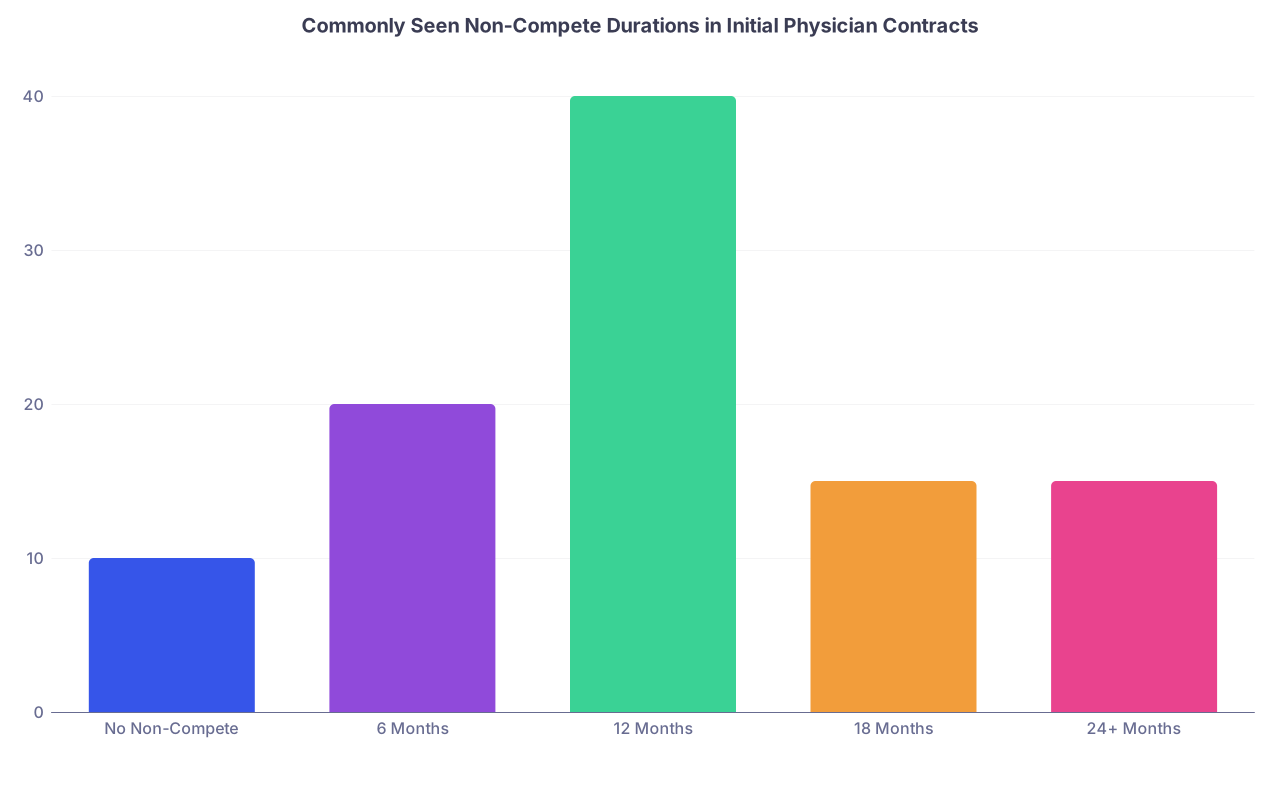
| Category | Value |
|---|---|
| No Non-Compete | 10 |
| 6 Months | 20 |
| 12 Months | 40 |
| 18 Months | 15 |
| 24+ Months | 15 |
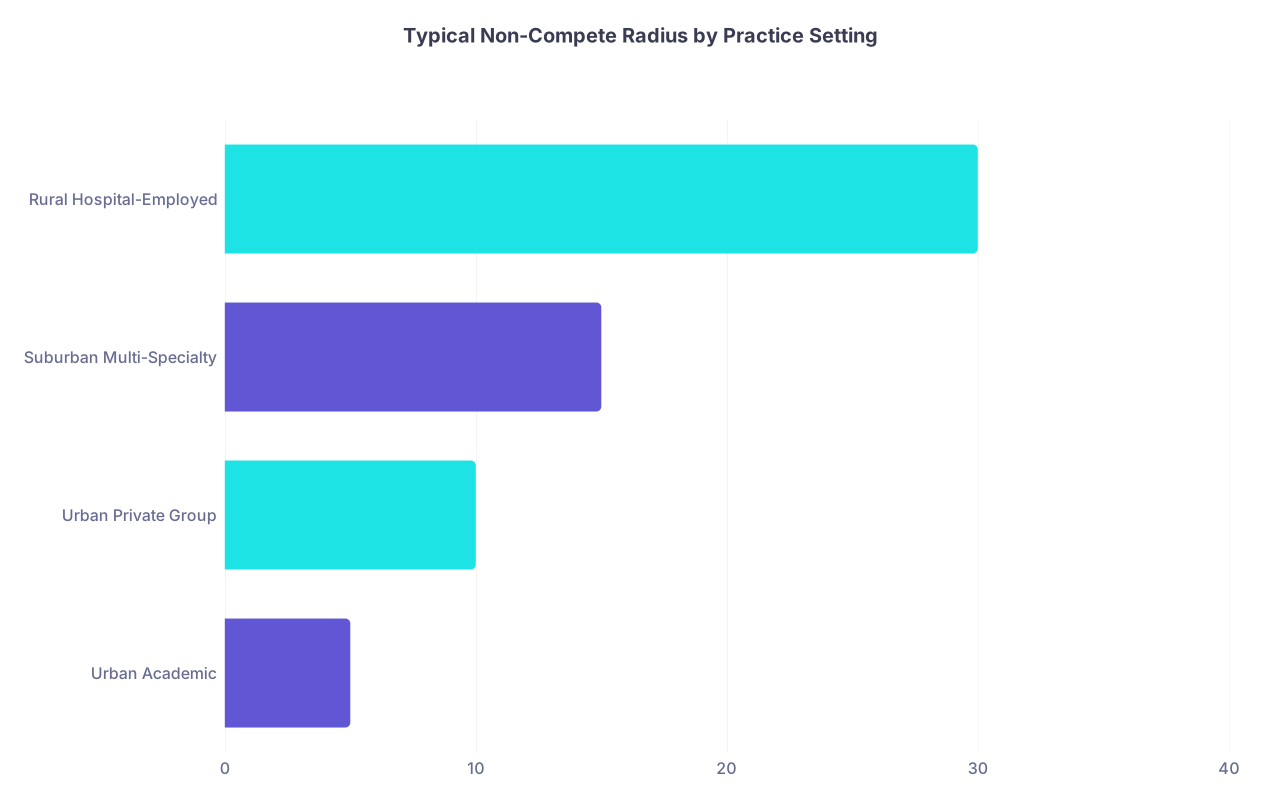
| Category | Value |
|---|---|
| Urban Academic | 5 |
| Urban Private Group | 10 |
| Suburban Multi-Specialty | 15 |
| Rural Hospital-Employed | 30 |
You are not crazy for wanting 6–12 months and a 5–15 mile radius. That is where a good chunk of reasonable contracts already land. Your job is to push your offer closer to those numbers and away from the punitive edge.
Key Takeaways
- Non‑competes are not just boilerplate; they define where you can live and work if the job goes bad. Radius, duration, and scope must all be narrowed and clearly defined.
- You should aggressively negotiate carve‑outs: no non‑compete if they terminate you without cause or you leave for good reason; explicit exceptions for academics, research, telemedicine outside the area, and existing complex patients.
- If a group insists on a wide radius, long duration, and no meaningful exceptions, believe what they are telling you about how they view physicians—as assets to control, not colleagues to partner with—and be ready to walk.


