

The biggest financial mistake new attendings make is signing “partnership track” offers they do not actually understand.
You are not just negotiating a salary. You are negotiating whether you will ever own the business that generates the revenue you create, on what terms, and how fairly you will be treated when you eventually leave. That is equity, buy-in, and buy-out. And most physicians do this wrong.
Let me break this down specifically.
1. Start With the Frame: Employment vs Ownership
If you do not first get this distinction straight, every other “partnership” term is just noise.
At a high level, you have three basic structures:
- Pure employee
- Employee with potential ownership / partnership track
- Immediate or near-immediate owner / shareholder / member
Groups will use different labels: partner, shareholder, member, owner, associate, track, junior partner, senior partner. Ignore the marketing language. Look for legal status:
- Are you currently an owner of the entity (PC, PLLC, LLC, S-Corp, etc.)?
- Are you guaranteed the opportunity to buy ownership?
- Is that opportunity discretionary (they decide later if you are “fit”)?
If you are not on a contractually defined path to ownership, then all talk of “partnership potential” is just that—talk.
Key reality:
The vast majority of upside in group practice medicine comes from ownership. Ownership gives you:
- A share of the profits (beyond W‑2 comp)
- A share of assets (accounts receivable, equipment, buildings, ASC stake, brand)
- A share of control (voting rights, governance, strategic decisions)
- A share of proceeds on sale (if the group sells to private equity, health system, etc.)
No ownership = you are labor. Maybe high-paid labor, but still labor.
So your first task in any “partnership track” offer is to get in writing:
- Is there an ownership track?
- When does it start?
- What are the conditions to be offered ownership?
- What will ownership cost (buy-in)?
- How will you be treated if or when you exit (buy-out)?
2. What “Equity” Really Means in a Group Practice
“Equity” gets thrown around by recruiters as if it is a signing bonus. It is not. Equity is risk-bearing ownership in the business.
Core questions you must answer
When they say “equity,” you should be able to answer:
- Equity in what entity?
- Expressed as what (percentage, number of shares, units)?
- With what rights (voting vs non-voting, economic rights, information rights)?
- Based on what valuation?
If you cannot get clear answers, you have no idea what you are buying or selling.
Typical equity structures in physician groups:
- Professional corporation (PC / PA) – shareholders
- PLLC / LLC – members with units
- Hybrid – operating entity + separate entities for real estate, ASC, imaging, etc.
Watch for this common scenario:
You become an “owner” of the professional practice, but the profitable pieces (real estate, ASC, imaging center, ancillary services) are in separate entities owned only by the founding partners. You get equity in the low-margin entity. They keep the good stuff.
You want to know all entities in the structure and whether you can buy into each.

3. Partnership Track: The Stuff That Actually Matters
Forget the glossy brochure language. Focus on these four variables: time, criteria, economics, and transparency.
3.1 Time to partnership
You want the exact length of the track, not “typically 2–3 years.”
Examples of clear vs vague:
- Good: “After 24 months of full-time employment, if productivity and professionalism criteria are met, the group shall offer the physician the opportunity to purchase an equity interest as outlined in Exhibit B.”
- Bad: “After an associate period, physician may be considered for partnership at the discretion of the current partners.”
If they insist on discretion, you push back and at least secure objective guardrails, like:
- Minimum and typical time to partnership in the last 5 years
- A requirement that they provide written reasons if they defer your offer
3.2 Criteria for partnership
This is where a lot of games get played.
You want clearly stated, ideally objective criteria in writing:
- Production thresholds (e.g., wRVUs, collections)
- Quality metrics or clinical benchmarks
- Professionalism / citizenship expectations (committee work, call coverage)
- Any board certification / fellowship requirements
Vague phrases like “cultural fit” and “alignment with group values” are where people get quietly blocked from partnership. They might not say “we do not like you,” but the effect is identical.
If they will not define criteria, assume the bar can be moved arbitrarily.
3.3 Economic shift: employee → owner
Usually:
- Employee phase: higher guaranteed salary, often modest bonus, no share of profit.
- Owner phase: lower base draw, higher variable distribution based on practice profit.
You need modeled numbers. They will not guarantee, but they can show actual historical ranges.
Sample modeling question you should ask:
“Give me an example of a recent partner’s first year. What was their W‑2 for the last employee year, and what was their K‑1 + W‑2 for their first partner year?”
You want at least a ballpark like this:
- Last year employee: $350k salary + $50k bonus
- First year partner: $275k draw + $200k profit distribution = $475k total
If the bump is tiny, and risk (malpractice tail share, capital calls, buy-in debt) is substantial, that partnership may not be worth the risk.
3.4 Transparency
If they avoid giving you:
- The ownership agreement (shareholder agreement, operating agreement)
- The buy-sell agreement
- A summary of historical partner compensation
…before you sign your initial employment contract, that is a flashing red light.
You do not need to memorize the partnership documents now, but you must see them. Hidden terms live there, especially around buy-out.
4. Buy-In: How You Actually Become an Owner
Buy-in is the price tag and mechanism for acquiring your equity. This is where groups can be either fair and transparent—or predatory.
4.1 The three big questions on buy-in
Ask these explicitly:
- How is the practice valued for buy-in?
- What percentage interest will I acquire?
- Over what period and on what terms do I pay?
| Model | How It Works | Typical Risk/Reward |
|---|---|---|
| Fixed nominal buy-in | Flat fee (e.g., $50k–$150k) | Simple, often under-market |
| Formula-based buy-in | Percentage of computed value | Can be fair or manipulated |
| Sweat equity / reduced comp | Discounted salary for years | Opaque, often under-disclosed |
Fixed nominal buy-in
Example: “New partners purchase one share for $75,000, paid over 3 years via paycheck deduction.”
This can be very reasonable when:
- The group values stability and parity over maximizing exit value
- Everyone historically has paid the same fixed buy-in
- Buy-out is also formulaic and symmetric, not wildly higher than buy-in
Risk: If the group is about to sell to private equity at a big multiple and they are offering you a low, fixed buy-in right before, you may be walking into a windfall… or you may be the last one in before they close the door to future ownership.
Formula-based buy-in
Common formulas:
- A multiple of average collections or EBITDA
- Net tangible assets + some multiple of goodwill
- Book value plus or minus adjustments
Real world example I have seen in contracts:
“New partners shall purchase a 5% interest in the practice at a price equal to 5% of [0.5 × (average of last 3 years’ collections)].”
If collection average is $8M, practice value is $4M, 5% = $200k buy-in. That is a serious check.
Key issues:
- Does the formula include goodwill?
- Are ancillary entities included or excluded?
- Is the formula symmetric for buy-out, or do they make you buy in high and sell out low?
You want the same valuation approach, or at least a predictable one, on both ends.
Sweat equity / reduced compensation
Sometimes they structure buy-in as:
“For your first 2 years as partner, you will receive 80% of full partner distributions; the 20% difference is deemed buy-in.”
This can be acceptable, but only if:
- You see modeling of what full partner distributions have been
- You see how that compares to the nominal value of the equity
- The math roughly tracks what prior partners actually paid
If no one can explain where the numbers come from, assume it benefits them, not you.
5. Buy-Out: The Exit Terms That Quietly Control Everything
Buy-out is the price and terms at which the group repurchases your equity when you leave, retire, die, or become disabled. This is where many groups are quietly unfair.
5.1 The universal rule: symmetry
You want buy-out terms that resemble buy-in logic. Not necessarily identical, but not grossly asymmetric.
Red flag pattern I see too often:
- New partner buy-in: Based on full goodwill + ancillaries + accounts receivable
- Buy-out: Only tangible book value, no goodwill, no AR, no share of ancillaries
Translation: You buy into the upside. You do not get paid out on it.
You must specifically ask:
- What events trigger a mandatory buy-out? (retirement, termination, non-renewal, death, disability, expulsion)
- Is the same valuation formula used for buy-in and buy-out?
- Are there different formulas depending on cause of departure (good leaver vs bad leaver)?
I have seen buy-sell agreements where:
- Voluntary departure before age 60 = book value only, payable over 5 years, no goodwill
- Retirement after age 60 with 10+ years as partner = full formula including goodwill, payable over 3 years
- Termination for cause = lesser of capital account or some nominal amount
You need to see that table, not just be told “our buy-out is fair.”
5.2 Payment terms matter
Even if you get a fair valuation, you can be harmed by terms like:
- Very long payout periods (7–10 years)
- No interest on unpaid amounts
- Ability of group to defer payments if “financially constrained”
Those clauses effectively give the group cheap financing at your expense. Or your widow’s expense.
A reasonable structure: payout over 3–5 years with interest (e.g., prime + 1–2%).
5.3 Death and disability
Do not ignore these. They are emotionally loaded but financially critical.
You want clarity on:
- What your estate or spouse receives on your death
- Whether group-owned life insurance or disability policies fund the buy-out
- Whether the death/disability valuation is the same or different from normal retirement
Too often, the documents say “in the event of death, the group shall repurchase the interest at book value.” If there is significant goodwill value, that is a major haircut for your family.
6. Private Equity and Sale Scenarios: Who Actually Gets Paid?
You must explicitly ask: “What happens if the group sells to a hospital system or private equity?”
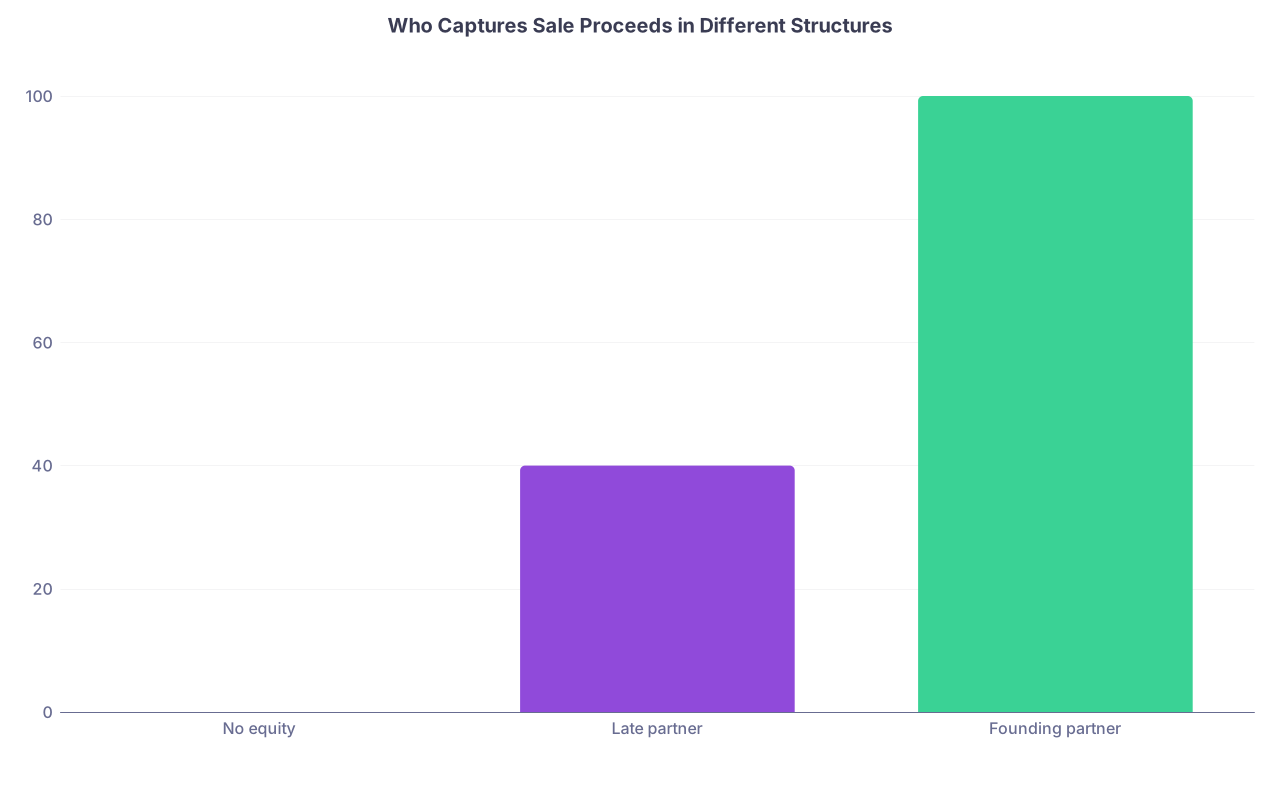
| Category | Value |
|---|---|
| No equity | 0 |
| Late partner | 40 |
| Founding partner | 100 |
Interpretation (qualitative):
- No equity physician: salary only, no check at closing.
- Late partner: smaller share of proceeds, shorter runway.
- Founding partner: larger share, often designed intentionally in the documents.
Key sale-related questions:
- Do all partners share pro rata (by ownership percentage) in sale proceeds?
- Are there vesting schedules (e.g., equity vests over 5 years; unvested portion reverts to others at sale)?
- Are there different share classes (Class A vs Class B) with different economic rights at sale?
I have seen groups do this:
- Founders hold Class A shares with full sale participation
- New partners get Class B shares that get a much smaller multiple on sale, or are capped
If the practice is clearly on a path to sale (multiple PE groups already sniffing around), you need these answers before you sign anything.
7. Negotiating Leverage: What You Can Actually Push On
You are not going to rewrite a group practice’s entire buy-sell agreement as a new grad. That is fantasy. But you do have leverage on three things:
- Clarity – making the implicit explicit, and getting documents in hand
- Symmetry – pushing back against gross asymmetry between buy-in and buy-out
- Individual protection – securing carve-outs that protect you specifically
7.1 Non-negotiables you should insist on
You should not sign without at least:
- Written description of the partnership track, including time and criteria
- A copy of the shareholder or operating agreement
- A copy or detailed summary of the buy-sell agreement or buy-out provisions
- A written explanation or example of buy-in and buy-out pricing
If they say “we only show that to partners,” the translation is: “We want you to commit without understanding the real economics.” That is unacceptable.
7.2 Items you can sometimes negotiate individually
- A guaranteed timeframe for partnership consideration (“no later than 36 months”)
- A requirement that they will provide a written explanation if partnership is not offered
- Confirmation that your buy-in valuation formula will be the same as the formula used for all current partners at their buy-in (or a clear reason if not)
- Floor protections in buy-out (e.g., minimum of capital contributions + X)
You will not always get yes. But pushing on these exposes the culture. Fair groups do not hide the ball.
8. Legal and Financial Due Diligence: How to Actually Evaluate This
This is where you stop thinking like “just a doctor” and start thinking like an investor joining a closely held business.
You need:
- A healthcare-savvy attorney who reviews physician group partnerships weekly, not your cousin the real estate lawyer.
- Ideally, a CPA or financial advisor who understands K‑1 income, pass-through taxation, and small-business valuation.
Documents you (or they) should review:
- Employment agreement
- Shareholder / operating agreement
- Buy-sell agreement or equivalent
- Any ASC, imaging center, or real estate LLC operating agreements
- Last 2–3 years of group financial statements (at least summarized): collections, overhead, partner distributions
If they will not show any financials, you are blind. You cannot assess whether the buy-in price resembles reality.

| Step | Description |
|---|---|
| Step 1 | Receive Offer |
| Step 2 | Identify Ownership Track |
| Step 3 | High Risk - Reconsider |
| Step 4 | Request Ownership and Buy-Sell Docs |
| Step 5 | Attorney and CPA Review |
| Step 6 | Negotiate or Walk |
| Step 7 | Compare Partner vs Employee Economics |
| Step 8 | Decide to Accept or Decline |
| Step 9 | Partnership Defined in Writing |
| Step 10 | Buy-In and Buy-Out Symmetric Enough |
9. Common Traps and How to Spot Them
You will see the same bad patterns over and over. Let me call them out.
Trap 1: “We will talk about partnership later.”
Translation: You have zero enforceable right to ownership. Ever.
If partnership is not at least outlined in your initial agreement or referenced with specific documents and exhibits, behave as if you are joining as a permanent employee.
Trap 2: Asymmetric buy-in / buy-out
Watch for language like:
- Buy-in based on “fair market value as determined by the board”
- Buy-out at “book value” or “capital account balance” only
You want the valuation method for buy-out defined as precisely as buy-in. Not left to the remaining partners’ discretion when you are the one leaving.
Trap 3: Ancillaries carved out
Very common:
- Group practice entity: you can become a partner
- ASC / imaging / real estate / lab: “legacy partners only” or separate invitation later
Sometimes that is fine. Sometimes it means you are forever on the outside of the major profit engines.
Ask: What percentage of partner total income comes from each entity? If 40–50% of senior partner income is from ASC or real estate distributions you can never access, your “partnership” is not equivalent.
Trap 4: Opaque “sweat equity”
Statements like:
“You are getting a discounted buy-in compared to what the practice is really worth. That is covered by your reduced comp during the associate period.”
If no one can show you the math, that is not sweat equity. It is a black box.
Trap 5: Non-competes tied to buy-out
Sometimes they tie enforcement of a non-compete to your buy-out rights. For example:
- If you compete within X miles within Y years, you forfeit your buy-out.
Or more subtly:
- If you breach any term (non-compete, nonsolicit), the group may offset damages against your buy-out.
This is not inherently unfair, but you need to understand how much of your retirement or exit value is at risk if the relationship sours.
10. How This Fits Your Phase: Post-Residency, First Job
You are in a weird position: you are simultaneously highly skilled labor and a naïve investor. You have no business training. The people across the table from you have often been tweaking these documents for a decade.
You do not need to become a lawyer. But you must understand the structure of the deal you are walking into.
Here is a simple mental framework:
- If you care mostly about stability, location, and guaranteed income → a clean, well-compensated employee role with no ownership may be entirely fine. Just stop pretending partnership will change your life.
- If you care about autonomy, upside, and wealth-building → ownership terms (equity, buy-in, buy-out) matter as much as—often more than—base salary.
And you must internalize one hard truth:
By the time you sign your first contract, you may already have decided whether you will ever own anything in that market. A lot of “partnership tracks” are dead ends dressed up as opportunity.
FAQs
1. Is it ever reasonable to accept a job without seeing the partnership and buy-out documents first?
It is rarely wise. If the group genuinely cannot share the full agreements because of internal rules, you at least want a detailed written summary of the key partnership, buy-in, and buy-out terms, and you want language in your employment contract that ties your future partnership offer to those existing terms “as of the date of this agreement.” If they resist even that level of transparency, treat it as a pure employment role and negotiate salary accordingly.
2. How big should a buy-in be for a typical small specialty group?
It varies wildly by specialty, payer mix, geography, and ancillaries. I routinely see fixed buy-ins in the $50k–$150k range for straightforward professional practices, and $200k–$500k+ when significant ASC or imaging equity is bundled in. The absolute number matters less than the ratio of buy-in price to typical annual partner profit. If buy-in is roughly equal to 6–24 months of incremental partner profit, that is commonly defensible. When buy-in equals 4–5 years’ worth of incremental profit, the math starts to look ugly.
3. Should I walk away from a group that will not guarantee partnership after a set time?
Not automatically. Some highly desirable groups keep partnership discretionary to guard culture and quality. But your risk is higher. If they will not give you historical data (how many associates made partner versus left in the last 5–10 years, and average time to partnership), you are gambling blind. If you have multiple offers, a group that puts partnership criteria and timeline in writing is usually the safer bet.
4. How do I compare total partner compensation to an employed hospital job?
You need apples-to-apples numbers. Ask the group for a realistic 5-year projection of: your last associate year comp, your buy-in obligations, your first 3 years as partner (draw + profit distributions). Compare the average annual after-tax income over that period to the hospital offer. Factor in: call burden, control over schedule, non-compete restrictions, and the value of any potential sale event (you will not get that at the hospital). Often, group partnership wins over the long term, but not always—and if their partnership terms are opaque or skewed, the hospital may be the saner choice.
Key points to keep in your head:
- “Partnership track” is meaningless until you know the actual equity, buy-in, and buy-out terms in writing.
- Symmetry between what you pay to get in and what you receive when you leave is the single biggest indicator of fairness.
- You are not just choosing a job; you are choosing whether you will ever own the business you spend your career building. Treat that like the six- or seven‑figure decision it is.


