

The most dangerous words in a physician contract are not about non‑compete. They are “termination without cause.”
Most new attendings skim that paragraph and think, “Fine, if I do my job, they won’t fire me.” That is wrong. Termination without cause is exactly how you can be fired when you do everything right. And the details of the notice period and severance language determine whether that termination is a painful setback… or a career‑ending disaster.
Let me break this down specifically.
What “Termination Without Cause” Really Means
“Without cause” termination is the employer’s legal escape hatch. It lets either party end the relationship for almost any reason, with no legal wrongdoing required.
A standard clause looks like this:
“Either party may terminate this Agreement without cause upon ninety (90) days’ prior written notice to the other party.”
Sounds symmetrical. It is not.
Why employers care so much about this clause
Hospitals and groups insist on without‑cause termination because:
- Volumes drop, service lines close, mergers happen. They want flexibility to shrink or reshuffle staff without proving “cause.”
- They do not want to litigate “poor fit,” culture issues, or political conflicts.
- Private equity–backed groups in particular like to “restructure” quickly. Without‑cause is how they do it.
I have watched entire hospitalist teams get replaced because a new national group won the contract. Everyone had “without cause” language. Everyone was gone in 90 days.
Why you should care even more
For you, this clause governs:
- How long you keep a paycheck after the relationship sours
- Whether your malpractice coverage is still active when you leave
- How much time you have to find another job before your non‑compete and immigration status (if any) become problems
- Whether you lose a six‑figure sign‑on bonus or student loan repayment
This is not just legal boilerplate. It is your safety net.
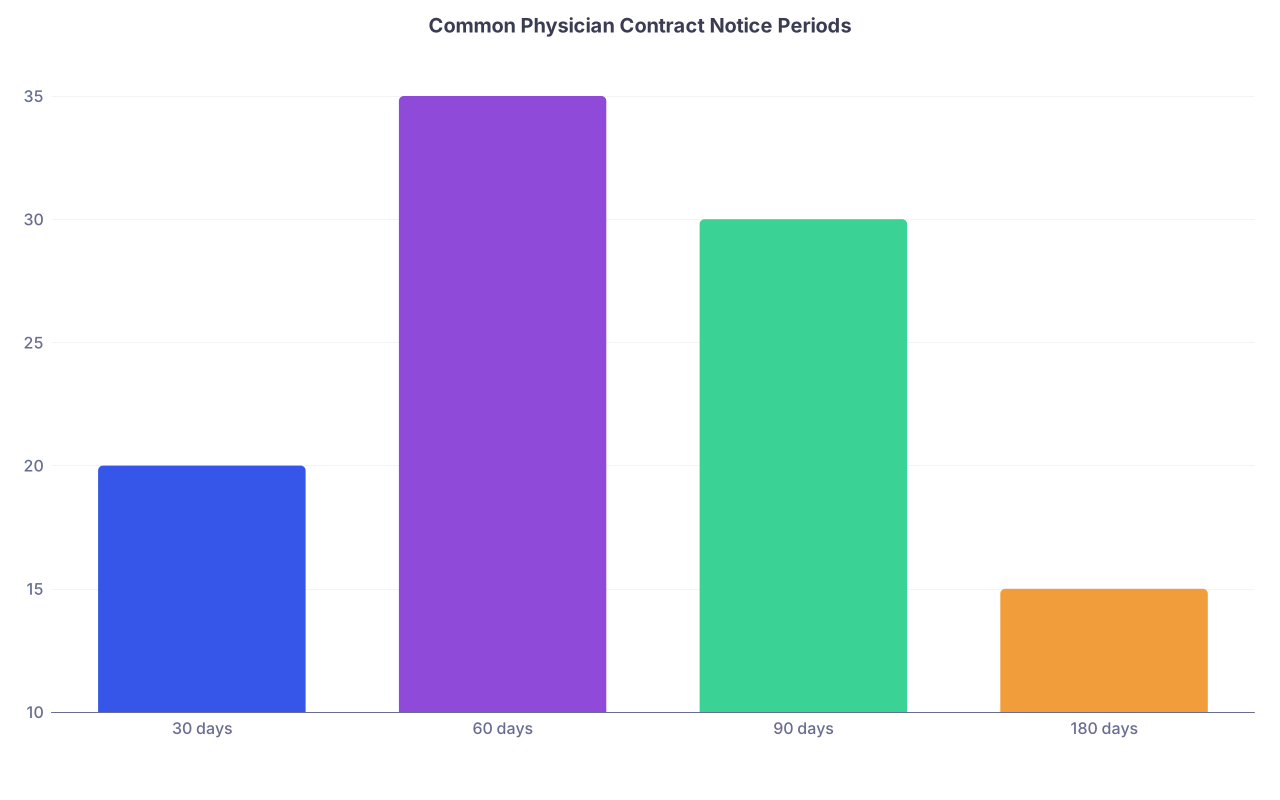
Notice Periods: 30 vs 60 vs 90 vs 180 Days
The notice period is the number of days between giving notice and your last day of employment. Both sides are typically bound to the same number, but the real-world effects are very different.
| Category | Value |
|---|---|
| 30 days | 20 |
| 60 days | 35 |
| 90 days | 30 |
| 180 days | 15 |
(Those numbers are illustrative: roughly how often I see each in early‑career contracts across primary care and hospital-based specialties.)
How notice operates in practice
Two key points:
Notice is minimum time, not guaranteed time.
If your contract says 90 days and they terminate you without cause today, they can:- Keep you working and paying you for 90 days, or
- Put you on “garden leave” (no work, still on payroll) for all or part of that period, or
- Sometimes pay you out for the notice period and cut you loose (if the contract allows).
Notice period doesn’t automatically equal severance.
Many physicians confuse these. If you are on notice and still on salary, that is not severance. It is just delayed termination.
Short notice (30 days): who benefits, who gets burned
I see 30‑day notice periods in:
- Small private practices
- Urgent care chains
- Some ER and hospitalist groups (especially staffing companies)
Upsides for you:
- Easier exit if the job is toxic or you get a much better offer.
- Less time stuck in a situation where your reputation is deteriorating.
Downsides:
- If they terminate you without cause, 30 days is almost nothing:
- You may not have time to secure a new position, license transfer, or credentialing.
- Health insurance may end immediately after that.
- Immigration status (H‑1B, J‑1 waiver positions) can become a full-blown crisis.
I consider 30‑day notice dangerous for new attendings unless there is excellent severance language or you are extremely geographically flexible.
Moderate notice (60–90 days): the common middle ground
Most hospital‑employed and large group contracts land here.
At 60–90 days, you generally have:
- Enough time to start a job search and interview
- Some financial cushion
- A bit of leverage to negotiate a matched start date for the next position
From the employer’s viewpoint, 60–90 days is still reasonable for scheduling, patient continuity, and recruitment.
If you are going to accept standard language without much negotiation, I want to see at least 60 days. Ninety is better.
Long notice (120–180 days): stability vs. handcuffs
I see 120–180 day notice periods in:
- Niche subspecialties with long recruitment cycles
- Certain academic positions
- High‑stakes leadership roles (CMO, program director, etc.)
Good side:
- If they fire you without cause, that is essentially built‑in severance. You are paid for 4–6 months while you figure things out.
- It signals they expect a long‑term relationship.
Bad side:
- If you want to leave, you are stuck for those 4–6 months unless they waive the notice.
- You can miss out on good offers that need someone in 60–90 days.
I do not like 180‑day unilateral notice for both sides in a first attending job without flexibility. If they insist on 180 days you must give, I want clarity on their side: either shorter notice for employer termination or guaranteed paid notice (no early cut‑off).
The Ugly Details Hidden Inside Without‑Cause Clauses
The broad framework is simple. The devil is in the add‑ons: carve‑outs, payment timing, and “immediate termination” cross‑references.
One‑sided vs mutual termination rights
Some contracts give only the employer the right to terminate without cause. That is a red flag.
Language to watch:
- Bad: “Employer may terminate this Agreement without cause upon ninety (90) days’ written notice.”
- Better: “Either party may terminate this Agreement without cause upon ninety (90) days’ written notice to the other party.”
You want mutual rights. If they refuse, assume they view you as a replaceable, controlled asset, not a professional partner.
“In employer’s sole discretion” death trap
You will often see:
“Employer may, in its sole discretion, relieve Physician of duties during the notice period.”
Fine, as long as they keep paying you and keep benefits in place during that same period. The moment they add:
“Employer may, in its sole discretion, pay Physician an amount equivalent to the compensation due during the notice period in lieu of continued employment.”
you need to look very closely at how they calculate that amount.
Questions:
- Is it based on base salary only? Or recent total compensation including RVU/bonus?
- Does it include benefits value? PTO payout?
- Does it cover call stipends, leadership stipends, etc.?
If they can terminate you “without cause,” then pay you one month of base salary instead of 90 days of full comp, your supposed safety net is mostly fiction.
Interaction with immediate “for cause” termination
Bad employers play games here. The structure usually looks like:
- Section A: Termination “for cause” – immediate, no notice, often no bonus, sometimes forfeiture of certain payments.
- Section B: Termination “without cause” – notice period, maybe some payout.
The trick: the contract may allow the employer to reclassify your departure as “for cause” late in the game.
Example pattern I have seen:
“If, following delivery of notice of termination without cause, Employer discovers facts that would have constituted cause, Employer may reclassify the termination as for cause effective as of the original notice date.”
Translation: they can fire you without cause, then go digging. If they later find something arguable as “cause,” they can retroactively erase your protections, severance, maybe tail coverage.
That is unacceptable language. It should be removed or heavily constrained.
Severance: When It Exists, What It Really Covers
Here is the blunt truth: most rank‑and‑file physician contracts have no true severance. Your “severance” is the paid notice period, if they keep you on payroll.
If you do see actual severance, it is usually:
- Leadership roles (medical director, chair, CMO)
- Highly recruited subspecialties
- Hospital-employed models in competitive markets
- Academic departments trying to lure people from other institutions

What real severance language looks like
Something like:
“If Employer terminates Physician’s employment without cause, Employer shall pay Physician severance equal to three (3) months of Physician’s then-current base salary, payable in regular installments, contingent upon Physician’s execution of a general release of claims.”
Key features:
- Tied to base salary (usually, not total comp)
- Triggered only when employer initiates without‑cause termination
- Conditioned on signing a release (you promise not to sue)
Variations you will see:
- 3–6 months base salary for senior roles
- Lump sum vs installments
- Inclusion of bonus proration (rare but worth asking for)
- Continuation of benefits for part of the severance period
How severance and notice interact
You must understand which of these you have:
Notice only, no additional severance.
- If they give 90‑day notice and keep paying you for 90 days, that is it.
- If they pay you “in lieu of notice” for 90 days, again, that is it.
Notice plus severance.
- They owe you the notice period (or payout) plus separate severance.
- Example: 90‑day notice + 3 months severance → potentially 6 months of pay if structured that way.
Severance replaces notice.
- Contract may say something like: “Upon termination without cause, Physician shall be entitled to severance equal to ninety (90) days of base salary in lieu of any further obligation with respect to the notice period.”
- Then your “notice” is just a label; the real protection is the severance.
I have seen a lot of residents get fooled by #3. They think they have 90‑day notice and 3 months severance. They actually just have 3 months of total protection, not six.
Read carefully. Do the math on an annualized basis. If you are:
- Earning $300,000 base
- With a “90‑day notice OR 90‑day severance” clause
Your maximum protection is $75,000 gross. Ask yourself how long that realistically lasts if you are the sole earner with six‑figure loans and a mortgage.
How Termination Language Ties Into Your Money (Bonuses, Clawbacks, RVUs)
This is where the bodies are buried. Termination without cause is not just about your last paycheck. It often dictates:
- Whether you repay your sign‑on bonus
- Whether your student loan assistance must be refunded
- Whether you lose future RVU or quality bonuses already “earned but not yet paid”
| Payment Type | If Terminated *With* Cause | If Terminated *Without* Cause |
|---|---|---|
| Sign-on bonus | Usually full or prorated repayment | Often prorated repayment or waived |
| Relocation reimbursement | Usually full repayment | Often prorated repayment |
| Loan repayment program | Often stopped + clawback | Sometimes kept, sometimes prorated |
| Productivity bonus | Often forfeited | May be prorated if language exists |
Sign‑on bonuses and repayment traps
Typical language:
“Physician shall repay the sign-on bonus in full if Physician’s employment terminates for any reason prior to twenty-four (24) months from the Effective Date, except where Employer terminates Physician without cause.”
Perfect. That is fair.
More hostile version:
“Physician shall repay the sign-on bonus on a prorated basis if Physician’s employment terminates prior to twenty-four (24) months, regardless of the reason for termination.”
Translation: even if they fire you without cause, you owe part of the sign‑on bonus. I have seen $25,000 checks demanded from physicians terminated in month 18 for “restructuring.”
You want exceptions carved out:
- No repayment obligation if employer terminates without cause.
- Ideally, no repayment on expiration of a fixed‑term contract not renewed by employer.
RVU and quality bonuses at termination
Another frequent point of confusion:
- Many RVU/quality bonuses are calculated quarterly or annually.
- If you are terminated mid‑cycle, the contract may not explicitly say what happens.
Three common outcomes:
- You lose everything not yet paid. (Most common if the contract is silent.)
- They prorate the bonus through your last day and pay it on the regular schedule.
- They calculate and pay a prorated amount at or shortly after termination.
What you want to see:
“Upon termination without cause, Employer shall calculate and pay to Physician, within sixty (60) days, any productivity or quality incentive compensation earned but not yet paid through the date of termination.”
If they will not add this, assume you are donating the last few months of work if they cut you loose before a bonus date.
Tail Coverage: The Silent Financial Landmine
Termination without cause + no tail coverage = you just took on a six‑figure liability.
If you are in a claims‑made malpractice policy environment (common in many states, especially for private groups), the policy that covers you during employment might not cover you for lawsuits filed after you leave.
You will see language like:
“Employer shall maintain professional liability insurance on behalf of Physician during the Term.”
That does not answer the question: who pays for tail when the relationship ends?
Now connect the dots:
- They terminate you without cause.
- Your last day is 60–90 days out.
- Patients can still sue you for several years.
- If you are responsible for tail, you may owe $30,000–$120,000 depending on specialty and state.
I want to see, in writing:
- “Employer shall be responsible for obtaining and paying the premium for any required tail coverage upon expiration or termination of this Agreement, regardless of the reason for termination.”
Some employers will negotiate:
- Employer pays tail if they terminate without cause.
- You pay tail if you resign or are fired for cause.
That is still much better than “physician pays tail in all scenarios.”
Non‑Compete + Without‑Cause Termination: The One‑Two Punch
You cannot talk about termination without cause without talking about restrictive covenants. Because what happens after termination determines whether your local career is intact or dead.

| Step | Description |
|---|---|
| Step 1 | Termination Without Cause |
| Step 2 | Free to work locally |
| Step 3 | Can job search with less risk |
| Step 4 | Financial hit before next job |
| Step 5 | Non-compete Active |
| Step 6 | Tail Coverage Paid |
Typical scenario:
- You work in a 30‑mile non‑compete radius.
- They terminate you without cause.
- You want to stay in the area (kids, spouse’s job, house).
- The non‑compete still applies, often for 12–24 months.
Without careful drafting, you get the absurd result: they can fire you without cause and simultaneously bar you from working anywhere nearby.
You want either:
- No non‑compete at all, or
- A clause that weakens or voids the non‑compete if they terminate you without cause.
For example:
“The restrictive covenants set forth in Section X shall not apply if Employer terminates Physician’s employment without cause or fails to renew this Agreement upon expiration of the initial term.”
Most employers will fight that. Sometimes you can at least narrow the radius or duration in that scenario.
Practical Negotiation Strategy: What To Push, What To Accept
You are not rewriting their whole agreement. You are trying to move 3–5 key levers that materially change your risk if things go sideways.

Step 1: Decide your priority – flexibility vs security
These are in tension:
- Short notice favors your ability to leave quickly.
- Long notice favors your financial security if they fire you.
For a first attending job, most people underestimate risk and overestimate how quickly they can replace an attending-level role. I lean toward security in the first 2–3 years, especially if:
- You have a narrow geographic preference.
- You are on a visa.
- You have heavy fixed expenses coming (house, childcare, loans).
So:
- Push for 60–90 days minimum notice both ways.
- If employer wants longer notice from you (120–180 days), push for asymmetry: they must give you at least as long, and they must keep you on payroll with benefits the whole time or pay full equivalent in lieu.
Step 2: Clean up the “gotcha” language
Specific edits you (or your attorney) should try:
Make without‑cause termination mutual.
Change “Employer may terminate” to “Either party may terminate.”Remove or narrow retroactive reclassification to “for cause.”
Strike language that allows them to reclassify your departure as for cause after initial notice.Clarify payment during notice:
- “During any notice period, Physician shall continue to receive base salary, benefits, and any applicable stipends as if fully employed, regardless of whether Employer elects to relieve Physician of duties.”
Lock in bonus treatment:
- Add a sentence ensuring prorated payment of any earned but unpaid productivity/quality bonuses on without‑cause termination.
Tail coverage allocation:
- At least: “If Employer terminates Physician without cause, Employer shall be responsible for the cost of any required professional liability tail coverage.”
Step 3: Address sign‑on and relocation clawbacks
Concrete targets:
- Add an exception: no repayment if employer terminates without cause or fails to renew at the end of the initial term.
- If they will not agree, push for sliding scale:
- Year 1: 100% repayment
- Year 2: 50%
- After Year 2: 0%
Better than writing a $30,000 check after 23 months of good service.
Step 4: Non‑compete modification if terminated without cause
Even if they will not fully waive the non‑compete, you can try:
- Reducing duration (e.g., from 24 months to 6–12) if employer initiates without‑cause termination.
- Reducing radius (e.g., from 30 miles to 10 miles) in that scenario.
- Carving out specific hospitals or clinics where you can continue to work.
A simple clause:
“If Employer terminates Physician without cause, the noncompetition restriction shall be limited to a radius of ten (10) miles and a duration of six (6) months from the date of termination.”
They may say no. But ask. Early‑career physicians who ask, get.
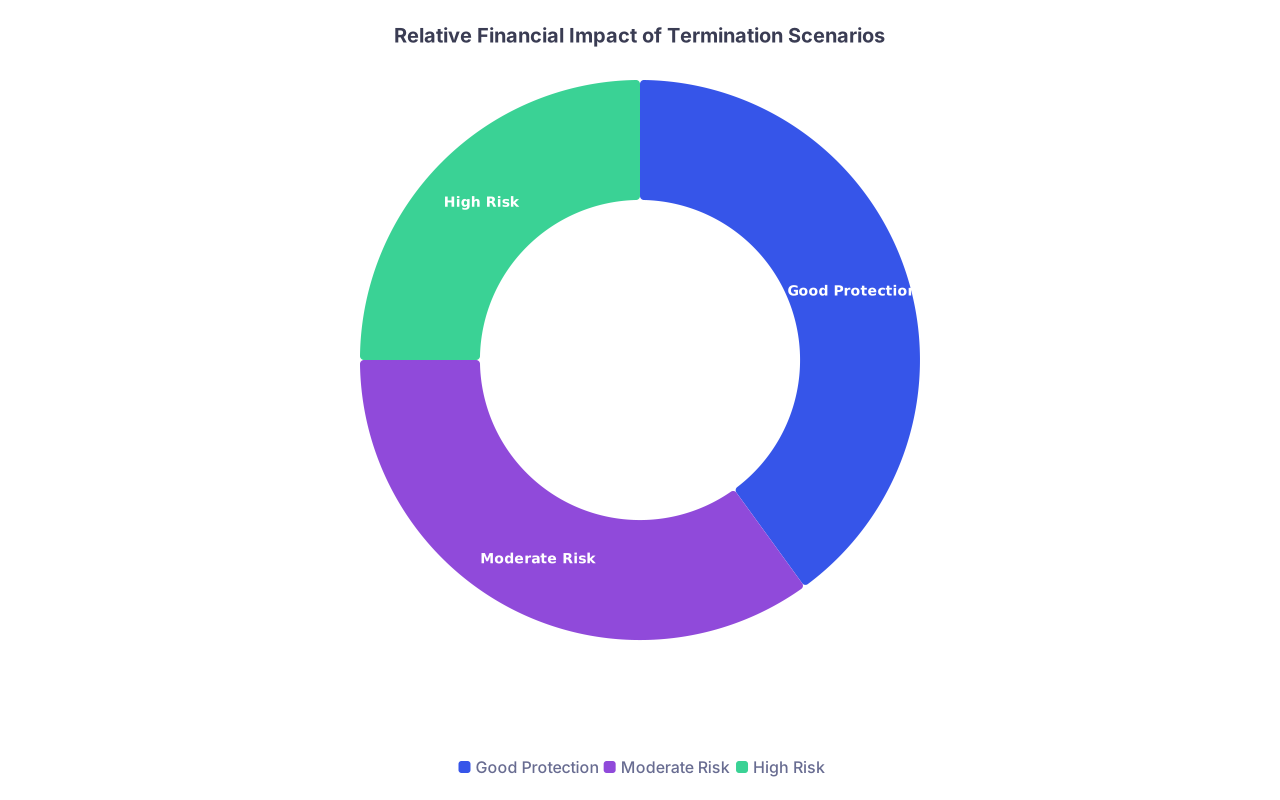
Three Realistic Scenarios And How The Language Plays Out
Sometimes examples are the only way this really sinks in.
| Category | Value |
|---|---|
| Good Protection | 40 |
| Moderate Risk | 35 |
| High Risk | 25 |
Again, values illustrative – not actual incidence.
Scenario 1: Hospitalist, 90‑day mutual notice, no severance, good tail clause
- You are terminated without cause after 18 months due to a new management contract.
- Contract says:
- 90‑day mutual without‑cause notice
- Employer pays tail in all terminations
- Sign‑on bonus repayment waived if employer terminates without cause
- Prorated RVU/quality payments on termination
Result:
- You get 90 days of full pay and benefits.
- You owe nothing back on the sign‑on bonus.
- Your tail is covered.
- You receive a prorated productivity bonus for the partial quarter.
- You have 3 months to interview. Worst case, you do some locums after.
This is what “good but not perfect” looks like.
Scenario 2: Outpatient IM, 30‑day notice, physician pays tail, bad clawback language
- You move cross‑country for a job. $30k sign‑on, $10k relocation.
- Contract says:
- 30‑day mutual notice
- Physician pays tail in all circumstances
- Full sign‑on and relocation repayment if you leave or are terminated “for any reason” in first 24 months
- No mention of bonus proration
At month 14:
- New CEO. They want more advanced practice providers, fewer MDs.
- You are terminated “without cause.”
Outcome:
- 30 days of salary.
- Demand letter for $40,000 repayment.
- Tail quote: $55,000.
- No productivity bonus for the last 4 months of heavy work; the quarter closed after your termination.
You are down six figures in obligations/income loss, with 30 days of pay. That is how careers get derailed.
Scenario 3: Academic subspecialist, 180‑day notice, limited severance, non‑compete softened
- You are recruited as a transplant hepatologist.
- Contract says:
- 180‑day notice either way
- If employer terminates without cause, they owe 3 months base salary severance in addition to notice, but may waive part of working notice by paying equivalent salary
- Employer pays tail in all terminations
- Non‑compete limited to 10 miles, and fully void if employer terminates without cause
Five years in, new chair, your niche program gets cut.
They give 180‑day notice and relieve you of duties after 60 days, paying out:
- Remaining 120 days of “notice” salary
- Plus 3 months severance
So you get 7 months of pay, full tail coverage, and zero non‑compete restrictions because they initiated without cause. You relocate on your timeline.
This structure is rare, but it shows what strong protection looks like.
A Quick Visual Checklist
If you want a brutally efficient checklist of what to scan in your contract around termination without cause, it is this:

| Step | Description |
|---|---|
| Step 1 | Read Termination Section |
| Step 2 | Ask to make it mutual |
| Step 3 | Check notice days |
| Step 4 | 60 to 90 days preferred |
| Step 5 | Clarify pay/benefits during notice |
| Step 6 | Check sign-on and relocation clawbacks |
| Step 7 | Check bonus proration language |
| Step 8 | Confirm tail coverage responsibility |
| Step 9 | Review non-compete impact on without cause |
| Step 10 | Mutual without cause? |
Key Takeaways
- “Termination without cause” is not just a formality. Your notice period length, who pays tail, and what happens to bonuses and clawbacks determine whether a termination is survivable or catastrophic.
- You should push for mutual without‑cause rights, at least 60–90 days of paid notice, clear bonus proration, and employer‑paid tail when they terminate you without cause.
- Never read termination language in isolation. Tie it explicitly to non‑compete restrictions, sign‑on and relocation repayment, and malpractice coverage. That integrated picture tells you your true risk.


