
You’re 55, post-call fatigue hits harder than it used to, and a younger partner just joked, “Yeah, I’ll be done at 50 once my rentals cover everything.” You laughed along, but it stung. You have high income, a solid 401(k), maybe a big house—and zero real estate beyond your primary residence.
This is the playbook for that situation. Late-career physician, no rentals, limited time to recover. You cannot afford dumb mistakes, gimmicks, or 15-year learning curves. You need a sober, efficient blueprint.
1. Reality Check: Where You Actually Stand
Before buying anything, you need brutal clarity on your starting point. Not vibes. Numbers.
Here’s what I want on one sheet of paper (yes, one):
Age and target “freedom” date
- Not when you stop all work. When you want the option to walk away from full-time clinical.
- Example: You’re 56, want flexible by 63, fully optional by 67.
Current investable assets
- 401(k)/403(b)/IRA balances
- Taxable brokerage
- Cash and short-term reserves
- Value of any existing syndicates or REITs if you already dabble
Annual spending (real, not fantasy)
- Track the last 3–6 months.
- Multiply by 12. That’s your burn.
Current saving rate
- How much you’re actually investing per year, not counting paying down a primary residence mortgage.
Once you have this, calculate:
- Your “number” for basic freedom: Annual spending × 25 (roughly 4% rule)
- Your “number” for comfort: Annual spending × 30
If your total investable assets are nowhere near that, real estate is not optional. You need more engines.
Now ask: how many years of full-time income do you realistically have left?
- 7–10 years? You still have room to build something meaningful
- 3–5 years? You must be selective and probably less hands-on
2. Core Constraints of the Late-Career Physician
You’re not a 32-year-old EM doc trying BRRRR flips on the side. Different game.
Your constraints:
- Time: Your schedule is not suddenly opening up. Nights, weekends, OR days—still happening.
- Risk tolerance: You do not have 20 years to recover from a blown deal.
- Cognitive load: You’re already carrying patient risk, charting, admin headaches. Complex projects will fry you.
- Financing timeline: Lenders love your income now. They may be far less generous after you cut clinical hours.
So your strategy has to be:
- Simpler
- More systematized
- Less speculative
- Front-loaded while you’re still earning strong income
If a strategy only works with “massive hustle,” it’s wrong for you.
3. Your Real Estate Menu: What Actually Makes Sense
Let’s be surgical. What can fit a late-career physician with no rentals?
| Strategy | Hands-On Level | Typical Hold Time | Main Goal |
|---|---|---|---|
| Local rentals (SFH/duplex) | Moderate | 10+ years | Cash flow + equity |
| Small commercial/office | High early | 10–15+ years | Appreciation + rent |
| Syndications/funds | Low | 5–10 years | Passive income |
| REITs (public) | Very low | Flexible | Diversification |
| Short-term rentals | High | 5–10 years | Income (volatile) |
Let me be blunt:
Short-term rentals (Airbnb)
Often a trap for busy physicians. High operational load, regulatory risk, hospitality business on top of medicine. Skip unless you have a trusted, experienced manager and very specific reasons.Heavy rehabs / flips
You do not need another stressful job with contractor drama and unpredictable timelines.Highly speculative development deals
Late-career + no experience = bad combo here.
What tends to work:
- Simple local long-term rentals (single-family, small multifamily)
- Owning your practice building or small commercial property with stable tenants
- Passive syndications and funds (if you’re picky and educated)
- REITs as a liquid, boring base
You’ll likely use a mix:
- 1–3 local properties you understand
- A basket of carefully vetted syndications/funds
- Maybe your own office building if it fits
4. Step-by-Step: 10-Year Catch-Up Blueprint
Assume you’re 55–60 with:
- High W-2 income
- No rentals
- Decent but not bulletproof retirement savings
You want $8k–15k/month in relatively reliable real estate income by your late 60s.
Step 1: Decide Your “Hands-On Level”
Be honest:
- Level 1: “I’ll spend 1–2 hours a week max.” → Syndications + REITs, maybe 1–2 local rentals with property management.
- Level 2: “I can commit a half-day every other weekend.” → Small local portfolio (3–6 doors) with management.
- Level 3: “I’m willing to treat this like a part-time job for 3–5 years, then taper.” → Larger local portfolio or a small commercial building.
If you guess wrong here, you’ll either burn out or underperform.
Step 2: Protect the Downside First
Before you buy any property:
- Build/verify a real emergency fund: 6–12 months of living expenses in cash or cash-equivalents.
- Get disability and adequate umbrella insurance (real estate adds liability exposure).
- Clean your personal balance sheet:
- High-interest debt gone
- Student loans refinanced or in a clear plan
- Stupid car loans handled
You don’t build a second story on a cracked foundation.
Step 3: Define a 10-Year Capital Plan
You need a written allocation like a treatment plan. For example:
- “Over the next 10 years, I will move ~$1.0–1.5M into real estate in stages, without blowing up my retirement accounts.”
Possible structure:
- Year 1–3:
- Buy 1–2 local rentals
- Place $100–200k into diversified real estate syndications or funds
- Year 4–7:
- Add 1–2 more rentals or a small commercial property
- Add another $200–300k in passive deals
- Year 8–10:
- Evaluate performance
- Maybe add final property or roll matured syndication returns into income-focused funds
Do not yank all money out of stocks to rush into real estate. You’re reallocating gradually, not panic-shifting.
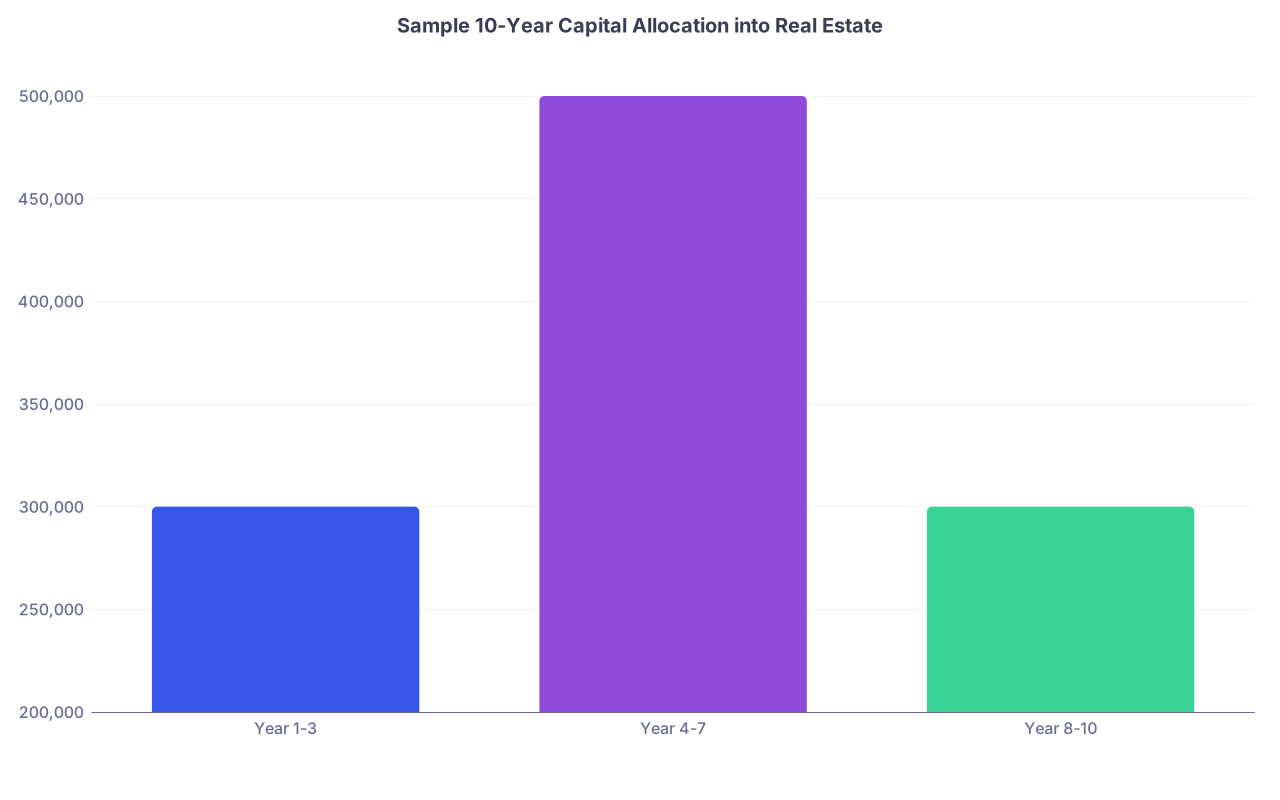
| Category | Value |
|---|---|
| Year 1-3 | 300000 |
| Year 4-7 | 500000 |
| Year 8-10 | 300000 |
5. The Safe Entry Plan: Your First 1–2 Properties
If you’re going to own any doors personally, the first 1–2 matter more than you think. They set your confidence—and your systems.
Choose Location Like a Grown-Up, Not an Influencer
Look for:
- 1–2 hours from where you live, or in a city you know extremely well
- Stable or growing population
- Diverse employers
- Landlord-friendly or at least neutral laws
Avoid chasing “cheap” in a collapsing town three states away.
Property Type
For a late-career doc with no rentals, I like:
- B-class single family homes in solid working/middle-class areas
- Duplexes or small multifamily (2–4 units) in similar neighborhoods
You want tenants who pay and stay. Not drama.
Your First Deal Filters
If the deal on your screen fails any of these, pass:
- You can put 25–30% down and still keep strong cash reserves
- After conservative expenses and property management, it cash flows at least a few hundred per month
- You wouldn’t panic if it were vacant for 2–3 months
- It’s not your dream renovation project. You want clean, functional, boring.
Think base hit, not home run.
6. Syndications and Funds: Passive, Not Mindless
A lot of physicians jump straight into syndications because “passive income” sounds like morphine after a 12-hour shift. Then some of them get burned.
Here’s how to not be that story.
Where They Fit for You
Given your time constraints, I almost always want some portion of your real estate allocation in:
- Diversified real estate funds, and/or
- Carefully vetted individual syndications
Especially in your 50s and 60s.
They give you:
- Exposure to larger properties you’ll never buy alone
- Zero tenant calls
- Geographic diversification
But they require due diligence upfront.
What You Actually Check
You’re not going to become a full-time underwriter. Good. But you must at least:
Underwrite the sponsor first
- Track record through a full cycle (not just 2013–2019 bull run)
- How they handled a bad deal
- References from other physicians not on their marketing website
Underwrite alignment
- How much of their own money is in the deal
- Fee structure (are they getting rich on fees while you take risk?)
Underwrite the deal at a high level
- Market: is it a real city with real jobs, not just hype?
- Business plan: value-add, core, development—what’s the actual play?
- Hold time: 5–7+ years is common. Are you OK with that?
Do not invest just because your colleague at M&M said, “These guys are awesome, I went to med school with them.”
7. Legal + Asset Protection Basics (No Tinfoil Hats)
You’re in “Financial and Legal Aspects” territory now. Good. Here’s the clean, no-gimmick framework.
Entity Structure for Local Rentals
Common pattern:
- Each property—or small group of properties—held in an LLC
- You personally own the LLC, or through a holding LLC, depending on your state and attorney’s advice
- Adequate liability insurance and umbrella coverage
You do not need:
- 20 shell LLCs in Wyoming with someone on TikTok as your “advisor”
- Exotic complicated trust structures you don’t understand
You do need:
- A real estate attorney in your state to:
- Draft/clean up your operating agreement
- Review your lease template
- Advise on entity + titling strategy
You spend a few thousand now to not lose millions later. That trade is obvious.
For Syndications/Funds
Usually:
- You invest as an individual or via an LLC or trust
- You review the PPM (private placement memorandum) with:
- A real estate-savvy attorney or
- At least your own legal brain turned fully on
Focus on:
- Liquidity: can you get out? Usually no. Assume your money is locked for the full term.
- Capital call provisions: can they ask you for more money? Under what conditions?
- Priority of distributions: who gets paid first, and when?
Do not skip this step because the deck has pretty photos and a projection line that goes up and to the right.

8. Tax Positioning: Quiet But Powerful
Real estate’s tax benefits are one of the few legal “cheat codes” left for high earners. Late career, you can still use them—but you must be realistic.
You’ll hear people scream “Cost segregation! Bonus depreciation!” like it solves everything. For you, it depends:
- If you’re still full-time W-2 and do not qualify as a real estate professional (you almost certainly don’t), losses from rentals are usually passive.
- Passive losses can offset passive income (from rentals, syndications), but not your clinical W-2 income in most cases.
Still useful:
- Depreciation on properties can shelter a big chunk of your rental income from current tax.
- Syndications often throw off paper losses early that offset later passive gains.
- If your spouse can qualify as a real estate professional and you file jointly, the game changes. Then some or all passive losses may offset W-2 income. That’s a bigger, more advanced play—get a real CPA who actually does this for physicians.
Do not structure your whole life around chasing losses. The property has to work on a pre-tax basis first.
9. A Realistic Outcome: What “Winning” Looks Like
Let’s paint a conservative scenario for a 57-year-old hospitalist, no rentals today, wants flexibility at 67.
She decides:
- Hands-on level: 2 (will put in some time, but not a second job)
- Capital she’s willing to direct into real estate over 10 years: ~$1.2M (from savings and some reallocated investments)
Her 10-year moves:
Years 1–3
- Buys 2 single-family homes in a solid suburb, $400k each, 25% down each
- Puts $200k into 2–3 vetted syndications (multifamily + self-storage)
Years 4–7
- Adds a small 4-plex, $600k, 25% down
- Puts another $250k into diversified real estate fund
Years 8–10
- No new doors, lets the portfolio stabilize
- Reinvests proceeds from any refinances/sales into income-oriented funds or paying down mortgages
By age 67, conservative result:
Local rentals:
- Combined net cash flow (after property management, reserves, etc.): maybe $4k–6k/month
- Significant equity built via amortization and modest appreciation
Syndications/funds:
- Some deals have gone full cycle; capital plus gains rolled forward
- Maybe $3k–5k/month in relatively passive distributions depending on yield and allocation
Total: $7k–11k/month from real estate, plus her 401(k)/IRA/social security.
Is this “I retired in 5 years with 200 doors and a Lambo” Internet nonsense? No. It’s reality. And for a late-career doc who started with no rentals, it’s a win.
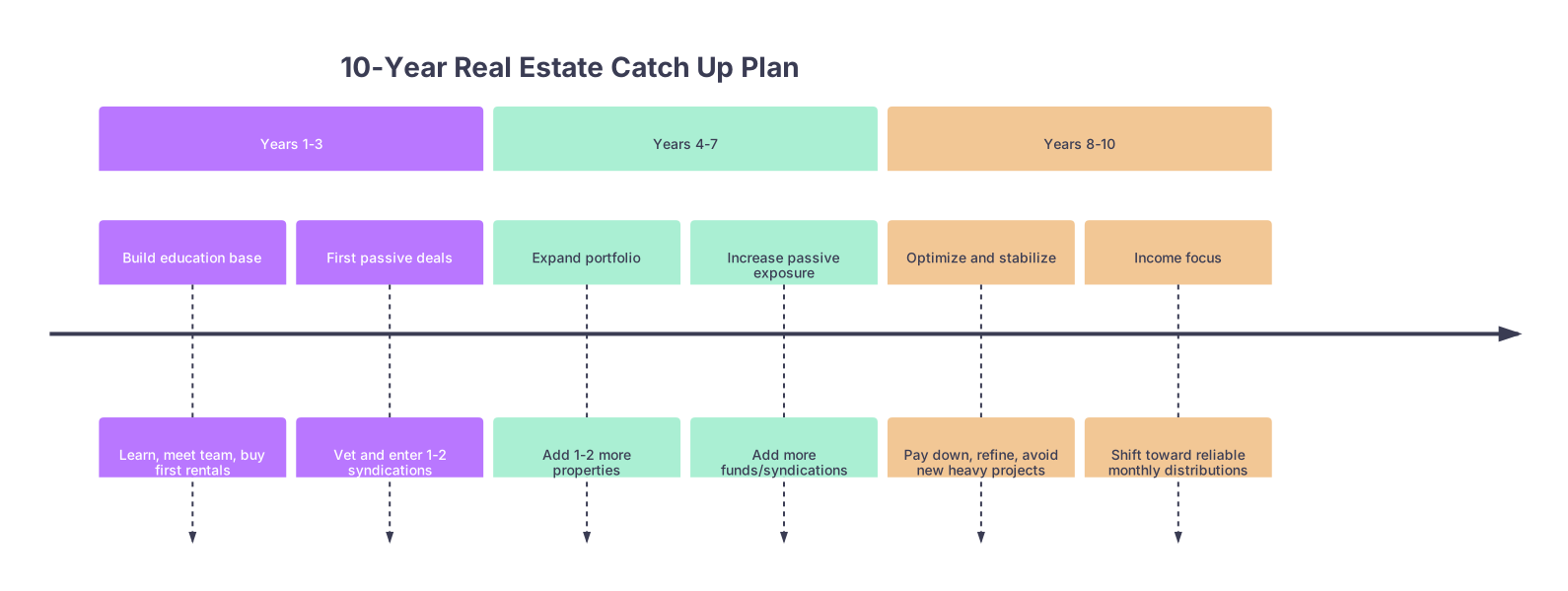
| Period | Event |
|---|---|
| Years 1-3 - Build education base | Learn, meet team, buy first rentals |
| Years 1-3 - First passive deals | Vet and enter 1-2 syndications |
| Years 4-7 - Expand portfolio | Add 1-2 more properties |
| Years 4-7 - Increase passive exposure | Add more funds/syndications |
| Years 8-10 - Optimize and stabilize | Pay down, refine, avoid new heavy projects |
| Years 8-10 - Income focus | Shift toward reliable monthly distributions |
10. How to Start in the Next 60 Days
You don’t need a five-year plan to take the first two steps. You need the next 60 days mapped out.
Here’s a tight action list:
Weeks 1–2
- Pull your full financial picture into one place
- Decide your hands-on level and 10-year horizon
- Schedule a meeting with:
- A real estate-focused CPA
- A local real estate attorney
Weeks 3–4
- Pick 1–2 local markets to focus on (ideally where you already live)
- Interview at least 2–3:
- Investor-focused real estate agents
- Property management companies
Weeks 5–8
- Analyze 10–20 potential rental deals (with your agent/PM’s help)
- Simultaneously, start a simple education pipeline for syndications:
- Attend 2–3 webinars with different sponsors
- Read 2 full PPMs, even if you don’t invest yet
By Day 60
- Either: Make an offer on your first property or
- Decide you’re going 80–90% passive and line up your first syndication or fund investment
Forward motion, not perfection.
FAQ (Exactly 4 Questions)
1. Am I starting too late if I’m already in my late 50s with no rentals?
No, but the strategy changes. You’re not playing the “buy 30 doors and refinance endlessly” game. You’re aiming for a handful of solid, boring assets plus some well-chosen passive investments. Your edge is strong income now and (usually) decent savings. If you give yourself 7–12 years and avoid dumb risks, you can absolutely build a meaningful real estate income stream. The mistake is believing you must either go all-in or do nothing.
2. Should I pay off my primary home before investing in rentals?
Not necessarily. Emotionally, it feels great to be mortgage-free. Mathematically, if your mortgage is at 3–4% and you can buy quality real estate that yields 6–8%+ over time, pouring every dollar into your home is often suboptimal. A balanced approach works better: keep your primary mortgage on a reasonable schedule, and direct a portion of excess cash flow into income-producing assets. What you must not do is over-leverage your home with risky HELOC use for speculative deals.
3. Is owning my practice building the best first real estate move?
Sometimes it’s fantastic, sometimes it’s a trap. If your practice is stable, the location is strong, and the numbers work even if your group left, owning your building can be a powerful wealth builder. But if reimbursement risk, hospital politics, or demographic shifts could hollow out your practice, you don’t want your real estate eggs in that single basket. Treat the building as an investment that must stand on its own, with market rents and realistic vacancy assumptions—do not buy just for ego or convenience.
4. How much of my net worth should be in real estate at this stage?
There’s no magic percentage, but for a late-career physician, I like a band roughly between 20–50% of total investable assets in real estate (including primary residence equity only at a discount mentally). Closer to 20–30% if you’re very risk-averse or close to retirement, higher if you have longer runway and strong stomach. Above 50% you’re becoming heavily concentrated, which can backfire if your job, home, and investments all hinge on a few local markets. Diversification still matters, even when catching up.
Key points: you’re not too late, but you’re out of time for sloppy experiments. Pick a hands-on level you can actually sustain, build a 10-year capital plan that protects the downside, and stick to simple, boring, cash-flowing assets plus carefully vetted passive deals. Do that, and late-career with no rentals stops being a confession and becomes just your starting line.