
Most physicians are getting the real estate tax rules completely backwards.
You’ve been told the only way real estate “works” for taxes is to become a “real estate professional,” quit medicine, track 750 hours, and somehow convince the IRS you’re a landlord first and a doctor second.
That story is dead wrong for 90–95% of physicians.
The reality: You can get substantial, legitimate real estate tax benefits without qualifying as a real estate professional (REP). And for many high‑income W‑2 physicians, chasing REP status is not just unrealistic—it’s a distraction from better, cleaner strategies.
Let’s dismantle the myths and walk through what actually works.
The Core Tax Reality: Passive vs Non‑Passive (Not “Real Estate vs Other”)
This is where people get lost. The tax code doesn’t care about “real estate” as a label; it cares about activity type:
- Active/non‑passive income: your W‑2 clinical pay, K‑1 from owning a practice where you materially participate, etc.
- Passive income: most rental real estate, syndications, funds, and businesses you own but don’t materially run day to day.
Losses can only freely offset income in the same bucket:
- Passive losses offset passive income.
- Non‑passive losses offset everything (including your W‑2).
Rental real estate is by default passive, even if you spend hours on it. The “real estate professional” status is a narrow exception that lets certain people reclassify their rental losses as non‑passive, so those losses can offset W‑2 and other active income.
That sounds amazing.
For most physicians, it’s also fantasy.
Why “Real Estate Professional” Status Is Usually a Bad Hill to Die On
Let’s be blunt: if you’re a full‑time practicing physician, getting REP status without lying is extremely hard.
The law (IRC §469) requires:
- More than 750 hours of “real property trades or businesses” in the year, and
- More than half of all your personal service hours that year must be in those real estate activities.
And if that weren’t enough, you also have to materially participate in your rentals, which is its own set of tests.
If you’re working 1.0 FTE as a hospitalist, surgeon, anesthesia, EM, whatever, hitting “more than half of your time in real estate” honestly is nearly impossible. The IRS has litigated this repeatedly. They read the time logs. They ask for call schedules. They look at your charting workload.
I’ve seen docs say things like, “My CPA said my spouse and I together qualify as real estate professionals.” That’s not how it works. REP status is tested per person, not as a couple. You file jointly, yes, but each spouse stands on their own:
- Either spouse can qualify as a REP,
- Then that spouse must materially participate in the rentals,
- Then those rental losses can be treated as non‑passive on the joint return.
So, there is a valid path where a non‑physician spouse becomes the real estate professional and you keep practicing medicine. That works—for some households. But for single physicians, dual‑physician couples, or where both spouses have full careers? REP is mostly a mirage.
The punchline: You don’t need REP status to get good tax results from real estate. And for many doctors, you’re better off ignoring REP completely and using strategies that are far less fragile in an audit.
The Big Myth: “If I’m Not a Real Estate Professional, I Get No Tax Benefit”
This one is pervasive. A resident hears it from a co‑resident who heard it from some YouTube guru: “Real estate isn’t worth it for taxes unless you’re a real estate pro.”
Nonsense.
Here’s what actually exists for non‑REP physicians:
1. Passive losses still have value
If you invest in a rental or syndication and it throws off paper losses (usually because of depreciation and sometimes cost segregation), those are passive losses.
You can use them to:
- Offset passive income from other rentals or syndications, and
- Offset certain passive gains (like selling another rental at a profit), and
- Carry forward to future years, when you do have passive income or sell a property.
Are they as sexy as “wipe out your W‑2 income”? No. Are they useless? Also no.
Over years, those carryforward losses can be a serious tax shield when you eventually start selling appreciated properties.
2. The $25,000 “active participation” allowance (for some)
There’s a small carve‑out in the law: if you actively participate in your rental (make management decisions, approve tenants, set rents), you can deduct up to $25,000 of losses against non‑passive income.
Two huge catches:
- Phases out between AGI $100k–$150k and is gone above $150k, and
- Most physicians are way above that AGI band.
So for the majority of attendings, this might as well not exist. But it’s very relevant for:
- Residents and fellows,
- Early attendings in lower‑pay specialties with big pre‑tax contributions, or
- Part‑time physicians keeping taxable income under ~150k.
If you’re a PGY‑3 making $70–80k, buying a small duplex and generating a paper loss could actually reduce your tax bill now—not just in some hypothetical future.
3. Long‑term capital gains rates and depreciation recapture
Hold a property more than a year, sell at a profit, and your gain is taxed at long‑term capital gains rates, not ordinary income. For high earners, that’s typically 15–20% plus maybe 3.8% NIIT, versus 35–37% ordinary.
Depreciation you claimed gets “recaptured,” but most of it is at 25% max, still better than your marginal ordinary rate. REP status doesn’t change the fundamentals here; it only affects when/what your losses offset.
Plenty of wealthy physicians build sizable net worth with simple buy‑and‑hold rentals, let the equity and cash flow compound, and eventually realize gains at better rates. No REP needed.
4. 1031 exchanges
You can defer capital gains and depreciation recapture tax by doing a 1031 exchange: sell an investment property, roll proceeds into another like‑kind property under strict timelines and rules.
REP status doesn’t control access to 1031. Anyone with an investment property can use it. The main barrier is complexity and finding good replacement deals, not your job title.
The Actually Powerful Middle Ground: STR Loophole & Spouse REP
Let me call out two pathways that do matter for physicians who want more aggressive tax advantages—without you pretending you’re a full‑time landlord.
Strategy 1: Short‑Term Rental (STR) “Loophole”
The tax code treats short‑term rentals (average stays of 7 days or less) in a different bucket. Under certain conditions, your STR activity is not treated as a “rental activity” for passive loss rules. Translation: you can sometimes generate non‑passive losses from STRs without REP status.
You still need to materially participate in the STRs. That means:
- You, personally, are heavily involved: screening guests, messaging, managing contractors, etc.
- Not fully outsourced to a property manager.
For a doc who works 0.7 FTE clinically or has shift flexibility, this can be viable. You buy or cost‑seg a high‑depreciation STR, generate a six‑figure paper loss, and that loss may offset W‑2 income in that same year.
Is it aggressive? Yes. Does it get audited sometimes? Also yes. But it’s based on actual code and regs, not wishful thinking.
Strategy 2: Non‑physician spouse as Real Estate Professional
This one’s classic and legit if done correctly:
- You’re full‑time clinical, high‑income W‑2.
- Your spouse either doesn’t work or has flexible, low‑hour work.
- Spouse builds a real estate business: self‑managing rentals, sourcing deals, overseeing rehabs, dealing with tenants/contractors.
- Spouse documents >750 hours and more than half of their working time in real estate activities.
- They also materially participate in the rentals (often via 100+ hours and more than anyone else).
Result: rental losses (especially enhanced by cost segregation) become non‑passive and can offset your physician W‑2 income on the joint return.
This is where those “I wiped out my income with real estate” conference stories usually come from. Not from a full‑time surgeon magically logging 1,000 hours of landlording.
So What Actually Makes Sense for Most Physicians?
Let’s get practical and evidence‑based.
Most attendings are:
- In the top 1–2 tax brackets
- Time‑poor, mentally exhausted, and
- Looking for leverage, not a second full‑time job.
Here’s what typically works without chasing REP:
Use real estate primarily as a wealth builder, not a tax gimmick.
The long‑term returns—debt paydown, appreciation, rent increases—are the main show. Taxes are an important, but secondary, optimization.Passive syndications/funds can still help.
You invest in a multifamily syndication. Year 1, you receive a K‑1 showing a loss of, say, $40k due to bonus depreciation. You don’t get to write that against your W‑2. But:- It shields passive income from other deals, and
- It sits there as a carryforward that can offset future passive income or capital gains when that deal sells.
Think of it as prefunding a tax shield for later, not immediate relief.
If you’re early‑career and sub‑$150k AGI, the $25k allowance is real.
I’ve watched residents offset most of their taxable income from moonlighting with a single small rental that kicked out $10–20k of paper losses. That window usually closes as income grows, but it’s a powerful early move.Keep your returns clean and defensible.
Over the last decade, the IRS has won a lot of REP audits because the taxpayer had:- Inflated time logs
- Overlapping hours with clinical work
- Property managers doing most of the work anyway
If your entire plan depends on “I swear I did 800 hours of real estate on top of 2500 hours of medicine,” you’re building on sand.
Common Misconceptions I Hear From Physicians (And Why They’re Wrong)
Let’s rapid‑fire a few that come up constantly in physician real estate circles.

“My CPA will just ‘make me’ a real estate professional.”
If your CPA is “making you” a REP while you’re charting late into the night five days a week, they’re not doing you a favor. They’re putting your return in the audit crosshairs.
The standard in court isn’t “my CPA signed off.” It’s: show your evidence. Calendars. Emails. Logs. Invoices. If you can’t prove those 750+ hours and “more than half your time,” the IRS doesn’t care about your CPA’s confidence.
“I’ll just say I did the hours. They’ll never check.”
The IRS doesn’t audit everyone. But when they do pick someone, they go line by line. They’ll pull your hospital schedules. Ask for EMR login history. Compare your claimed real estate hours to your actual calendar.
You’re a licensed professional. If your standard is “I’ll just lie and hope,” you’re playing a dumb game with your license and your sanity.
“Syndications are useless because I can’t use the losses now.”
They’re not useless; they’re deferred benefit. A syndication that gives you a $50k paper loss in year 1 might shelter:
- Distributions from that deal in later years, and
- The passive gain when it sells after 5–7 years.
That’s still hard cash you don’t send to the IRS. It’s just on a different timeline.
“Real estate is only good for taxes if you get big K‑1 losses.”
That’s how you know someone’s been fully indoctrinated by Twitter. The real value over 10–20 years is:
- Loan paydown by tenants
- Rent increases tracking or beating inflation
- Appreciation amplified by leverage
Every physician I know who actually got wealthy from real estate did it via equity growth + cash flow, with taxes as a bonus, not the main course.
Quick Reality Check: Who Should Actually Consider REP?
There are a few physician‑adjacent situations where REP makes sense:
| Profile | REP Realistic? |
|---|---|
| Full-time W-2 attending | Rarely |
| Part-time clinician (≤0.5 FTE) | Sometimes |
| Non-physician spouse managing RE | Often |
| Single resident/fellow | Usually no |
| Retired or semi-retired physician | Often |
Notice something? The target is not “busy full‑time attending trying to save taxes right now.” It’s people with actual time to run a real estate business.
Visual: How Different Strategies Offset Income
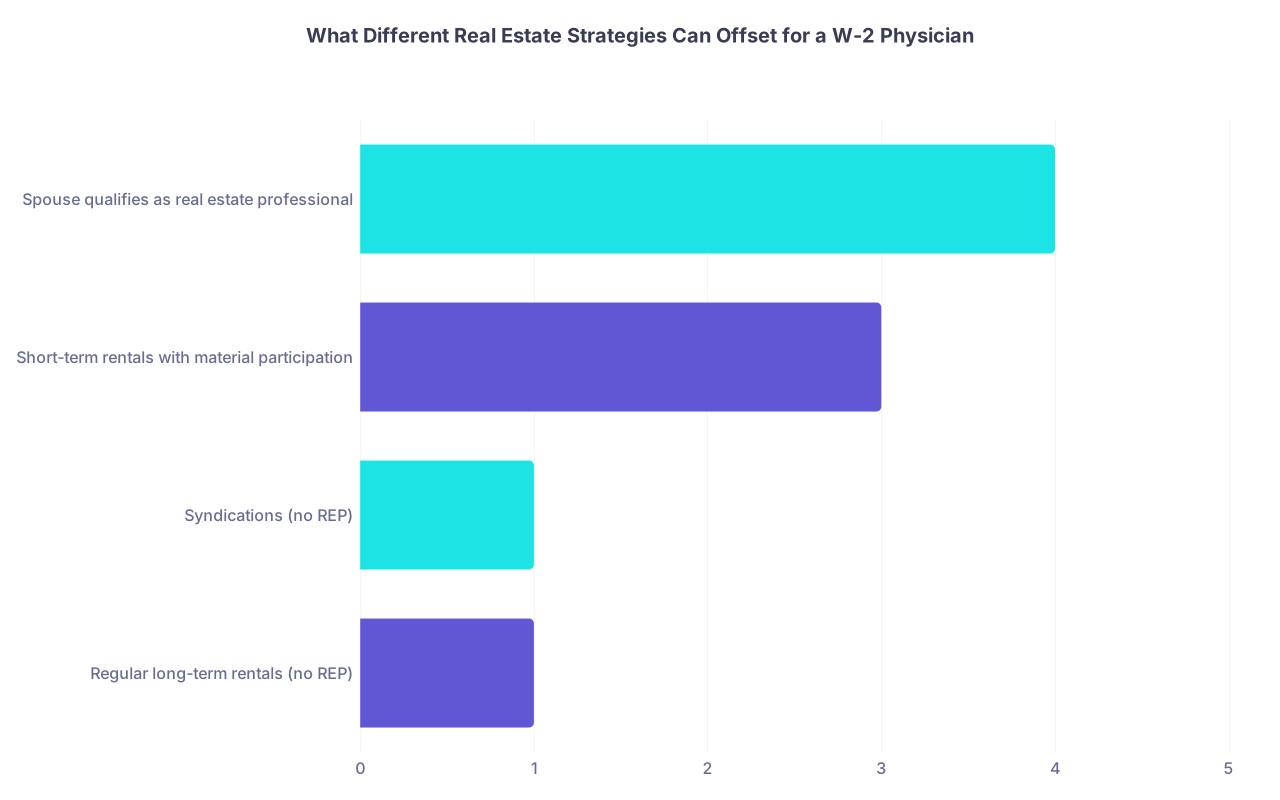
| Category | Value |
|---|---|
| Regular long-term rentals (no REP) | 1 |
| Syndications (no REP) | 1 |
| Short-term rentals with material participation | 3 |
| Spouse qualifies as real estate professional | 4 |
Legend (conceptual “power” scale 1–4):
1 = Mainly offsets passive income / future gains
3 = Can offset W‑2 if structured properly
4 = Can heavily offset W‑2 with cost seg and large losses
You don’t need to chase “4” to make real estate useful. Many physicians compound wealth perfectly fine at “1” and “2”.
Bottom Line: You’re Chasing the Wrong Prize
Let me be direct: if your only reason to buy real estate is “my buddy said I can pay no taxes,” you’re already in the danger zone.
For most physicians:
- You do not need to be, and realistically will not be, a real estate professional.
- You can still get real, measurable tax benefits from depreciation, long‑term capital gains, 1031 exchanges, and passive loss carryforwards.
- The biggest financial value from real estate isn’t the year‑1 K‑1 loss—it’s 10–20 years of leveraged, inflation‑protected equity growth.
Use the tax code as a tailwind, not as the entire strategy.
FAQ (Exactly 5 Questions)
1. If I’m a full‑time W‑2 attending, is REP status basically off the table?
For most, yes. To qualify, you’d need more hours in real estate than in medicine, plus at least 750 hours in real estate. With a standard 40–60 hour clinical week, that’s nearly impossible to document honestly. The rare exceptions are physicians who drastically cut clinical time and actually run a real estate business.
2. Are real estate syndications still worth it if I can’t use the losses against my W‑2 income?
They can be. The losses are passive, but they carry forward indefinitely and can offset future passive income and gains when properties sell. You’re essentially building a tax shield for the future. That’s not as dramatic as wiping out your W‑2, but it’s still real money saved.
3. How does the short‑term rental (STR) “loophole” help without REP status?
Certain STRs (average stay 7 days or less, with your material participation) are not treated as passive rental activities. Losses can be treated as non‑passive and may offset W‑2 income, even if you’re not a REP. It requires real involvement and careful structuring, and it’s more audit‑sensitive, but it’s a legitimate path.
4. Can both spouses combine hours to meet the 750‑hour REP requirement?
No. Each spouse is tested separately. Either spouse can qualify as a real estate professional, and if that spouse also materially participates in rentals, the losses can be non‑passive on the joint return. But you can’t blend hours across spouses to hit 750.
5. I’m a resident with AGI under $150k. What’s my best realistic tax angle with rentals?
You might benefit from the up‑to‑$25k “active participation” allowance. If you actively manage a small rental and generate a paper loss, you can potentially deduct part or all of that loss against your clinical income, as long as your AGI is under the phase‑out range ($100k–$150k). Once you’re a higher‑paid attending, that specific benefit usually disappears, but the long‑term real estate benefits remain.
Key points: You don’t need to be a “real estate professional” to get real tax benefits from real estate, and for most full‑time physicians, chasing REP is a distraction or a compliance risk. Use real estate as a long‑term wealth engine first, and treat the tax perks—depreciation, passive losses, favorable capital gains rates—as a powerful but secondary advantage.