
Free lunches, CME funds, and “perks” are wildly overrated as physician compensation. In many contracts they’re mostly camouflage—cheap ways to make a modest offer look generous on paper.
Let’s strip this down to numbers instead of vibes.
The Myth of “But the Perks Are Great”
I’ve lost count of how many times I’ve heard this in contract reviews:
“They’re a bit under MGMA, but the benefits are amazing—CME, phone stipend, free lunches, gym access…”
Translation: “They’re paying you less than market and distracting you with sandwiches.”
Here’s the core problem: employers often present perks as if they’re equivalent to cash compensation. They are not. They’re usually small, sometimes illusory, and often used to justify a salary that’s $30–80k below what similar physicians are earning.
Let’s quantify what we’re actually talking about in a fairly typical employed setting:
| Perk | Typical Range (Annual Value) |
|---|---|
| CME funds | $2,000 – $5,000 |
| CME paid days (3–5 days) | $2,000 – $6,000 |
| Free lunches | $1,000 – $3,000 |
| Cell phone/internet | $600 – $1,200 |
| Parking | $0 – $2,000 |
| Licensing/dues | $1,000 – $3,000 |
Best case, you’re looking at maybe $15–20k of value, if everything is actually usable and you’d otherwise pay it out of pocket.
Now compare that to being $40k below market on base salary. Or being 5 RVUs per half-day above peers with no extra compensation. You’re trading dollars for donuts.
Let’s break these down one by one, with an eye on what’s real and what’s fluff.
Free Lunches: Convenience, Not Compensation
The free lunch is the most visible and the least meaningful “benefit” you’ll get.
Does it have any value? Sure. But not the way recruiters talk about it.
What free lunches are actually worth
Assume you’re getting:
- 3–4 catered lunches per week, worth about $10–15 each if you’d otherwise buy food.
- That’s generous already; plenty of places are 1–2x per week max.
Let’s be nice and say 3 lunches/week, $12 each, 48 working weeks:
3 × $12 × 48 = $1,728 per year.
Call it $1.7k. Before taxes, if we’re being generous in valuing it like “cash equivalent”.
Now look at how it’s often used:
“We’re slightly below median on base, but our physicians don’t even need to buy lunch. That’s a big cost savings!”
No. It’s noise. If you’re $30k under market for your specialty and geography, free Chipotle twice a week is about 6% of that gap. You’re still getting underpaid.
The hidden downside: control and time
I’ve watched this play out in hospital conference rooms over and over:
You’re “invited” to a lunch that is actually:
- A mandatory meeting
- Pharma-sponsored education thinly veiling drug marketing
- Admin updates that could’ve been an email
You’re not just getting free food; you’re giving up time and autonomy. You’re locked in that room, answering portal messages on your phone, eating in 7 minutes while someone goes through 40 minutes of low-yield slides.
Try billing for that time. You won’t.
So yes, lunches are nice. But they’re not compensation. They’re a minor convenience often used to reclaim off-the-clock time.
If a recruiter or administrator is seriously leaning on “free lunches” as a major selling point, your red flag meter should spike.
CME Funds and Days: The Most Legit of the Perks… With Asterisks
CME is the one area where “perks” can meaningfully matter—if you understand the structure and if you actually use it.
What the data and norms look like
In many employed physician settings (hospital, large group), you’ll see:
- CME allowance: usually $2,000–$4,000 per year
- CME days: 3–5 days of paid time off specifically for CME
- Sometimes more in higher-paying subspecialties or academic roles
Real-world example: A hospitalist offer I reviewed last year:
- Base salary: $260k, below regional median of ~$285k
- CME: $3,500 + 5 paid days
- Licensing and DEA: covered
That sounds “generous,” right?
Let’s be blunt: $3.5k plus 5 days of CME doesn’t justify being $25k low on base. Ever.
Even if you valued those days at your daily rate, say $260k / 220 working days ≈ $1,180/day:
5 days ≈ $5,900 “value” + $3,500 CME funds ≈ $9,400.
You’re still $15k+ below market, and CME is not actually cash you can redirect to rent, student loans, or retirement. It’s locked into one category: education.
The illusion of flexibility
Here’s the other trick: a lot of CME money goes unused or poorly used.
Common issues:
- CME reimbursement is bureaucratic. You front the money, submit receipts, argue with HR about “approved vendors,” and wait.
- You might not have the time to actually take those days because coverage is thin and no one wants to swap.
- Some employers quietly cap certain expenses—e.g., they won’t cover exam fees, certain board prep tools, or travel over X dollars.
So that $3–5k headline number? In practice, plenty of physicians actually use maybe 50–70% of it in a normal year, especially early on when they’re just surviving, not flying to Hawaii for conferences.
And the “CME days”? I’ve seen more than one hospital where “you can use your CME days” becomes “we really need you on the schedule—can you just do online CME instead?” That’s not 5 extra vacation days. That’s often 0–2 real days off if you’re honest.
Where CME is meaningful
If two offers are financially similar on base and bonus, CME can break the tie.
If Offer A and Offer B are otherwise equal, and one gives you:
- $4k CME + 5 days + covers licensure/DEA/board fees
vs - $1.5k CME, no days, and you pay your own licensing
That difference is real. You’re avoiding a few thousand in inevitable costs and picking up time off you’ll probably use.
But CME should never be used as the main justification for accepting a below-market base.
CME is a nice tie-breaker. Not a reason to excuse a bad offer.
Phone, Parking, Gym, and All the Other Shiny Objects
Let’s hit the smaller stuff quickly. These do have value. Just not career-decision-level value.
Phone/internet stipend
You’ll typically see $50–$100/month for phone or phone+internet.
That’s $600–$1,200 per year.
It’s nice if they pay it. It’s not nice enough to accept $10–20k less on salary, much less $50k.
If someone brings this up as a “big benefit,” that’s telling you they are either:
- Clueless about how physicians think about money
- Hoping you’re not doing math
Neither is reassuring.
Parking
This actually varies a lot. In some city hospitals, parking can be $150–250/month. In others it’s free or negligible.
Assume a serious urban setting: $200/month. That’s $2,400/year if covered.
Genuinely nice. Still not compensation in the meaningful sense if they’re $30k under market for your specialty.
Parking should matter only when comparing two already-solid offers in the same ballpark.
Gym, wellness perks, random perks
Work gyms, discounted memberships, wellness stipends, on-site yoga, “physician lounges” with snacks. All nice. All with a cash value usually under $1–2k/year.
More importantly, ask yourself: will you realistically use them with your schedule?
I’ve seen attendings “with gym access” who haven’t walked into the facility in 18 months because they’re charting at home until 11 p.m. three nights a week.
If you would not pay real money for it out of pocket, don’t assign real money value to it in your decision.
The Compensation Pie: Where the Real Money Actually Is
Stop getting distracted by the crumbs around the edge of the plate. The serious money for physicians is in four buckets, and perks are barely a sliver.
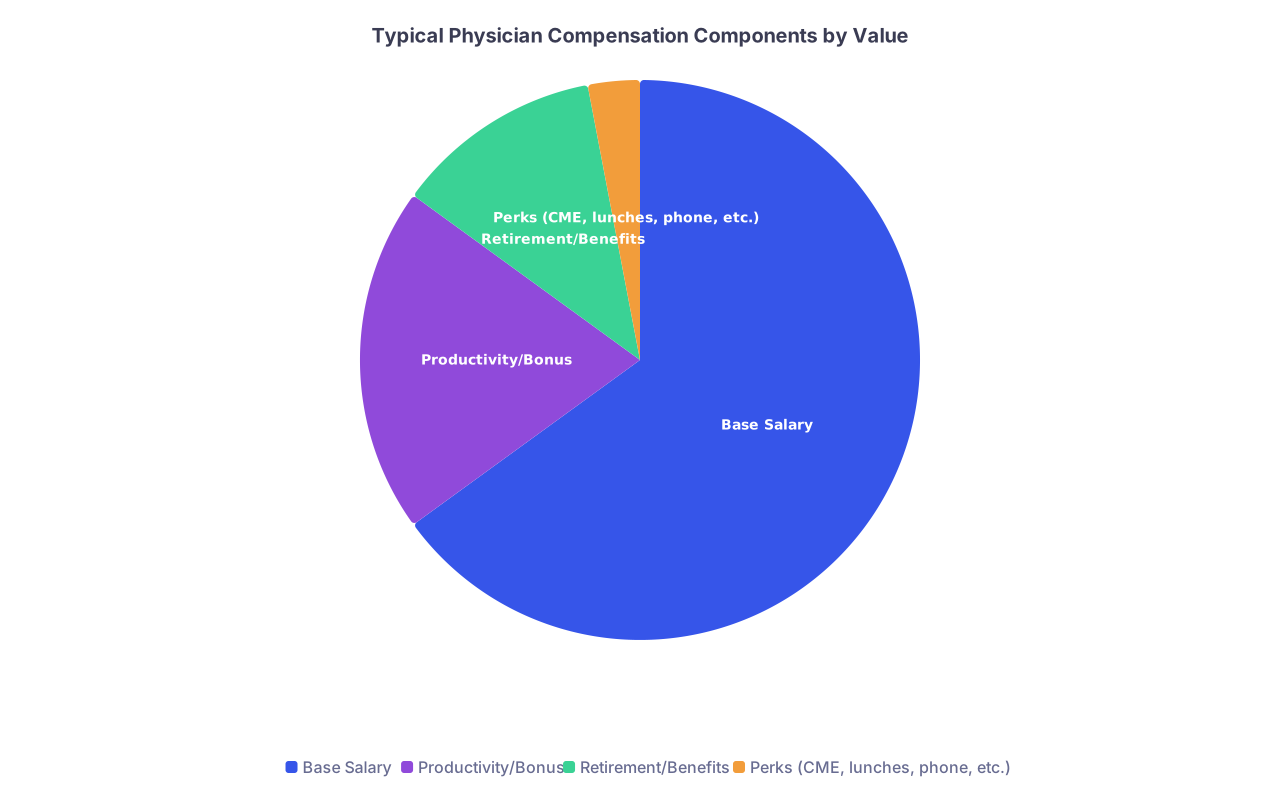
| Category | Value |
|---|---|
| Base Salary | 65 |
| Productivity/Bonus | 20 |
| Retirement/Benefits | 12 |
| Perks (CME, lunches, phone, etc.) | 3 |
Perks like free lunches, CME funds, and phone stipends might be 2–5% of your total compensation picture.
What actually matters:
- Base salary: 60–70% of the pie in many guaranteed-comp structures.
- Productivity/bonus: in RVU or collections models, this can add or subtract tens of thousands easily.
- Retirement match/defined contribution: some systems quietly put $20–30k/year into a 403(b)/401(a) equivalent. Others put in almost nothing.
- Health/disability/malpractice (with or without tail): this is actual financial risk transfer, not fluff.
If an offer is:
- $40,000 below regional median on base
- Weak on productivity upside
- Mediocre retirement match
- But waves around “we have amazing wellness programs and free lunches”
You’re being lowballed with theatrics.
When Perks Actually Change the Equation
There are situations where these non-cash items really do matter. But the bar is higher than most people think.
They matter when:
- Two offers are very close on salary and true benefits (retirement, health, malpractice), and you’re genuinely indifferent. Then yes, better CME, parking, and quality-of-life perks can tip the scale.
- The perk is unusually large or directly offsets a real, recurring cost you must pay. Example: they fully cover a $5k annual board fee and $3k DEA/state licensure every cycle, versus you paying it all elsewhere.
- The perk resets your lifestyle or burnout risk in a tangible way. Example: a structured 5-day CME block that your group actually honors so you have a protected, paid week off for a high-yield conference every year—that is both time and money.
These are edge cases. They’re not the norm.
If you’re a new attending looking at your first contract and someone says, “Our salary is a bit below median, but physicians love the perks,” your default assumption should be: this is not a good financial deal.
Tell them you care more about:
- Base compensation that reflects your specialty and RVU expectations
- Clear, written productivity and bonus structures
- Retirement contributions in hard numbers
- Malpractice and tail coverage terms
Then, after that, you can talk about how nice the cafeteria sushi is.
How to Mentally Price Perks (Without Getting Played)
Here’s a simple way to keep yourself honest.
- Convert the perk to an actual annual dollar amount you’d realistically use.
- Ask: “Would I rather have this perk or $X more in base salary?”
- Remember that $1 in base is really ~$0.60–0.70 after taxes, while some benefits (like retirement contributions) are pre-tax and worth more than face value.
Example:
- Free lunches: $1.5–2k/year → after tax maybe worth $900–1,400 in your pocket if converted to salary. Nice, but not remotely worth a $10–20k salary haircut.
- $3k CME fund: you wouldn’t spend that on yourself if it weren’t offered? Then the real value is lower than $3k. Maybe it’s $1k of stuff you truly care about.
- Phone/parking: $1–3k/year. Good, but still small compared to base.
I’ve sat with residents signing first contracts who got dazzled by:
- $3k CME
- $1k phone
- “Free” parking
- Free lunches
- On-site gym
Total theoretical “perk value”: maybe $7–10k/year.
Same contract was $40k under what local comparables were getting in similar hospital-employed roles.
This is how you quietly burn through hundreds of thousands of dollars over a decade and don’t even realize it, because your brain is anchored to the wrong line items.
The One Perk That Really Isn’t a Perk: Time
Here’s the only non-cash “benefit” I take very seriously: control over your time and workload.
Some groups try to sell “perks” because they don’t want to talk about:
- RVU targets that require 60-hour weeks to hit
- Clinic templates that are brutal (24+ patients/day plus inbox)
- Weekend and call schedules that chew up your life
I’d take:
- A slightly average perk package
- With protected time, reasonable RVU expectations, and true control over time off
over
- A “great perks” package
- In a job where I’m constantly catching up, seeing 26 patients/day, and answering MyChart messages until midnight
Every. Single. Time.
But that’s not about free lunches. That’s about workload, staffing, culture, and whether “PTO” actually gets approved.
Those are the real levers for quality of life. Lunch trays are just props.
The Bottom Line
Three things you should walk away with:
- Free lunches, CME dollars, and small stipends are conveniences, not compensation. In most contracts, they represent maybe 2–5% of your total economic value.
- Employers love to overhype perks when the real money—base salary, productivity structure, retirement contributions, malpractice/tail—is underwhelming. Do the math and anchor your negotiations on those core pieces, not the fringe.
- Use perks as tie-breakers between financially comparable offers, not as a reason to accept a below-market salary or excessive workload. If the numbers are bad, no amount of catered sandwiches will fix it.