
Waiting until your first contract to learn about physician pay is how doctors end up trapped in bad jobs for three years.
You need to treat compensation models like a core clinical topic—there is a right time and sequence to learn it. If you wait until you are desperate for a job, recruiters and hospital attorneys will drive the agenda. And they are not on your side.
Here is the timeline: MS3 → MS4 → Residency → Job Search → First 90 Days in Practice. At each stage, there are specific things you should understand and specific numbers you should start tracking.
I will walk you through what to do and when. Chronologically. No fluff.
MS3: Foundations – “What are they even talking about?”
At this point you should not be obsessing over RVU conversion factors. You should be learning the vocabulary so you are not lost later.
Mid-MS3 (first 3–6 months of clerkships)
Your goals now:
- Learn the basic compensation languages
- Notice how money shapes clinic and hospital behavior
- Start a “career/comp” notes file
At this point you should be able to define:
- Base salary
- Bonus / incentive compensation
- wRVU (work Relative Value Unit)
- Productivity model
- Guaranteed salary / draw
- Partnership track
- Buy-in
- Non-compete (restrictive covenant)
- Tail coverage (malpractice)
- Call pay / stipends
You do not need to know exact benchmarks, but you should not hear “RVU” for the first time in residency.
Action checklist (MS3 mid-year):
- Create a one-page “comp terms” document in your notes app
- Ask attendings casually:
- “Are you salary or RVU-based?”
- “Do you get paid for call?”
- “Does your group have partnership?”
- Notice behavior:
- Who is double-booking?
- Who leaves at 4 vs 7?
- Which clinics are packed, which are ghost towns?
You are not prying into salaries; you are understanding structure. Most physicians will talk structure if you focus on models, not exact dollar amounts.
Late MS3 (last 3–4 months)
Now you tighten the focus toward your likely specialty.
At this point you should:
- Identify 2–3 common compensation models in your target specialty.
- Know whether your specialty is:
- Mostly employed (e.g., hospitalists, academic IM, many hospital-based fields)
- Frequently private practice / partnership (e.g., many surgical subspecialties, anesthesia, radiology, EM groups)
- Mixed (EP, GI, ortho, cards, etc.)
Start a simple comparison table for your specialty.
| Model Type | Setting | Typical Features |
|---|---|---|
| Straight Salary | Academic | Lower pay, security, teaching time |
| Salary + RVU bonus | Employed group | Moderate floor, upside for volume |
| Partnership track | Private practice | Lower start, big jump at partnership |
You do not need to know which one you want yet. You just need to know they exist.
MS4: Reality Check – “What does this look like in my field?”
Now the decisions start to matter. Your specialty choice, geography, and training path will shape your earning trajectory for a decade.
Early MS4 (before ERAS / in parallel with it)
At this point you should:
- Have a rough understanding of:
- MGMA / AAMC reports (you won’t have access yet, but know they exist)
- That compensation varies by:
- Region
- Practice type
- Academic vs community
- Call burden and procedures
Concrete tasks:
- During away rotations and sub-Is, ask senior residents:
- “What do most grads from this program end up doing for jobs?”
- “Are people more academic or private?”
- “Do most graduates feel well-prepared for contract negotiations?”
- Start a simple file: “Post-residency job landscape – [Specialty].”
- Separate notes into:
- Academic jobs
- Hospital-employed jobs
- Private practice / groups
- Locums / hybrid setups
- Separate notes into:
You are building a mental map: what kinds of jobs exist and how they typically pay.
Late MS4 (after interviews, before graduation)
This is when you connect compensation models to lifestyle and training.
At this point you should:
- Ask specific, concrete questions on interviews (to residents and young faculty, not chairs):
- “Do graduates feel they understand RVUs by the end of training?”
- “Do you get any formal teaching on contracts and compensation?”
- “Where did the last few graduates go and what type of jobs did they take?”
- Start to notice program culture:
- Programs where no one can explain their own compensation model? Red flag.
- Programs where young attendings can describe their deals clearly? Better.
You are not negotiating anything yet. You are choosing environments that will either set you up well for your first job—or leave you clueless and vulnerable.
PGY1–PGY2: Core Training – “Learn the system you are working in”
Interns do not need to become contract experts. But you are already working inside someone’s compensation model. If you ignore it entirely, you miss free education.
PGY1 (first year of residency)
At this point you should:
- Understand how your attendings get paid:
- Are they hospital-employed? Academic faculty? Partners in a group?
- Is there a difference between hospitalists vs subspecialists vs proceduralists?
- Learn the basics of RVUs in your specialty:
- For procedural fields: which procedures are “high RVU” vs “low RVU”
- For cognitive fields: how RVUs relate to clinic volume and documentation
PGY1 checklist:
- Attend any GME talk on contracts / finances, even if scheduled at a bad time. These are often the only semi-objective sessions you will get.
- Ask one trusted attending:
- “When should I start really learning about compensation models for my first job?”
- “What do you wish someone had told you as a PGY2?”
Most will say something like, “I waited too long.” Believe them.
PGY2 (early–mid residency)
This is the formal start of your comp education. Before this you were collecting vocabulary and impressions. Now you start tracking actual numbers.
At this point you should:
Understand the three big model families:
- Straight salary
- Often academic or large systems
- Predictable, low upside
- Salary + productivity bonus (usually RVU-based)
- Common in hospital-employed jobs
- Base + bonus above a certain RVU threshold
- Eat-what-you-kill / partnership models
- Common in private practice, anesthesia, radiology, EM, some surgical groups
- Income tied closely to collections and practice ownership
- Straight salary
See rough ranges for your specialty by practice type.
Here is a stylized example (numbers are illustrative, not gospel):
| Practice Type | Early-Career Range (Year 1–2) |
|---|---|
| Academic | $200k – $320k |
| Hospital-employed | $280k – $450k |
| Private practice | $300k – $600k+ |
| Locums-heavy mix | Highly variable |
- Know that “average” data is a trap. The distribution is wide. Outliers exist in both directions.
PGY2 specific actions:
- Ask your program director or chief:
- “Do we have access to MGMA or AAMC compensation data?”
- Ask graduates 1–3 years out:
- “What model are you on?”
- “Do you like it?”
- “What surprised you about your first contract?”
You are not negotiating yet. You are building your pattern recognition.
PGY3 (and PGY4, PGY5, etc.): Preparation – “Turn vague concepts into a plan”
This is where most people either do it right—or screw it up badly.
At this point you should be deliberate. Month-by-month.
18–24 months before finishing training
For a categorical 3-year residency, this means early PGY2. For longer residencies/fellowships, adjust accordingly.
You should:
- Decide if you are leaning toward:
- Academic vs community
- Employed vs private practice
- Big city vs regional vs rural
- Understand roughly:
- How academic offers are structured for your field
- How hospital-employed packages are structured
- Whether private practice is realistic from your training path
You are not locked in. You just need a working hypothesis.
12 months before graduation (Job search minus 1 year)
This is the critical learning window for compensation models. If you are not serious about it by this point, you are late.
At this point you should:
Study actual data, not hearsay.
If you can get access (through faculty, professional societies, or alumni):
- MGMA
- AAMC
- Specialty society surveys
Look at:
- Median and 25th/75th percentile total comp
- Differences by region (Midwest vs coasts vs South)
- Differences by practice type
Understand core RVU math for your specialty:
- Typical RVUs for:
- New patient visit
- Follow-up visit
- Common procedures
- Typical annual RVU thresholds for bonuses in your field
- Typical RVU conversion factor (e.g., $45–$70 per wRVU, depending on specialty and market)
- Typical RVUs for:
Recognize red-flag structures, such as:
- Very high RVU thresholds compared with peers
- Tiny base salary with “unlimited upside” but no real support
- Productivity expectations that are incompatible with safe practice
Here is a simplified snapshot of how different models weight components:
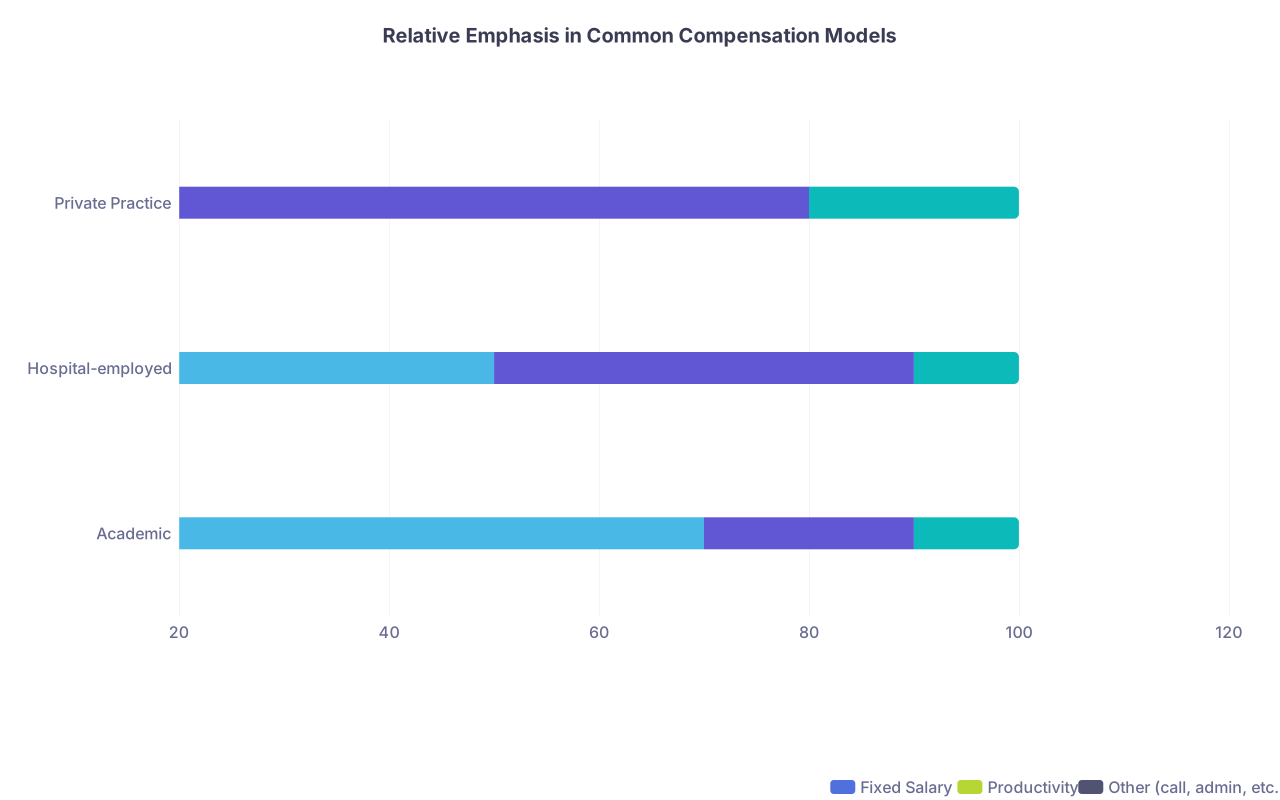
| Category | Fixed Salary | Productivity | Other (call, admin, etc.) |
|---|---|---|---|
| Academic | 70 | 20 | 10 |
| Hospital-employed | 50 | 40 | 10 |
| Private Practice | 20 | 60 | 20 |
9–12 months before graduation: Start talking to recruiters
Now your comp knowledge becomes practical. The goal is not to sign anything. The goal is to interrogate the model.
At this point you should:
- Ask every recruiter:
- “Is this salary-only, salary plus RVU, or partnership track?”
- “What is the RVU target for bonus?”
- “What is the RVU conversion factor?”
- “What did new hires here actually earn in year 1 and 2? Range is fine.”
- “Who pays malpractice and tail?”
Write this down. Every time. You will not remember.
You are not committing. You are building a dataset that is specific to you and your geography.
Final Year of Training: Job Offers – “From theory to signatures”
Once interviews turn into offers, the compensation model is no longer an abstract topic. It is your life for the next 2–5 years.
At the point of first written offer
This is the hard line: if you reach this point without understanding compensation models, you are in a weak position. Fix that fast.
At this point you should:
Be able to translate the offer into:
- Guaranteed minimum for the year (base + guaranteed draws)
- Best realistic case (based on typical productivity)
- Worst realistic case (if volume is lower than promised)
Understand your risk profile:
- Straight salary:
- Lower financial risk
- Often lower autonomy and upside
- Heavy RVU / productivity:
- Higher earnings potential
- Higher risk if referrals, OR time, or support staff are inadequate
- Partnership track:
- Lower initial pay
- Potential big jump later, but only if:
- The group is stable
- The equity and buy-in terms are transparent
- Collections and overhead are reasonable
- Straight salary:
Bring in professional help:
This is where many physicians try to save a few hundred dollars and lose tens of thousands per year.
- Hire a physician contract attorney who:
- Works with your specialty
- Knows your region
- Use them specifically to:
- Explain the compensation model as written
- Compare to regional norms
- Identify vague language and loopholes
- Hire a physician contract attorney who:
Do not let the hospital or group’s lawyer “explain” the model to you as your only source. That is like letting pharma write your prescribing guidelines.
3–6 months before start date: Fine-tuning and planning
Once you sign (after review), your focus shifts from “what am I being offered” to “how will I actually hit these numbers without burning out.”
At this point you should:
- Clarify operational details that drive compensation:
- Clinic template (new vs follow-up slots)
- OR block time
- Expected call burden and whether call is paid
- Support staff (MA, scribe, NP/PA)
- Ask about:
- Average RVUs or volumes of partners in similar roles
- How long it took them to reach current productivity
- Whether there is ramp-up support (marketing, referral introductions, etc.)
You are aligning expectations with reality. If the comp model assumes volume that no one in the group has ever hit, that is not “opportunity.” That is a trap.
First Job: The First 90–180 Days – “Learning your own dashboard”
Once you start your first job, your education on compensation models is not over. It is just now personal.
First 30 days
At this point you should:
- Get access to your productivity reports:
- RVUs or encounters
- Collections (if relevant)
- Identify who in your organization can:
- Pull real-time or monthly numbers
- Explain how they are calculated
- Set a recurring reminder (monthly) to:
- Review volume and RVUs
- Compare to your contract’s thresholds and structure
30–90 days
Now you start closing the loop.
You should:
- Check if promised inputs match reality:
- OR time
- Call schedule
- Clinic support
- Referral flow
- Meet with:
- Your department chair or practice leader
- Someone in finance / practice management
Ask very simple, pointed questions:
- “If I keep working like this, what would my annualized RVUs look like?”
- “How do my numbers compare to others at my stage?”
- “Are there bottlenecks we can fix that are limiting access?”
You are not chasing every last RVU. You are making sure the model and the infrastructure you were sold exist in reality.
90–180 days
By six months you should have:
- A clear understanding of:
- Your actual clinic and procedural volume
- RVU pace relative to thresholds (if RVU-based)
- How your compensation will likely shake out by the end of year one
- Enough data to:
- Push for operational adjustments if needed
- Decide whether this is a good 2–3 year fit or a short-term stop
If the compensation model is fundamentally misaligned with your sanity or values, it is better to figure that out at month six than year three.
When Exactly Should You Start?
Let me be unambiguous.
Here is the latest safe time to learn key pieces:
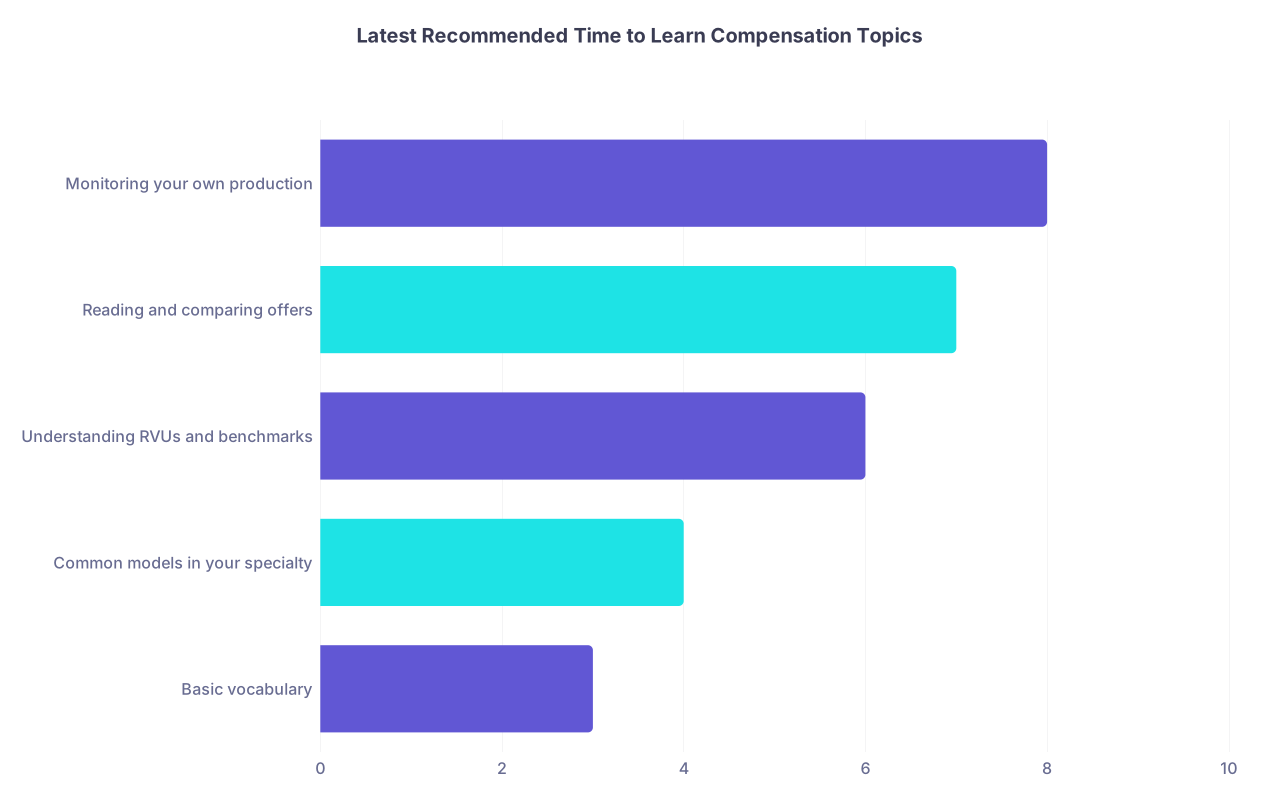
| Category | Value |
|---|---|
| Basic vocabulary | 3 |
| Common models in your specialty | 4 |
| Understanding RVUs and benchmarks | 6 |
| Reading and comparing offers | 7 |
| Monitoring your own production | 8 |
Interpretation (1 = MS3, 2 = MS4, 3 = PGY1, 4 = PGY2, 5 = PGY3, 6 = Final year of training, 7 = Job offer stage, 8 = First months in practice):
- Basic vocabulary – by MS3
- Common models in your specialty – by MS4 / early residency
- Real RVU and benchmark understanding – by PGY2–PGY3
- Ability to evaluate offers – by final year of training
- Monitoring your own production – from day 1 of first job
Later than that and you are voluntarily driving blind.
Quick Visual Timeline
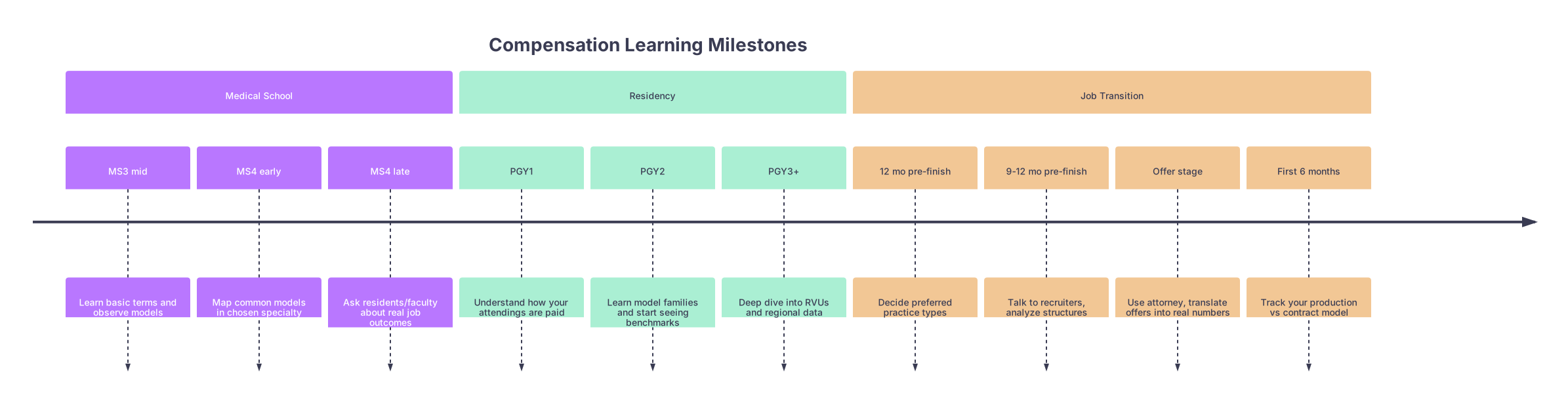
| Period | Event |
|---|---|
| Medical School - MS3 mid | Learn basic terms and observe models |
| Medical School - MS4 early | Map common models in chosen specialty |
| Medical School - MS4 late | Ask residents/faculty about real job outcomes |
| Residency - PGY1 | Understand how your attendings are paid |
| Residency - PGY2 | Learn model families and start seeing benchmarks |
| Residency - PGY3+ | Deep dive into RVUs and regional data |
| Job Transition - 12 mo pre-finish | Decide preferred practice types |
| Job Transition - 9-12 mo pre-finish | Talk to recruiters, analyze structures |
| Job Transition - Offer stage | Use attorney, translate offers into real numbers |
| Job Transition - First 6 months | Track your production vs contract model |
FAQ (exactly 3 questions)
1. Is it “too early” to ask about money as a student or resident?
No. Asking “How are physicians here typically compensated?” is not rude, it is professional. You are not demanding someone’s W-2. You are learning the structure of the job you are training for. The only people who get offended by structural questions about compensation are usually those benefiting from others’ ignorance.
2. Do I really need a contract attorney if the hospital is “reputable”?
Yes. Large systems are very good at writing contracts that protect the institution. They are not evil, just self-interested. A physician-specific contract attorney will pay for themselves many times over by catching vague language, unfair non-competes, lopsided RVU thresholds, and malpractice issues. You hire experts for clinical problems; do the same for your career.
3. What if I realize late (PGY3 or later) that I understand nothing about compensation models?
Then you compress the timeline. In the next 3–6 months you:
- Learn the basic terms and model types.
- Get recent MGMA / specialty data through mentors or societies.
- Talk to 3–5 recent graduates about their offers and experiences.
- Commit to using a contract attorney before signing anything. You will be behind, but not doomed. The real disaster is pretending money does not matter until after you are already locked into a bad deal.
Key points: start early with vocabulary in MS3, get serious about actual models and benchmarks by PGY2–PGY3, and never sign a contract without fully understanding how every dollar in it is supposed to be generated. Your future self—exhausted on a post-call Monday, wondering why your paycheck looks like that—will thank you.