

Myth of the ‘Rich Dermatologist’: What the Actual Income Data Shows
Why do so many med students think dermatology is a golden ticket to a 9-to-5 life and $700K a year by age 35?
Let’s tear that apart.
Dermatology absolutely is a high-paying specialty. It is not, however, the automatic “rich doctor” path people tweet about. That fantasy version exists mostly in premed group chats, Reddit threads, and the occasional overconfident MS2 who just discovered MGMA reports.
If you actually look at the income data—and not just the cherry-picked top 1% anecdotes—the story is more complicated, more boring, and a lot less “guaranteed millionaire by 40.”
You want evidence. Here it is.
What the Data Actually Shows About Dermatology Income
Start with broad, credible survey data. Not the one guy you shadowed who owns three clinics and a surgery center.
Most years, dermatology lands in the upper-middle of physician income rankings. Not number one. Not number ten. Usually somewhere between 5–10 depending on the survey and how you slice ownership and geographic differences.
Look at typical survey ranges from large physician compensation reports (Medscape, Doximity, MGMA-type data between roughly 2021–2024):
- Average dermatologist total compensation: about $400K–$520K
- Employed dermatologists: more often $350K–$450K
- Partners/owners: commonly $500K–$800K+, with a long tail on the high end
Sounds high. Because it is. But it is not categorically different from several other specialties people do not obsess over on SDN.
| Specialty Tier / Example Field | Typical Average Range (USD) |
|---|---|
| Orthopedic Surgery | $600K–$750K |
| Plastic Surgery | $550K–$700K |
| Cardiology (interventional/noninv) | $500K–$650K |
| Dermatology | $400K–$520K |
| Emergency Medicine | $350K–$450K |
| Internal Medicine / Pediatrics | $250K–$320K |
Point being: dermatology is well-compensated, but it’s not some outlier living on its own planet of money.
Where the myth comes from is not the mean. It’s the top decile. The rare private-practice derm with optimized cosmetics, Mohs, ownership in a lab, maybe a few midlevels cranking volume—those people can absolutely clear $1M+.
But those are not residency-matching odds. Those are business-building odds.
The “Derm Pays the Most” Myth
Every cycle, some student says, “I want derm because it’s the best lifestyle and highest pay.” Usually in that order.
Reality: dermatology is good lifestyle plus high pay, but it is not the top-paying specialty once you include ortho, plastics, neurosurg, and some cardiology groups. It’s the combo of lifestyle + money that creates the legend.
Look at lifestyle vs income tradeoffs.
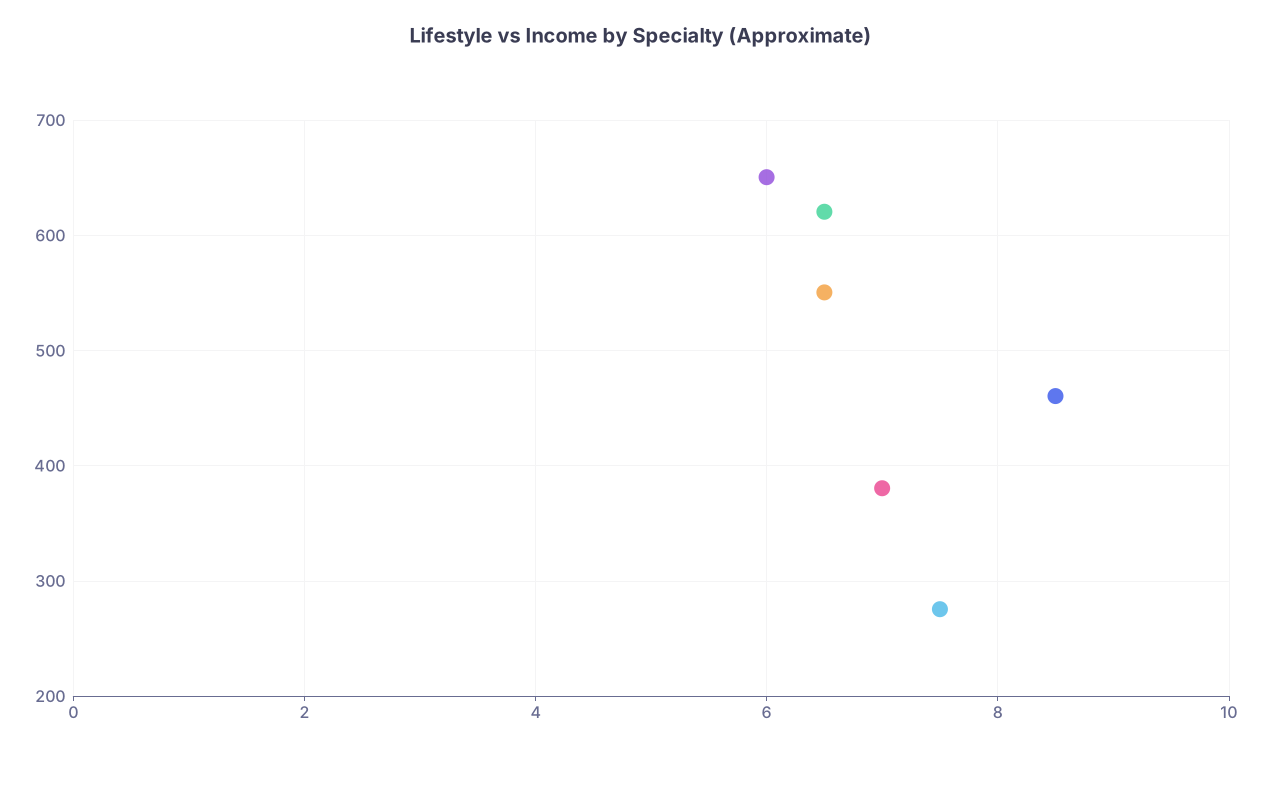
| Category | Value |
|---|---|
| Dermatology | 8.5,460 |
| Orthopedics | 6,650 |
| Plastic Surgery | 6.5,620 |
| Cardiology | 6.5,550 |
| Emergency Med | 7,380 |
| Internal Med | 7.5,275 |
Rough “lifestyle score” is subjective of course, but you get the idea: derm has an unusually favorable tradeoff between hours, call, and pay. That’s the draw. Not that it “pays the most.”
What students almost never appreciate:
- A lot of dermatologists are on the lower side of that range if they’re academic, urban, or heavily medical-only.
- Cosmetic-heavy private practice in affluent suburbs is a different universe than VA derm in a saturated metro.
- Income variation inside dermatology is massive—far larger than people assume.
This is the first big myth crack: “Dermatologists are rich” depends hugely on which dermatologists you are talking about.
The Huge Gap: Academic vs Private Derm
This is the part people conveniently ignore.
In dermatology, academic salaries can be borderline depressing compared to what private practice makes for the same clinical skill set.
Typical patterns:
- Academic assistant professor derm in a coastal city: maybe $250K–$350K, sometimes with a bonus structure, often below what an outpatient internist makes in a busy private group.
- Employed community derm in a medium/low COL area: $350K–$450K with RVU or productivity bonuses.
- Private practice partner or owner in a well-run group: $500K–$900K+, depending on procedures, cosmetics, ancillaries.
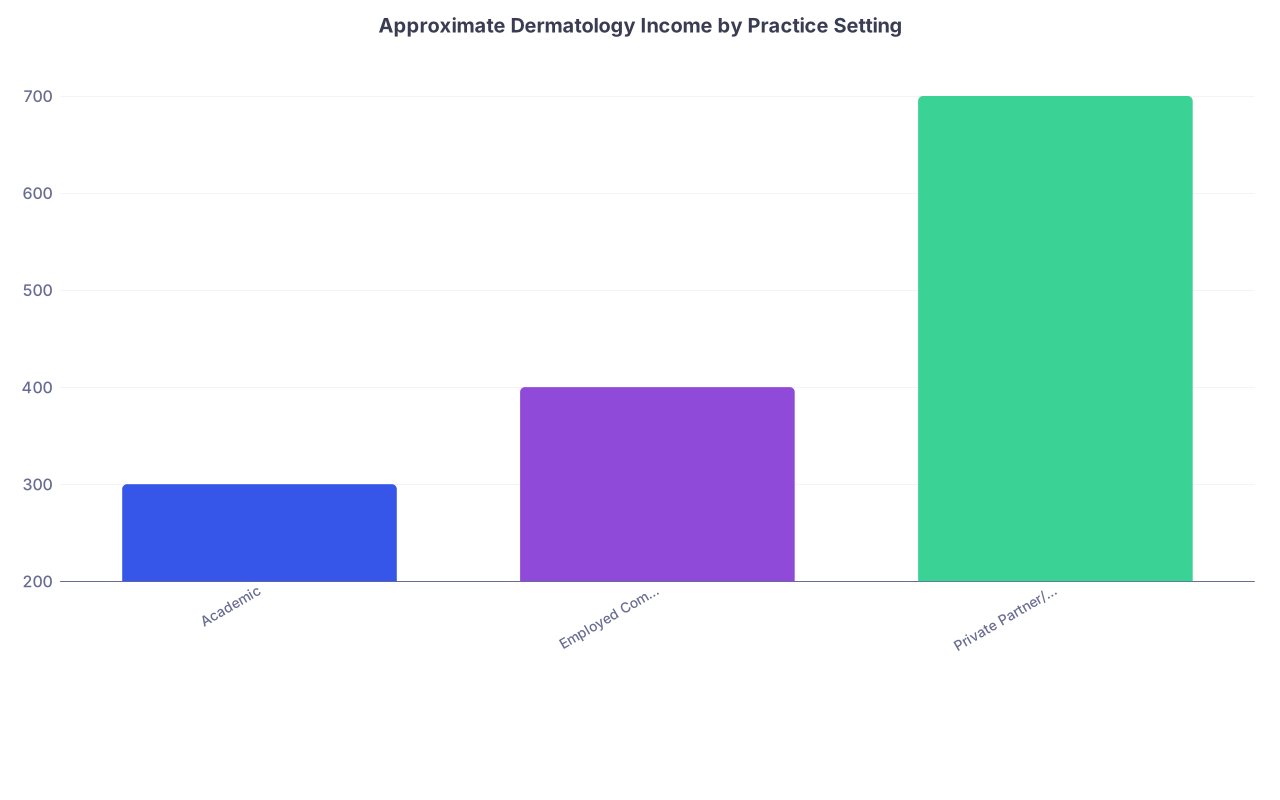
| Category | Value |
|---|---|
| Academic | 300 |
| Employed Community | 400 |
| Private Partner/Owner | 700 |
Again, these are broad ballpark figures based on what you consistently see in compensation reports and real offers floating around.
Does that academic derm at $280K drive the same narrative as the suburban Mohs surgeon pulling $1.2M? No. But they’re in the same specialty. Same residency match, same board exam, same training years.
So when someone says “dermatologists are rich,” they’re usually talking about the upper-tier private practice ones. Not the full distribution.
The Dark Side of the “Derm = Rich” Narrative
Beyond just being numerically wrong in a lot of cases, the myth is actively harmful.
I’ve watched students:
- Rank derm above specialties they clearly loved more (radiology, anesthesia, ophtho) purely because “derm makes bank.”
- Be devastated when they don’t match because in their heads they’d already mentally spent the imaginary $700K salary.
- Completely misunderstand what actually drives high income in dermatology (business decisions, risk, location) and think the specialty itself is the wealth generator.
Let me be blunt: the specialty does not make you rich. Your practice model does.
You can be a derm attending with a mediocre salary and poor savings habits and be functionally broke at 50.
You can be an outpatient internist making $320K in a low-cost area, investing consistently, and be quietly wealthy at 55.
Derm gives you a strong earning ceiling and a solid baseline, but it doesn’t bypass math.
Income Distribution: Most Dermatologists Are “Comfortable,” Not Ultra-Rich
The myth treats “dermatologist” as synonymous with “financially elite.” Reality is more like this:
- Many dermatologists are solid upper-middle-class to upper-class professionals.
- A smaller fraction are genuinely wealthy by most definitions.
- A tiny slice (the outlier practice owners) are ultra-high-income.
Think of the distribution in rough terms:
- Bottom quartile (academic, part-time, saturated market): maybe $225K–$325K
- Middle bulk (employed/community): $350K–$500K
- Upper quartile (partners, procedural heavy, good markets): $500K–$900K+
- Top few percent (multi-site owners, heavy cosmetics, ancillary profits): $1M+
Those last few percent shape the entire student perception. It’s like judging “software engineer salaries” by only looking at early employees at Stripe and ignoring everyone doing corporate IT for a regional bank.
The Business Factor: Why Some Derms Actually Do Get Rich
Now the part people really do not want to hear: the “rich dermatologist” typically isn’t just a good clinician. They’re a business builder.
Here’s what I’ve seen repeatedly in those seven-figure derm stories:
- Practice ownership, not long-term employment.
- Multiple revenue streams: cosmetics, procedures, product sales, PA/NP extenders, pathology labs, sometimes surgery centers.
- Geographic arbitrage: affluent suburbs or under-served areas where demand is insane and payers are friendlier.
- Serious risk tolerance: taking on leases, buying buildings, hiring, firing, marketing, swallowing dry spells.
It’s not just “pick derm → get rich.” It’s “pick derm → then, if you want the big numbers, accept a second career as an entrepreneur.”
Plenty of dermatologists do not want that life. They like clinic from 8–4:30, a stable paycheck, predictable days, and time with their kids. They’re not idiots. They’re choosing a different tradeoff.
Those people are still doing just fine financially, but they’re not the caricature “rich derm” students fantasize about.
Comparing Dermatology to Other “High Pay” Specialties
Let’s stop pretending derm lives in a vacuum.
If we’re talking raw numbers, orthopedics and plastic surgery routinely outrun dermatology on average pay. Interventional cardiology isn’t far behind. Some neurosurgeons look down on everyone.
So why is there no “myth of the rich ortho” discourse at the same level?
Because the lifestyle is visibly brutal. Call, trauma, nights, long operations. Nobody pretends you’ll be home at 4 and golfing twice a week.
Derm’s unusual combination is:
- High-ish pay
- Low-ish hours
- Minimal call
- Outpatient setting
- Elective procedures and cash pay opportunities
That is rare. The ratio of hours worked to income generated is where derm looks amazing. And that’s the real story—not that it’s the highest paying specialty, but that it’s one of the most efficient for time and stress.
If you want to obsess over something, obsess over income per hour and income stability, not “headline salary.”
Taxes, Debt, and Cost of Living: The Reality Check
Another part of the myth: people quote gross salary as if that’s what lands in your bank account.
It is not.
Take an employed dermatologist in a big coastal city making $400K:
- Federal income tax: easily into the 32–35% bracket.
- State tax (CA/NY/NJ): add 6–10% effective.
- Payroll taxes, retirement contributions, malpractice tail costs if you move, professional dues.
Now layer on:
- $250K–$400K in med school debt, maybe more if you lived like a high roller or trained in a HCOL city.
- Housing. A “starter” home in certain metros is $1M+ with property taxes to match.
- Kids, childcare, and all the joys of inflation.
Is that dermatologist still well off? Absolutely. But “$400K derm” is not equivalent to “$400K software engineer with no loans living in Austin renting a modest place.”
Lifestyle creep eats doctors alive. Dermatologists are not immune.
The Matching Delusion: Chasing Money into an Ultra-Competitive Field
Here’s where this myth does real damage to actual human lives.
Dermatology is one of the most competitive specialties. You know this. You’ve seen the match data. High Step 2 scores, AOA, research, away rotations, letters from brand-name faculty, all of it.
If your only reason for chasing derm is “rich and chill,” you’re playing a dangerous game:
- You’re competing against people who actually like skin, pathology, chronic disease management, cosmetics, surgery.
- You’re choosing a low-probability path based on a half-understood financial stereotype.
- You may end up scrambling into a different field with zero emotional prep for that identity whiplash.
I’ve watched people fixate on derm as the “only good outcome” because of money myths, then end up in IM or FM and spend years resentful—when in reality, with smart financial choices, they could have been just as wealthy over a 30-year career.
Again: specialty choice is a small piece of long-term wealth. Behavior, savings rate, investment discipline, and location choice are bigger.
So, Is Dermatology Financially Overrated?
No. It’s financially excellent. But it’s over-mythologized.
What the actual income data shows:
- Dermatology is consistently above average in pay—often high, sometimes very high.
- It’s not uniformly higher than every procedural specialty.
- Academic and saturated-market derm incomes can look surprisingly pedestrian.
- The “rich dermatologist” stereotype comes from a specific subset of business-savvy private practitioners—not the median.
- Financial independence is much more about what you do with your income than which specialty prints your paychecks.
The classmate who says, “I’m going for derm because I love the pathology, the outpatient rhythm, the procedures, and yeah, I like that it’s well-paid”—that person gets it.
The one who says, “I just want to be rich so I’m going derm”—that person is chasing a mirage built on selective storytelling and ignoring the actual distribution of outcomes.
Years from now, you will not care that derm was ranked #4 or #7 in some compensation survey; you’ll care whether you chose a field you can stand for 30 years and whether you quietly built a financial life that lets you sleep at night.


