
Academic medicine is subsidized by your goodwill. And too many physicians are quietly paying the bill with their salary.
If you are in a low‑paying academic role, you are not imagining it:
- Your market value is probably 1.5–3.0x what you are currently earning.
- Your department is relying on your inertia.
- The “mission” talk is often a smokescreen for bad business.
You can keep the mission. You just do not need to do it at a discount.
What you need is a structured, low‑risk plan to move from underpaid academic work to appropriately compensated clinical, hybrid, or private roles. That is what I am going to build for you here: a blueprint. Step‑by‑step, with financial and legal guardrails.
Step 1: Get Ruthlessly Clear on Your Numbers
You cannot negotiate or transition effectively if you do not know:
- What you are worth.
- What you current job really pays (all‑in).
- What it actually costs you to leave.
1.1 Calculate your true current compensation
List everything. Do not guess. Pull paystubs, HR docs, and benefits summaries.
Break it down:
Base salary
- Academic base: $X
Variable comp / incentives
- RVU bonus
- Quality bonus
- Teaching stipends
- Call stipends
Benefits (convert to dollar value annually)
- Employer retirement contributions (403(b)/401(a)/pension)
- Health/Dental/Vision employer premium contributions
- Disability and life insurance
- CME allowance
- Paid time off (PTO) days (convert: daily pay rate × # of days)
Noncash perks
- Free parking
- On‑site childcare subsidy
- Tuition benefits
- Loan repayment programs
Put it into a simple table like this:
| Component | Annual Value |
|---|---|
| Base Salary | $210,000 |
| RVU / Quality Bonus | $10,000 |
| Retirement Match | $12,000 |
| Health/Dental Value | $7,000 |
| CME + Licensing | $5,000 |
| PTO (20 days) | $16,000 |
Total: $260,000 in this example.
Most physicians underestimate this number by 10–25% because they ignore benefits. Do not do that. You need this baseline to make clean comparisons.
1.2 Get real market data for your specialty
Stop relying on vague comments like “our salaries are competitive.” Competitive with what? Other underpaying academic centers?
Use actual data sources:
- MGMA (Medical Group Management Association) – gold standard in many markets.
- AMGA, SullivanCotter, ECG – also widely used.
- Doximity, Medscape, Merritt Hawkins salary surveys.
- State specialty societies sometimes have regional data.
- Talk to:
- Former colleagues who left academics.
- Recruiters actively placing physicians in your specialty.
Look at:
- Median (50th percentile)
- 75th percentile
- 90th percentile
For both academic and non‑academic roles if data is available.

| Category | Value |
|---|---|
| Academic | 260000 |
| Community | 380000 |
| Private | 450000 |
If you discover you are at $240k in a market where:
- Academic median = $300k
- Community median = $380k
then you are underpaid even by academic standards. That changes your strategy.
1.3 Know your personal “walk‑away” number
Three questions:
- What is the minimum all‑in comp at which you would stay in your current job?
- What is the minimum you would accept to leave for a lateral role (similar work, different employer)?
- What number would make you say, “I would be foolish not to leave”?
Write them down. Do not keep them vague in your head.
Step 2: Audit Your Contract and Legal Constraints
Before you start making moves, you must know where the landmines are:
- Non‑competes
- Non‑solicits
- Moonlighting limits
- Repayment obligations
2.1 Non‑compete: know exactly what you signed
Pull your contract. Actually read it. Look for:
- Geographic scope – miles from primary practice site or any system facility.
- Time duration – 6 months, 1 year, 2 years?
- Scope of practice – all clinical care, only your subspecialty, only employed positions?
- Buy‑out options – some contracts have a fee to waive the non‑compete.
Red flags I see all the time:
- “Within 25 miles of any facility owned or operated by Employer.”
That can effectively lock you out of an entire metro area if your system is huge. - “For a period of two (2) years following separation.”
Two years is brutal. It is not impossible to work around, but it changes tactics.
If you are not comfortable parsing legal language, pay a healthcare attorney for 1–2 hours of their time. Worth every penny.
Ask them:
- Is this non‑compete enforceable under my state law?
- How have local courts treated similar clauses?
- What realistic options do I have to work in this region after leaving?
If you are in a state where non‑competes for physicians are restricted or banned, your leverage just went up.
2.2 Other restrictive clauses you cannot ignore
Common traps:
- Non‑solicitation – you cannot take patients, staff, or referrals with you for X months.
- Repayment obligations – sign‑on bonus, relocation, retention bonus, loan repayment.
- Tail coverage – if you leave, who buys it? You or them?
Make a simple list:
| Item | Detail / Amount |
|---|---|
| Non-compete radius | 15 miles, 1 year |
| Non-solicit | 1 year, patients/staff |
| Sign-on repayment | $25,000, prorated 3 yr |
| Tail Coverage | Estimated $18,000 |
Total “friction cost” to leave in year 2 of a 3‑year agreement might be $25k + $18k = $43k. That looks big until you compare it with a $120k–$200k annual pay bump elsewhere.
2.3 Moonlighting and outside work rules
You need to know:
- Does your contract allow moonlighting?
- On or off campus only?
- Must be approved by department chair or compliance?
- Any cap on hours or income?
Most academic centers have some language like:
- Must not interfere with duties.
- Must not compete with employer services.
- Must be reported and approved.
Why you care: moonlighting is one of the safest ways to test the market and increase income before you leave. We will build that into the blueprint.
Step 3: Engineer a Financial Cushion and Exit Budget
Leaving academics without a financial buffer is like doing a major surgery without blood available. Possible, but stupid.
3.1 Build a 6–12 month “career runway”
Target: 6–12 months of core living expenses in cash or cash‑equivalents.
Core expenses = mortgage/rent, utilities, groceries, insurance, transportation, minimum debt payments, childcare. Not vacations, boats, or luxury cars.
If your core burn rate is $8k/month, your goal is $48k–$96k. Aggressive? Yes. Necessary? Also yes, if you want to negotiate and transition without panic.
Fastest ways to build it:
- Lock down lifestyle inflation immediately.
- Direct all excess income (bonus, extra shifts, tax refund) into a dedicated “Career Runway” savings account.
- Use short‑term moonlighting or locums to accelerate it.
3.2 Price your exit
Remember that friction cost list? Turn it into an actual exit budget:
- Non‑compete work‑around costs (relocation, temporary commuting, etc.)
- Contractual repayments
- Tail coverage
- Credentialing gap (1–3 months with reduced or no income)
Add that to your runway target. Uncomfortable number? Good. It forces discipline and planning.
Step 4: Use Targeted Moonlighting to Test and Transition
Moonlighting is your lab. You test:
- Pay rates.
- Work environments.
- How you feel practicing outside your institution’s bubble.
And you get paid to do it.
4.1 Choose moonlighting that moves you toward your goal
You are not just trying to “make extra cash.” You are scouting your next life.
Better moonlighting choices:
- At community hospitals or groups that might eventually hire you.
- In practice environments that mirror where you want to land (ED, hospitalist, outpatient, telemedicine, procedural).
- Through locums agencies with strong placements in your specialty.
Worse choices:
- Random per‑diem work with no continuity or hiring potential.
- Shifts that massively increase burnout without teaching you anything useful.
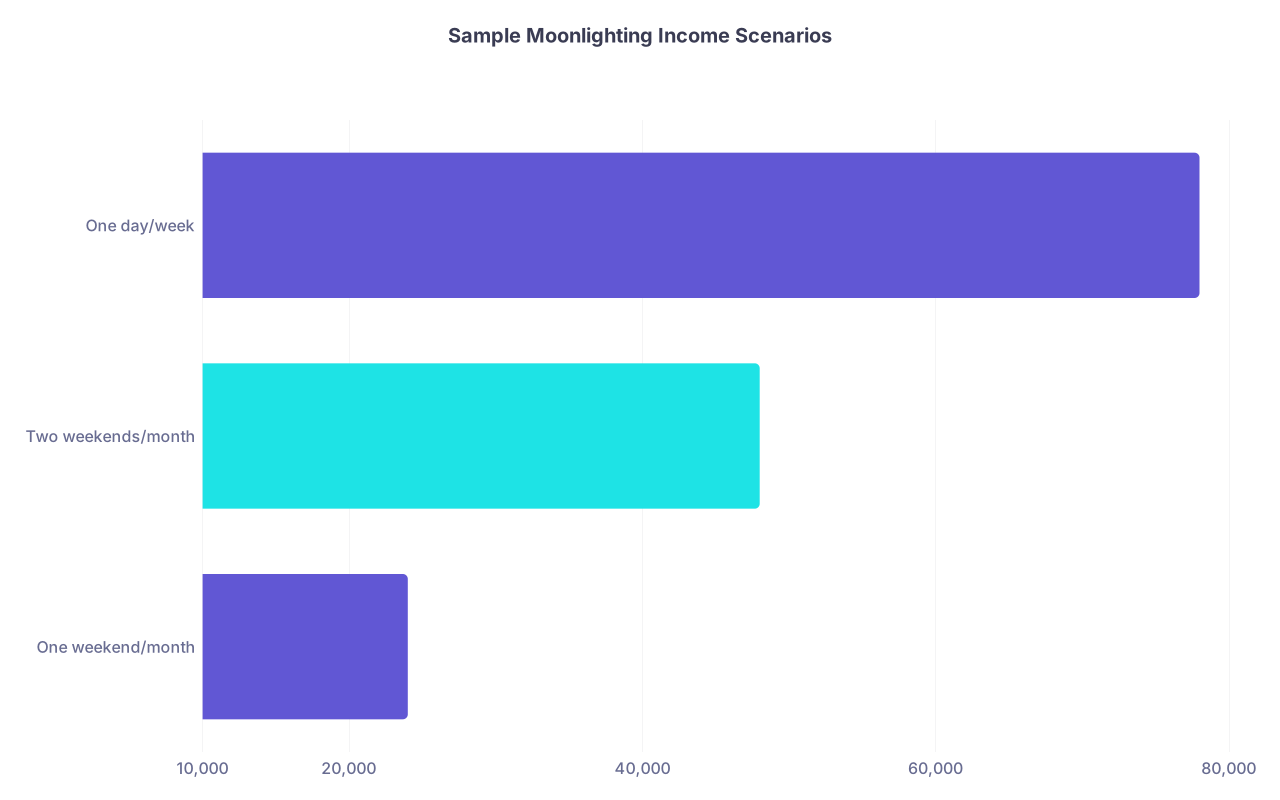
| Category | Value |
|---|---|
| One weekend/month | 24000 |
| Two weekends/month | 48000 |
| One day/week | 78000 |
Example:
- 1 day/month at $2,000 per shift = $24k/year.
- 2 weekends/month at $2,000 per day = $48k/year.
- 1 day/week at $1,500 = $78k/year.
That money can:
- Build your runway.
- Pay off high‑interest debt.
- Fund tail coverage and exit costs.
4.2 Clarify scope and liability
Before you moonlight:
- Confirm written approval per your contract.
- Ensure malpractice coverage is clear:
- Occurrence vs claims‑made.
- Who pays for tail if required?
- Keep good documentation of hours and pay rates.
Mental note: the moment your moonlighting rate shows you are getting paid $200/hour elsewhere while effectively making $120/hour in academics, it becomes harder to swallow the status quo. That is by design.
Step 5: Build a Targeted Transition Strategy (Not a Blind Leap)
Now you know:
- Your current comp.
- Your market value.
- Your legal constraints.
- Your financial runway plan.
- Your mood after non‑academic shifts.
Time to engineer the actual transition.
5.1 Choose your destination lane
Common options out of low‑paying academic roles:
Higher‑paying academic or academic‑affiliated job
- Pros: Keeps teaching/research; familiar culture.
- Cons: Pay still often below community, bureaucracy persists.
- When it works: You actually like academic work, but your current institution is particularly bad on compensation.
Community employed position (hospital system or large group)
- Pros: Big pay jump, better RVU rates, still some stability/benefits.
- Cons: Can be productivity‑heavy; less formal academic time.
- Ideal if: You like clinical work and do not mind giving up protected time.
Private practice (solo, small group, partnership track)
- Pros: Highest earning potential; more control long term.
- Cons: Business risk, call burdens, need to understand finances and operations.
- Good for: Proceduralists, high demand specialties, entrepreneurial personalities.
Hybrid roles
- 0.8 FTE clinical + part‑time teaching.
- Telemedicine plus occasional in‑person.
- Consulting, medical directorships, industry roles combined with part‑time clinical.
You do not need to pick forever. You need to pick your next move that breaks the low‑pay ceiling.
5.2 Build a short, focused target list
Stop shotgun‑applying to every listing. Instead, build a list of 5–15 specific targets:
- Geographic filters (where you are willing to live or commute).
- Compensation band (must be at least X all‑in).
- Practice style you can tolerate for 5+ years.
Then do this:

| Step | Description |
|---|---|
| Step 1 | Define Goals |
| Step 2 | Review Contract |
| Step 3 | Build Runway |
| Step 4 | Start Moonlighting |
| Step 5 | Research Target Jobs |
| Step 6 | Interview and Compare Offers |
| Step 7 | Negotiate and Sign |
| Step 8 | Give Notice and Transition |
Sequence, not chaos. That is the whole point.
5.3 Use recruiters strategically, not passively
You are not a product on a shelf. Do not just sit back and “see what comes in.”
Instead:
- Contact 2–4 recruiters who specialize in your specialty and preferred region.
- Be explicit:
- Minimum base or total comp.
- Dealbreakers (24‑hour call, heavy nights, certain EHRs).
- Non‑compete radius constraints.
Ask directly:
- “What are you seeing as median and upper‑quartile offers for my profile in this region?”
- “Which employers are paying at or above MGMA 75th percentile?”
Then verify what they tell you against independent data.
Step 6: Compare Offers Like a Professional, Not a Desperate Escapee
When an offer shows up, your only job is to answer:
“Is this meaningfully better than my current situation on both money and life?”
Use a structured comparison.
| Factor | Current Academic | Offer A (Community) | Offer B (Private) |
|---|---|---|---|
| Base Salary | $220k | $350k | $300k Yr 1 |
| Bonus Structure | $10k | RVU uncapped | Partnership track |
| Retirement Match | 5% | 4% | None Yr 1 |
| Call Schedule | Q4 weekends | Q6 weekends | Q3 weekends |
| Non-compete | 15 mi / 1 yr | 10 mi / 1 yr | None |
Then ask:
- What is the realistic all‑in comp (not aspirational top‑line if everything goes perfectly)?
- What is the worst‑case comp if volume is lower than expected?
Do some napkin math:
- Expected RVUs × RVU rate.
- Expected call stipends.
- Expected bonuses actually paid to current physicians (ask them directly, not just leadership).
On the non‑financial side:
- Clinic support (RN vs MA, scribe or not).
- Control over schedule.
- Admin time.
- Culture (you know within one interview if it feels toxic).
Step 7: Negotiate Like You Plan to Stay, Even if You Might Leave Later
Academic physicians are often terrible negotiators because they were trained to “be grateful” for the job. That mindset has to go.
Negotiation principles:
- You are not begging; you are offering revenue, expertise, and reputation.
- You do not need to be rude. You do need to be specific.
Target negotiations on:
- Compensation:
- Higher base.
- Better RVU rate.
- Signing bonus and relocation.
- Loan repayment.
- Constraints:
- Narrowing non‑compete radius or duration.
- Carve‑outs (e.g., can do telemedicine or limited side work).
- Employer‑paid tail coverage.
- Lifestyle:
- Defined clinic hours.
- Reasonable call.
- Admin time in writing.
You can also use external offers to negotiate inside your current institution. But be realistic:
- Some departments have zero flexibility.
- Some chairs will match or improve.
- Some will show their cards by lowballing you even then. That tells you everything you need to know.
If you go that route, go in with:
- A clear outside written offer.
- A specific ask:
- “To stay, I would need base of $X, Y clinic days/week, and protected Z% academic time.”
- A timeline:
- “I need a written response by [date] as the other institution has a response deadline.”
If they stall or waffle? That is your answer.
Step 8: Plan Your Exit Logistically and Legally
Once you sign a new contract, do not wing the exit. There is a right and wrong way to leave academics.
8.1 Check required notice period
Your contract probably says:
- 60, 90, or 120 days notice.
Plan backwards:
- Credentialing at new job: 90–180 days typically.
- State license if new: add 60–120 days in some states.
You want overlap, not a gap, unless you deliberately plan a sabbatical.
8.2 Coordinate tail coverage and patient care
- Confirm in writing who is paying for tail.
- Confirm your last clinic date and arrangements for urgent follow‑up.
- Clean up documentation; do not leave open charts. That stuff follows you.
8.3 Do not violate non‑solicit or non‑compete on your way out
Common mistakes:
- Emailing patients to tell them where you are going. Often prohibited.
- Telling staff to follow you. Usually explicitly banned.
Correct path:
- Let the institution handle official patient notifications.
- Ask what you can say when patients ask directly.
- Get any unique or personal teaching materials that are yours (not PHI) before you lose access.
Step 9: Stabilize in the New Role, Then Rebuild Your Academic Identity (If You Want)
Leaving academics does not mean leaving teaching, scholarship, or prestige.
Once you stabilize in a better‑paying role:
- Join voluntary faculty at a local medical school.
- Take students/residents in your clinic or on service.
- Continue to publish or participate in research through collaborations.
- Serve on hospital committees or as medical director (often with stipends).
The difference now: you are doing the “mission” work on top of a compensation base that respects your value.
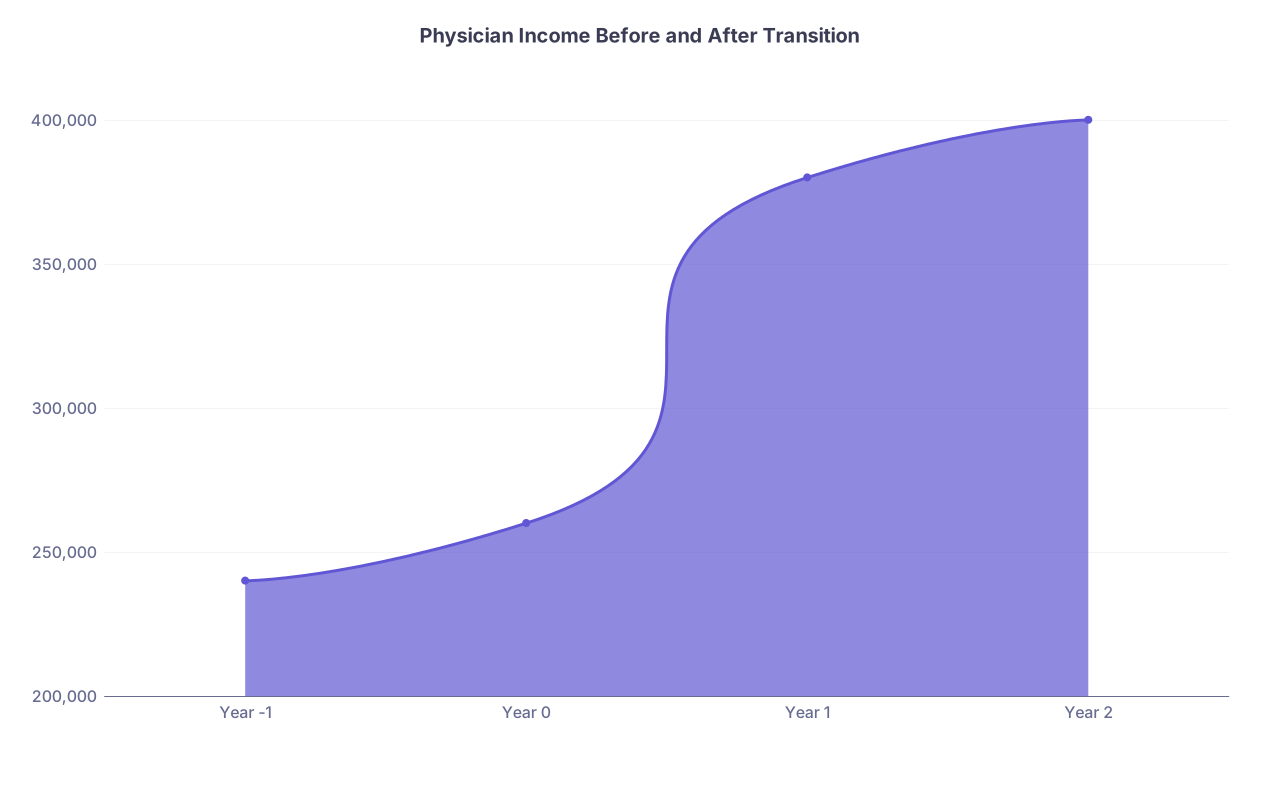
| Category | Value |
|---|---|
| Year -1 | 240000 |
| Year 0 | 260000 |
| Year 1 | 380000 |
| Year 2 | 400000 |
The bump from Year 0 to Year 1 is what you are aiming for. The slope after that is up to you—partnership, productivity, side ventures, leadership.
Step 10: Protect the Upside – Legal and Financial Hygiene in the New Role
Do not escape one bad setup only to walk blindly into another.
In the new job:
- Have your new contract reviewed before signing. Do not repeat old mistakes.
- Clarify:
- Non‑compete specifics.
- Termination clauses (with and without cause).
- Malpractice coverage form and tail responsibilities.
- Set up:
- Automatic retirement contributions at a healthy rate.
- A separate savings / investment plan with the pay bump (do not let lifestyle eat it all).
- Disability insurance that reflects your new income.
This is where a financial planner who understands physicians actually earns their fee, if you choose to use one.
One Concrete Action You Can Take Today
Right now—before the day ends—do this:
- Pull your last paystub and benefits summary.
- Write down your true total annual compensation (salary + bonus + employer benefits).
- Open any reputable salary survey for your specialty and region (MGMA, Doximity, Medscape).
- Compare your number to the 50th, 75th, and 90th percentile.
If your all‑in number is more than 20–25% below the community median, accept this reality:
You are not just “underpaid.” You are subsidizing your institution.
From there, you can either:
- Stay and negotiate with a plan.
- Or start building the runway, moonlighting, and targeted search I outlined above.
But do not keep drifting. Pick up your contract, do the math, and take the first deliberate step out of a low‑paying academic trap.