

Why are so many smart physicians trading real money for “future upside” in startups that statistically will be dead in five years?
Let me be blunt: the cult of equity has infected physicians. Founders dangle “0.5% advisory equity” and suddenly a rational adult who won organic chemistry thinks ghost shares in a pre-revenue company are better than $400/hr cash.
They usually lose.
You’ve heard the story of the orthopedic surgeon who took shares in a device company instead of cash and made millions. What you haven’t heard are the thousands of docs who took equity instead of money and got exactly what their shares were worth at exit: zero.
Let’s strip the romance out of this and walk through what actually happens.
The Myth: “Always Take Equity, That’s Where the Real Money Is”
This myth is everywhere in physician side hustle circles:
“If you really believe in the company, don’t ask for cash — ask for equity.”
“Advisory equity is how you get rich without more call shifts.”
“If it hits unicorn status, your 1% could be life-changing.”
Sounds compelling. It also sounds suspiciously like a lottery ticket pitch.
Here’s what the data actually shows from startup-land (and this applies to your “hot AI healthcare startup” too):
- Roughly 90% of startups fail outright.
- Of the 10% that “survive,” most never have a meaningful exit. They limp along, raise down rounds, recap the cap table, or sell for scrap.
- The vast majority of employee and advisor equity never becomes liquid. It vests, then dies in a private company no one wants to buy.
For physicians, there’s an extra twist: you are usually not getting the same kind of equity as founders or early employees. You’re getting:
- Tiny advisory grants with long vesting
- Options priced at fantasy valuations
- Equity that’s structurally junior to the money investors put in
- Paper that you have no ability to sell or hedge
You’re swapping guaranteed, high hourly income for a lottery ticket in an asset class with brutal failure rates. That is not “sophisticated investing.” That’s gambling in slow motion.
How Startup Equity Really Works (Not the Version You Hear on Podcasts)
Most docs I talk to couldn’t explain the difference between:
- Common stock
- Preferred stock
- Options
- RSUs
- Phantom equity
Yet they’re signing “advisory agreements” with all kinds of equity language they don’t understand.
Here’s the unvarnished version.
Founders and investors structure cap tables to protect themselves, not you. Your little slice sits way down the waterfall. Money goes to:
- Debt holders
- Preferred shareholders (VCs, seed investors) with liquidation preferences
- Then, if there’s anything left, common shareholders and options
You, as the physician advisor or part-time CMO, are almost always in bucket 3.
Worse, the percentage you’re offered is usually pre-dilution fantasy.
You might be told you’re getting “0.5% advisory equity.” That’s usually:
- Subject to a 3–4 year vesting schedule
- Possibly subject to performance milestones you’ll never see again after signing
- Prone to massive dilution as they raise more rounds
By Series C, that 0.5% might be 0.05%. And then there’s the possibility of recapitalizations that crush common shareholders while preferred investors get “make-whole” preferences.
You are not getting “0.5% of the exit.” You are getting 0.5% (or less) of the scraps after everyone senior to you gets paid.
The Physician Math: Why Cash Is Often the Smarter Play
Doctors have something founders and early employees usually don’t: extremely high, reliable earning potential per hour.
So the right question isn’t “Could this equity be big?” It’s “Is this equity actually better than my alternative — working a few extra OR days, urgent care shifts, or telemed hours?”
Let’s do the cold math.
Say a startup wants you as:
- A fractional CMO (4–8 hours/month)
- Clinical advisor for product design
- KOL who helps with strategy and intros
They offer you:
- 0.25% equity, 4-year vesting, no cash
- Or $400/hr consulting with no equity
You’re working 8 hours/month for a year.
- Hours: 96 hours total
- Cash deal: 96 × $400 = $38,400 (this year, real, in your bank account)
- Equity deal: 0.25% in a pre-revenue company with a 5–10% chance of any real liquidity event, and maybe even less chance that your tranche meaningfully pays out
Now discount for reality:
- Probability of meaningful exit: generously 10%
- Probability your equity slice isn’t crushed by dilution or structure: maybe 50% of that 10%
- Effective probability that your equity is worth anything notable: ~5%
You’re trading $38k guaranteed for a 5% chance at maybe, one day, a big payout. If you saw that in any other context, you’d call it what it is: a high-risk speculative bet.
But physicians get hypnotized by the one anesthesiologist who got rich from an early stake in a monitoring company and ignore the survivorship bias.

| Category | Value |
|---|---|
| Guaranteed Consulting Cash | 38400 |
| Expected Value of Equity | 2000 |
That bar for “expected value” is being generous.
When Equity Can Make Sense for Docs
Equity is not always bad. It’s just heavily misused and misunderstood.
There are specific situations where taking equity — usually in addition to some cash — is rational.
It looks more like this:
- You’re doing substantial work: not just a quarterly Zoom call, but actually building something — leading clinical product, designing protocols, opening real doors.
- You negotiate a mix: reduced cash + equity, not “work for free and pray.”
- You have real visibility: you see metrics, burn rate, and investor quality, not just hype.
- You understand the cap table: you know exactly where you sit in the stack and how dilution will work.
- You’re not overexposed: it’s one speculative slice among many assets, not your main side hustle “plan.”
If you’re essentially acting as a fractional executive (true CMO, real weekly hours, accountable deliverables), then not having any equity is probably a mistake. But that’s not the typical doc-advisor story.
Most physician “startup deals” are 4 hours a month on Zoom and Slack, for pure equity. That’s unpaid consulting dressed up in fancy words.
The Ugly Reality of “Advisory Boards” for Startups
Let’s talk about how advisory boards often really function.
I’ve seen the pattern dozens of times:
- Founder raises a small seed round
- They want credibility with hospitals, pharma, or payers
- They “recruit” recognizable names — chairs, chiefs, big-city specialists
- They issue tiny equity grants, announce a glossy “Clinical Advisory Board” on LinkedIn
- Actual engagement: maybe 1–2 meetings a year, a few email intros, some slide deck quotes
The advisory equity isn’t really about compensating you. It’s marketing currency.
The company gets:
- Your name on decks and website
- Your reputation leveraged in investor conversations
- A sense of “clinical validation” they can wave around
You get:
- A handful of basis points on a cap table you never see
- No cash
- Obligations and reputational risk if they cut corners or pivot into something sketchy
If you’re lending your name and license to something, you should be paid. In actual dollars.
You’re not an unpaid influencer.
Red Flags in Startup Deals Physicians Keep Ignoring
There are patterns that should make you pause hard before accepting equity instead of money.

“We can’t pay right now, but the equity will be worth much more later.”
Translation: “We value your time at zero, and we want you to subsidize our risk.”“We’re pre-revenue but valued at $20M post-money.”
Translation: “Your 0.25% is worth $50k on a fictional spreadsheet, not in reality.”No vesting clarity.
If you can be fired anytime and lose unvested equity, you essentially have to trust they’ll keep you around until there might be value. Why give that power away for free?No board, no real investors, no governance.
Then your equity terms can be rewritten with the stroke of a pen via recapitalization when they bring in a serious fund.You’re one of 25 “advisors.”
If there’s a huge advisory board, your name is likely more about optics than meaningful contribution. Your slice is even harder to justify as a substitute for real cash.
If you see three or more of these, take cash or walk away.
Deciding Between Cash, Equity, or Both: A Simple Framework
Here’s a practical lens that cuts through a lot of noise.
Ask yourself, in this order:
If this were a pure consulting gig with no equity, what hourly rate would make it worth it?
If you can’t answer, you’re not thinking like a professional. Set a floor.Can they meet that rate in cash?
- If yes: Take cash, ask for a small equity kicker if they really want you long-term.
- If no: They’re asking you to subsidize them. That’s an investment, not just “advising.”
Would you invest your own after-tax money into this company at the current valuation?
If the answer is no, then why are you “investing” your most valuable resource (time) under worse terms?What percentage of your annual side hustle time are you willing to allocate to high-risk, illiquid bets?
Cap it. Maybe 10–20%. The rest should be in high-certainty, high-cash activities: actual consulting, telehealth, expert witness work, clinical review, etc.What happens if this goes to zero?
If your answer is “I’d be annoyed but financially unchanged,” fine.
If your answer is “Then my side hustle plan is dead,” you’ve already made a bad decision.
| Scenario | Smart Default Choice |
|---|---|
| Light advisory, few hours/year | Cash |
| Fractional CMO, weekly work | Cash + equity |
| Early, no real product/traction | Mostly cash, tiny equity |
| Late-stage, real revenue | Negotiated mix |
| Massive advisory board already | Cash or pass |
Why Docs Overvalue Startup Equity (And How to Stop)
There are predictable psychological traps physicians fall into with startups.
One: status.
Being “Chief Medical Officer” of a startup sounds cooler at cocktail parties than “I do two extra telemed shifts a week.” Even if the telemed pays you $70k/year and the CMO title pays you in empty promises.
Two: boredom.
Many clinicians are intellectually understimulated by repetitive clinical work. The startup world feels exciting. Strategy, product, tech, AI. So they mentally discount the financial side because “it’s interesting.” That’s fine — but then call it what it is: an expensive hobby unless you get paid.
Three: survivorship bias.
You hear about the rare doc who wins big. You don’t see the denominator of hundreds who never see a cent. So your brain distorts the odds.
Four: deference to “business people.”
Docs assume the founder or early investors know what they’re doing financially. Often they don’t. Or they do — and structuring your deal in their favor is part of what they’re doing.
The antidote isn’t to avoid startups. It’s to treat them like what they are: speculative, long-shot bets that should not replace straightforward, cash-based side hustles.
What a Rational Physician Startup Strategy Looks Like
Let me sketch the pattern I’ve seen work for physicians who manage to benefit from startups without getting burned.
They:
- Build a solid, boring income base from clinical work and/or straightforward consulting.
- Cap their “startup exposure” to a small slice of time and mental bandwidth.
- Reserve equity-only work for rare cases where they have strong conviction, access to real information, and meaningful influence.
- Prefer cash + equity over “equity only” whenever possible.
- Actually read the cap table and ask annoying questions.
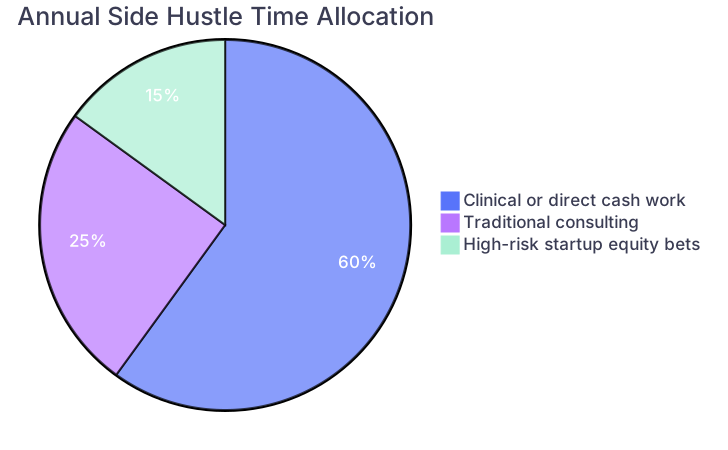
The key theme: they treat equity as a bonus, not the main course.
If the equity hits, great. If not, that year’s side hustle still looks good on paper and in the bank.
Years from now, you won’t brag about how much phantom equity you once had in three dead digital health startups. You’ll remember the deals where you valued your time correctly, got paid accordingly, and took calculated risks only when the odds and structure actually made sense.


