It’s 9:45 p.m. You just finished charting, your inbox is still a mess, and yet your brain is spinning on something completely different: “I need another income stream. But what the hell should I actually do?”
Consulting? Real estate? Telemedicine? Coaching? A course? Locums? You Google “physician side hustles” and end up with a 50-item list that’s worse than useless. You do not need more ideas. You need a way to decide.
Here’s the answer you’re looking for: a simple, ruthless decision framework to pick your first side hustle as a physician—one that fits your life, your risk tolerance, and your actual personality, not some Twitter finance bro’s fantasy.
Step 1: Get Honest About Why You Want a Side Hustle
If you skip this, you’ll chase the wrong thing and burn out twice.
Your primary driver matters more than anything else. You can want multiple things, but you must pick the main one.
Common real reasons (not the pretty ones you say at dinner):
- Replace or escape clinical income
- Increase financial security / diversify risk
- Outlet for skills your day job doesn’t use
- More control over schedule and location
- Long-term equity / wealth building
Pick one primary and one secondary. That’s it.
Now, here’s how that choice narrows your options.
| Primary Goal | Best-Fit Side Hustle Types |
|---|---|
| Escape clinical work soon | Established businesses, locums agency, telemedicine at scale |
| Income diversification | Real estate, consulting, small digital products |
| Use nonclinical skills | Expert consulting, coaching, writing, speaking |
| Schedule/location control | Asynchronous telehealth, digital products, remote consulting |
| Long-term equity/wealth | Real estate, owning a practice or group, scalable online business |
If your primary goal is “I just want an extra $1–2K/month without wrecking my life,” you’re in a very different game than “I want out of clinical medicine in 5 years.”
Be precise. Write down your primary and secondary drivers on paper. If you can’t articulate them clearly, you’re not ready to choose a side hustle.
Step 2: Choose Your Side Hustle “Profile”
There are three main “profiles” for physician side hustles. Most mistakes happen when people pick something that doesn’t match their profile.
Profile A: The Energy-Strapped Clinician
You’re full-time (or more), maybe with call. You’re tired. You want extra income but not another job.
Your constraints:
- Time: Tight and unpredictable
- Attention: Fragmented
- Tolerance for hassle: Low
What generally works:
- Low-maintenance investing (real estate syndications, index funds + maybe covered calls with help)
- Simple telemedicine on your terms (not an extra 20 hours/week)
- Niche chart review, utilization management, or occasional expert witness work
- Very small, leveraged digital products (templates, checklists, niche guides)
What usually fails:
- Starting a big content brand from scratch (podcast + blog + newsletter + YouTube) while on 1.0 FTE
- Trying to build a tech startup with no time, no cofounder, no capital
- Any model that requires you to be “always on” for customers
Profile B: The Builder
You like projects. You’re willing to trade evenings/weekends for something that might be big.
Your constraints:
- Time: Moderate (0.6–0.8 FTE clinically, or you’re willing to cut back soon)
- Risk tolerance: Moderate
- Learning appetite: High
What generally works:
- Building a consulting niche (industry, pharma, health tech, med-legal)
- Growing a telemedicine micro-practice in a narrow niche
- Online education (courses, membership, communities in a specific area)
- Small group practice or direct care model on the side
What usually fails:
- Spreading yourself across 4–5 tiny hustles instead of going deep on one
- Anything that requires huge capital outlay before proof of concept
Profile C: The Escape Artist
You want out of clinical work. Not in theory—actually gone in 3–7 years.
Your constraints:
- Time: Variable, but you’re ready to re-allocate
- Risk tolerance: Higher than average
- Motivation: High (because pain is high)
What generally works:
- Aggressive real estate (direct ownership, small multifamily, or focused syndications + education)
- Joining or building a growing group (e.g., tele-psych, urgent telemed, niche clinics) with equity
- Nonclinical pivot with clear path: medical director roles, pharma, informatics, utilization management
- Scalable online business tied to real demand (not “hope marketing”)
What usually fails:
- “Cute” side projects with no clear business model
- Endless credential collecting (extra MBAs, random certificates) with no practical path
Pick your profile. Keep it in front of you as we go.
Step 3: Map Your Constraints Like a Real Business
Your life is the operating system. Your side hustle has to run on it.
Answer these four, honestly:
How many real hours/week can you commit for 6–12 months?
Not fantasy hours. Real ones you’d actually work after a hard clinic day.What’s your cash runway?
- “I can invest $0–$1K to start”
- “I can invest $5K–$20K and not panic”
- “I can deploy $100K+ into something like real estate and sleep fine”
What’s your emotional runway?
How long can you work on this before it has to show some meaningful progress? 3 months? 6 months? 2 years?What can’t you violate?
Sleep, family time, current job contract, non-compete, board rules, malpractice coverage, etc.
Now, put side hustle categories against those constraints.
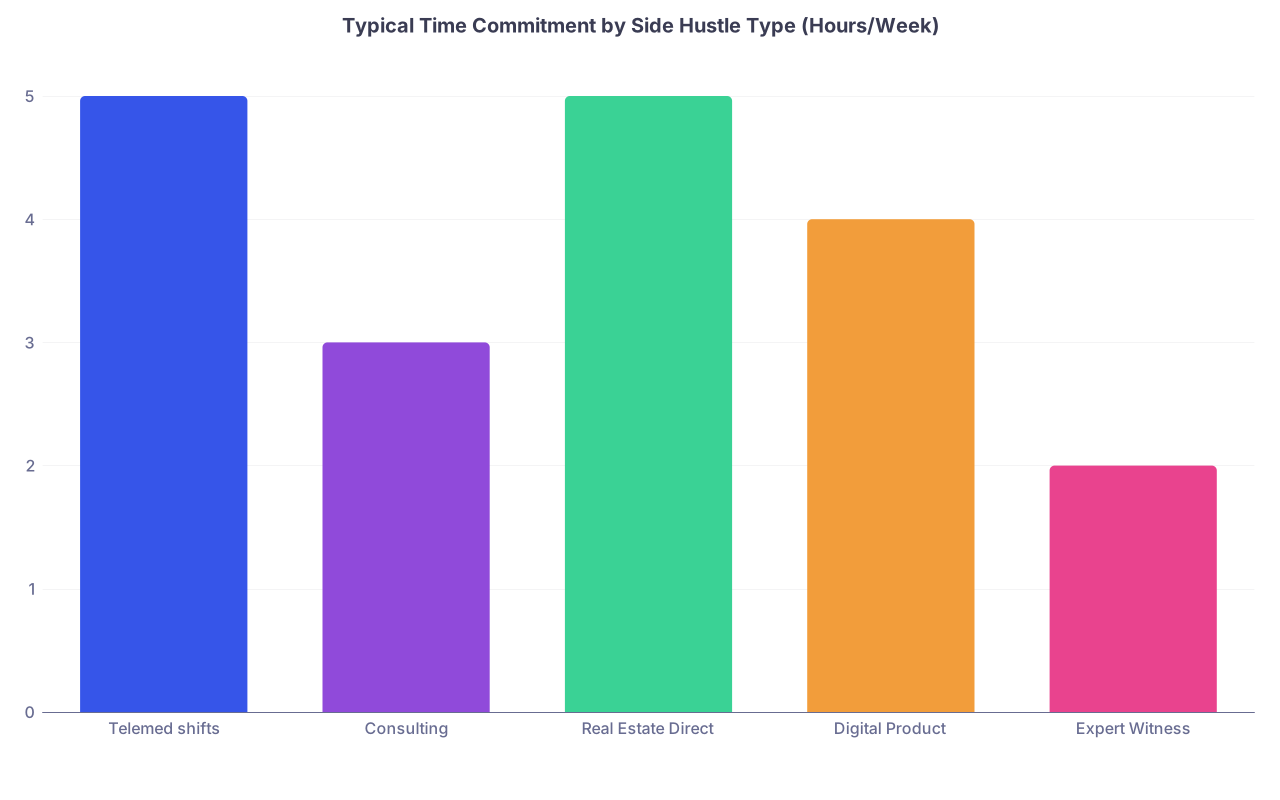
| Category | Value |
|---|---|
| Telemed shifts | 5 |
| Consulting | 3 |
| Real Estate Direct | 5 |
| Digital Product | 4 |
| Expert Witness | 2 |
If you’ve got 3–4 hours/week, starting a direct primary care practice on the side is fantasy. If you’ve got $2K total, going all-in on heavy real estate renovations is nonsense.
Your first filter is not “What sounds cool?” It’s “What actually fits these constraints without breaking me?”
Step 4: Inventory Your Leverage (Skills and Assets)
This is where most physicians leave money on the table. You have more leverage than you think.
Leverage comes from:
- Knowledge: specialty, systems, billing, quality, EMR pain points
- Network: colleagues, leadership, vendor reps, lawyers, accountants, tech folks
- Credentials: your letters matter massively in certain arenas (expert witness, consulting, education)
- Personality: you like to write, speak, teach, analyze, build systems, or sell
Ask yourself:
- If a health tech company called you tomorrow and said, “We’ll pay $300/hr if you can fix X problem for us,” what would X be?
- What questions do colleagues constantly ask you about? That’s usually a monetizable skill.
- Where have you already solved a painful problem for yourself? (Charting, scheduling, burnout, hiring, coding, etc.)
Now connect that to side hustle buckets.
| Major Strength | Example Side Hustles |
|---|---|
| Loves teaching | Online courses, CME content, coaching, speaking |
| Obsessed with systems/EMR | Consulting for EMR vendors, workflow optimization |
| Deep subspecialty expertise | Industry advising, expert witness, niche telemedicine |
| Good with numbers & analysis | Real estate underwriting, consulting, compensation design |
| Strong communicator/storyteller | Writing, copywriting for health brands, patient education |
Your first side hustle should sit at the intersection of:
- Your main goal (Step 1)
- Your profile (Step 2)
- Your constraints (Step 3)
- Your leverage (Step 4)
If an idea doesn’t line up with at least three of those, drop it for now.
Step 5: Run Every Idea Through a Simple Scorecard
Here’s the decision framework you were looking for: a blunt scoring system.
Take 3–5 side hustle ideas. Score each 1–5 (5 = excellent, 1 = terrible) on each dimension:
- Goal fit: How directly does this move your primary goal?
- Time fit: Can it work inside your actual hours and schedule volatility?
- Money fit: Does startup cost and risk match your reality?
- Leverage fit: Does it use what you’re already good at?
- Asymmetry: Is the upside meaningfully larger than the downside?
- Energy: Do you feel energized or drained imagining working on this for 6–12 months?
Then total the score (out of 30). Anything under ~18? Probably not a first side hustle.
You don’t need the “perfect” opportunity. You need a clearly better than the others opportunity that you’re willing to commit to.
Step 6: Decide Your First Experiment, Not Your Forever Identity
Your first side hustle is a test, not a tattoo.
Pick one idea and define a 90-day experiment with:
- A specific problem you solve
- A narrow audience
- A clear, small outcome
Examples:
- Telemedicine: “I’ll sign up with 1 reputable platform, commit to 2 shifts/week for 12 weeks, and see if the income and workflow feel sustainable.”
- Consulting: “I’ll reach out to 10 health tech companies in my niche, land 1–2 paid advisory calls, and see if this fits.”
- Expert witness: “I’ll get registered with 2–3 attorney networks, take the training, and aim for 1 case in 6 months.”
- Digital product: “I’ll build 1 simple, high-value template/bundle, get it in front of 100 physicians, and see if at least 5–10 buy.”
You’re not building an empire yet. You’re testing for:
- Demand: Do people actually pay you money for this?
- Fit: Does this feel sustainable mentally and logistically?
- Traction: Does effort → results in a way that could scale?
Document this. One page. If you can’t describe your 90-day experiment in one page, it’s too complicated.
Step 7: Think Ahead About Risk, Compliance, and Reputation
Physicians play by different rules. You can’t pretend you’re a random YouTuber.
Before you commit:
Check your employment contract for:
- Non-compete clauses
- Restrictions on “outside work” or “telemedicine”
- Requirements for employer approval for outside income
Check malpractice and licensure:
- Does your policy cover any new clinical work?
- Do you need separate coverage for telemedicine, consulting, or procedures?
- Are you crossing state lines with telehealth?
Check optics:
- Will this side hustle clash with your brand at your current institution?
- Are you comfortable with colleagues, patients, and leadership knowing you do this?
It’s better to slightly under-monetize a first side hustle than to torch your license or your reputation.
Common Traps I See Over and Over
I’ve watched a lot of physicians do this the hard way. Let me save you some pain.
Chasing status, not fit
“I should start a fund / SaaS / large platform” when you hate managing people and tech makes you twitchy.Copy-pasting someone else’s playbook
Just because a radiologist buddy made a killing in short-term rentals doesn’t mean that fits your city, capital, or tolerance for phone calls about broken dishwashers.Underestimating the learning curve
Real estate, content businesses, and tech startups all have steep curves. They can work, but they are not “set and forget” in year one.Spreading thin across 4–5 “small” hustles
You end up with 5 mediocre income streams and no leverage. Pick one and go deep first.Ignoring your spouse/family reality
If your partner is already carrying more than their share at home, adding 15 hours/week to your plate without a conversation is a good way to create resentment.
A Simple Flow: From Idea Overwhelm to Clear First Move
Here’s the process, in one picture.

| Step | Description |
|---|---|
| Step 1 | Clarify Primary Goal |
| Step 2 | Choose Profile A B or C |
| Step 3 | Define Time and Money Constraints |
| Step 4 | Inventory Skills and Leverage |
| Step 5 | Generate 3 to 5 Hustle Ideas |
| Step 6 | Score Ideas with Framework |
| Step 7 | Design 90 Day Experiment |
| Step 8 | Check Risk and Compliance |
| Step 9 | Start Single Focused Experiment |
| Step 10 | Evaluate Fit and Traction |
| Step 11 | Top Score Above Threshold |
If you’re stuck at any step, it’s usually because you’re skipping one and jumping straight to “I need an idea.”
FAQs
1. I’m already burned out. Is a side hustle just going to make this worse?
Possibly. If you treat it like a second job that looks exactly like your first job, yes. If you choose something that uses different skills, is under your control, and is time-bounded (90-day experiment), it can actually reduce burnout by giving you agency and a future you’re building toward. The key is ruthless time boundaries and starting small.
2. What are the best side hustles for physicians who want low time commitment?
Typically: expert witness work, selective telemedicine shifts, small high-ticket consulting, and very simple digital products built around things you already know cold. Real estate investing (not being a landlord for 12 doors yourself) can also fit if you partner with competent operators and stay in your lane as capital + strategy.
3. Do I need an LLC or legal entity to start?
Not for everything. You can start as a sole proprietor for many low-risk, nonclinical activities and then form an LLC or S-corp once you’ve validated the idea and income. For clinical work or anything with substantial liability, get proper legal and tax advice up front. Don’t let entity formation become a procrastination hobby.
4. How much income should I realistically expect from a first side hustle?
If it’s your first and you’re full-time clinically, a realistic initial target is $500–$3,000/month after 6–12 months. Anything more is possible but not typical. The main point of the first one isn’t huge money; it’s building the skill of creating income outside your W-2. Once you’ve proved that to yourself, scaling becomes much easier.
5. Is content creation (YouTube, podcast, blog) a good first side hustle for physicians?
Only if you actually enjoy the process and are willing to treat it as a multi-year game. Content is slow to monetize and brutally competitive, but it can be powerful leverage if you already have a clear service or product to attach it to. As a pure first hustle “to make money,” it’s usually a frustrating choice.
6. How do I know when to quit a side hustle that isn’t working?
Decide the kill criteria before you start: for example, “If after 6 months and 100 focused hours I haven’t made at least $2,000 or seen clear, growing demand, I will pause or pivot.” If it consistently drains your energy, harms your primary job or family life, or fails every reasonable metric you set, that’s not grit—that’s sunk cost fallacy.
Key points to walk away with:
- Pick your first side hustle based on goal, profile, constraints, and leverage—not hype.
- Use a simple scoring framework and commit to a 90-day, single-focus experiment.
- Protect your license, time, and sanity; the right side hustle makes your life bigger, not smaller.