

The belief that side hustles can fully fix a bad specialty-income choice is fantasy-level dangerous.
That’s the blunt truth I wish someone had told me when I first ran the numbers and realized: “Oh. I might have just locked myself into a lifetime of being $150–300k behind my friends in ortho and dermatology.”
If you’re anything like me, you’re caught in that mental spiral:
- “Did I ruin my financial future by choosing primary care, peds, psych, IM, whatever?”
- “Is my only way out to grind myself into dust with 2–3 side hustles?”
- “Am I going to be 55, still doing call, with no way to slow down because I picked wrong at 27?”
Let me untangle this as cleanly as I can, from the perspective of someone who obsesses over all the worst-case scenarios too.
The Hard Math: How Big Is the “Wrong Specialty” Gap Actually?
Let’s stop being vague and put some rough numbers to the anxiety.
Ballpark attending incomes (US, pre-tax, broad ranges, not academic salaries):
| Specialty | Typical Range (USD) |
|---|---|
| Pediatrics | $180k–$260k |
| Psychiatry | $230k–$320k |
| Internal Med (outpatient) | $220k–$300k |
| Emergency Med | $300k–$420k |
| Anesthesia | $400k–$550k |
| Orthopedic Surg | $550k–$800k+ |
Now imagine you’re making $230k in outpatient IM and your buddy from med school is at $500k in ortho. That’s a $270k pre-tax gap. Every. Single. Year.
Your brain probably goes straight to: “Okay, I’ll just pick up some telemed, consulting, maybe real estate, and close that.”
Here’s where the math starts getting brutal.
Let’s say you somehow build a side hustle that nets you $100k a year after expenses. That’s already elite-level for most physicians. You’re still behind the ortho friend by ~ $170k pre-tax.
And you’re doing it on top of your main job.
This is why I say the “side hustles will fix everything” narrative is dangerous. It sets you up to believe that you can out-grind structural differences with pure hustle. Sometimes you can close part of the gap. But not all of it. And rarely without consequences.
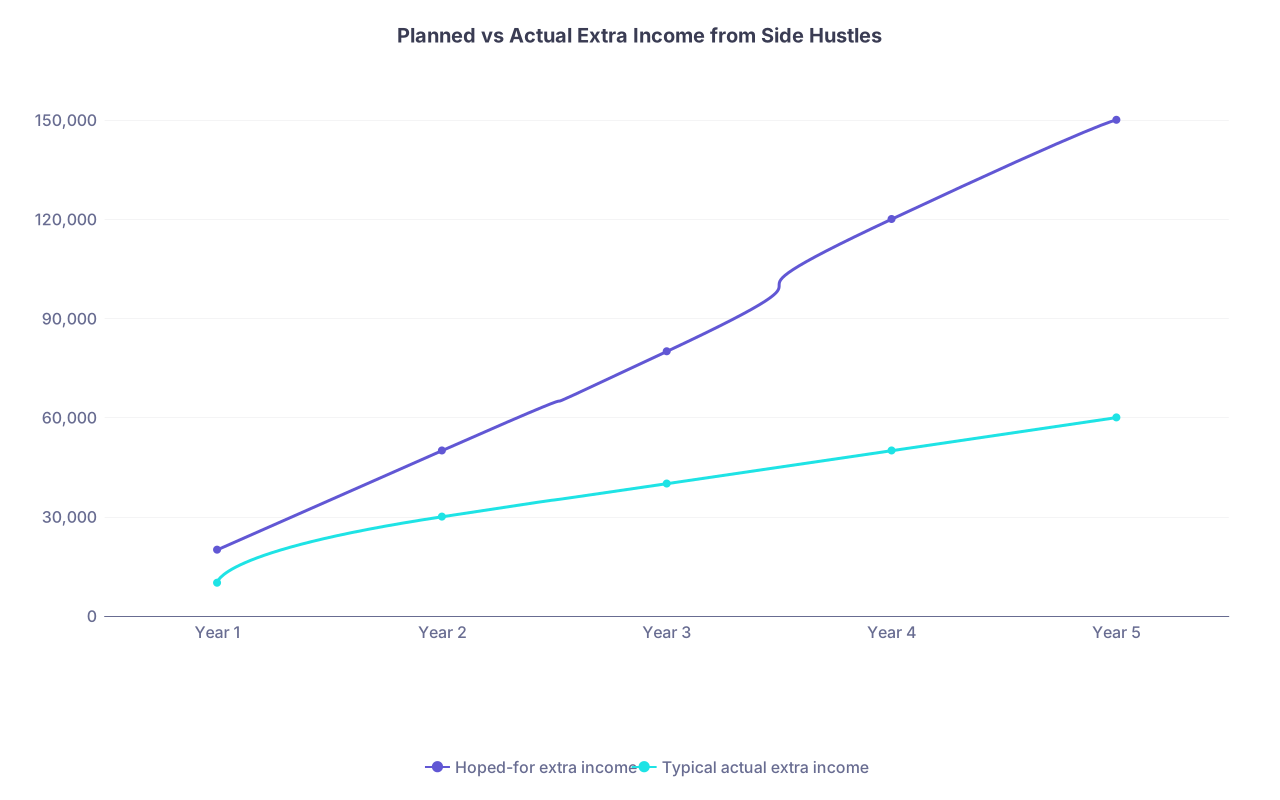
To visualize the emotional part of this, here’s how people think their plan will go vs how it usually shakes out over time.
| Category | Hoped-for extra income | Typical actual extra income |
|---|---|---|
| Year 1 | 20000 | 10000 |
| Year 2 | 50000 | 30000 |
| Year 3 | 80000 | 40000 |
| Year 4 | 120000 | 50000 |
| Year 5 | 150000 | 60000 |
The gap between the blue and the orange? That’s the part that destroys people’s sleep at 2 a.m.
What Side Hustles Can Realistically Do (and What They Definitely Can’t)
Let me be clear: side hustles aren’t useless. Some are fantastic. But they have lanes.
They can:
- Change the trajectory of your finances over 10–20 years
- Give you leverage to work less clinically down the line
- Create optionality: early semi-retirement, fewer clinic days, less call
- Help you crush loans faster and build wealth earlier than colleagues in the same specialty
They cannot reliably:
- Turn pediatrics into ortho money overnight
- Fix a lifestyle problem you refuse to address (overspending, no budget, huge house, private school x3, luxury everything)
- Compensate long-term for a toxic job or chronic burnout if it’s just “more work on top of too much work”
The truth that nobody markets on Instagram:
A reasonable, sustainable physician side hustle usually nets $10k–$50k/year after ramp-up. More than that is possible. But rare. And usually slow.
The “Wrong Specialty” Fear: Is It Actually About Money?
Here’s where I have to call out our own brains.
Most people who tell me, “I chose the wrong specialty because of money,” eventually admit about 20 minutes later:
It’s not just about the cash.
I hear stuff like:
- “I feel dumb when my friends talk about their compensation packages.”
- “I killed myself to get here and I still feel… behind.”
- “I’m afraid I’ll have to work full-time forever while other people can cut back at 45.”
Money is the surface-level problem. Underneath, it’s fear of being trapped.
So let’s talk about actual levers you have. Not fantasy ones.
The 4 Big Levers: It’s Not Just “Make More”
You have four main levers. Side hustles are only one.
- Income (clinical + side)
- Spending / lifestyle choices
- Geography / practice setting
- Time and compounding
If you ignore 2–4 and only obsess over 1, you will feel screwed forever.
1. Clinical income is still your primary engine
This hurts to admit, but your main job is still the easiest place to move the needle.
I’ve seen:
- A primary care doctor go from $210k to $320k by switching from academic to private practice with productivity bonus. No side hustle in the world was giving her a clean $110k raise that fast.
- A psychiatrist bump up income by $80k by mixing in one extra telepsych day (from home, no commute) instead of starting something totally different from scratch.
As much as we want the fun “I built a 7‑figure brand” story, the boring move is more reliable: Negotiate. Change jobs. Switch practice environments. Adjust your mix of inpatient/outpatient/urgent care/telehealth.
2. Lifestyle creep is a monster, no matter your specialty
I hate this part, because it feels like blaming the victim. But I’ve watched a derm who makes $700k feel “broke” and a peds doc at $230k feel surprisingly secure.
The difference?
The peds doc was ruthless about housing, cars, and debt early on. The derm bought the giant house, 3 cars, private school, nonstop travel. So guess who feels trapped now?
If you choose a lower-paying specialty, you don’t have to be poor. You do have to be sharper and earlier about lifestyle design. That’s just reality.
3. Geography is a cheat code nobody wants to hear about
You know what quietly beats a side hustle for a lot of people?
Moving.
Same specialty:
- High COL coastal city at $230k
vs - Mid-size city or rural-ish area at $300k–350k + way lower cost of living
That can be a six-figure swing in real, usable money once you factor rent/mortgage, taxes, childcare, everything.
But our brains prefer: “I’ll stay in the expensive city I love, keep overspending, and just add 3 side hustles.”
It feels more glamorous than “move 2 states away and have money left over every month.”
Side Hustles That Actually Pair Well With “Lower-Paying” Specialties
Not all side hustles are equal. Some are pure time-for-money. Some scale. Some are just slow-motion burnout.
Here are a few that do make sense if you’re trying to close some of the gap without destroying yourself.
1. Extra clinical work (but on your terms)
This is technically not a separate “business,” but it behaves like one.
Things like:
- Telemedicine (urgent care, primary care follow-up, mental health if you’re psych)
- Per diem urgent care shifts
- Locums during certain months
I’ve seen people pick up:
- 1–2 telemed evenings per week from home and add $20k–$40k/year
- Short bursts of locums to cover specific financial goals (loan payoff, down payment, IVF, adoption, etc.)
It’s not glamorous, but it’s predictable. And you already have the skills.
2. Expert witness / chart review / utilization management
These have a much better hourly trade-off once you’re established.
- Chart review / UM: remote, often flexible, $100–$200/hr range
- Expert witness: higher ceiling, but slow to build and requires patience and networking
This works especially well for IM, EM, psych, anesthesia, neurology. You’re not changing your life overnight. But a solid, consistent $20k–$50k/year here compounds insanely over a decade.
3. Teaching, course creation, and niche content
Not generic “be a YouTuber.” I’m talking targeted, high-value stuff:
- Board review teaching/tutoring
- Niche CME content
- Paid online courses for residents, med students, NPs/PA-Cs
The people who succeed here don’t just “start a blog.” They solve a specific pain for a specific group.
Example: a psych attending creating a high-yield course for residents on forensic evaluations or starting outpatient psych practice.
This takes the longest to pay off. But if it works, it’s the one that can actually scale beyond trading hours for dollars.
The Silent Risk: Side Hustles Can Make You Hate Medicine Faster
This is the part almost no one says out loud.
If you already feel:
- Underpaid
- Underappreciated
- Burned out
And then you stack more work on top of that?
You’re basically speed-running your way to hating everything.
I’ve watched people:
- Pick up 2–3 side gigs
- Have a kid or two
- Try to be a “present” parent
- And then quietly break down one night because they literally don’t have a single hour per week that’s just… open.
You know what ends up happening?
They drop the side hustles. Or they quit the main job. Or their health forces a decision.
This is the worst-case scenario that haunts me:
Trying so hard to “fix” the income gap that you torch the only reliable income engine you have — your clinical career.
You can’t brute-force your way out of a specialty mismatch with sheer hours. At least not for long.
A More Boring, Less Terrifying Strategy That Actually Works
If you want the realistic, non-Instagram version of “fixing” a lower-paying specialty, it looks more like this:
Stabilize your clinical job first
Get to a place that’s not toxic. Reasonable hours. Some semblance of control. You can’t build anything on top of a crumbling foundation.Clean up the obvious leaks
High-interest debt. Insane car payments. Housing that’s pushing your limits.
This isn’t about being ascetic. It’s about giving your future self some breathing room.Add one side hustle. One. Slowly.
Test it. Track your actual hourly rate after taxes, overhead, and time. If it nets you $15/hr effectively, kill it. If it’s $150/hr and sustainable, keep it and maybe expand.Revisit geography and job structure every couple years
It’s not a moral failure to leave academics. Or move cities. Or go part-time clinical plus part-time something else.Accept that you may never fully “catch” the ortho/derm person — and that’s not failure
Your win condition is not “be the richest.”
It’s: “Have enough money and enough control over my time to not feel trapped.”
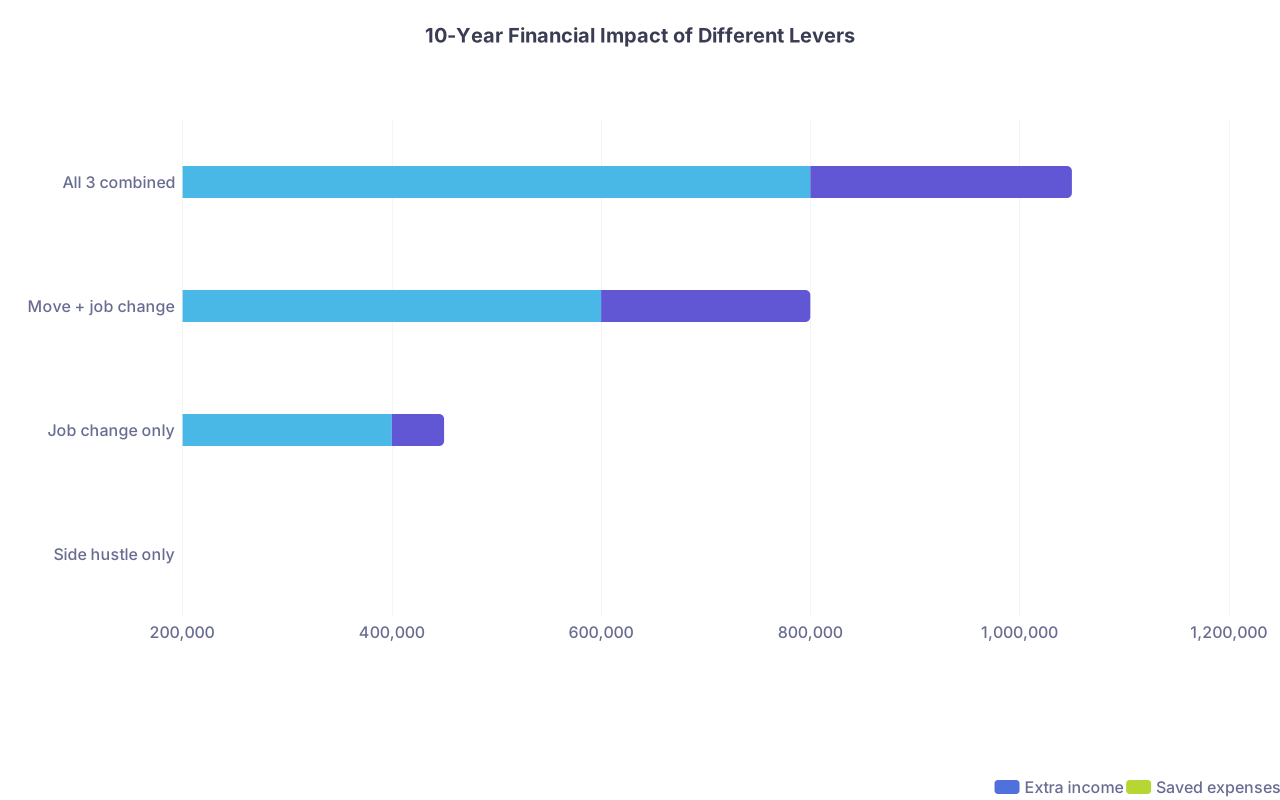
To see how different combos actually move the needle over time, here’s a rough comparison of total extra money created over 10 years with different choices:
| Category | Extra income | Saved expenses |
|---|---|---|
| Side hustle only | 200000 | 0 |
| Job change only | 400000 | 50000 |
| Move + job change | 600000 | 200000 |
| All 3 combined | 800000 | 250000 |
Notice how “side hustle only” isn’t nothing. But it’s also not the strongest move by itself.
So… Did You Actually Choose the “Wrong” Specialty?
Maybe. Maybe not.
If you genuinely hate the work, that’s a different crisis than money. That’s a question of whether you eventually pivot specialties, re-train, or redesign your role entirely.
But if your main issue is:
“I like my specialty but I’m scared I’ll always be behind financially,”
then here’s the uncomfortable answer:
Side hustles can help. Sometimes a lot.
They just won’t erase the gap by themselves.
They’re a tool. Not magic.
And if you try to use them as magic, they’ll bite back.
FAQ (exactly 4 questions)
1. I’m a resident and already regret my specialty choice. Should I start a side hustle now?
You can, but be careful. Residency is already chronically under-slept, underpaid, and overworked. If you must start something, pick something low-risk, low-time, and high-learning: writing, tutoring, small online projects. Don’t bank on big money during residency. Bank on skills, systems, and testing what you enjoy. And stay open to the fact that attendings in your specialty may have very different lifestyles than residents — some people like their specialty a lot more once they’re no longer being tortured in training.
2. Is it ever realistic to replace my clinical income entirely with side hustles?
Yes, but it’s rare and it usually takes years. The people who pull this off either build scalable online businesses, real estate portfolios, consulting firms, or high-paying non-clinical roles. You need tolerance for risk, delayed payoff, and a ton of work up front. If you’re just hoping telemed + small consulting will equal a full attending salary, you’ll almost always fall short. Think of full replacement as a long-term optionality play, not a quick fix.
3. How do I know if a side hustle is actually “worth it” for me?
Track your real hourly rate. Take what you earned, subtract taxes and expenses, then divide by all hours spent (admin, marketing, setup, emails, everything). If that number isn’t meaningfully better than extra clinical work — and the hustle doesn’t bring joy, skills, or future opportunity — it’s probably not worth keeping. Also track how you feel: if every week you’re dreading it, that cost is real, even if it doesn’t show up in a spreadsheet.
4. Is it too late to fix things if I’m already an attending 5–10 years in and feel behind?
No, but you need to be decisive. I’ve watched attendings in their 40s completely change their trajectory in under 5 years by doing a combo of: moving, changing jobs, tightening lifestyle a bit, and adding one well-chosen side hustle. The advantage you have over the med student or resident is clarity: you know what you hate, what you like, and where you’re burning out. Use that. You don’t need to perfectly “catch up” to some imaginary colleague; you need to give your 55‑year‑old self options. That’s still very possible.
Key takeaways:
You’re not doomed by your specialty choice, but you also can’t hustle your way out of structural pay gaps with raw hours forever. The real fix is boring: a better clinical setup, smart lifestyle choices, maybe geography changes, and one or two thoughtful side hustles layered on top. Side hustles are a lever — powerful, yes — but they work best as part of a bigger strategy, not as your only lifeline.


