You finish charting at 10:30 p.m., step out into the dark gravel lot, and it’s just you, your pickup, and a sky full of stars. No traffic. No restaurants still open. No networking events. Just another long day in a town with one stoplight and a hospital that always needs more from you than it gives back. And in the back of your mind is the same question that’s been there for months: “How do I build something else… without having to move?”
If that’s where you are—a rural doc with limited local options but unlimited internet—this is for you. Let’s be specific: you want location-independent side hustles. Things you can do from your kitchen table, call room, or a tiny office above the clinic. Things that don’t depend on a big city.
Here’s how you actually do that, in the real world, with a real schedule and real fatigue.
Step 1: Get Clear On What You Actually Want From a Side Hustle
Before we talk about telehealth, online courses, or “medical writing,” you need to decide what “success” looks like for you. Otherwise, you’ll chase the wrong opportunity and burn out faster.
Ask yourself three blunt questions:
What’s my primary goal?
- Extra income (e.g., $2–5K/month)?
- Exit ramp from full-time clinical?
- Something intellectually interesting that isn’t EMR hell?
How much mental energy do I have after clinic or call?
- Be honest. If you’re doing 1:3 call with OB, ICU, and ED coverage, you’re not building some massive startup on the side. You need low-friction work that you can turn on/off.
How much do I care if this is “doctor-branded” vs anonymous?
- Some people want their name on everything.
- Some want a pseudonym and zero patients finding them on Google.
Once you’ve answered that, we can match you to realistic, rural-friendly pathways instead of generic “physician side hustles” that never survive your call schedule.
Step 2: Side Hustles That Work Especially Well in Rural Settings
You don’t have local consulting gigs or fancy academic titles. Fine. What you do have: broad clinical exposure, high autonomy, and usually a strong work ethic. That’s gold if you know where to point it.
1. Telehealth (Done Strategically, Not Desperately)
Telehealth is the obvious answer. But most docs screw it up by either:
- Signing up with the first low-paying volume-mill company, or
- Thinking they’ll “just do some telemedicine” without a plan.
If you’re rural, you can leverage telehealth in two main ways:
A. Volume-based telehealth platforms
These are your Teladoc/Amwell/Dr. on Demand types plus smaller startups.
Pros:
- 100% location-independent.
- Plug-and-play: use their platform, malpractice, scheduling.
- You can stack short shifts around call or clinic.
Cons:
- Pay can be mediocre ($20–$60 per consult depending on type).
- You’re a cogs-in-the-machine doc.
- Often evenings/weekends are the only lucrative times.
Use this if:
- You want relatively brainless extra income.
- You can tolerate standardized care pathways.
- You’re okay with short-term side income, not a long-term asset.
How to make this not miserable:
- Negotiate for blocks, not random trickle consults. A tight 3–4 hour block beats random pings all evening.
- Track your effective hourly rate. If you’re making <$80/hr after taxes and overhead, reconsider.
- Batch credentialing. Apply to multiple platforms once; use that effort across several companies.
B. Niche telemedicine practice (your own or with a boutique company)
This is where rural docs can punch above their weight.
Examples:
- Weight management
- Sleep medicine
- Migraine/headache clinic
- Men’s or women’s health
- ADHD (if you’re willing to deal with scrutiny and do it properly)
- Chronic pain non-opioid-focused approaches
Pros:
- Higher hourly rates.
- You’re building a brand and potentially an asset.
- You choose your clinical lane.
Cons:
- You need to handle (or pay for) admin: scheduling, EMR, malpractice, maybe billing.
- It takes time to fill your panel.
- You must watch multi-state licensing and telehealth regs.
Realistic path:
Pick a niche where:
- You’re already comfortable.
- There’s strong demand.
- It can be managed largely via telemedicine.
Get 2–3 key state licenses (not 15). Focus on states with:
- Large populations, and
- Telehealth-friendly laws.
Start part-time with:
- 1–2 half-days per week dedicated time.
- Self-pay or cash-only at first. Simplifies everything.
Use one of the “telehealth-in-a-box” platforms so you’re not building tech from scratch.
If you’re in a rural setting with small-town politics and you want separation, you can market the telehealth niche under a different brand that’s not obviously “Dr. Smith from Smallville Hospital.”
2. Medical Writing and Reviewing (The Underrated Quiet Hustle)
You’re in a town where the biggest business is a feed store and the hospital cafeteria. But online, nobody cares. You have an MD/DO—companies will pay for that.
Types of work:
- CME content development
- Question writing for board-style platforms
- Patient education content (sites, apps, hospital chains)
- Health tech copy and UX writing (“rewrite our patient onboarding emails so they’re not awful”)
- Peer review for journals or grant reviews (often lower pay but good for academic cred)
Pros:
- 100% location independent.
- Asynchronous: work when you can—post-call afternoon, early mornings, random Sunday.
- Lower emotional load than patient care.
Cons:
- Pay varies wildly.
- You need to prove reliability to get steady work.
- First few gigs are often underpaid until you learn the market.
How to actually start:
Inventory your strengths:
- Are you good at simplifying clinical concepts?
- Do you enjoy evidence review?
- Do you write quickly?
Go where physician writers are actually hired:
- Established CME companies (Medscape, Oakstone, Pri-Med, etc.)
- Question banks (UWorld, AMBOSS, BoardVitals, specialty-specific banks)
- Content agencies that do medical/health content.
Build a simple, professional “proof page”:
- One-page site or even a clean PDF with:
- Your training and current role (rural FP, EM, hospitalist, etc.)
- Any prior writing/teaching/lecturing.
- 2–3 writing samples (can be de-identified clinic handouts you’ve rewritten to be good).
- One-page site or even a clean PDF with:
You don’t need to “be a writer.” You need to be a physician who can string together clear sentences and hit deadlines. I’ve seen rural FM docs pull $2–4K/month doing this on the side without killing themselves.
3. Expert Work: Chart Review, File Review, and IME
You already review charts all day. Might as well get paid better for a cleaner version of the same skill.
Options that are location-independent:
- Utilization review for insurers or UM companies
- Disability file reviews
- Medico-legal chart review (not necessarily testifying in court)
- Independent medical exams (IME) – some are in-person, but many reports can be written remotely after chart review and occasional travel
Pros:
- High leverage on your clinical experience.
- Often asynchronous—review files and submit reports.
- Pay per case can be solid.
Cons:
- Bureaucracy, forms, and checklists. Some people hate it.
- You need to be meticulous with documentation.
- It can be sporadic at first.
How to start:
- Look up “physician utilization review jobs remote.”
- Contact vendors that service insurers/workers’ comp and ask about independent contractor roles.
- For medico-legal, connect with firms that specialize in expert matching.
Set your boundaries on:
- Turnaround time (how many business days you’re willing to commit to).
- Maximum cases per week.
- What specialties/conditions you’ll touch and what you won’t.
If you’re in a rural setting, the beauty is you can do this in a quiet office, no commute, no “city traffic.” Use that to your advantage.
4. Online Education and Courses (Without Becoming a Cringe Influencer)
“Make an online course!” is the most abused advice in this space. Most physician courses fail because they’re broad, boring, and not aimed at a real paying audience.
Where rural docs can win: narrow, specific, high-value niches.
Examples:
- “Procedural skills for new rural FPs” – chest tubes, central lines, emergency OB maneuvers.
- “Telehealth for small-town clinics” – workflow, billing, documentation.
- “Managing X condition with minimal local resources” (e.g., heart failure management without local cardiology).
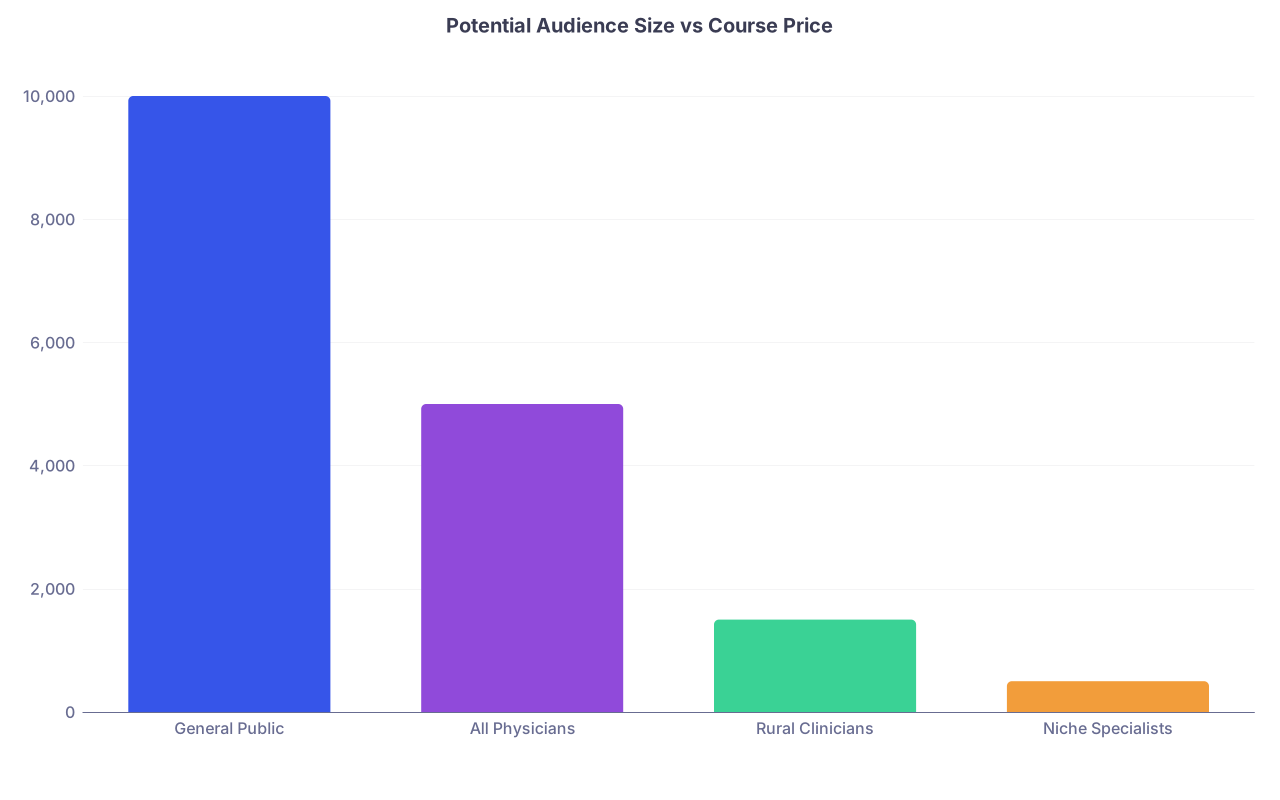
Potential audiences:
- Other clinicians (if you have a teaching bent).
- Non-physician clinicians (NPs, PAs) in similar environments.
- Health systems training their rural staff.
| Category | Value |
|---|---|
| General Public | 10000 |
| All Physicians | 5000 |
| Rural Clinicians | 1500 |
| Niche Specialists | 500 |
General pattern:
- The narrower and more specialized the audience, the higher you can charge per learner.
- The broader the audience, the more marketing you need.
How to approach this without drowning:
- Start by teaching live (Zoom workshop) before you record anything “final.”
- Use that to refine content and see if people will pay.
- Only after you’ve done it live 2–3 times and gotten real feedback, package it as an evergreen course.
You can run the whole thing from a rural town as long as your internet is decent and you’re willing to be on camera occasionally.
5. Consulting for Health Tech and Startups
Everyone loves to say “consulting” like that means anything. Let’s be concrete.
Types that work well for rural physicians:
- Product feedback and clinical workflow input for digital health tools.
- Advisory roles for startups targeting rural health, telemedicine, or primary care.
- EHR usability testing or clinical workflow design.
You don’t need to be a Stanford professor. You do need:
- Clear articulation of what rural reality looks like (poor connectivity, low health literacy, staff shortages).
- Willingness to say “this won’t work in a real clinic” and explain why.
Where to find this work:
- LinkedIn, yes—but not by posting inspirational quotes. By directly messaging founders or product managers in companies that clearly need rural insights.
- Alumni networks.
- Through any telehealth/care delivery companies you already work for.
If you see a health tech product that’s obviously missing the rural angle, you can credibly pitch yourself as the “rural clinical reality check.” That has value.
Step 3: Comparing the Main Options Side-by-Side
Here’s a rough comparison to help you pick what fits your situation best.
| Hustle Type | Schedule Flexibility | Startup Difficulty | Income Potential (Monthly) | Emotional Load |
|---|---|---|---|---|
| Volume Telehealth | Medium | Low | Low–Medium | Medium |
| Niche Telehealth | Medium | Medium–High | Medium–High | Medium |
| Medical Writing | High | Medium | Low–Medium | Low |
| Chart/File Review | High | Medium | Medium | Low–Medium |
| Online Courses | Low–Medium | High | Medium–High | Medium |
The point: if you’re drowning in call and have minimal bandwidth, medical writing or chart review are friendlier on your nervous system than building a personal brand and a course empire.
Step 4: Make This Work With a Rural Schedule (Call, Winters, and All)
Rural life adds some specific wrinkles. You don’t have Starbucks for “co-working.” Your internet might be sketchy. Weather can cut power. Call can be brutal.
So you build around that, not against it.
Protecting Time in a Chaotic Schedule
Rules that actually work:
Don’t chase daily consistency.
You’re not a YouTuber. You’re a doc with 24-hour shifts. Think in weekly units, not daily habits.
Example: “8–10 hours per week on the side hustle” instead of “1 hour per day.”Use your best brain, not your leftover brain.
Writing or strategic work is miserable at 10 p.m. after a 12-hour clinic day. Block 1–2 mornings or post-call afternoons for side-hustle work when you’re reasonably functional.Design “tiny, shippable units” of work.
- One article draft.
- One telehealth block.
- Two chart reviews.
- One video module.
Each sits in a 60–120 minute box. Nothing sprawling.
Infrastructure: Internet, Tech, and Privacy
You don’t need a tech palace. You do need:
- Solid internet. If your DSL is terrible, look into:
- Starlink or other satellite services.
- Cellular hotspots (often better in rural areas with good towers).
- Decent webcam and mic if you do telehealth or video.
- A private space with a neutral background—spare room, office, or even a converted shed if that’s what you’ve got.

Legal/privacy detail people forget:
- Use a different phone line (even just a separate VOIP or Google Voice) for side work.
- Separate email and calendars for side hustle vs hospital.
- Never mix hospital EMR or hardware with side-gig tech.
Step 5: One-Year Plan: From Zero to Functional Side Hustle
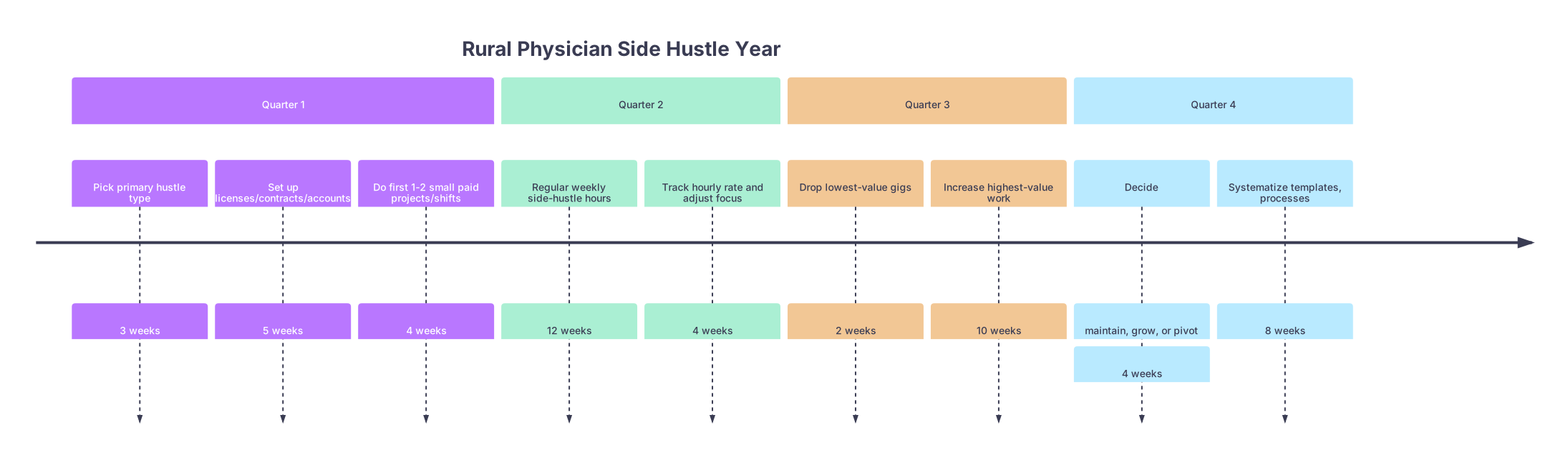
If you want a realistic, non-fantasy timeline, it looks something like this.
| Period | Event |
|---|---|
| Quarter 1 - Pick primary hustle type | 3 weeks |
| Quarter 1 - Set up licenses/contracts/accounts | 5 weeks |
| Quarter 1 - Do first 1-2 small paid projects/shifts | 4 weeks |
| Quarter 2 - Regular weekly side-hustle hours | 12 weeks |
| Quarter 2 - Track hourly rate and adjust focus | 4 weeks |
| Quarter 3 - Drop lowest-value gigs | 2 weeks |
| Quarter 3 - Increase highest-value work | 10 weeks |
| Quarter 4 - Decide | maintain, grow, or pivot |
| Quarter 4 - Systematize templates, processes | 8 weeks |
Quarter 1:
- Choose one primary lane.
- Get the boring logistics done (contracting, licensing, accounts).
- Aim for 1–2 small paid projects or shifts—just to break the psychological barrier.
Quarter 2:
- Commit to a weekly time target that’s sustainable (e.g., 6–10 hours).
- Do not obsess about “scale.” Obsess about learning:
- What pays best.
- What drains you.
- Where you’re surprisingly good.
Quarter 3:
- Ruthlessly drop low-value gigs. If a platform pays trash, leave.
- Double down on 1–2 best sources of work.
- Consider modest expansion (more state licenses, more clients) only if your life doesn’t feel worse.
Quarter 4:
- Decide if this is:
- A steady income stream to keep, or
- A bridge to something bigger (less clinical, more independent), or
- A failed experiment that told you what doesn’t fit. That’s still a win.
Step 6: Avoid These Common Traps
A few mistakes I’ve watched rural docs make over and over.
Chasing every idea at once.
Telehealth. Blog. Course. Social media. Consulting. Then nothing gets traction. Pick one primary, maybe one secondary. That’s it for the first 6–12 months.Underpricing because “it’s just extra.”
No. Your time is finite. If your side hustle consistently pays less than your clinical hourly rate and drains you, it better be building a long-term asset or skill. Otherwise, kill it.Ignoring contract details.
Watch for:- “Work for hire” language that takes all rights forever.
- Non-competes blocking you from other telehealth or similar writing work.
- Minimum shift or turnaround requirements that wreck your call flexibility.
Building in secret with zero support.
Rural docs can feel isolated. Use online communities—physician Facebook groups, Slack groups, listservs. You’re not the first person to try building a non-local income stream.
If You’re Reading This From a Call Room Right Now
If you’re mid-shift in a 25-bed hospital where you know half the patients’ kids by name, here’s the short version of what to do next:
Choose one realistic lane:
- Telehealth (volume or niche),
- Medical writing, or
- Chart/file review.
Commit to 4–8 hours per week for 3 months.
Non-negotiable, scheduled, and protected from random “could you just…” hospital asks.Get your first $1,000 from something not tied to your local employer.
That’s the turning point. Once you see money hit your account from work you did at your kitchen table or home office, the entire game looks different.
You do not need to move to a city, work fewer clinical hours, or become some online celebrity to build a location-independent side hustle. You need a focused lane, a realistic schedule, and the willingness to say no to low-value nonsense.
Key points to leave you with:
- Rural is not a handicap online. Your MD/DO and broad experience are marketable far beyond your zip code.
- Pick one path and run it for at least 3–6 months before judging it. Depth beats dabbling.
- Protect your time and your brain. The whole point is more control and options, not just a different way to burn out.