

You’re between cases, scrolling your phone in the physician lounge, looking at a $32,000 tax bill you just paid. Your colleague just bragged, “My CPA cut my tax by 20k this year once we fixed my entity structure.” Same income. Very different result.
Now you’re wondering: do you actually need some “physician-focused” CPA who markets on podcasts and conferences? Or is that just branding, and any competent tax pro can do the job?
Let’s cut through the noise.
The Short Answer: It Depends Who You Are and How You Earn
Here’s the blunt truth:
- If you’re a W‑2 employed hospitalist with no side gigs, no rental properties, and no complex investments, you probably don’t need a physician‑specialized CPA.
- If you’re an independent contractor, practice owner, or you’re stacking locums, 1099, telehealth, rentals, and backdoor Roths… you probably do need someone who actually knows physician tax issues cold.
The mistake I see all the time: high‑earning docs assuming “any CPA” means “good CPA.” It doesn’t. There are CPAs who barely know what a backdoor Roth is, let alone reasonable comp or group practice buy‑ins.
So the real question isn’t “physician‑specialized or not?”
It’s: “Does this person understand the real tax patterns physicians face and how the tax code interacts with your specific situation?”
Let’s break down when specialty matters, when it doesn’t, and exactly how to vet someone.
Why Physician‑Specific Knowledge Actually Matters
A good generalist CPA can handle a lot. But physicians have a few recurring themes that cause trouble when the tax pro doesn’t know what to look for.
1. Common Physician Income Structures
You’re not a standard 9–5 employee. Typical physician profiles:
- W‑2 employed by a hospital or large system
- W‑2 plus 1099 for moonlighting, locums, or telehealth
- Full 1099 independent contractor
- Partner or owner in a practice, ASC, or imaging center
- K‑1 income from group practices or private equity arrangements
Each one triggers different choices: entity type, retirement plans, deductions, payroll, and state tax exposure.
A CPA who “does small business taxes” but rarely sees physicians might:
- Miss when you should switch from sole prop to S corp
- Botch state income allocation when you do locums in multiple states
- Ignore practice‑specific benefits or buy‑in structures that change your tax picture
2. Retirement and Investment Moves That Are Very Physician‑Specific
High‑earning physicians are constantly dealing with things like:
- Backdoor Roth IRAs (and avoiding the pro‑rata trap)
- Mega backdoor Roth in 401(k)s (often mis-explained or ignored)
- Two or more 401(k)’s from multiple employers or side gigs
- Defined benefit / cash balance plans in private practices
- Non‑qualified deferred compensation from large hospital systems
A non‑specialized CPA might say “sure, we can do that” but then:
- Fail to track your traditional IRAs correctly → backdoor Roth gets partially taxed
- Misinterpret your multi‑401(k) limits → over-contribution mess
- Ignore the opportunity to layer a solo 401(k) on top of W‑2 income from a separate job
I’ve seen brand‑new attendings lose thousands in unnecessary tax because their preparer “didn’t really do” backdoor Roths and just winged it.
3. Entity Choice and “Reasonable Compensation” Issues
If you earn 1099 or own a practice, entity structure matters a lot:
- Sole proprietor vs single‑member LLC vs S corporation vs partnership
- Owner‑physician W‑2 salary vs distributions
- Adding a spouse on payroll or as an employee
- How much to pay yourself as “reasonable comp” to manage payroll vs pass‑through income
This is where physician‑specialized CPAs often earn their keep. They’ve done this exact dance for dozens of practices:
- Radiology groups
- Surgery groups
- Concierge or DPC
- Telehealth entities
- Anesthesia groups with complex call-pay
A non‑specialist might just say:
“Let’s do an S‑corp. Pay yourself $250k and distribute the rest.”
That might be fine. Or it might be lazy, poorly documented, and indefensible if audited.
You want someone who’s seen your type of income pattern dozens of times, not just once.
When “Any Good Tax Pro” Is Probably Enough
Let’s be fair here. Not everyone needs a boutique “physician‑only” firm that charges $3,000+ a year.
You’re likely fine with a strong generalist CPA or EA if:
- You’re W‑2 only, maybe with a tiny 1099 side thing under $10–15k
- No rental properties, no complex K‑1s, no private practice
- You’re not doing backdoor Roths, HSAs, or multi‑401(k) stacking yet
- You don’t live or work across multiple states
In that situation, your main needs are:
- Accurate return
- Basic optimization (HSA, FSA, retirement limits, itemized vs standard deduction)
- Good communication and responsiveness
That doesn’t require “physician specialization.”
It requires competence and attention.
If this is you, you can focus less on “physician branding” and more on:
- Credentials (CPA or EA, active license, no major disciplinary issues)
- Whether they actually answer questions and explain concepts
- Their comfort with high‑income W‑2 earners, AMT, RSUs/bonuses, etc.
Just don’t cheap out with a chain tax prep mill where the person doing your return in March also sells car insurance in April.
When You Really Should Consider a Physician‑Focused CPA
You’re in much more “you need real expertise” territory if any of these are true:
- You’re 1099 (locums, telehealth, anesthesia, EM, or surgical specialties)
- You own or are buying into a practice, ASC, or imaging center
- You have multiple 401(k)s (employee + solo, or multiple employers)
- You’re doing or want to do:
- Backdoor Roth IRAs
- Mega backdoor Roth
- Defined benefit or cash balance plans
- You do telemedicine or locums across multiple states
- You’re using or considering advanced things like:
- Cost segregation on rentals
- Short‑term rental tax strategies
- Physician‑owned real estate (office condo, building)
- You’re within a few years of a large liquidity event (practice sale, PE deal, big partnership buyout)
In these cases, the cost of a mediocre advisor is massive. Not just in extra tax, but in:
- Missed opportunities (plans you never set up)
- Bad structures that are painful and expensive to unwind
- Sloppy documentation that increases audit risk
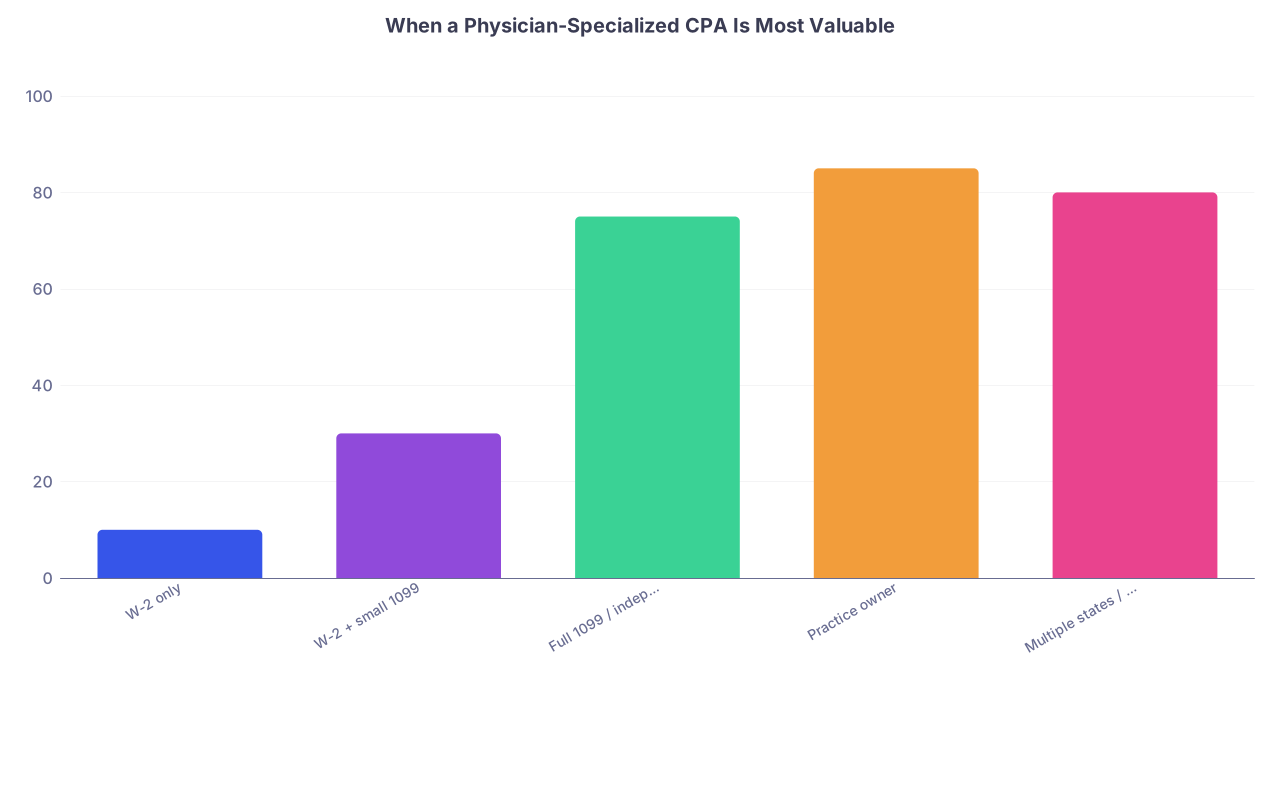
| Category | Value |
|---|---|
| W-2 only | 10 |
| W-2 + small 1099 | 30 |
| Full 1099 / independent | 75 |
| Practice owner | 85 |
| Multiple states / rentals | 80 |
That’s how I’d roughly “weight” how important a specialist is. Once you cross into full 1099 or ownership, the stakes jump.
How to Decide: A Simple Framework
Use this 3‑step filter.
Step 1: Classify Yourself
Which bucket are you in?
- Simple:
W‑2 only, no complex investments, no backdoor Roth, no side business. - Moderate:
W‑2 + some 1099, starting backdoor Roths, maybe 1–2 rentals. - Complex:
1099 heavy, practice owner, multi‑state work, advanced retirement plans.
Simple → strong generalist is fine.
Moderate → either a very good generalist who shows clear understanding, or a physician‑friendly CPA.
Complex → I’d strongly lean toward someone who already has a bench of physician and practice clients.
Step 2: Ask Better Questions in the First Call
Forget the website marketing. The initial call is where you find out if they’re the real deal.
Ask questions like:
- “How many physician or medical practice clients do you currently work with?”
- “How do you typically structure 1099 income for physicians? When do you use S‑corps vs disregarded LLCs?”
- “What’s your process for handling backdoor Roths to avoid the pro‑rata rule?”
- “Do you help setup and coordinate things like solo 401(k)s or cash balance plans, or just record what we do?”
- “How many clients do you have who work in more than one state?”
If they stumble on those or sound vague (“Oh, backdoor Roths… yeah, we can do those”), that’s not great.
You want crisp, specific answers. Ideally with examples.
Step 3: Compare Cost vs Value, Not Just Price
A lot of doctors get stuck here:
“My current guy is $500. The physician‑specialized one is $2,000. That’s a big jump.”
True. But run the math.
If the specialist:
- Shifts you into a better entity structure
- Adds or optimizes retirement plans
- Reduces self‑employment tax with rational, documented reasonable comp
- Fixes multi‑state filing issues you didn’t know you had
…saving $10k–$30k a year in tax is not uncommon for higher‑earning docs.
Paying an extra $1,500 for that? Obvious decision.
On the other hand, if you’re W‑2 only and they can’t articulate what they’d do differently, then yes, paying 4x just because their website says “for physicians” is dumb.
Red Flags: When “Any Tax Pro” Definitely Won’t Work
A few patterns that should make you walk away fast:
- They’ve never heard of a backdoor Roth IRA, or they say “those are illegal”
- They insist you “can’t” have more than one 401(k) without even asking for details
- They don’t ask about:
- Moonlighting
- Locums
- Telehealth
- CME and licensing costs
- Malpractice premiums
- They never bring up entity structure if you’re 1099
- Their entire relationship happens between March 1 and April 15 with zero proactive planning
If they’re just a glorified data‑entry service, it doesn’t matter what their niche is. They’re the wrong fit.
What a Good Physician‑Focused CPA Actually Does Differently
Let’s be concrete. Here’s what I see strong physician‑focused firms do that generic preparers often don’t:
- Ask about your compensation design: base, RVU, call pay, bonuses, partnership track
- Review your employment contract or IC agreement for tax‑relevant details
- Explain in plain English how your 1099 income should flow:
- Entity → payroll (if S‑corp) → distributions → retirement contributions
- Create a year‑round plan: estimated taxes, retirement contributions timing, and cash flow
- Coordinate with your financial planner and practice attorney so the tax, legal, and investment pieces line up
- Help you evaluate:
- Cash balance plan vs just maxing 401(k)
- Buying the building vs renting
- Structuring spouse involvement (if appropriate and legit)
This is planning, not just filing. Totally different level.
| Feature | Generalist CPA | Physician-Specialized CPA |
|---|---|---|
| Handles W-2 employee returns | Yes | Yes |
| Deep 1099/locums experience | Variable | Usually strong |
| Practice ownership/partnerships | Sometimes | Core client base |
| Backdoor Roth familiarity | Hit or miss | Should be routine |
| Multi-state physician work | Often weak | Much more common |
| Proactive tax planning | Variable | Common selling point |
How to Transition If You Decide to Upgrade
If you realize you’ve outgrown your current tax pro, don’t overcomplicate it.
Time it right
Best time is after this year’s return is filed and before Q3 estimated taxes. But honestly, any time is better than never.Ask for a prior‑year review
A good new CPA will often review your last 1–3 years to:- Find missed deductions
- Fix backdoor Roth errors
- Adjust entity/payroll going forward
Get all your files
Ask your old preparer for:- Full copies of prior year returns (with all schedules)
- Depreciation schedules (if you own property or equipment)
- Entity documents (if they helped set those up)
Don’t burn bridges
Just tell them you’re moving to someone with more experience in physician practices. That’s it.
Visual: When to Upgrade Tax Help

| Step | Description |
|---|---|
| Step 1 | Start |
| Step 2 | Have 1099 or practice income |
| Step 3 | Good generalist CPA is fine |
| Step 4 | Consider specialist or advanced generalist |
| Step 5 | Strongly consider physician CPA |
| Step 6 | Choose experienced CPA with physician clients |
| Step 7 | Income only W-2? |
| Step 8 | Any rentals or complex investments? |
| Step 9 | Own practice or big 1099? |
Common Physician Tax Planning Areas a Specialist Helps With
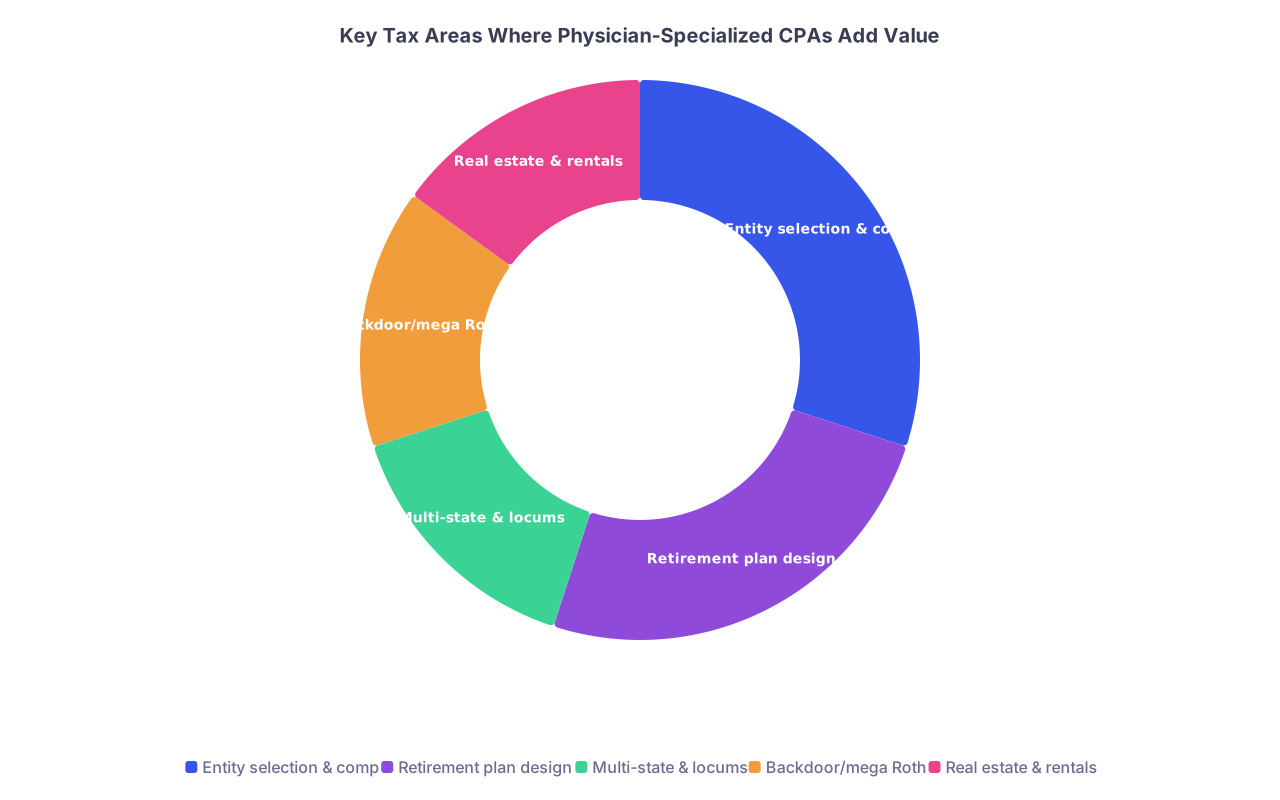
| Category | Value |
|---|---|
| Entity selection & comp | 30 |
| Retirement plan design | 25 |
| Multi-state & locums | 15 |
| Backdoor/mega Roth | 15 |
| Real estate & rentals | 15 |
Those five buckets are where I see the most mistakes from non‑specialized preparers working with high-earning physicians.

What To Do Next (Concrete Steps)
- Classify your complexity: simple, moderate, or complex.
- Decide what you actually want:
- Tax prep only
- Tax prep + proactive tax planning
- Interview 2–3 pros:
- At least one physician‑focused firm
- At least one high‑quality local or virtual generalist with high‑income clients
- Ask the pointed questions from earlier. Don’t be shy.
- Choose the one who:
- Understands your situation immediately
- Can clearly describe what they’d do differently or better
- Communicates in a way that makes sense to you
And if nobody impresses you? Keep looking. “Good enough” is expensive at a $400k+ income.

FAQs

1. I’m a W‑2 hospitalist making $320k, no side gigs. Do I need a physician‑specialized CPA?
Probably not. Your situation is high income but structurally simple. Focus on a competent CPA or EA who:
- Knows how to handle bonuses, state taxes, and AMT if applicable
- Reviews your withholdings
- Coordinates with your retirement contributions and HSA
If later you add 1099 work or rentals, then reassess.
2. I’m a new attending with 1099 moonlighting. Should I set up an LLC or S‑corp right away?
Don’t let anyone give you a blanket answer without numbers. Under roughly $60k–$80k of 1099 income, the S‑corp “savings” after payroll costs and admin burden may not be worth it. A good CPA (specialized or not) will run the math:
- Projected income
- State taxes
- Self‑employment tax impact
Then decide if/when an S‑corp makes sense.
3. How much should I expect to pay a good physician‑specialized CPA?
Ballpark ranges I see:
- Simple W‑2 + basic planning: $600–$1,200
- 1099/locums with entity, solo 401(k), and planning: $1,500–$3,000
- Practice owners with multiple entities and full planning: $3,000–$7,500+
If someone is charging $300 for a complex physician practice return, be suspicious. If someone wants $5,000 for a straight W‑2 return, they’re milking the “physician” label.
4. Is a CPA automatically better than an EA (Enrolled Agent) for physicians?
No. CPA is a broader accounting credential. EA is a tax‑specific federal credential. I’ve seen fantastic EAs who run circles around lazy CPAs on tax issues. For complex practice/partnership work, CPAs are more common, but I’d take a sharp EA with physician experience over a clueless CPA any day.
5. Can I switch CPAs if we’re already in the middle of tax season?
Yes, but it’s messy. If your old CPA has started the return, you’ll likely still owe them something. Better move: finish this year with them (if they’re competent, just not ideal), then switch after filing before the next season. If they’re genuinely making big mistakes, you may need to cut bait mid‑season. Just be direct and get copies of all documents.
6. My CPA never suggested a backdoor Roth. Did they screw up?
Maybe. If:
- Your income was above Roth limits,
- You didn’t have other pre‑tax IRAs,
- You had consistent savings capacity,
then yes, they missed an easy, high‑yield strategy. It’s not malpractice, but it’s a sign they’re not proactive. Bring it up. See how they respond. If they’re dismissive or confused, it’s a sign to upgrade.
7. I already work with a financial advisor. Do I still need a separate CPA?
Yes. Most financial advisors aren’t licensed to prepare tax returns, and many don’t go deep on technical tax rules. Ideal setup for complex situations:
- CPA for tax design and filing
- Fee‑only advisor for investments and long‑term planning
- Occasional attorney input for contracts and entity work
They should talk to each other. If your advisor is “handling your taxes” by themselves without being a CPA/EA, that’s a yellow flag.
Key takeaways:
- You don’t need a physician‑specialized CPA just for the title. You need someone who actually understands your specific income, benefits, and goals.
- Once you cross into 1099, practice ownership, multi‑state work, or advanced retirement planning, the value of a real physician‑savvy CPA usually dwarfs the extra cost.
- Stop guessing. Classify your complexity, ask pointed questions, and choose the person who clearly demonstrates they’ve solved your exact problems many times before.


