

The Backdoor Roth IRA is absolutely still worth it for most high‑earning physicians—but only if you do it correctly and you understand the traps.
Let me walk you through exactly when it makes sense, when it backfires, and how to decide in under 10 minutes whether you personally should still bother.
Quick Answer: Who Should Still Use a Backdoor Roth IRA?
If you’re a physician with:
- Income too high to contribute directly to a Roth IRA, and
- No (or very little) traditional/rollover SEP/SIMPLE IRA money in your name
…then yes, a Backdoor Roth IRA is still one of the best low‑effort, high‑value moves in physician tax planning.
You’re getting:
- Tax‑free growth
- Tax‑free withdrawals in retirement (if rules are followed)
- Protection against future higher tax rates
- More money in Roth space on top of your 401(k)/403(b) and possibly a Roth 401(k)
The key issue today isn’t “Is it still allowed?”—it is. The real issues:
- The pro‑rata rule (this is where most doctors screw it up).
- Interaction with your group’s retirement plan options.
- Whether the amount is actually meaningful in the context of your income and goals.
Let’s break those down.
Backdoor Roth Basics (30‑Second Refresher)
You earn too much to contribute directly to a Roth IRA. So you do it “through the backdoor”:
- Make a non‑deductible contribution to a traditional IRA (TIRA).
- Convert that money to a Roth IRA shortly after.
There’s no income limit on making a non‑deductible traditional IRA contribution. There’s also no income limit on doing a Roth conversion. When you pair those two, you’ve created a legal workaround.
For 2024:
- IRA contribution limit: $7,000
- Age 50+ catch‑up: extra $1,000 (so $8,000)
Married couple, both high‑income physicians, both eligible? That’s $14,000–$16,000 per year in Roth space, every year.
Does that move the needle over 20–30 years? Yes. In a serious way.
The Real Enemy: The Pro‑Rata Rule
This is the part nobody told you about at that hospital “financial wellness” lunch.
The IRS doesn’t let you pick and choose which IRA dollars you convert. For tax purposes, all your IRA money of the same type is one pot.
That includes:
- Traditional IRAs
- Rollover IRAs
- SEP IRAs
- SIMPLE IRAs
It does not include:
- 401(k), 403(b), 457(b)
- Solo 401(k)
- Defined benefit/cash balance plan
- Roth IRAs
If you have pre‑tax money in any traditional/SEP/SIMPLE IRA, the pro‑rata rule can make your Backdoor Roth partially taxable and messy.
Here’s a simple case:
- You contribute $7,000 non‑deductible this year to a new traditional IRA (basis = $7,000).
- You already have $93,000 in a rollover IRA from an old 401(k) (all pre‑tax).
- Total in all IRAs: $100,000 (7k after‑tax, 93k pre‑tax).
- You convert $7,000 to Roth.
The IRS says: 7% of that conversion is after‑tax, 93% is pre‑tax. So:
- $490 tax‑free
- $6,510 taxable as ordinary income
That’s not what you had in mind.
So the first question any high‑earning physician should ask before doing a Backdoor Roth:
“Do I have any pre‑tax money sitting in a traditional/rollover/SEP/SIMPLE IRA?”
If yes, you must fix this first or accept partial taxation.
How to “Fix” the Pro‑Rata Problem
There are three main solutions I’ve seen physicians use successfully.

1. Roll IRA money into an employer 401(k) or 403(b)
Best option if available and the plan is halfway decent.
- Many hospital and academic plans will accept incoming rollovers from traditional or rollover IRAs.
- Once the pre‑tax dollars are inside a 401(k)/403(b), they are not counted in the pro‑rata calculation.
- You’re left with a clean traditional IRA holding only your new non‑deductible contribution, which you then convert to Roth with almost no tax cost.
If your current employer plan is bad (high fees, poor funds), you still have to weigh:
- Slightly worse investment options vs
- The ability to get clean Backdoor Roth IRA contributions every year, tax‑free growth forever.
For most high earners, that trade is still worth it.
2. Set up a Solo 401(k) if you have any 1099 income
If you do consulting, locums, moonlighting, or any side gig as an independent contractor:
- You can open a Solo 401(k) in that business.
- Many Solo 401(k) providers (Fidelity, Vanguard, etc.) allow you to roll pre‑tax IRA money into the Solo 401(k).
- Same benefit: gets the pre‑tax IRA money off the pro‑rata radar.
Caveat: your 1099 needs to be legitimate business income, not just “I want to open a Solo 401(k).”
3. Skip the Backdoor Roth if it’s truly not fixable
Rare, but it happens.
Examples:
- No employer plan accepts rollovers
- No side 1099 income to support a Solo 401(k)
- Large SEP/SIMPLE IRA at a small practice that you can’t practically migrate
In this case, you may decide:
- Either accept partially taxable conversions (usually not great), or
- Focus on other tax‑advantaged options (mega backdoor Roth, taxable brokerage, HSA, etc.)
Is a Backdoor Roth Still Worth It in 2024+?
Short answer: yes, for most high‑earning physicians, it’s still a clear win.
Here’s why it hasn’t been killed yet—and why Congress keeps eyeing it but hasn’t pulled the plug:
- The dollar amounts are relatively small compared to 401(k)/403(b) limits.
- It mostly benefits people who are already saving aggressively.
- It’s easier politically to attack mega backdoor Roths and huge conversions than these $7k contributions.
And the upside is meaningful:
- Tax‑free growth for decades
- No RMDs (Required Minimum Distributions) during your lifetime on Roth IRAs
- Good asset to leave to heirs (even with the 10‑year distribution rule)
Combine that with your workplace plan, and you have a solid base of tax‑protected growth.
Backdoor Roth vs Other Retirement Vehicles for Physicians
Let’s be blunt. For a typical attending making $300k–$600k+ with good benefits, the Backdoor Roth is not the main engine of your retirement—but it’s a very efficient sidecar.
Here’s how it stacks up:
| Account Type | 2024 Limit (Under 50) | Tax Treatment Now | Tax Treatment Later |
|---|---|---|---|
| 401(k)/403(b) | $23,000 | Pre‑tax or Roth | Taxed or tax‑free |
| Cash Balance/DB | Varies, often $50k+ | Pre‑tax | Taxed later |
| Backdoor Roth IRA | $7,000 | After‑tax | Tax‑free |
| HSA | $4,150 (single) | Pre‑tax | Tax‑free (med use) |
| Taxable Brokerage | Unlimited | After‑tax | Capital gains/div |
You don’t pick Backdoor Roth instead of maxing your 401(k)/403(b) or HSA.
You do both.
The sequence I usually like for a high‑earning physician:
- Grab any employer match in 401(k)/403(b).
- Max HSA (if you’re in a high‑deductible plan).
- Max 401(k)/403(b) contributions.
- Do Backdoor Roth IRA (you and spouse if eligible).
- Fund taxable brokerage or practice/real estate investments.
- If available, explore cash balance/defined benefit or mega backdoor Roth.
Backdoor Roth is step 4 in that stack. Small dollars compared to everything else, but incredibly high‑quality dollars.
Common Mistakes Physicians Make with Backdoor Roths
And yes, I’ve seen all of these in real life.

Ignoring pre‑tax IRAs and triggering pro‑rata taxes
You already know this one. But it’s the #1 screwup.Waiting too long between contribution and conversion
The market goes up, your $7,000 becomes $7,400 before you convert. That $400 is taxable as ordinary income at your rate.
Fix: contribute, then convert soon after. A few days is fine.Not filing Form 8606 correctly
Form 8606 tracks your non‑deductible IRA basis. Miss it, and you risk paying tax twice on the same dollars later.
Every year you make a non‑deductible contribution, Form 8606 should be there.Accidentally deducting the IRA contribution
If you or your spouse are covered by a retirement plan at work and you’re high‑income, the traditional IRA contribution is usually non‑deductible.
Some tax software or uninformed preparers try to “help” and take a deduction. That breaks the strategy.Thinking a Backdoor Roth just means “convert anything to Roth”
I’ve seen attendings convert $200k+ of pre‑tax IRA money in one year because they thought that’s what “Backdoor Roth” meant. At 37% federal + state, that hurts.
Step‑by‑Step: How a High‑Earning Physician Should Do It
If you want the mechanical, “just tell me what to do” version, here it is.

| Step | Description |
|---|---|
| Step 1 | Check for pre tax IRAs |
| Step 2 | Open traditional IRA |
| Step 3 | Roll to 401k or Solo 401k |
| Step 4 | Contribute non deductible IRA |
| Step 5 | Wait a few days |
| Step 6 | Convert to Roth IRA |
| Step 7 | Invest in chosen funds |
| Step 8 | File Form 8606 with tax return |
| Step 9 | Any traditional SEP SIMPLE IRA? |
- Confirm you have no pre‑tax IRA balances (or move them into a 401(k)/403(b)/Solo 401(k)).
- Open a traditional IRA (if you don’t already have one) at a low‑cost brokerage.
- Contribute up to $7,000 (or $8,000 if 50+) as a non‑deductible contribution.
- After the money settles, convert that amount to a Roth IRA at the same brokerage.
- Invest the Roth IRA in a sensible long‑term allocation (e.g., total stock market / total international).
- At tax time, make sure Form 8606 is correctly completed and filed.
That’s it. Once you’ve done it once, repeating annually is straightforward.
“But the Law Might Change—Is It Still Worth It?”
Here’s the honest answer: yes, because you’re playing a decades‑long game, and this is one of the lowest‑risk moves you can make.
Congress has talked about killing the Backdoor Roth and mega Backdoor Roth multiple times (Build Back Better bill, for example). So far, nothing has stuck for standard‑size Backdoor Roths.
If they kill it in 5 years?
- You still had 5 years of Roth contributions and tax‑free growth.
- They’re extremely unlikely to retroactively tax already done conversions. That would be political suicide.
So you’re weighing:
- Upside: decades of tax‑free growth on $7k/year per person.
- Downside: the strategy is closed in the future, but you keep what you already did.
That’s an easy call.
When a Backdoor Roth Might Not Be Worth It
There are a few edge cases where I’d tell a physician to skip it.
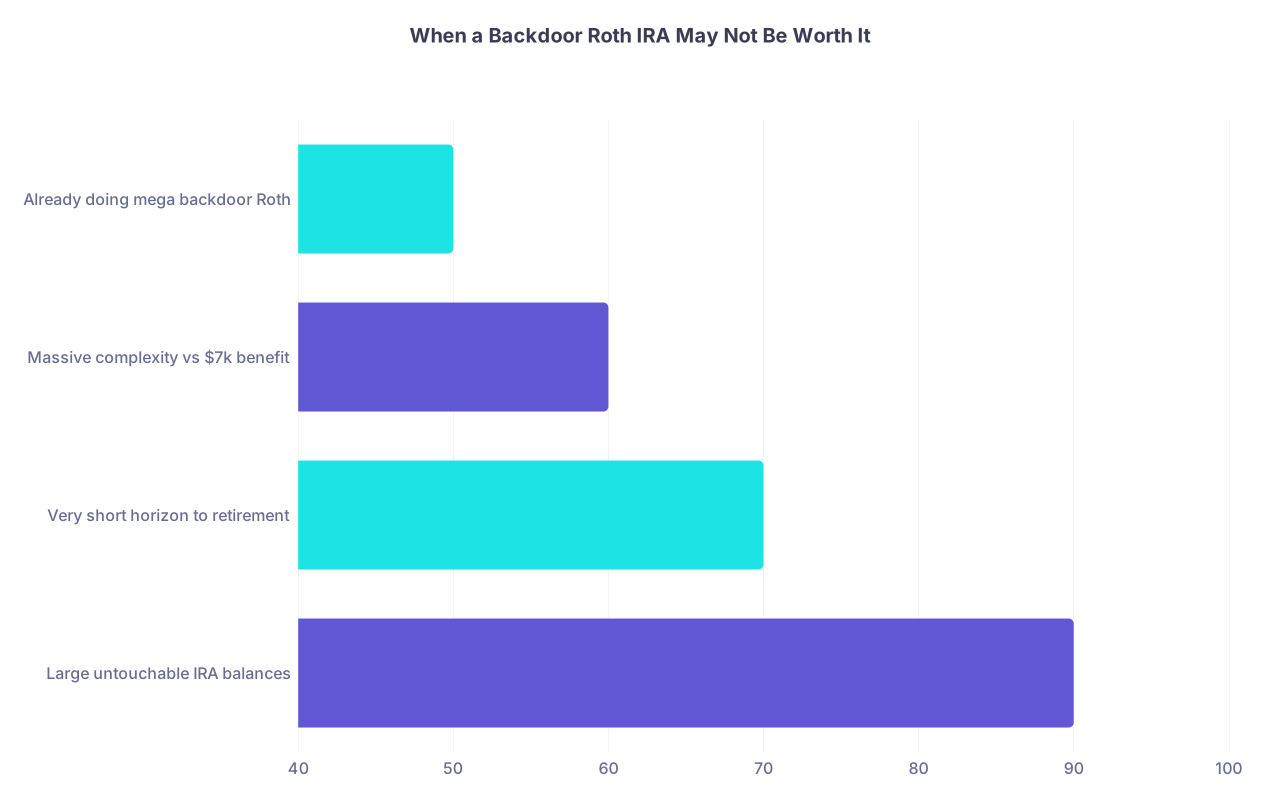
| Category | Value |
|---|---|
| Large untouchable IRA balances | 90 |
| Very short horizon to retirement | 70 |
| Massive complexity vs $7k benefit | 60 |
| Already doing mega backdoor Roth | 50 |
Possible “skip it” scenarios:
Huge, unmovable pre‑tax IRAs
Example: multiple six‑figure SEP IRAs with a small practice that won’t adopt a 401(k). You’d pay a lot of tax to “clean it up,” and the benefit from a $7k/year Backdoor Roth might not justify that pain.You’re 2–3 years from retirement and barely saving
The benefit from 2–3 years of small Roth contributions is minimal compared with bigger levers like tax‑efficient withdrawals, Roth conversions in retirement, or selling a practice.You’re already stuffing huge amounts into Roth via a mega backdoor Roth in your 401(k)
If your plan lets you put $20k–$30k+ extra after‑tax and convert in‑plan to Roth every year, the regular Backdoor Roth becomes marginal. Still good, but not essential.You or your CPA consistently botch the paperwork
If every tax season is a mess with mis‑filed 8606s and pro‑rata confusion, the headache may outweigh the benefit—unless you fix the process by getting better help.
Putting It All Together: Decision Framework for Physicians
If you want this condensed into a 30‑second decision tree, here you go.

| Step | Description |
|---|---|
| Step 1 | High earning physician |
| Step 2 | Just do direct Roth IRA |
| Step 3 | Check for pre tax IRAs |
| Step 4 | Do Backdoor Roth IRA |
| Step 5 | Roll funds then do Backdoor Roth |
| Step 6 | Partial taxable conversion Backdoor |
| Step 7 | Skip Backdoor Roth focus on other accounts |
| Step 8 | Eligible for direct Roth IRA? |
| Step 9 | Any traditional SEP SIMPLE IRA balance? |
| Step 10 | Can roll to 401k or Solo 401k? |
| Step 11 | Willing to accept pro rata taxes? |
The bottom line:
- If you’re a high‑earning physician with no pre‑tax IRAs you can’t move, a Backdoor Roth IRA is still one of the cleanest tax planning wins available to you.
- If you have big messy IRAs and no way to roll them into a 401(k), you need a more careful calculation—sometimes the Backdoor is not worth forcing.
But default assumption? It’s still very much alive, and still very much worth doing.
FAQ: Backdoor Roth IRA for High‑Earning Physicians
Can I get in trouble with the IRS for doing a Backdoor Roth IRA?
No, not if it’s done correctly. The Backdoor Roth is simply a combination of a non‑deductible traditional IRA contribution and a Roth conversion—both explicitly allowed by the tax code. The IRS doesn’t love it, but they’ve seen it for years. The risk comes from executing it wrong (pro‑rata issues, missed Form 8606, mis‑reported basis), not from the concept itself.Should I wait between the contribution and conversion to avoid the “step transaction doctrine”?
In practice, no. Most physicians and planners I’ve seen contribute and then convert within a few days, once funds settle. The IRS has had over a decade to challenge this pattern and hasn’t. Waiting months just creates more taxable growth before conversion. A short, clean interval is fine.What if I accidentally earned a few dollars in the traditional IRA before converting?
Then that small gain is taxable as ordinary income in the year of conversion. For example, if your $7,000 grew to $7,050 before conversion, $50 is taxable. It’s not a disaster; it’s just reported on your return. Try to keep the lag short to minimize this.Can I still do a Backdoor Roth if I’m in a cash balance or defined benefit plan through my group?
Yes. Cash balance and defined benefit plans do not count in the pro‑rata IRA calculation. They’re separate qualified plans, like a 401(k). The only issue is whether your practice has SEP/SIMPLE/traditional IRAs as part of its structure. If your retirement benefits are a 401(k) plus a cash balance plan, that usually plays very nicely with doing annual Backdoor Roth IRAs.My spouse doesn’t work—can we still do a Backdoor Roth in their name?
Yes, if you file jointly and have enough earned income to cover both contributions. This is called a spousal IRA. You can contribute up to the full IRA limit for your non‑working spouse, then convert via the Backdoor route in their name, assuming they also don’t have problematic pre‑tax IRA balances. That effectively doubles your Roth space as a household.
Key points to remember:
- For most high‑earning physicians, a clean Backdoor Roth IRA is still absolutely worth doing each year.
- The pro‑rata rule and pre‑tax IRA balances are the critical pitfalls—solve that and the rest is straightforward.
- It’s not your main retirement engine, but it’s one of the highest‑quality, lowest‑friction moves in your entire tax planning toolkit.


