

What exactly happens to your tax bill if you drop $100k into a real estate syndication that promises “massive bonus depreciation” and “paper losses”? Does it actually reduce your taxes—or just create pretty K‑1s that do nothing?
Here’s the answer you’re looking for:
Real estate syndication can be a legit, powerful tax tool for physicians.
But it only actually lowers your current tax bill in specific situations. For most W‑2 doctors, the tax benefits are often delayed (or oversold) unless you structure it right.
Let’s walk through what’s real, what’s hype, and how to use syndications without getting burned.
Quick Baseline: What Is a Real Estate Syndication, Really?
Strip away the jargon. A real estate syndication is:
- A group investment in a specific property or portfolio (usually apartments, self‑storage, industrial, etc.)
- Run by a sponsor/general partner (GP) who finds the deal, arranges financing, manages renovations/operations
- Funded by limited partners (LPs) like you who put in money but don’t do the day‑to‑day work
You, as a busy physician, are almost always coming in as an LP.
Your role:
- You invest (say $50k–$250k)
- You get a K‑1 at tax time
- You get distributions (ideally)
- You have no active management or legal control
For tax purposes, that’s critical:
You’re almost always considered a passive investor unless you qualify as a Real Estate Professional (REP) and materially participate, which most full‑time doctors don’t.
That “passive” label is the dividing line between “this saves you a ton in taxes now” and “this is just a long‑term nice‑to‑have.”
How Syndication Tax Benefits Actually Work
Let me break down the mechanics, because this is where a lot of sales pitches get fuzzy.
1. Depreciation and Bonus Depreciation
Real estate gets depreciated. The building value (not land) is deducted over 27.5 years (residential) or 39 years (commercial).
Syndications often use a cost segregation study to accelerate this:
- They break the property into components (carpets, appliances, parking lots, fixtures)
- Shorter‑life components (5–15 years) can be bonus depreciated in year 1
- Result: large paper losses early, even if the property is cash‑flow positive
Example:
You invest $100k into a multifamily syndication.
The syndication does cost seg + bonus depreciation.
Your K‑1 in year 1 shows a $50k passive loss even though you got, say, $5k of cash distributions.
So far, so good. This is real. This is how big operators pay very little tax on large cash flows.
But then comes the key question: can you use that $50k loss?
2. Passive vs Non‑Passive Income: The Brick Wall
The IRS splits income into:
- Non‑passive (active): W‑2 wages, 1099 clinical income, business income where you materially participate
- Passive: Rental real estate (unless you’re REP), LP stakes in syndications, other investments where you’re not active
Rule:
Passive losses can only offset passive income.
They do not offset your W‑2 salary or 1099 consulting, unless you qualify for special exceptions (we’ll hit those).
So for a standard W‑2 attending making $400k with no other rentals:
- That $50k passive loss from the syndication will NOT lower your tax bill this year
- It becomes a suspended passive loss
- It carries forward indefinitely
- You use it later against:
- Passive income from other real estate or syndications, or
- The gain when that specific syndication sells or you dispose of your interest
This is where a lot of physicians feel misled—because no one explained that “bonus depreciation” ≠ “automatically lower taxes this year.”
When Syndications Do Give You Big Immediate Tax Savings
There are three main ways a syndication can crush your current tax bill instead of just building future benefits.
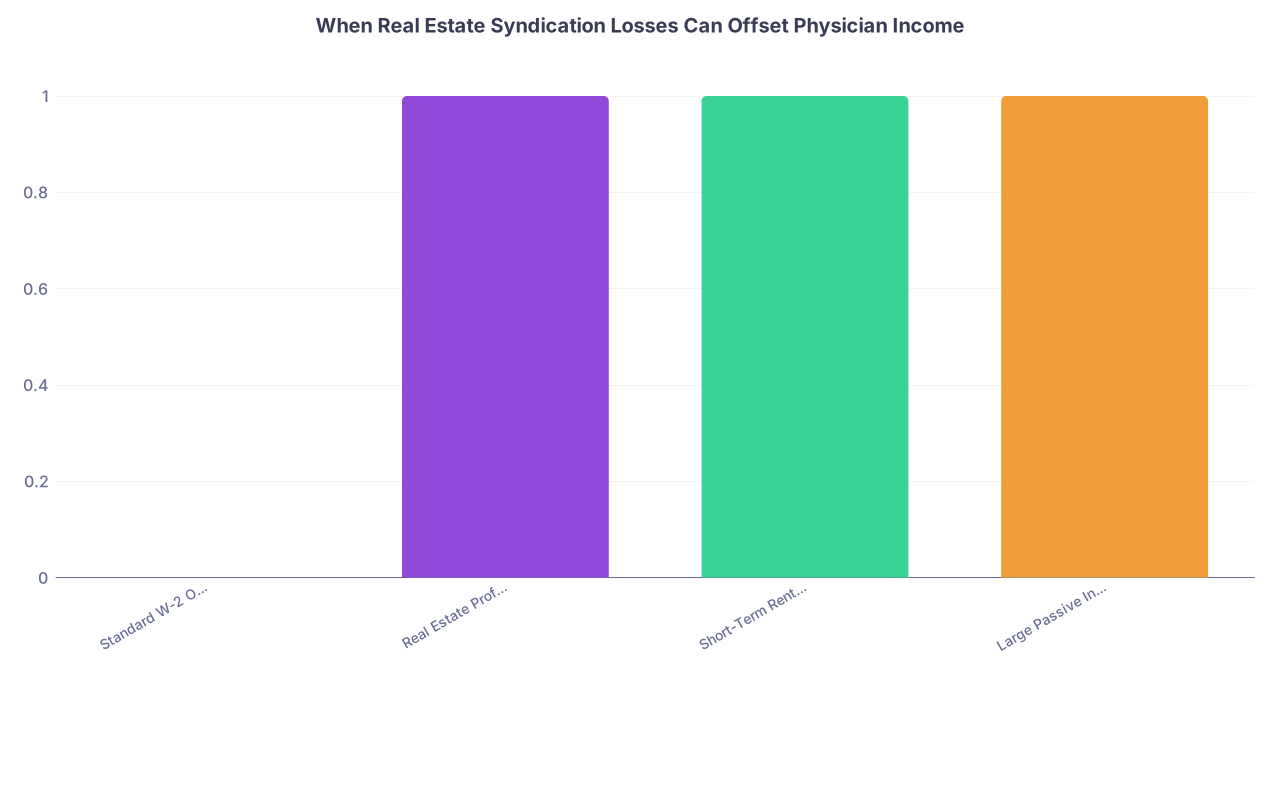
| Category | Value |
|---|---|
| Standard W-2 Only | 0 |
| Real Estate Professional | 1 |
| Short-Term Rental Strategy | 1 |
| Large Passive Income Already | 1 |
1. You (or your spouse) Qualify as a Real Estate Professional (REP)
This is the big one. If you or your spouse is a REP and you materially participate in your rental activities, your rental income and losses can be non‑passive.
High level REP criteria:
- More than 750 hours per year in real property trades or businesses
- More than half of your total work time is in real estate
- Material participation in the specific activity (hours, decisions, involvement)
Real talk:
If you’re a full‑time physician (>40 hrs/week) and you’re claiming REP for yourself, you’d better have immaculate documentation and a very gutsy tax advisor. The IRS has beaten plenty of people in court on this.
More realistic path for physicians:
Your spouse becomes REP, manages a portfolio of rentals, and materially participates.
Then, large bonus depreciation from a syndication or your own rentals can offset the family’s W‑2/1099 income.
Used correctly, this can turn a $150k+ annual tax bill into something much smaller. Used sloppily, it can trigger audits and very expensive lessons.
2. You’re Playing the Short-Term Rental (STR) Game (Separate from Syndications)
Different but related strategy:
Short‑term rentals (average stay < 7 days) can avoid the passive activity rules if you materially participate, even without REP status.
That means STR losses (enhanced by bonus depreciation) can in some cases offset W‑2/1099 income. But this is typically not a pure “syndication” move; STR syndications where you materially participate are rare for busy docs.
I mention it because people often see these two strategies mixed together in the same podcast episode and walk away confused.
3. You Already Have Significant Passive Income
If you already have big passive income:
- Cash‑flowing rentals
- Other syndications that are spinning off taxable income
- K‑1s from businesses where you’re passive
Then those big paper losses from a new syndication can absolutely wipe out the passive income and lower your current tax bill.
For example:
You have $80k of passive income from older deals.
You invest in a new syndication that generates a $100k passive loss.
Result: your taxable passive income drops to zero, and $20k of loss carries forward.
No REP required. Just matching buckets correctly.
So… Is Real Estate Syndication a “Legit” Tax Strategy?
Yes—if you understand what “tax strategy” actually means here.
For most physicians, syndications are:
- A way to convert cash flow into tax‑deferred wealth, not totally tax‑free
- A machine that generates suspended passive losses you’ll use later
- A powerful accelerator if you pair them with REP or a planned passive income stack
Where it becomes not legit is in the marketing:
- “You can wipe out your W‑2 income with one deal” → usually false for full‑time docs
- “This is how doctors pay zero taxes” → half‑truth at best
- “The IRS designed this for you” → no, the IRS is not your friend
Used correctly, syndications are a legit part of a physician tax plan.
Used naïvely, they’re just another illiquid investment with a pretty K‑1 that doesn’t move your actual tax bill for years.
What Busy Physicians Should Look At Before Investing
Here’s how I’d structure the decision if you’re considering syndications primarily for tax reasons.
| Question | If Mostly 'Yes' | If Mostly 'No' |
|---|---|---|
| Have REP spouse / real plan? | Tax strategy can be front and center | Treat tax as secondary benefit |
| Have existing passive income? | Losses likely useful now | Losses likely suspended, used at exit |
| Understand illiquidity risk? | Proceed carefully | Slow down, get educated |
| Trust the sponsor + due diligence? | Might be worth allocating capital | Do not invest for tax benefits alone |
| Working with tax pro who gets RE? | Easier to execute, less audit risk | Higher chance of missteps/misunderstanding |
1. Start with the Investment, Then the Tax
If the deal stunk but had great tax losses, would you still invest?
If the answer is yes, you’re in danger territory.
You should be evaluating:
- Sponsor track record (full cycle deals, not just pro formas)
- Fees (acquisition, asset management, refinance, disposition)
- Debt structure (fixed vs variable, maturity, rate caps)
- Business plan realism (is that 25% rent growth fantasy?)
- Your own liquidity and time horizon
The tax benefit is a secondary filter, not the first reason to wire $100k.
2. Get Very Clear on Your Tax Profile
This is where an actual tax pro who understands real estate is non‑negotiable. Not your cousin’s friend who mostly does basic 1040s.
You want to know:
- Your projected W‑2 / 1099 income
- Current and expected passive income
- Whether REP or STR strategies are on the table
- How much loss you can really use this year and the next 3–5
Then ask specifically:
“If I invest $X in this type of syndication, with typical bonus depreciation, what impact will it have on my actual tax owed in years 1–5?”
If your CPA can’t answer that in real numbers, they’re not the right person for this game.
Legal & Audit Risk: Where Docs Get In Trouble

Let me be blunt: the IRS has seen all the tricks.
Red flags for audits in this space:
- Full‑time W‑2 physician claiming REP with minimal documentation
- “Consultant” firms selling cookie‑cutter REP “packages” with almost no real participation
- Losses that consistently wipe out all earned income without a credible real estate activity
- Huge K‑1 losses combined with zero understanding of the underlying investments
If you want to be aggressive, you need:
- Detailed time logs if claiming REP or material participation
- Real decision‑making involvement (not just signing a PPM)
- A CPA who is willing to sign their name to the return and defend it
If you want to be conservative (which most docs should):
- Treat syndication losses as passive
- Plan to use them against future passive income and sale gains
- Use the structure as long‑term tax deferral and diversification, not instant tax magic
Where Syndications Fit in a Physician’s Bigger Plan
Here’s the sane way to think about it.
For most busy physicians, real estate syndications are best used as:
- A diversifier away from pure stocks/bonds
- A tax‑efficient way to grow wealth in a separate bucket
- A future lever: build up suspended losses now, use them later when passive income ramps or deals sell

| Step | Description |
|---|---|
| Step 1 | Physician Income Profile |
| Step 2 | Use Syndications for Passive Loss Build Up |
| Step 3 | Coordinate With Tax Pro |
| Step 4 | Offset Future Passive Income and Sale Gains |
| Step 5 | Model Actual Tax Impact Before Investing |
| Step 6 | Target Deals With Strong Economics and Depreciation |
| Step 7 | REP or STR Plan? |
If your primary goal is to cut your tax bill this year:
- REP with an involved spouse plus targeted syndication and direct ownership can do that
- STR strategy plus cost seg can do that
But if your primary goal is: “I want to invest in real estate, not manage tenants, and be reasonably tax‑efficient along the way,” then:
- Syndications are legit
- The tax benefits are real
- They just don’t always show up where the podcasts make it sound like they will
FAQs: Real Estate Syndications & Physician Taxes
1. I’m a full‑time W‑2 hospitalist. If I invest $100k in a syndication, will it lower my taxes this year?
Probably not, at least not directly. You’ll almost certainly get a passive loss on your K‑1 thanks to bonus depreciation, but as a full‑time W‑2 doc who isn’t REP, that loss is passive. It can’t offset your W‑2 income. It will carry forward and can be used against future passive income or when that deal sells.
2. What if my spouse doesn’t work or works part‑time—can they be the Real Estate Professional?
Yes, that’s exactly how many physician families structure it. If your spouse truly meets the REP requirements (750+ hours, more than half of their work time in real estate, real material participation in the properties), then rental real estate losses—including from syndications in some cases—can offset your active income. But it has to be real work with strong documentation, not just signing forms.
3. Are all syndications equal from a tax perspective, or do some give better losses?
They’re not equal. Syndications that do cost segregation and aggressively use bonus depreciation will front‑load bigger paper losses. Asset type matters too—multifamily and self‑storage often have lots of depreciable components. You should be asking sponsors directly: “Do you typically do cost seg studies?” and “What kind of year‑1 loss-to-investment ratio have your past deals produced?”
4. What happens to all those suspended passive losses when the property sells?
Good news here: when your interest in that passive activity is fully disposed of in a taxable transaction (e.g., the syndication sells the asset and the entity winds down, or you sell your entire interest), your suspended passive losses are freed up. They can offset the gain from the sale and then other income in the passive bucket. This is where a lot of the true tax efficiency shows up: at exit, not at year 1.
5. Bottom line—should I invest in real estate syndications mainly for tax reasons as a busy physician?
No. You should invest in syndications primarily because you believe in the deal quality, sponsor, and long‑term wealth‑building potential. The tax benefits are very real but often delayed or limited unless you have a REP/STR strategy or existing passive income. Use them as a tax‑efficient investment, not as your primary tax‑reduction hammer. If someone’s pitch is “this will erase your W‑2 taxes,” walk away or get a second opinion from a serious real‑estate‑savvy CPA.
Key points to walk away with:
- Syndication tax losses are usually passive for physicians, so they don’t touch your W‑2 income unless you have REP/STR strategies or other significant passive income.
- The tax benefits are legit, but often back‑loaded—they shine when you have passive income or at exit, not always in year 1.
- Never let tax tail wag the investment dog; the deal quality and sponsor matter more than the K‑1 optics.


