

The biggest mistake new physicians make with W‑2 vs 1099 is thinking, “1099 means more money.” That’s flat-out wrong for most first jobs.
You’re really choosing between two completely different tax and risk setups. Not just a form.
Let’s walk through how to actually decide.
Quick Answer: Who Should Pick What?
If you want the bottom line first, here it is:
- If this is your first real attending job and you’re not already working with a CPA or advisor:
- Default to W‑2 unless there’s a very clear financial upside and you understand the tradeoffs.
- If you’re already comfortable with estimated taxes, retirement plans, and keeping records, and the 1099 rate is materially higher:
- 1099 can win—if the pay bump is big enough and you actually use the extra flexibility.
But that’s too simplistic. You need to see how the money, taxes, and benefits shake out side by side.
What’s the Actual Difference Between W‑2 and 1099?
Forget the IRS jargon. Here’s what it means in your life.
W‑2 (Employee)
Hospital or group hires you as an employee.
They:
- Withhold taxes from your paycheck
- Pay half of your Social Security/Medicare taxes
- Usually provide benefits: health insurance, 401(k)/403(b), malpractice (often), CME, etc.
You:
- File your taxes like a “normal” worker
- Cannot deduct most job-related expenses against W‑2 income anymore (post-2018)
- Generally have simpler, more predictable cash flow
1099 (Independent Contractor)
You’re paid as a contractor, not an employee.
They:
- Pay you gross, no taxes withheld
- Don’t owe you benefits, PTO, or job protections
- Usually give you a higher hourly or per‑shift rate to compensate (at least they should)
You:
- Pay both halves of Social Security/Medicare (self-employment tax)
- Cover your own benefits, malpractice (sometimes), CME, licensure, etc.
- Can deduct business expenses and possibly set up powerful retirement plans
- Have to handle estimated taxes during the year
So you’re not just picking a form. You’re picking:
- Cash now vs. benefits + structure
- Simplicity vs. flexibility
- Training wheels vs. full control
Follow This Framework: 7 Key Tax + Money Factors
Use this as your decision checklist. If you can’t answer these comfortably for a 1099 offer, you’re not ready to pick it.

| Step | Description |
|---|---|
| Step 1 | New Job Offer |
| Step 2 | W2 usually better |
| Step 3 | Need detailed cost comparison |
| Step 4 | 1099 can be good |
| Step 5 | Is pay 1099 vs W2 at least 15 to 20 percent higher? |
| Step 6 | Are benefits for W2 strong health, retirement, malpractice? |
| Step 7 | Comfortable with taxes and saving 30 to 40 percent? |
1. Total Compensation, Not Just Hourly Rate
Hospitals love to throw an attractive 1099 hourly rate at you. You need to translate that to total value.
Compare:
W‑2 offer:
- Base salary + bonus
- Employer 401(k)/403(b) match
- Health insurance subsidy
- Malpractice coverage (claims-made vs occurrence)
- CME, licensing, DEA, board fees
- Disability and life insurance
- PTO (paid vacation, CME days)
1099 offer:
- Higher rate… maybe
- No benefits by default
- You pay for everything above out of pocket
Rough rule: if the 1099 rate isn’t at least 15–20% higher than the effective W‑2 compensation after valuing benefits, 1099 usually isn’t worth the hassle for a new attending.
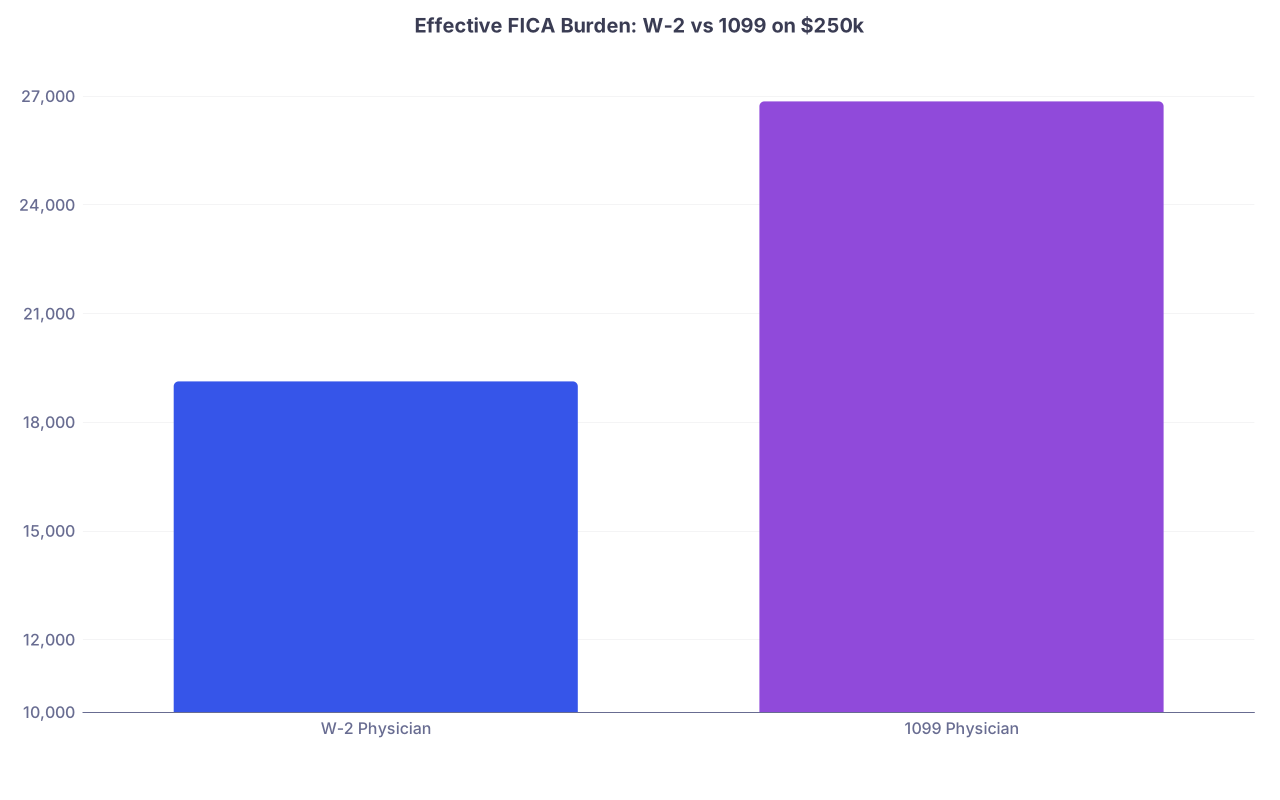
2. Payroll vs Self-Employment Tax: Who Pays FICA?
On W‑2:
- You pay 7.65% FICA (Social Security + Medicare) on wage income.
- Employer pays the other 7.65%.
On 1099:
- You pay both halves as self-employment tax:
- 15.3% on the first Social Security wage base
- Plus additional Medicare tax at higher incomes
Yes, you can deduct half of the self-employment tax, but the cash still leaves your pocket first.
This alone can eat a chunk of that “higher 1099 pay.”
| Category | Value |
|---|---|
| W-2 Physician | 19125 |
| 1099 Physician | 26850 |
(Values are illustrative, not exact; point is: 1099 owes more unless you plan aggressively.)
3. Benefits and Insurance: Are You Ready to Be HR?
On W‑2, HR does all the unsexy but crucial stuff.
On 1099, you are HR. You must set up and pay for:
- Health insurance: typically via ACA marketplace or spouse’s plan
- Malpractice: if not provided by the facility
- Retirement plan: solo 401(k), SEP IRA, etc.
- Disability and life insurance: individual policies
- CME, licensure, DEA, credentialing costs
- Tail coverage if your contract requires it
If the group is calling it “1099” but:
- Dictating your hours
- Requiring you to be on site
- Providing tools and oversight like an employee
Then you may be a misclassified employee. Which is an IRS problem waiting to happen—for them and potentially for you.
How Retirement and Tax Planning Change
Here’s where 1099 can absolutely crush W‑2—if your income is high enough and you actually use the tools.
4. Retirement Plan Options: W‑2 vs 1099
For W‑2 physicians:
- Employer 401(k)/403(b)
- 2025 employee deferral limit: check current IRS limit (roughly mid-$20k range historically)
- Possible employer match
- Might have 457(b) (if a government or certain non-profit employers)
- Maybe a backdoor Roth IRA
For 1099 physicians:
You can create your own “mini plan sponsor” setup.
Common options:
- Solo 401(k)
- Employee deferral up to the standard 401(k) limit
- Plus employer profit-sharing up to a total limit (much higher than employee-only limit)
- SEP IRA
- Contribution up to 25% of net self-employment income, capped at the annual limit
- Backdoor Roth IRA (still available)
This means a high-earning 1099 doc can often shelter more into tax-advantaged accounts than a W‑2-only doc—especially if you have no existing employer plan.
| Feature | W-2 Only Physician | 1099 Physician (Solo) |
|---|---|---|
| Choose plan provider | Rarely | Yes |
| Maximize beyond one plan | Often limited | Much more flexibility |
| Admin responsibility | Low | High |
| Typical annual limit | Standard 401k limit | Potentially much higher |
If you’re not going to max these accounts, a big chunk of the 1099 advantage disappears.
5. Deductions: What Can You Actually Write Off?
This is where people wildly overestimate 1099 benefits.
On W‑2, after the 2017 tax law changes, you generally can’t deduct most “employee business expenses” on your federal return. Scrubs, home office, CME, mileage? Mostly dead for federal taxes (state rules vary).
On 1099, reasonable and necessary business expenses become deductible against your income:
- Malpractice premiums
- CME, board review, conferences
- Licensing fees, DEA registration
- Professional society dues
- A portion of cell phone and internet (business share)
- Home office (if used regularly and exclusively for the business)
- Computer, software, EHR tools
- Travel for locums or multiple sites
But here’s the catch no one tells you:
If you don’t actually spend much on these things (because employer pays them), your deductions are small. A 1099 label doesn’t magically create big write-offs. They come from real spending.
Cash Flow and Administrative Load
This part is boring. And it’s exactly where new attendings get burned.
6. Taxes: Withholding vs Quarterly Estimates
W‑2:
- Employer withholds federal and state taxes.
- You might adjust your W‑4 once and forget about it.
- Filing is straightforward: W‑2 plus a few extra forms for investments.
1099:
- No taxes taken out.
- You must:
- Track income and expenses
- Pay quarterly estimated taxes (federal and usually state)
- File a Schedule C (or K‑1 if you go entity route like an S‑corp)
- Possibly make state franchise or entity-level tax payments
Miss estimates? You may owe:
- A large balance in April
- Penalties and interest for underpayment
I’ve watched new 1099 physicians spend their first two years just digging out of unexpected tax bills because they didn’t set aside enough cash.
A safe starting rule for 1099:
Set aside 30–40% of your gross 1099 income into a separate tax account immediately.

| Category | Value |
|---|---|
| Taxes | 35 |
| Living Expenses | 45 |
| Savings/Investing | 20 |
You can refine that once you have a CPA and real numbers.
7. Risk, Autonomy, and Legal Exposure
W‑2:
- More job protections
- Employment law benefits (unemployment, anti-discrimination protections, sometimes stronger for W‑2)
- Often easier underwriting for mortgages (lenders like W‑2 paystubs)
- Clearer malpractice coverage, especially if the employer provides tail
1099:
- More “at will” in practice—easier for them to drop your shifts
- You might need your own entity (LLC, PLLC, PC) depending on state and contract
- Legal exposure flows through that entity, and malpractice must be carefully structured
You’re also more portable with 1099. Want to work 3 different hospitals via locums? Fine. Need time off? You usually just don’t book shifts.
When 1099 Clearly Wins vs When W‑2 Is Safer
Let’s be blunt.
1099 usually makes sense when:
- You’re doing locums, multiple sites, or part-time gig-style work
- The rate is significantly higher (often 25–40% or more above typical W‑2 equivalents)
- You have or will hire:
- A CPA who understands physicians
- Ideally a financial planner familiar with attending-level income
- You’re disciplined about:
- Saving for taxes
- Funding retirement accounts
- Keeping records and receipts
W‑2 usually makes sense when:
- This is your first attending job
- You want stable income, clear benefits, and less admin
- The gap between W‑2 and 1099 pay is small
- You’re planning major life events soon (house, kids, PSLF, etc.)
- You’re at an academic center or large system offering:
- Solid 401(k)/403(b) with match
- Good health coverage
- PSLF-eligible employment (for federal loans)
Simple Comparison Example
Use this rough thought experiment.
You have two offers for similar clinical work, same geography:
| Component | W-2 Offer | 1099 Offer |
|---|---|---|
| Base comp / rate | $300k | $360k |
| Health insurance cost to you | $3k | $12k (individual plan) |
| Malpractice (claims-made) | Included | $15k (you pay) |
| Retirement contributions | $20k match | Up to $66k possible |
| Employer pays half FICA | Yes | No |
| Admin complexity | Low | High |
Does the 1099 offer still look better after:
- Extra self-employment tax
- Paying for health insurance + malpractice
- Losing the “free” retirement match
- Extra admin and risk
Sometimes yes. Often, for a new attending, not really.
FAQs
1. Can I be both W‑2 and 1099 in the same year?
Yes. Plenty of physicians are W‑2 at a main job and 1099 for moonlighting or locums. You’ll:
- Get a W‑2 from your employer
- Get 1099-NEC forms from each contracting entity
- File a single tax return that includes both
You’ll likely need quarterly estimates for the 1099 portion even though W‑2 tax is withheld.
2. Should I form an LLC or S‑corp for my 1099 physician income?
You usually need some sort of entity for contracting (often a PLLC/PC depending on state). The S‑corp question is separate and depends on:
- Your income level
- How much you can reasonably pay as salary vs distributions
- State tax rules
S‑corp can reduce self-employment tax at higher incomes, but it adds complexity, payroll requirements, and risk if misused. This is exactly where a physician-focused CPA earns their fee.
3. Does 1099 help me qualify for the Qualified Business Income (QBI) deduction?
Physicians are a “specified service business,” so the QBI deduction phases out at higher incomes. At most attending compensation levels, you often get little or no QBI deduction. Don’t choose 1099 expecting QBI to be a huge win without your CPA running the numbers.
4. Which is better for Public Service Loan Forgiveness (PSLF)?
W‑2 almost always. You need qualifying employer status, which is usually:
- Government
- 501(c)(3) non-profit
Those jobs are W‑2. PSLF doesn’t care if you moonlight as 1099 on the side, but your qualifying payment history is tied to that W‑2 employer. A 1099-only role at a private group usually doesn’t help PSLF at all.
5. Is 1099 always illegal if I work at just one hospital?
No. It’s not black and white, but misclassification is common. The IRS looks at:
- Control over your schedule and work
- Who provides tools, staff, and supervision
- Whether you have business risk and multiple clients
If you’re functionally treated like an employee but labeled 1099, that’s a red flag. It won’t usually blow up on you personally day one, but it’s worth asking an employment attorney if things feel off.
6. What’s one smart move before I sign either type of contract?
Have both:
- A physician contract attorney
- A tax-focused CPA (ideally who works with doctors)
Review the job structure, pay, and benefits before you sign. Ask them:
“If I take this as W‑2 vs 1099, what’s my likely after-tax income and risk profile?”
Then do this today:
Pull up your top job offer and write “W‑2” or “1099” at the top. Underneath, sketch a rough budget: taxes, benefits, retirement savings, malpractice, and take-home pay. If you can’t fill in those numbers with confidence, you’re not ready to choose—loop in a professional before you commit.


