

The most common mistake physicians make with side income is under-saving for taxes—and the IRS does not care that it was “just a little locums on the side.”
Here is the blunt answer you are looking for:
If you are a W‑2 physician earning decent money, you should usually set aside 30–40% of your new 1099 side income for taxes. Then refine that number once you run the math I’ll lay out below.
Let’s walk through how to stop guessing and start using a simple, repeatable framework.
Step 1: Understand What Gets Taxed on Side Income
Side income as a physician is usually paid on a 1099 (locums, telemedicine, expert witness, chart review, consulting, aesthetics, small private practice work).
That has three tax components:
- Federal income tax – based on your marginal bracket
- State income tax – if your state has one
- Self‑employment (SE) tax – Social Security + Medicare on net business income
You only pay SE tax on profit after business expenses, not gross revenue.
So if you earn $50,000 doing telemed but deduct $5,000 of legitimate expenses (CME, home office portion, malpractice, software, etc.), SE tax applies to $45,000.
Typical ballpark for a high‑income W‑2 doc with 1099 side work:
- Federal: 24–37% marginal
- State: 0–10%
- SE tax effective rate (once over the Social Security wage base): ~2.9–3.8%
- If under the SS wage base, SE tax effective rate is closer to 14–15% on that chunk
That is why 30–40% set‑aside is usually safe for side income. It covers all three.
Step 2: Quick “Tiered” Rule of Thumb
If you want a fast answer without getting a CPA on the phone:
| Situation | Suggested Set-Aside |
|---|---|
| W-2 comp already > Social Security wage base | 30–35% of net side income |
| W-2 comp below SS base + large 1099 income | 35–40% of net side income |
| No state tax + high W-2 comp | 28–32% of net side income |
| Resident/fellow with modest side 1099 | 25–30% of net side income |
| Very high earners in high-tax states | 40% (or a custom calc) |
“Net side income” means after realistic business expenses.
If you want something even lazier that still usually works:
- No state tax: save 30% of your net 1099 income
- State tax: save 35% of your net 1099 income
Then adjust once you actually run the numbers once a year.
Step 3: Use Your Marginal Rate, Not Your Average Rate
The key: your side income is taxed at the top of your income stack.
I keep seeing attendings say, “My overall effective rate is 22%, so I’ll save 22%.” That is how you end up writing a painful check in April.
You need your marginal rate, which might be 32–37% federally even if your effective rate is much lower.
A simple way to estimate it:
- Look at last year’s 1040 or use a tax projection tool
- Find your taxable income and bracket (24%, 32%, 35%, etc.)
- Assume all new side income falls in that bracket or higher
Then add:
- Federal marginal rate
- Plus state marginal rate
- Plus SE tax estimate on your net side income
Example (Realistic Attending Scenario)
- You are an anesthesiologist making $400,000 W‑2 in a 5% state
- You add $60,000 of 1099 locums
- You are already over the Social Security wage base from your W‑2 job, so only Medicare applies on the side income
Your tax on that $60,000 (rough estimate):
- Federal marginal: 35%
- State marginal: 5%
- SE tax: Medicare 2.9% (1.45% employee + 1.45% employer equivalent, both via SE tax)
Total marginal hit: about 42.9% on that extra $60,000.
You absolutely do not want to only save 25% on that.
Step 4: Factor in Self‑Employment Tax Correctly
This is the part most physicians misunderstand.
Self‑employment tax is:
- 12.4% Social Security on earnings up to the annual wage base
- 2.9% Medicare on all earnings
- Plus 0.9% additional Medicare if your total income is high (but that’s handled on the 1040, not SE directly)
On 1099 income, you pay both halves of Social Security and Medicare via SE tax (because you are both the “employer” and “employee”).
Two scenarios.
Scenario A: Your W‑2 already maxes out Social Security
If your hospital W‑2 is already above the Social Security wage base (it usually is for attendings), then the 1099 side income only pays Medicare via SE tax.
Effective SE tax rate on side income: ~2.9% (plus a bit of deduction interaction).
Scenario B: Your W‑2 is below Social Security wage base
This is common for residents, new attendings, or part‑time folks.
Now your 1099 income may trigger full 15.3% SE tax (12.4% + 2.9%) on at least part of it, until your combined W‑2 + 1099 earnings reach the wage base.
So if you are a PGY‑3 making $70k and do $30k of 1099 moonlighting, a chunk of that 30k is going to get whacked with full 15.3% SE tax.
That alone can add $4,000–5,000 of tax, separate from regular income tax.
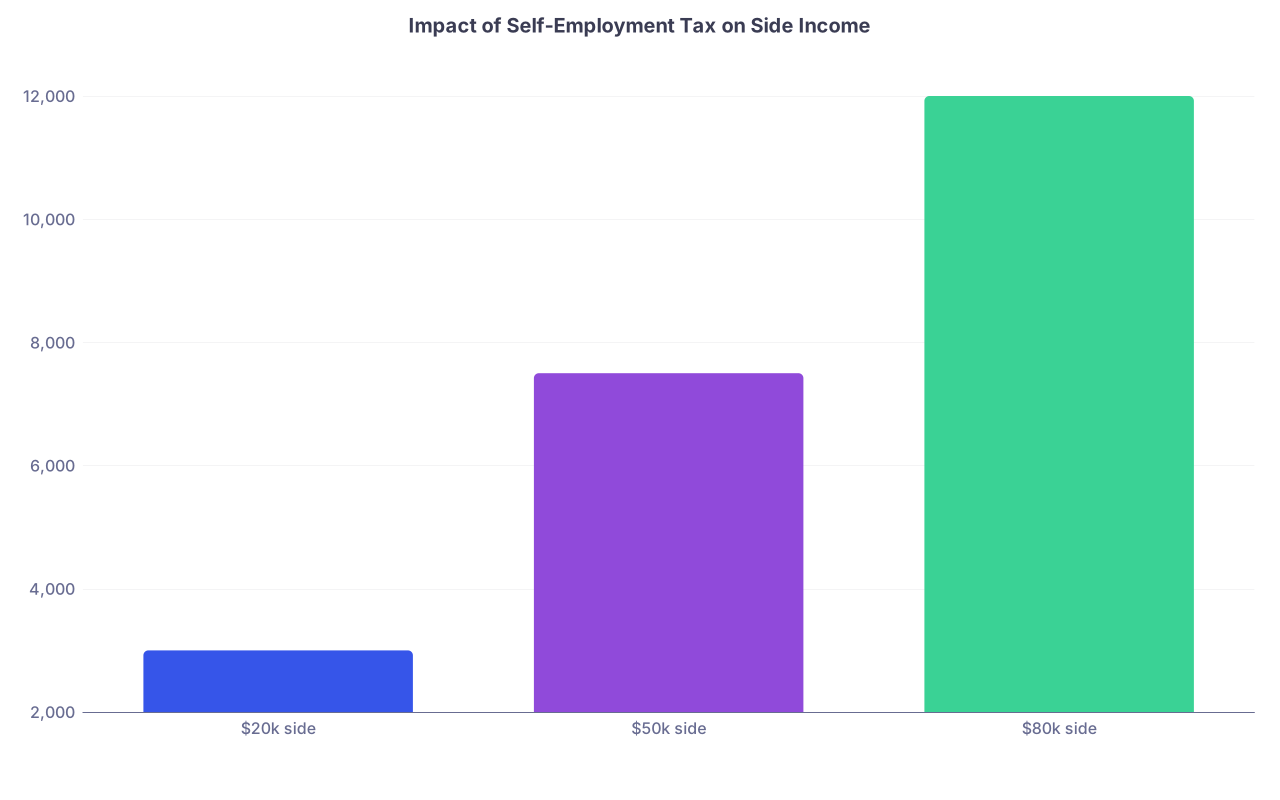
| Category | Value |
|---|---|
| $20k side | 3000 |
| $50k side | 7500 |
| $80k side | 12000 |
(These are rough SE tax impacts when you are below the Social Security wage base.)
Step 5: Use a Simple 3-Bucket Estimate
Here’s a cleaner framework you can run on your phone calculator:
- Estimate your federal marginal rate from last year (24, 32, 35, 37)
- Add your state marginal rate (0–10)
- Add SE tax estimate:
- If W‑2 already above SS base: +3%
- If below SS base: +10–15% on at least part of it
So for a common scenario (W‑2 $350k, 6% state, over SS base):
- Federal: 32%
- State: 6%
- SE: 3%
- Total: ~41%
You do not need perfection. You just need to over‑save by a few percent, not under‑save by 10–15%.
Step 6: How and When to Actually Pay the Taxes
If your side work is significant, the IRS expects you to pay quarterly estimated taxes, not wait until April.
The quarters:
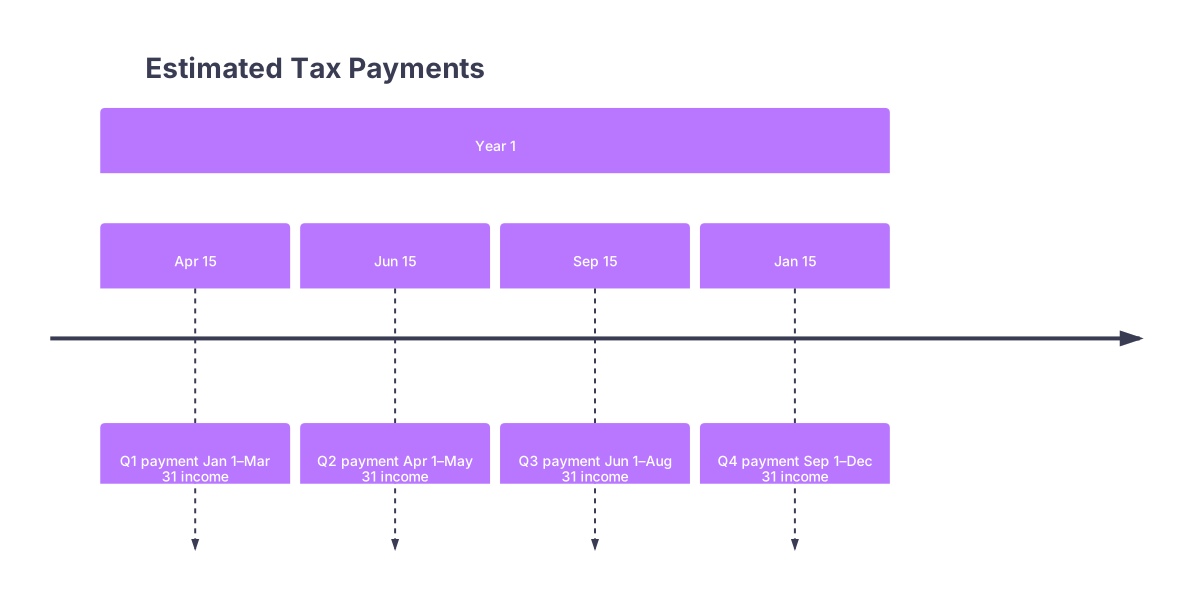
| Period | Event |
|---|---|
| Year 1 - Apr 15 | Q1 payment Jan 1–Mar 31 income |
| Year 1 - Jun 15 | Q2 payment Apr 1–May 31 income |
| Year 1 - Sep 15 | Q3 payment Jun 1–Aug 31 income |
| Year 1 - Jan 15 | Q4 payment Sep 1–Dec 31 income |
What you should do in practice:
- Open a separate side‑business savings account
- Every time you get paid from 1099 work, immediately transfer 30–40% into that account
- Once a quarter, send a payment to:
- IRS (Form 1040‑ES payment or online at IRS Direct Pay)
- Your state, if applicable
If you hate quarterly payments, you have another lever: increase W‑2 withholding at your main job to soak up the extra tax. But that only works:
- If the employer payroll system lets you bump up withholding enough
- And if you are disciplined about not spending the saved 30–40% you should have been putting aside
Personally, for physicians with more than about $10–15k of side profit, I prefer actual quarterly estimates. Cleaner. Easy to track.
Step 7: Do Not Forget Business Expenses
You should be paying tax on profit, not just gross checks.
Common legitimate expenses for physician side income:
- Malpractice premiums (for that side gig)
- Licensing fees, DEA fee allocation
- CME directly related to that line of work
- Professional subscriptions, medical societies
- Telehealth platforms, EMR subscriptions
- Billing/service fees
- Home office portion (if you qualify)
- Phone/internet allocation used for that work
- Accounting or legal fees tied to the side business
If you make $80,000 in side 1099 revenue and have $15,000 of legitimate expenses, your taxable net is $65,000.
Applying 40% to $65,000 is a lot better than applying 40% to $80,000.
Just do not invent expenses. If you would be embarrassed explaining it to an auditor, it probably does not belong as a deduction.
Step 8: Common “Gotchas” With Physician Side Income Taxes
I’ve seen these mistakes over and over:
- Using your blended tax rate instead of marginal – under‑saves by thousands.
- Ignoring SE tax because “I already pay FICA on my W‑2” – partly wrong, especially for Medicare.
- Waiting until March to add it all up – now it is too late to fix underpayment penalties.
- Not separating funds – side income drops into the same checking account and silently gets spent.
- Assuming an S‑corp will magically fix everything – sometimes helps, often overkill for <$150k of profit and adds complexity.
If you are easily clearing six figures in side profit, fine, talk to a CPA about S‑corp, accountable plans, retirement plans, etc. But the core rule still stands:
Set aside a high enough percentage and pay it quarterly.
Sample Scenarios (So You Can See the Math)
Scenario 1: Hospitalist with modest locums
- W‑2: $260,000, 0% state tax
- Side: $30,000 telemed, $3,000 expenses → $27,000 net
- Federal marginal: 24% moving into 32% range, so call it ~32% on the margin
- SE tax (Medicare only; already over SS base): ~3%
Total marginal: 35%
Safe set‑aside: 35% of $27,000 ≈ $9,450
Monthly: about $790 into your tax savings account.
Scenario 2: Resident with moonlighting
- PGY‑3, W‑2: $70,000, 5% state
- Side: $20,000 moonlighting, $1,000 expenses → $19,000 net
- Federal marginal: 22%
- State: 5%
- SE tax: closer to full 15.3% on most of it (under SS base)
Total: 22 + 5 + 15 ≈ 42%
Safe set‑aside: 40–42% of $19,000 = ~$7,600–8,000
Yes, the tax hit is ugly. But if you know that upfront and auto‑save 40%, you will not be shocked later.
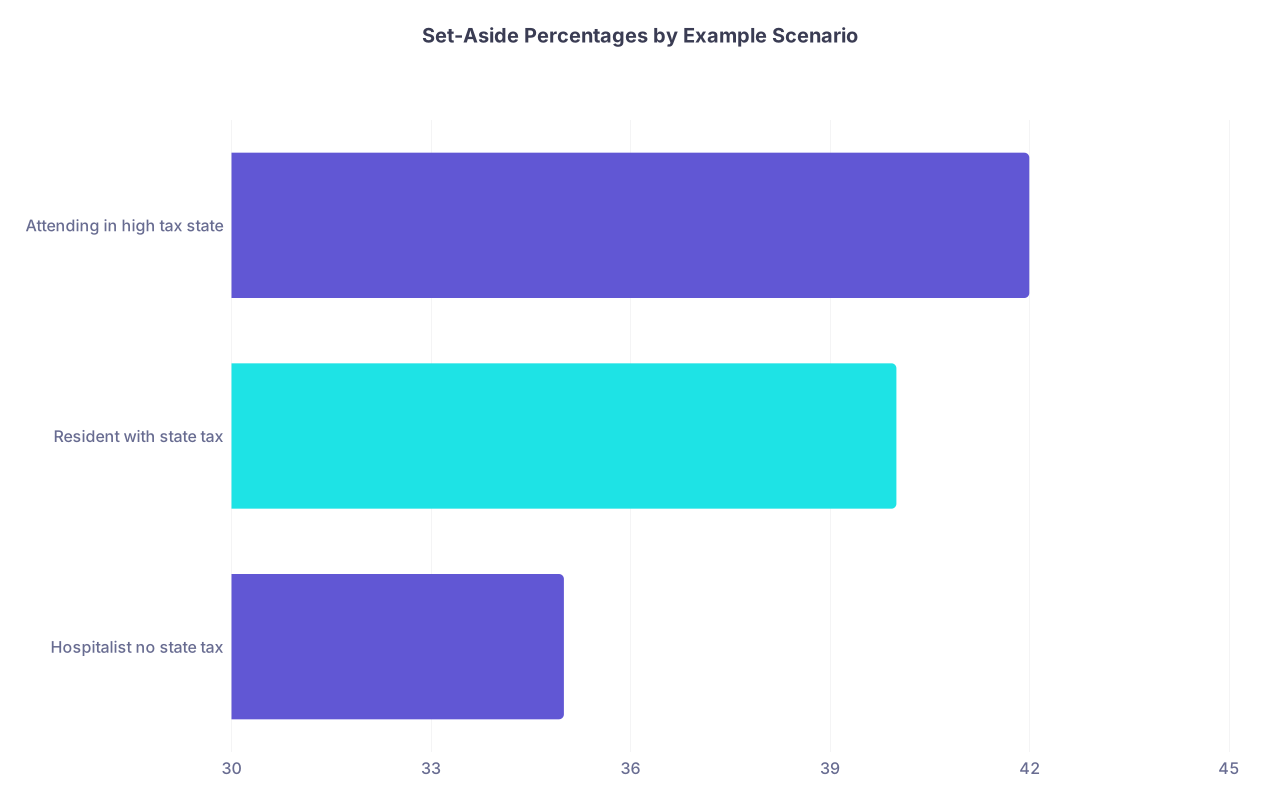
| Category | Value |
|---|---|
| Hospitalist no state tax | 35 |
| Resident with state tax | 40 |
| Attending in high tax state | 42 |
How to Refine Over Time (Without Becoming an Accountant)
Your plan for year 1 with new side income:
- Start aggressive: 30–40% set‑aside based on your rough bracket.
- Track total side income and expenses in a simple spreadsheet or accounting app.
- At mid‑year (June/July), do a quick projection with a CPA or quality tax software:
- Total expected W‑2
- Total expected 1099 net
- Check if your set‑aside rate needs to be adjusted up or down
If you end up with a big refund, lower your set‑aside next year. If you owed more than you liked, bump it up by 5 percentage points.

| Step | Description |
|---|---|
| Step 1 | Get Side Income |
| Step 2 | Estimate Net Income |
| Step 3 | Find Marginal Rates |
| Step 4 | Choose Set Aside % |
| Step 5 | Move Cash to Tax Account |
| Step 6 | Pay Quarterly Estimates |
| Step 7 | Review Mid Year |
| Step 8 | Adjust % for Next Year |
Over two or three years, you will know your real number. Not some blog’s average. Yours.
What I’d Tell a Busy Attending in One Sentence
If you do not want to think about this deeply and just want to be safe:
Move 35% of every 1099 paycheck into a dedicated “tax” savings account the same day you get it, then pay quarterly estimates from that pile.
Then once a year, sit down with a CPA for one hour and refine.
FAQ: Physician Side Income Tax Planning
1. How do I know if I actually need to make quarterly estimated payments?
If, after including your side income, you will owe more than $1,000 in tax beyond what is withheld from your W‑2, the IRS expects estimated payments. You can sometimes avoid penalties by meeting a “safe harbor” (like paying 100–110% of last year’s tax through withholding), but with big jumps from side income, it is cleaner to just pay quarterly.
2. Can I just increase withholding at my main job instead of paying estimates?
Yes, and many physicians do exactly that. You file a new W‑4, increase the extra withholding per paycheck enough to roughly cover the annual tax on your side income. The catch: you must actually calculate that amount and check in mid‑year. And you still should be saving that 30–40% in a separate account so cash is available even if you overshoot a little.
3. Should I form an LLC or S‑corp for my physician side gig?
Forming an LLC can be helpful for legal and organizational reasons, but it usually does not change your tax hit by itself—you are still paying tax on the profit. Electing S‑corp status can save you some SE tax at higher income levels, but it adds payroll, extra filings, and more ways to screw things up. I usually do not recommend S‑corp until you are seeing consistent net profit of at least $150k+ and you have a good CPA.
4. Does my side income affect my ability to contribute to Roth IRA or backdoor Roth?
Yes, indirectly. All your income—W‑2 plus 1099—counts toward the limits for direct Roth IRA eligibility and other phaseouts. But side 1099 income can actually be a positive thing because it may allow you to open a solo 401(k) and shelter more money. Just do not skip the tax set‑aside because you are fixated on shoving every dollar into retirement accounts.
5. What if my state has no income tax—can I safely save less?
You can, but do not get cocky. In a no‑tax state and high federal bracket, you might realistically land around 30–35% total. If you want simplicity, use 30% for a conservative starting point, then refine after the first tax year. If you are in the 35–37% federal bracket, I still would not drop below 32–33% set‑aside unless you have run the numbers.
6. How do I track my side income and expenses without going crazy?
Keep it simple. One separate checking account for your side business. All 1099 payments go in, all expenses go out. Use a basic spreadsheet or something like QuickBooks Self‑Employed, Wave, or even a well‑structured Google Sheet. At the end of the year, you want:
- Total gross income
- Total expenses by category
- Net profit
That is all your CPA cares about for the Schedule C.
7. What’s the easiest next step if I’m starting a new physician side gig this month?
Open two new accounts:
- a dedicated business checking (or at least a “side gig” checking) for all income and expenses, and
- a high‑yield savings labeled “TAX HOLDING.”
Then set a rule for yourself: each time side income lands, immediately move 35% into that tax account. Do that today—log into your bank, open the accounts, and label that savings account “Do Not Touch – Taxes.”


