

It’s March 28th. You’re scrolling through last year’s charges in your email: board recert fee, three CME conferences, UpToDate, specialty society dues. You add it up and feel a little sick. Then you wonder: “Can I write any of this off as a hospital‑employed doc, or am I just eating the whole thing?”
Here’s the answer you’re actually looking for, not the vague “talk to your CPA” non‑answer.
The Short, Painful Answer First
If you are a W‑2 hospital‑employed MD (what the IRS calls a common law employee), you generally cannot deduct your CME, conference, or board exam/maintenance fees on your personal tax return anymore.
That changed with the 2017 Tax Cuts and Jobs Act (TCJA), which:
- Eliminated the miscellaneous itemized deduction for unreimbursed employee business expenses (this is where CME used to live)
- Applies for tax years 2018–2025 (and might be extended or made permanent; don’t plan your life on Congress changing it back)
So for most hospital-employed physicians:
- CME you pay out of pocket: not deductible
- Conferences: not deductible
- Board exams and MOC: not deductible
- Hospital-required licenses, DEA, subscriptions: not deductible
…if they’re unreimbursed and you’re W‑2.
That’s the bad news. Now let’s talk about the exceptions and workarounds, because they matter.
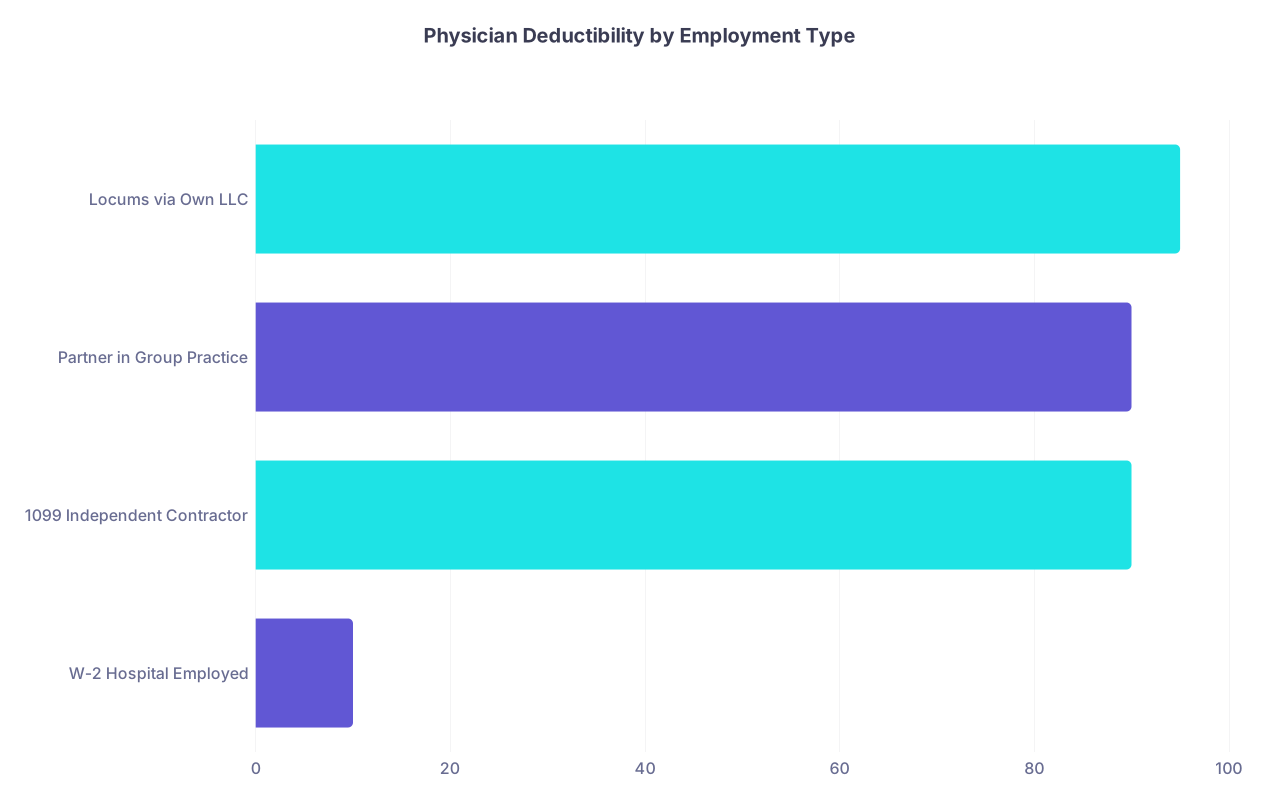
| Category | Value |
|---|---|
| W-2 Hospital Employed | 10 |
| 1099 Independent Contractor | 90 |
| Partner in Group Practice | 90 |
| Locums via Own LLC | 95 |
(Values represent rough “percent of typical CME/board expenses that can be deducted somewhere” — not exact but directionally right.)
Step 1: Figure Out What You Actually Are (W‑2 vs 1099 vs Owner)
Don’t skip this. Everything depends on your status.
Look at your year‑end tax form:
- You get a W‑2 from the hospital → you’re an employee
- You get a 1099‑NEC from the hospital or locums agency → you’re an independent contractor
- You get a K‑1 from a group/partnership/PC → you’re an owner (active partner/shareholder)
If you’re W‑2 from the hospital: your CME and board fees are employee business expenses. For you, those used to go on Schedule A, line “Job expenses”. Now they don’t. That line is basically dead through at least 2025.
If you’re 1099 or a partner: your CME and board fees are business expenses and can usually be deducted on:
- Schedule C (sole proprietor/LLC)
- or your entity return (S‑corp, partnership, PC)
Different world. Much better world.

Step 2: Understand What Counts as “Unreimbursed Employee Expenses”
For a W‑2 hospital‑employed physician, any work expense that your employer could theoretically reimburse but doesn’t is an unreimbursed employee expense. That includes:
- CME conference registrations and travel
- Online CME platforms
- Board exam fees (initial) and MOC
- Specialty society dues (ACP, ACC, ACOG, etc.)
- State license, DEA, hospital staff dues, credentialing fees
- Textbooks, apps, UpToDate, Journal subscriptions
- Even scrubs, white coats (if you have to buy your own)
Under the old rules, you could itemize these if they exceeded 2% of your AGI. Now: zero federal deduction for W‑2s.
Key nuance: this doesn’t mean they’re “personal” in the IRS sense. It just means Congress removed your ability to claim them individually.
State taxes are a different beast.
Step 3: Where You Can Still Get Tax or Cash Value as a Hospital Employee
You’re not powerless. You just have to stop thinking “line item deduction” and start thinking plan design and structure.
1. Employer CME / Education Allowance (Best First Step)
If your hospital has any of these:
- CME allowance (e.g., $2,000/year)
- Education fund
- Professional development budget
- Admin fund
Use it. Max it. And yes, ask for it if it doesn’t exist.
Properly structured, an employer‑paid CME allowance is:
- A business expense to the hospital (they deduct it)
- Non‑taxable to you if it’s under an accountable plan (you submit receipts)
- Functionally the same as a deduction, except better: you’re spending pre‑tax dollars and you’re not using your own cash
If your employer is lazy and pays a flat “CME stipend” in your paycheck without receipts, that’s taxable income to you. That’s worse.
What you want: an accountable reimbursement plan. You submit detailed receipts; they cut you a non-taxable reimbursement. Push HR/Med Staff Office toward this setup if they don’t already have it.
2. State Income Tax – Some States Still Allow Employee Expense Deductions
A few states still allow unreimbursed employee expenses as deductions on the state return, even though the feds killed it.
Examples (rules change; verify each year):
- Pennsylvania
- Arkansas
- Alabama
- Some itemizing states may allow certain job expenses
So you could have:
- No federal deduction, but
- State deduction for CME, board fees, etc.
Does this make you rich? No. But if your state rate is 5–7% and you’re dropping $10k/year on truly unreimbursed professional expenses, that’s still $500–$700 back. Not nothing.
Ask your CPA point‑blank:
“Does our state return allow unreimbursed employee business expenses? If yes, I need you to capture my CME/board/licensing costs.”
3. Union or Professional Organization Dues
Union dues and certain professional membership fees used to be in the same “miscellaneous itemized” bucket federally. Right now, they’re also basically dead on the federal return for employees.
But again: state may differ. Keep tracking them; they take 5 minutes to export from your card statement.
4. Hybrid Roles – If You Have 1099 Income on the Side
This is huge and heavily misunderstood.
Let’s say:
- You’re W‑2 hospitalist at Hospital A
- You also moonlight as 1099 locums somewhere else
Now you’ve got a bona fide business (your 1099 work). Many of your education and licensing costs are ordinary and necessary for that business too.
You can often legitimately allocate:
- CME
- Board fees
- DEA / licenses
- Subscriptions
- Part of your phone, internet, home office if applicable
…to your 1099 Schedule C or entity, where it’s fully deductible.
No, you can’t just move 100% of everything automatically. But if the CME clearly supports both jobs, you’ve got a strong argument that it’s a business expense for your 1099 work.
I’ve seen physicians reclaim thousands per year this way by:
- Getting a small amount of real 1099 work (even 1–2 weekends a month)
- Tracking and allocating appropriate expenses to that 1099 activity

| Step | Description |
|---|---|
| Step 1 | Physician pays CME/boards |
| Step 2 | No federal deduction |
| Step 3 | Deduct as business expense |
| Step 4 | Deduct on state return |
| Step 5 | Ask employer for reimbursement |
| Step 6 | Claim on Schedule C or entity |
| Step 7 | Employment type |
| Step 8 | State allow employee expenses |
Step 4: If You’re 1099 or an Owner, Here’s What You Can Deduct Cleanly
If any part of your work is 1099 / partnership / S‑corp, then CME, conferences, and boards flip from “annoying dead cost” to “textbook deductible business expense.”
Typical deductible items for an independent doctor:
- CME conferences and registration fees
- Airfare, hotel, Uber, meals while attending CME (subject to business travel rules)
- Online CME platforms and board review courses
- Initial board exam fees and maintenance / recertification
- State licenses, DEA, hospital and credentialing fees
- Specialty society and professional association dues
- UpToDate, journals, textbooks, medically necessary apps
You claim them on:
- Schedule C (if you’re a sole proprietor/independent contractor)
- Or your entity return (S‑corp/PC/partnership), then they flow through to you
| Situation | Where It’s Deductible |
|---|---|
| W-2 hospital employed only | Generally nowhere federally |
| W-2 + deductible state rules | State return (employee expenses) |
| 1099 independent contractor | Schedule C (business expense) |
| Partner/shareholder in group | Partnership/S-corp tax return |
| CME reimbursed by employer | Employer deducts; non-taxable to you |
| W-2 + 1099 side gig | Allocated on Schedule C/entity |

Step 5: Special Questions – Boards, MOC, Conferences, and Travel
Here’s how the IRS typically views the big categories, for those who can deduct (1099/owners) and for state purposes.
Board Exams (Initial Certification)
- For your first certification in a new field (e.g., going from IM residency to first ABIM exam), technically this sits in a gray zone: the IRS tends to see it as qualifying you for a new trade or business, which is usually not deductible.
- For most practicing physicians, CPAs often take the position that maintenance and specialty‑to‑specialty shifts are still part of the same “physician trade,” and they deduct it. Risk tolerance issue.
If you’re purely W‑2: it doesn’t matter. You can’t deduct it personally anyway unless state rules allow.
MOC / Recertification / Ongoing Boards
This is generally treated as maintaining your existing skillset, which is much more clearly deductible for business owners and 1099s.
CME Conferences and Travel
For deductible situations:
- Conference fee: generally 100% deductible.
- Travel: airfare, hotel, Uber/Taxi, Wi‑Fi in hotel = business travel if primary purpose is CME.
- Meals: usually subject to 50% limit.
- Spouse travel: almost never deductible unless they’re a bona fide employee and working (and even then, scrutinized).
For W‑2s: again, these are unreimbursed employee expenses with no federal deduction.
Online CME, Board Review Courses
Clearly deductible for those with business returns; good to track for state W‑2 purposes.
Hospital-Paid vs You-Paid
Key rule: if your employer pays directly or reimburses you under an accountable plan, you don’t deduct it. The employer does.
If the hospital refuses to pay and it’s out of your own pocket, then:
- W‑2 only → dead at federal level, maybe alive at state level.
- 1099/owner → your business deduction.
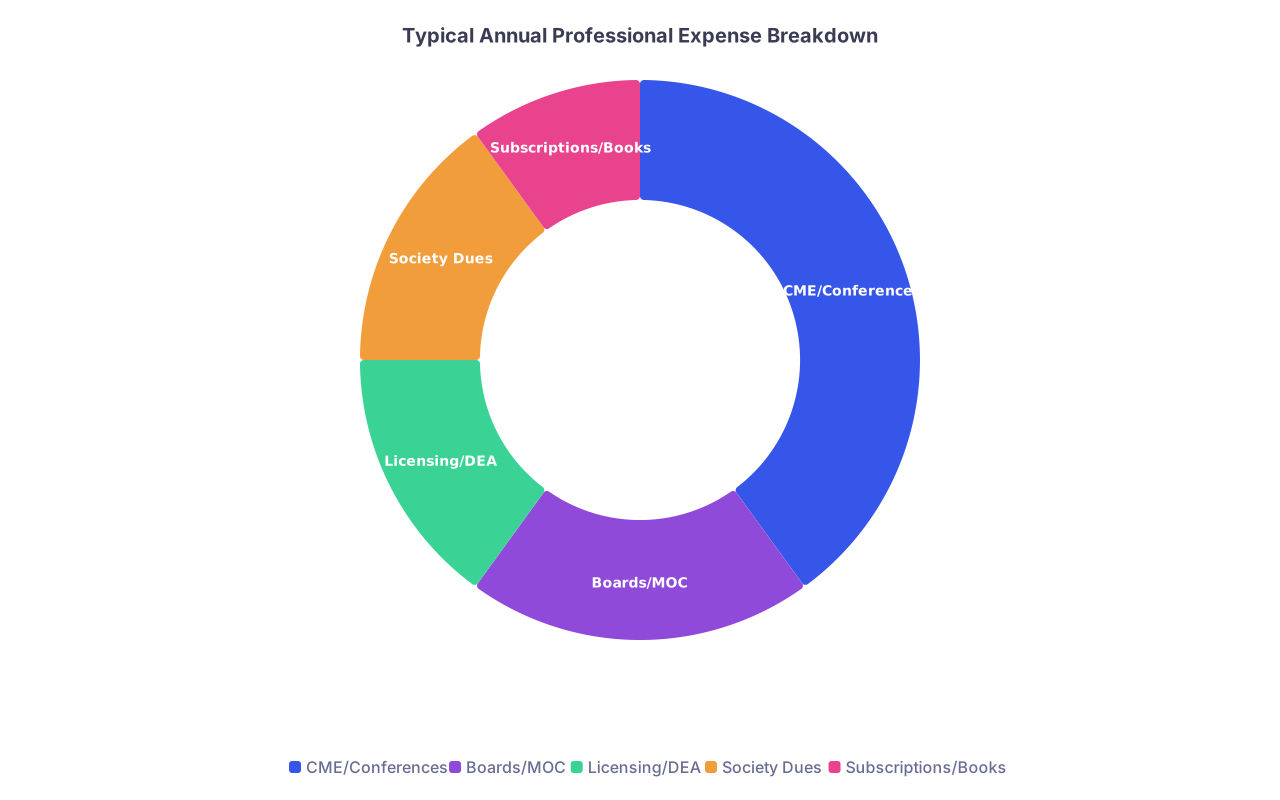
| Category | Value |
|---|---|
| CME/Conferences | 40 |
| Boards/MOC | 20 |
| Licensing/DEA | 15 |
| Society Dues | 15 |
| Subscriptions/Books | 10 |
Step 6: Tactics That Actually Move the Needle for Hospital‑Employed Docs
If you’re stuck as pure W‑2, here’s what’s actually worth doing instead of just complaining about TCJA at lunch.
Push for better reimbursement policies.
Ask your department chief: “Why are board fees and licenses on us when they’re mandatory for our job?” Some hospitals will quietly expand CME/education buckets if enough MDs ask.Negotiate at contract/renewal time.
Don’t just negotiate RVUs and base salary. Ask specifically for:- Higher CME allowance (e.g., $5k/year)
- Board/MOC fee reimbursement
- Full coverage of license/DEA/hospital dues
Every dollar they reimburse is basically like a dollar of pre‑tax income.
Consider building some 1099 work.
Locums, telemedicine, expert witness work, chart review. You create a legitimate business and open the door to real deductions.Know your state rules.
If your state lets you deduct employee expenses, you need:- A clean log of CME and professional expenses
- Receipts or card statements
- To tell your CPA explicitly, “I want these on my state return”
Stop assuming “no deduction” means “no documentation.”
Laws change. TCJA provisions could expire or be modified. If the miscellaneous deduction bucket returns after 2025, you’ll want clean records so you can go right back to deducting.

FAQ – CME, Conferences, and Board Fees for Hospital‑Employed MDs
1. I’m a full‑time W‑2 hospitalist. Can I deduct my $4,000 CME conference on my federal taxes?
No. As a W‑2 employee, your unreimbursed CME is an employee business expense, and that category of miscellaneous itemized deductions is suspended for federal returns through at least 2025. You may still get a state deduction depending on where you live, but there’s no federal write‑off for that conference as a W‑2 only physician.
2. My hospital gives me a $3,000 CME stipend but runs it through payroll. Is that taxable?
Yes. If it hits your paycheck as a lump sum, it’s taxable income. Better structure: have the hospital run an accountable reimbursement plan. You submit CME receipts; they cut you a non‑taxable reimbursement. Same cash, less tax. It requires a policy and documentation, but it’s completely normal and legal.
3. I’m W‑2 at a hospital and do 1099 telemedicine on the side. Can I put all my CME and board fees on Schedule C?
You probably can’t justify “all,” but you can usually justify some or most. If the CME and board costs clearly support your 1099 work, they’re ordinary and necessary business expenses for that side gig and can be deducted there. A CPA can help you decide a reasonable allocation method, but the key is: having any legitimate 1099 work opens the door to deducting things that support that work.
4. Are initial board exam fees deductible as CME or professional expenses?
For pure W‑2s, practically speaking: no federal deduction either way. For 1099s/owners, initial certification is in a gray area. Technically, expenses that qualify you for a new profession are not deductible. Many CPAs still treat initial specialty boards as part of entering the same “physician” trade and deduct them, but that’s a risk‑tolerance and documentation conversation to have with your tax pro.
5. My employer refuses to pay my MOC fees even though they require me to stay certified. Any tax relief?
If you’re only W‑2, no federal relief. You either:
- Try to negotiate reimbursement or a higher CME allowance, or
- See if your state tax code allows unreimbursed employee expenses so you can at least deduct it there, or
- Add some 1099 work so you can legitimately treat those fees as business expenses for your independent work as well.
Right now, Congress closed the federal door for W‑2s, so you’re stuck with structural fixes, not line‑item deductions.
6. What should I actually track during the year if I’m hospital‑employed?
Track everything anyway: CME, conferences, travel, board/MOC, licenses, DEA, society dues, journals, subscriptions. Use a separate card or spreadsheet. Why?
- State returns may allow you to deduct them.
- If TCJA’s suspension of miscellaneous deductions expires or changes after 2025, you’ll want history.
- If you add any 1099 or ownership income, you’ll instantly have clean records to support valid business deductions.
Key takeaways:
- Pure W‑2 hospital‑employed physicians cannot deduct unreimbursed CME, conferences, or board fees on their federal returns under current law.
- The real levers are structure (W‑2 vs 1099 vs owner), employer reimbursement design, and state tax rules — not trying to force deductions where they don’t exist.
- If you want those expenses to be deductible again, build some true 1099 or ownership income and treat your professional life like a business, because from the IRS’s perspective, it is one.


