

Most physicians do NOT need an S‑Corp for a side business—an LLC taxed as a sole proprietorship is usually enough at the beginning.
But. Once you hit certain income and profit levels, not understanding S‑Corp vs LLC can cost you tens of thousands in unnecessary payroll and taxes.
Let me walk you through this like I would with a physician in clinic between patients: fast, practical, and focused on what actually changes your after‑tax income.
Quick Answer: When LLC Is Enough vs When S‑Corp Starts to Matter
Here’s the core rule I use with physicians:
- Under about $75k–$100k in net profit from the side business → LLC (no S‑Corp) almost always fine
- Over about $100k–$150k in net profit and consistent work → LLC taxed as S‑Corp starts to make sense
- Under $30k in profit → S‑Corp is almost always overkill and just adds complexity and cost
Notice I said “net profit”, not revenue. That’s revenue minus expenses.
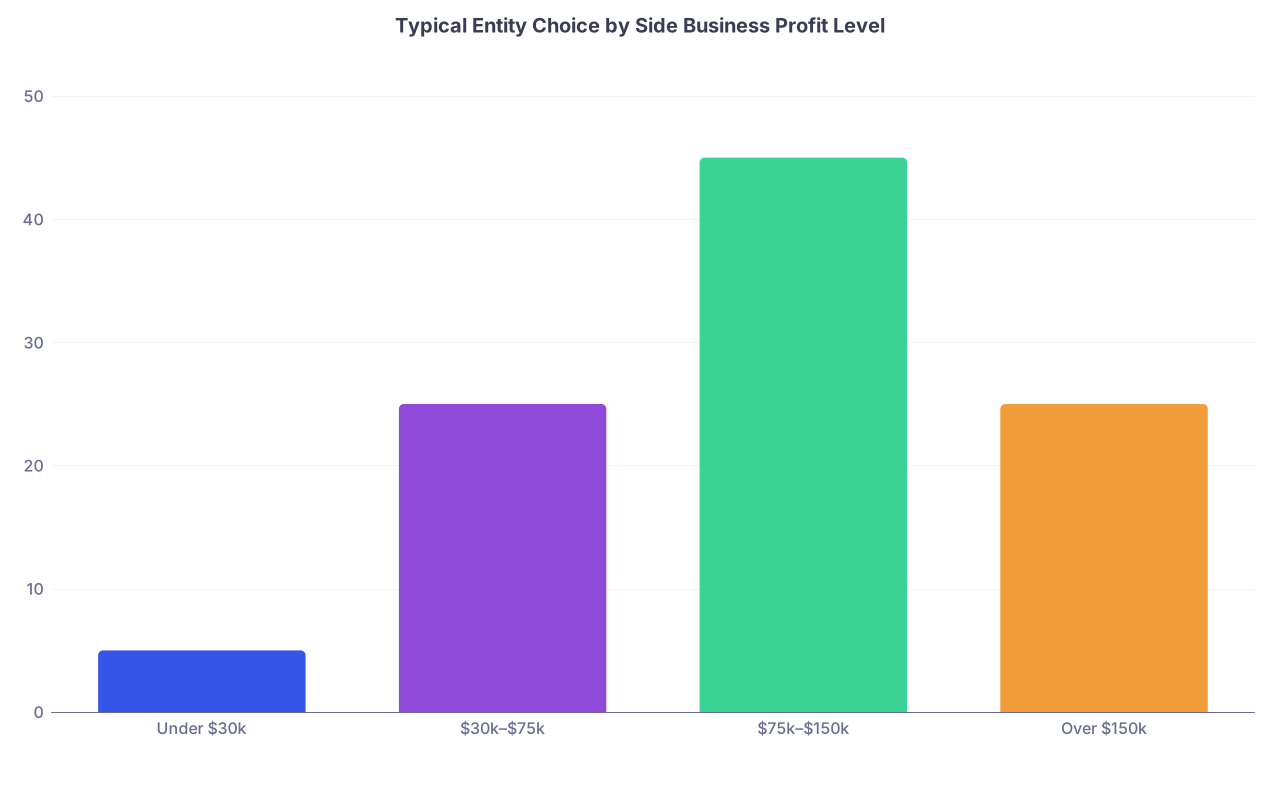
| Category | Value |
|---|---|
| Under $30k | 5 |
| $30k–$75k | 25 |
| $75k–$150k | 45 |
| Over $150k | 25 |
Roughly how I see real-world choices shake out:
- Under $30k: almost everyone should be simple Schedule C (single‑member LLC or sole prop)
- $30k–$75k: still usually Schedule C; maybe start planning for S‑Corp if growth is clear
- $75k–$150k: S‑Corp usually worth running the numbers
- Over $150k: in many cases, S‑Corp or more advanced structures absolutely worth a close look
Step 1: Separate the Legal Question from the Tax Question
Physicians mix these up all the time.
Legal structure answers:
- Do I have liability protection?
- What does my state require?
- How do I own this business?
Tax structure answers:
- How does the IRS see me?
- Which taxes am I paying, and on what?
The same entity can be one legal thing and another tax thing:
- You form an LLC at the state level. That’s the legal shell.
- For tax purposes, that LLC can be:
- Disregarded entity (sole prop – default single‑member)
- Partnership (default multi‑member)
- S‑Corporation (if you elect S‑status)
- C‑Corporation (if you elect C‑status — almost never for a doc side gig)
So the real question is not “LLC or S‑Corp?”
It’s: “Should my LLC be taxed as a sole proprietorship, or should I elect S‑Corp status?”
Most physicians should:
- Start: LLC, taxed as sole proprietorship
- Then: Elect S‑Corp later once profits and complexity justify it
Step 2: Understand What S‑Corp Actually Does for Taxes
If you do not get this, everything else is noise.
How you’re taxed WITHOUT S‑Corp (LLC taxed as sole prop)
- All net profit from your business:
- Subject to income tax, and
- Subject to self‑employment tax (Social Security + Medicare ≈ 15.3% on the first chunk, then 2.9% Medicare, plus 0.9% extra Medicare for high earners)
Translation: every dollar of profit is hit with both income tax and FICA/SE tax.
How you’re taxed WITH S‑Corp
With an S‑Corp (or LLC electing S‑Corp):
- You must pay yourself “reasonable salary”:
- That salary is subject to payroll taxes (Social Security and Medicare)
- Any remaining profit is paid to you as distribution:
- That distribution is NOT subject to Social Security / Medicare tax
- It is still subject to income tax
This is the big S‑Corp “tax savings”: distributions avoid payroll tax.
Example: $150k net profit side business
Let’s assume you’re already maxing out Social Security from your W‑2 attending job (over the wage base). Only Medicare portion matters here.
Without S‑Corp (sole prop):
- $150k profit → all subjected to 2.9% Medicare + 0.9% additional Medicare (since you’re a high earner)
- Roughly 3.8% on $150k = $5,700 in Medicare taxes on your side profit
With S‑Corp:
Let’s say “reasonable salary” is $80k and the rest $70k is distribution.
- Payroll Medicare (2.9% + 0.9% on employee side; employer side 1.45%) roughly on $80k ≈ $3k–$3.5k
- Distribution $70k → no Medicare tax
Savings: you’ve just avoided Medicare tax on $70k, which at roughly 3.8% is ≈ $2,600.
Now ask: does the added cost and complexity of S‑Corp exceed $2,600 per year? If yes, not worth it. If no, worth it.
That’s the real math. Not theory.
Step 3: When an S‑Corp Is Usually NOT Worth It
1. Low or inconsistent profit
If your side gig is:
- Picking up occasional expert witness work
- Teaching a course once or twice a year
- Early in building a telehealth or coaching practice with < $50k profit
Then:
- Your self‑employment tax bill is not huge
- Setting and paying payroll, filing extra returns, and paying CPA fees can cost as much as (or more than) the tax savings
Rough numbers I’ve seen:
- Extra CPA + payroll service: $1,500–$3,000/year
- If you’re only saving $1,200 in payroll tax? You’re losing money and time.
2. Very high W‑2 comp with low side profit
If your hospital/academic/combo job already has you:
- Maxing the Social Security wage base, and
- Earning so much that your side gig is just $20k–$30k/year
Then the S‑Corp play on that $20k side profit just doesn’t move the needle enough.
3. Short‑term experiment businesses
If you’re “trying” a consulting or digital product idea and might shut it down in 1–2 years, don’t start life as an S‑Corp. You can always elect S‑Corp later once it’s clearly working and the numbers justify it.
Step 4: When an S‑Corp Starts to Make Sense
Now the flip side.
1. Stable, six‑figure side income
You’re:
- Doing independent telemedicine under your own entity
- Running a thriving aesthetics practice on the side
- Running a high‑revenue blog, course, or consulting shop
And you’ve got $100k–$300k in reliable, repeatable net profit.
Here, S‑Corp is usually worth running full numbers on.
Why? Because once:
- Reasonable salary might be, say, $120k
- But you’re making $250k net profit
Then $130k as distribution avoids Medicare tax.
3.8% of $130k ≈ $4,940.
Now the $2–3k of professional and compliance costs look like a good trade.
2. You want to layer in retirement and health strategies
S‑Corp structures can play nicely with:
- Solo 401(k)s
- Defined benefit plans
- Putting a spouse on payroll (if truly working in the business)
- Health insurance through the S‑Corp in some setups
Those can get complex fast, but I’ve seen S‑Corp structures plus a solo 401(k) add a lot of value for high‑earning physicians who are maxing out their W‑2 retirement space.
3. You’re serious about building a real business, not just a “side hustle”
If you’re building something you might:
- Sell in 5–10 years
- Bring on partners or investors
- Grow into a group practice
Then you want a clean, thought‑through entity and tax structure. Many start as LLC, then elect S‑Corp when profits justify it and the business direction is clear.
Step 5: Practical Framework — How to Decide for Your Side Business
Here’s how I’d decide in the real world, with a physician in front of me.

| Step | Description |
|---|---|
| Step 1 | Start |
| Step 2 | Estimate annual net profit |
| Step 3 | Use single member LLC or sole prop |
| Step 4 | Stay LLC taxed as sole prop, reassess yearly |
| Step 5 | Model S Corp with CPA |
| Step 6 | Elect S Corp |
| Step 7 | Under 30k |
| Step 8 | 30k to 100k |
| Step 9 | Over 100k and stable |
| Step 10 | Tax savings greater than costs |
Walk yourself through this:
Estimate 12 months of net profit
- If you’re just starting, project conservatively.
Classify yourself:
- Under $30k → keep it simple (sole prop or single‑member LLC)
- $30k–$100k → LLC taxed as sole prop; monitor growth
- Over $100k and looks stable → talk to a CPA who knows physician S‑Corps
Have that CPA show you:
- Projected self‑employment tax without S‑Corp
- Projected payroll tax + costs with S‑Corp
- Actual annual savings after fees and compliance costs
If the net savings are < $2,000, I usually tell people it’s not worth the hassle unless they’re building towards something bigger and want that structure anyway.
Step 6: LLC vs S‑Corp on Liability and Compliance
Let’s kill a common myth:
S‑Corp does NOT give you “more” liability protection than an LLC.
Both are limited liability entities.
Your real protection as a physician also heavily depends on:
- Professional liability insurance
- Proper contracts and consents
- Separating clinical activities from non‑clinical (and the right entity type for each; some states require PLLC or PC for clinical work)
What S‑Corp does add is compliance and complexity:
- You must run payroll (even if it’s just to yourself)
- You must file corporate tax returns (Form 1120‑S)
- You must keep cleaner records of salary vs distributions
- You’ll almost certainly want a CPA involved every year
LLC taxed as sole prop? For many of you, that’s:
- One Schedule C on your existing 1040
- No payroll unless you have employees
- Bookkeeping is simpler
| Feature | LLC (Sole Prop Tax) | LLC with S-Corp Election |
|---|---|---|
| Liability protection | Yes | Yes |
| Extra tax return | No | Yes (1120-S) |
| Payroll required | No | Yes |
| SE/Payroll tax savings | None | Possible |
| Best for profit level | < $100k | > $100k and stable |
Step 7: Special Issues for Physicians
Physicians are not typical freelancers. A few extra wrinkles:
1. Your W‑2 job already covers a lot of payroll
If your attending job already maxes your Social Security contributions, then the S‑Corp benefit is often only about Medicare taxes on the side business. Still real money, but smaller than the classic SE‑tax illustrations written for non‑physicians.
2. State law and professional entities
Some states require that clinical practice be done through:
- A Professional Corporation (PC) or
- A Professional LLC (PLLC)
And in some states, professional practices cannot elect S‑Corp or have restrictions. You need a local attorney or CPA to confirm what’s allowed for physician practices in your state.
3. Mixed businesses: clinical vs non‑clinical
Common combos I see:
- You do clinical telemedicine and non‑clinical consulting
- You run a medspa plus online courses/coaching
- You own rental real estate plus a consulting practice
These might not all belong in the same entity, and they may not all benefit from the same tax treatment. Do not just throw everything into one S‑Corp because someone on a podcast said “always use an S‑Corp.”
Concrete Examples
Let me give you three real‑world style scenarios.
Example 1: Early‑career hospitalist with a small consulting gig
- W‑2: $260k hospitalist job
- Side: Expert witness and chart review for attorneys
- Year 1 net profit: $18k
- Year 2 net profit: $27k
Should they elect S‑Corp? No.
A simple single‑member LLC filing a Schedule C is fine. The tax savings from S‑Corp here will be tiny compared with the cost and annoyance of payroll and extra filings.
Example 2: Mid‑career anesthesiologist with strong locums side work
- W‑2: $400k academic job
- Side: Locums under own LLC
- Net profit from locums: $160k and stable for 3 years
Here, I’d absolutely get a CPA to model S‑Corp vs no S‑Corp.
Because W‑2 already maxes Social Security, the S‑Corp game is mostly about avoiding Medicare tax on part of that $160k. Even after CPA and payroll costs, there’s a good chance the S‑Corp election adds several thousand per year in net savings.
Example 3: Dermatologist with growing aesthetics brand
- W‑2: $350k at group practice
- Side: Own aesthetics LLC with injectables, skincare line, and online content
- Net profit: $80k last year, trending to $130k this year
This is borderline. At $80k, maybe not worth it. At $130k and clearly growing, S‑Corp might start to pay off. This is where you model it for the coming 2–3 years, not just last year. If growth is clear and you’re building a brand you’ll keep, S‑Corp likely becomes attractive.
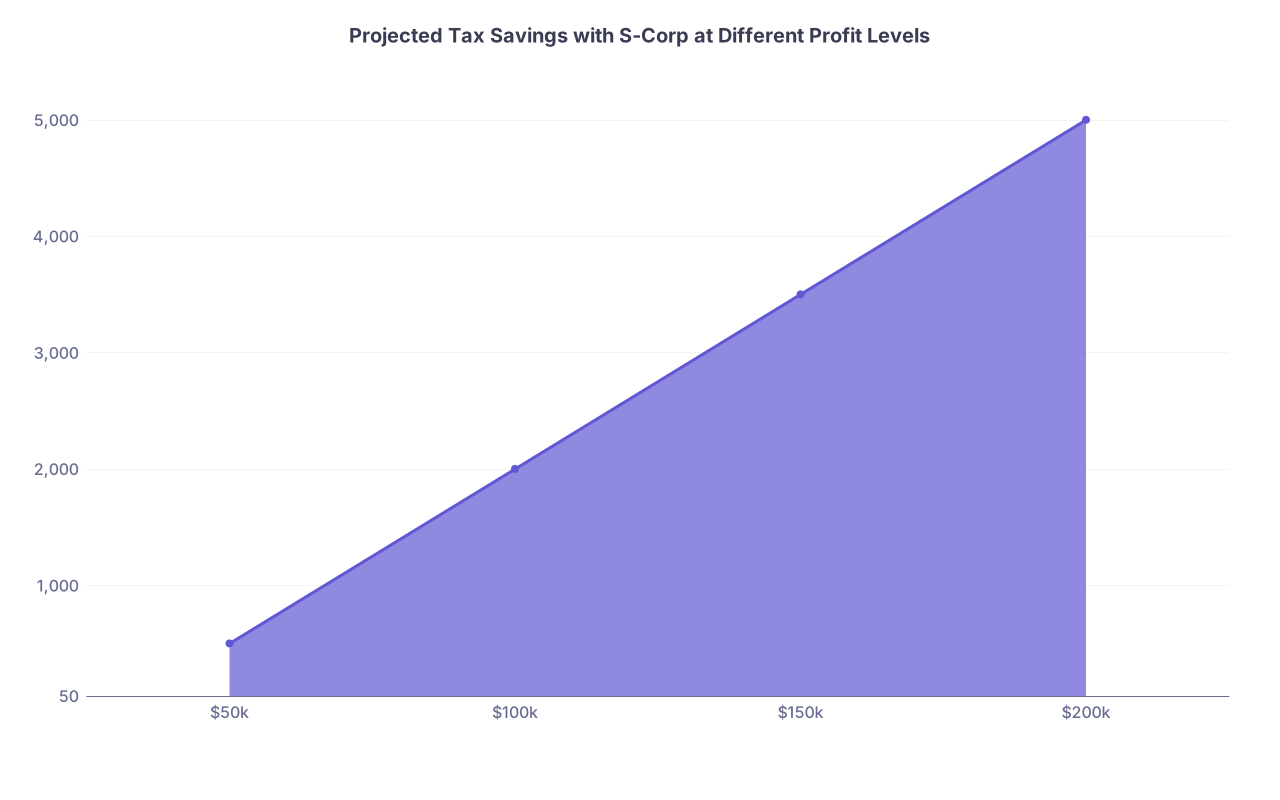
| Category | Value |
|---|---|
| $50k | 500 |
| $100k | 2000 |
| $150k | 3500 |
| $200k | 5000 |
Implementation Tips if You Decide “LLC Is Enough (For Now)”
If you’re going to stay with the simpler setup for now, at least:
- Form an LLC in your state (or a PLLC/PC as required for clinical work)
- Get an EIN
- Open a separate business bank account
- Track all income and expenses cleanly (QuickBooks, Wave, or even a good spreadsheet)
- File a clean Schedule C with your personal return
Then put a reminder on your calendar:
- Once a year, revisit your last 12 months of net profit
- If you cross into the $100k+ stable profit zone, schedule a call with a CPA who does this regularly with physicians

Implementation Tips if You Decide to Go S‑Corp
If the math checks out and you go S‑Corp:
Keep your LLC, elect S‑Corp for tax purposes
- File Form 2553 with the IRS (usually with CPA help)
Set up payroll
- Use Gusto, ADP, or a similar service
- Decide on a reasonable salary (this is a big deal strategically)
Get a CPA who understands physicians
- Prepare 1120‑S each year
- Do your K‑1 properly
- Coordinate with your personal return, retirement plan, and W‑2 income
Do not treat distributions like free candy
- Watch cash flow
- Make sure you’re keeping enough in the business for taxes and expenses

One More Thing: Don’t Let the Tax Tail Wag the Dog
If your side business is burning you out, taking time from family, or putting you in legal gray zones, the tax structure is not the main problem.
Entity structure is there to support:
- Protecting you legally
- Reducing friction
- Optimizing taxes around a business that already makes sense
It is not there to justify a marginal or miserable business.

FAQs
1. Should I start my physician side business as an LLC or just a sole proprietorship?
For most, I’d file an LLC from the start. It’s cheap in many states, gives you formality and separation from day one, and you can always change the tax treatment later. A sole proprietorship (no LLC) is legally simpler but blends everything with your personal identity and assets.
2. Can I elect S‑Corp for my LLC later, or do I have to decide now?
You can absolutely elect S‑Corp later. That’s often the smart move. Start as an LLC taxed as a sole prop, see real numbers for a year or two, then elect S‑Corp once profits are high and steady enough to justify it. There are timing rules, so have a CPA handle the Form 2553.
3. How do I figure out a “reasonable salary” for my S‑Corp as a physician?
You look at what you’d have to pay someone else to do the job you’re doing in that business, for that number of hours. Market‑based. Many physicians end up around 40–70% of their total S‑Corp profit as salary, but that’s not a rule, just a pattern. You want a defensible number if the IRS ever asks.
4. Does an S‑Corp help protect me from malpractice claims?
Not really. Your professional negligence as a physician is almost always on you personally, regardless of entity. That’s why you carry malpractice insurance. The entity matters more for contractual and business liabilities, leases, employees, and non‑clinical risk.
5. If I do clinical work in my side business, does that change things?
Yes, potentially. Some states require that clinical work be done under a professional entity (PLLC, PC) and may have specific rules about ownership and tax elections. You need state‑specific legal and tax advice here; don’t copy what a random doc in a different state did.
6. Will an S‑Corp help me save on income tax brackets?
No. S‑Corp doesn’t change your income tax brackets. It changes how much of your profit is subject to payroll/self‑employment tax vs pure income tax. Your total taxable income still lands on your 1040 and flows through the regular bracket system.
7. What’s the minimum profit where I should seriously consider an S‑Corp?
In physician land, I start paying attention around $75k–$100k of stable, repeatable net profit. Below that, the math often doesn’t justify the cost and headache. Above that, especially if you’re over $150k in steady profit, not at least modeling S‑Corp is usually a mistake.
Key takeaways:
- Start with an LLC taxed as a sole proprietorship; it’s enough for most early‑stage physician side businesses.
- When net profit is consistently above ~$100k, model an S‑Corp election with a CPA who understands physician income.
- Let the numbers and stability of your business—not tax hype—decide whether S‑Corp is worth the extra cost and complexity.


