

The biggest myth in physician finance is that you’re “limited” to one or two retirement accounts. You’re not. High‑income physicians can legally stack a surprising number of tax‑advantaged accounts if they understand the rules.
Let me cut straight to the answer, then break it down.
A single physician can easily and legally use 8–12 different retirement‑type accounts in the same year. In more complex setups (multiple jobs + side business + spouse with benefits), I’ve seen families using 15+ distinct buckets, all within IRS rules.
The Core Principle: Limits Are Per Plan and Per Type, Not “One Per Person”
The tax code doesn’t say “one 401(k) per person.” It says:
- You have a deferral limit across all 401(k)/403(b)/most 457(b) plans from your own salary.
- You also have separate employer/flex limits per plan in many cases.
- And then you have a bunch of completely separate buckets: IRAs, HSAs, defined benefit plans, cash balance, etc.
So the real question isn’t “How many accounts can I have?” It’s:
- How many different types of accounts can I legally use?
- How many different plans can I access without double‑counting a limit?
Let’s walk through the main ones a high‑income physician can stack.

| Step | Description |
|---|---|
| Step 1 | Physician Income |
| Step 2 | Employer Plans |
| Step 3 | Personal Plans |
| Step 4 | Side Business Plans |
| Step 5 | 401k or 403b |
| Step 6 | 457b - governmental |
| Step 7 | 457b - non gov |
| Step 8 | Traditional IRA |
| Step 9 | Roth IRA - backdoor |
| Step 10 | HSA |
| Step 11 | Solo 401k |
| Step 12 | Cash Balance Plan |
1. Employer‑Sponsored Plans: The Big Buckets
A. 401(k) or 403(b) – Salary Deferral + Employer Money
Most employed physicians get one of these:
- 401(k): common in private practice/hospital systems
- 403(b): common in academic/nonprofit hospitals
Key rules:
- Employee deferral limit (2025 numbers):
- $23,000 under 50
- $30,500 age 50+ (includes $7,500 catch‑up)
- This limit is shared across all 401(k) and 403(b) plans you participate in through employment in a year. You don’t get $23k at Hospital A and $23k at Hospital B. Total employee deferral is capped.
But:
- Employer contributions (match, profit sharing) don’t count toward that $23k/$30.5k.
- The combined limit (employee + employer) per plan is much higher ($69,000 under 50, $76,500 age 50+ for 2025).
So what does this mean practically?
If you work at one big hospital system:
- You can use one 401(k) or 403(b) there.
- You max your employee deferral once, but the employer can pile on match and profit share up to the total plan limit.
If you have two unrelated W‑2 employers each offering a 401(k):
- You still only get one $23k/$30.5k employee deferral total.
- But each employer can add their own employer contribution up to their plan’s total limit.
So from an “account count” standpoint:
You could easily have 2–3 different 401(k)/403(b) accounts open from current/prior jobs, but they all share that same annual deferral cap.
B. 457(b) Plans – Separate Bucket (Usually)
This is where most physicians leave money on the table.
If you’re at an academic or large nonprofit or state system, you may have a 457(b) in addition to a 403(b) or 401(k).
There are two flavors:
Governmental 457(b) (state university, state hospital)
- Has its own $23k limit (2025) separate from your 401(k)/403(b) deferral.
- Usually safer. Assets technically belong to the government, but default risk is low.
- Often rollable to an IRA or other qualified plan when you separate.
Non‑governmental 457(b) (nonprofit hospitals)
- Still has its own $23k limit separate from your 401(k)/403(b).
- BUT subject to employer creditors; money is technically theirs, not yours, until paid out.
- Usually not rollable to an IRA; distributions are taxable and often forced on separation.
Bottom line:
If you have a 403(b) and a 457(b), you can legally do:
- Up to $23k (or $30.5k with catch‑up) into the 403(b)/401(k)
- Plus another $23k into the 457(b)
That’s $46k+ pre‑tax or Roth deferrals just from your main employer.
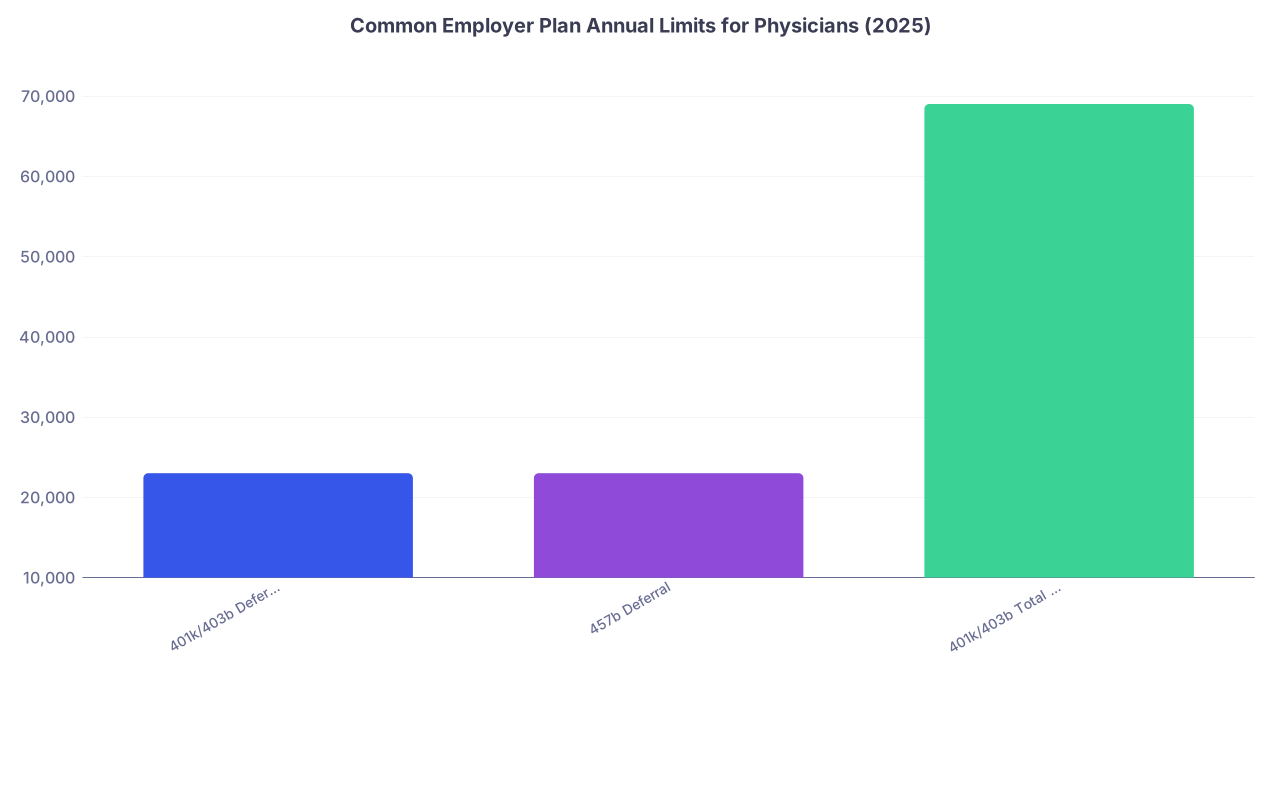
| Category | Value |
|---|---|
| 401k/403b Deferral | 23000 |
| 457b Deferral | 23000 |
| 401k/403b Total (with employer) | 69000 |
So on employer side alone, a high‑income physician might be actively using:
- 1× 401(k) or 403(b)
- 1× 457(b) (gov or non‑gov, sometimes both in rare setups)
That’s already 2 major retirement accounts.
2. Personal Retirement Accounts: IRAs and HSAs
These are separate from employer plans and have their own rules.
A. Traditional IRA and Roth IRA (Backdoor Roth)
For high‑income physicians, you’re usually phased out of direct Roth IRA and can’t deduct a Traditional IRA contribution. But the backdoor Roth IRA is 100% legal and very common.
The structure:
- Contribute to a non‑deductible Traditional IRA (no income limit to contribute).
- Convert that amount to a Roth IRA soon after (backdoor Roth).
Key rules:
- IRA contribution limit (Traditional + Roth combined):
- $7,000 under 50
- $8,000 age 50+ (2025 numbers)
- This limit is per person, not per job.
- The backdoor only works cleanly if you don’t have pre‑tax money in other Traditional/SEP/SIMPLE IRAs (pro‑rata rule).
So a high‑income physician can usually add:
- 1× Traditional IRA (used as a stepping stone)
- 1× Roth IRA (where the money ends up)
If married and spouse has income? Duplicate the process for them. Two more accounts.
B. Health Savings Account (HSA) – The “Stealth IRA”
If you’re in a high‑deductible health plan (HDHP), you can contribute to an HSA.
Why it matters:
- Contributions are pre‑tax (or tax‑deductible).
- Growth is tax‑free.
- Withdrawals for qualified medical expenses are tax‑free.
- After 65, non‑medical withdrawals are taxed like a traditional IRA.
So functionally, this is a triple‑tax‑advantaged retirement account if you pay current expenses out of pocket and let the HSA grow.
2025 limits (approx pattern; confirm final year’s numbers):
- Self‑only HDHP: around $4,300
- Family HDHP: around $8,550–$8,750 range
- Extra $1,000 catch‑up age 55+
The HSA is completely separate from your 401(k)/IRA/457(b) limits. It’s another bucket.
So now you’re looking at:
- 1× HSA
- 1× Traditional IRA
- 1× Roth IRA
We’re up to 5–6 accounts for one physician pretty quickly.

3. Side‑Gig and Practice Owner Plans: The Multiplier
This is where high‑income physicians can really stack accounts.
If you have 1099 income (locums, moonlighting, consulting, speaking, small practice), you’re allowed to open retirement plans for that business separately from your W‑2 job.
A. Solo 401(k) (a.k.a. Individual 401(k))
If you have self‑employment income and no employees other than you and possibly your spouse, you can open a solo 401(k).
Two hats here:
- As “employee” of your own business:
- You share the same $23k/$30.5k employee deferral already used at your W‑2 job. You can’t double dip.
- As “employer” (your business):
- The business can make employer profit‑sharing contributions up to 20–25% of net self‑employment income, within the overall $69k total plan cap.
Net effect:
- If you’ve already maxed your employee deferral at your main job, you can’t do more deferral in your solo 401(k).
- But you can still do employer contributions from your 1099 income. That’s often tens of thousands more.
So that’s another 401(k) plan (solo) and another account, with its own employer bucket.
B. Defined Benefit / Cash Balance Plans
For very high‑income physicians (especially in partnerships), a cash balance or defined benefit plan can add huge extra tax‑deferred space.
Key points:
- Limits are based on age, income, and actuarial assumptions.
- For someone in their 40s–50s, contributions can easily be $50k–$200k+ per year.
- This is completely separate from 401(k)/IRA/HSA limits.
Usually set up by:
- Physician groups
- Small private practices
- High‑earning 1099 docs wanting to shovel more into pre‑tax space
So on the side‑gig/practice side, you could have:
- 1× Solo 401(k)
- 1× Cash balance/defined benefit plan
Now we’re up to 7–8 accounts just for one physician.
| Account Type | Separate Annual Limit? | Typical For |
|---|---|---|
| 403(b) or 401(k) | Shared deferral limit | Hospital/academic |
| 457(b) | Separate from 401k | Academic/nonprofit |
| HSA | Completely separate | HDHP users |
| Backdoor Roth IRA | Separate IRA limit | High‑income docs |
| Solo 401(k) employer | Separate per business | Locums/1099 side gig |
| Cash Balance Plan | Separate plan limit | Groups/owners |
4. How Many Accounts Is “Too Many”?
Legally, there’s no “too many.” Practically, there is.
I’ve seen setups like this for a single physician:
- 403(b) at main academic hospital
- 457(b) governmental at same hospital
- Non‑governmental 457(b) at related system
- Backdoor Roth IRA
- HSA
- Solo 401(k) for speaking/consulting
- Cash balance plan through their group
- Old 401(k) from prior employer rolled to IRA
- Another tiny 401(k) from a one‑year job
That’s 8–9 current or recent accounts without even involving a spouse. Entirely legal.
The problem isn’t legality. It’s complexity:
- Keeping track of investment allocations across 10+ accounts
- Monitoring fees and plan changes
- Keeping non‑deductible basis straight in IRAs
- Managing distribution rules in 457(b)s
So the better question is: What’s the maximum number of accounts you can manage without screwing it up? For most busy physicians, 5–8 is where it starts to feel heavy, especially if each is scattered at different institutions.
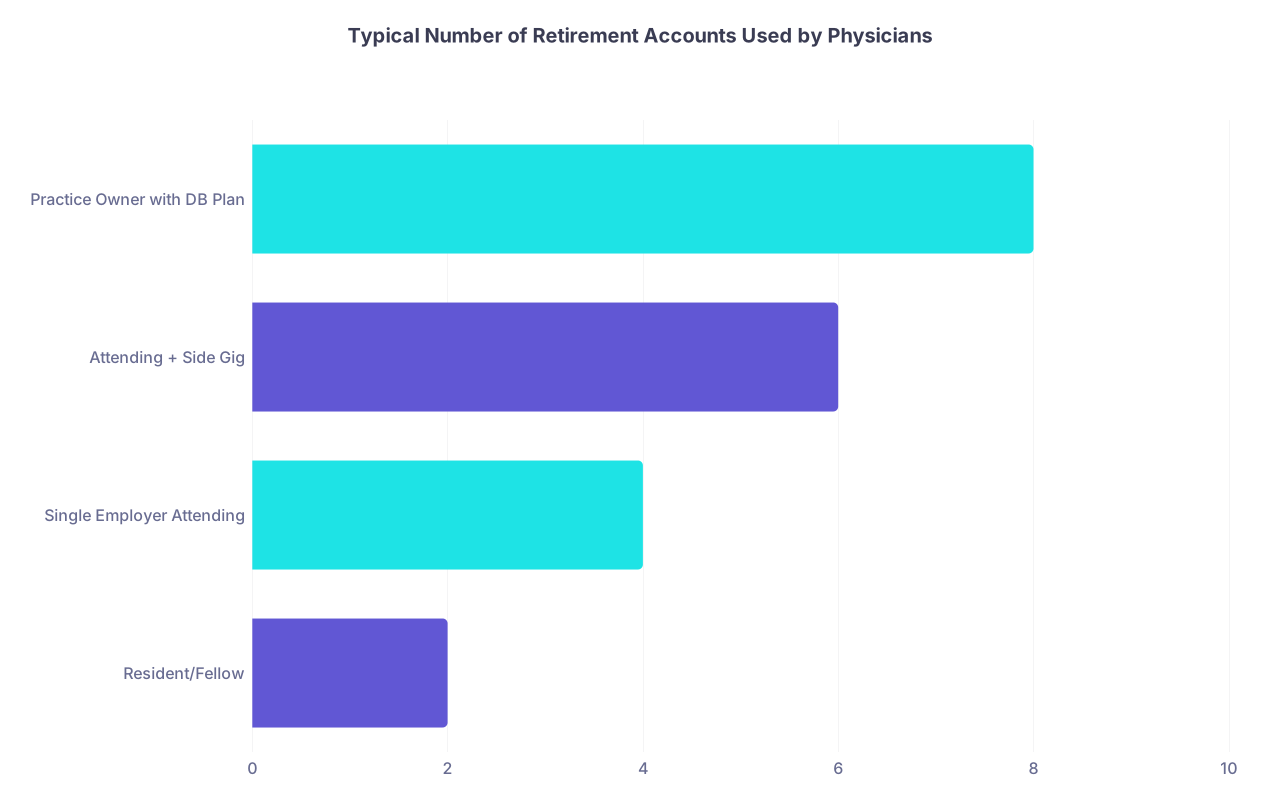
| Category | Value |
|---|---|
| Resident/Fellow | 2 |
| Single Employer Attending | 4 |
| Attending + Side Gig | 6 |
| Practice Owner with DB Plan | 8 |
5. A Realistic “Max‑Use” Setup for a High‑Income Physician
Let’s put it together. Assume:
- Age 45 attending
- Academic hospital (W‑2) with 403(b) + governmental 457(b)
- HDHP with HSA
- Locums/consulting income on 1099
- Married, spouse with income but no benefits
Here’s a perfectly legal lineup for just you:
- 403(b) – max employee deferral + employer match
- 457(b) governmental – max deferral
- HSA – family limit
- Traditional IRA (non‑deductible) → backdoor to
- Roth IRA
- Solo 401(k) – employer (profit‑share) contribution from 1099 income
- Cash balance plan (through group or your own practice entity, if structured)
That’s 7 different retirement‑type accounts actively used in the same year. All clean. All within IRS rules.
Now add spouse:
- Spouse Traditional IRA → backdoor Roth IRA
- Spouse Roth IRA
- Spouse 401(k) at their job (if available)
- Same shared HSA
- Taxable brokerage account for overflow savings (not a “retirement account” legally, but often part of the retirement strategy)
You’re now in the 10–12 account territory for the family.

6. Where Physicians Go Wrong With Multiple Accounts
There are three common mistakes I see repeatedly:
Double‑counting the employee deferral limit
Someone puts $23k into a 401(k) at Hospital A, then switches to Hospital B mid‑year and does another $23k. That’s not allowed. The limit is per person, not per plan. Fixing this after the fact is annoying and sometimes expensive.Ignoring the pro‑rata rule for backdoor Roths
They have a big pre‑tax rollover IRA, then try to do a $7k backdoor Roth. The conversion becomes mostly taxable. If you’re going to do backdoor Roths, keep pre‑tax Traditional/SEP/SIMPLE IRAs empty by using 401(k)s to hold pre‑tax money.Under‑using the 457(b)
Many docs freeze up because they’ve heard “457(b)s are risky” and ignore the plan completely. That’s lazy thinking. Governmental 457(b)s are usually fine. Non‑gov 457(b)s require real risk assessment, but often still worth using up to a level you’re comfortable with employer credit risk.
7. How to Decide Which Accounts to Prioritize
You don’t need to use everything just because it’s legal. Here’s the rough priority order I’d push most high‑income physicians toward:
- Get the full match in your 401(k)/403(b). Free money.
- Max the HSA if eligible. Triple tax benefit.
- Max your 403(b)/401(k) deferral.
- Max a solid governmental 457(b) if offered.
- Do backdoor Roth IRA (you and spouse).
- If you have 1099 income: add solo 401(k) employer contributions.
- If income and age justify: cash balance/defined benefit plan.
- After that, invest in a taxable brokerage account. Good funds, low turnover, no nonsense.
If you do all that, you’re sheltering a massive amount each year. For many high‑income docs, that’s $100k–$300k+ annually into tax‑advantaged space without breaking a single rule.
FAQ (Exactly 7 Questions)
1. Is there a legal limit to the number of retirement accounts I can have?
No. The IRS limits how much you can contribute by account type and plan, not how many accounts you can own. You could have 10 old 401(k)s from different employers and multiple IRAs and HSAs and still be 100% within the rules, as long as your annual contributions stay under the relevant limits.
2. Can I contribute the maximum to more than one 401(k) in the same year?
You can have multiple 401(k)/403(b) plans, but your employee salary deferral limit is shared across them: $23,000 (or $30,500 if 50+) total. However, each employer can still make their own employer contributions, so you can sometimes get more total money into tax‑advantaged space across multiple employers.
3. Do 457(b) contributions share a limit with 401(k)/403(b) contributions?
No. 457(b) plans (governmental and non‑governmental) have a separate $23,000 limit from your 401(k)/403(b) employee deferral. So you can max your 403(b) and separately max your 457(b) in the same year. That’s one of the biggest advantages academic and hospital‑employed physicians have.
4. Can I do a backdoor Roth IRA if I already max my 401(k)?
Yes. The 401(k)/403(b) limits are completely separate from IRA limits. You can:
- Max your 401(k)/403(b) deferral,
- Then make a non‑deductible Traditional IRA contribution,
- Then convert it to a Roth IRA (backdoor),
as long as you manage the pro‑rata rule by not holding other pre‑tax IRA balances.
5. If I have a solo 401(k) for side income, do I get another $23k deferral limit?
No. The employee deferral limit is global. You only get one $23k/$30.5k employee deferral across all 401(k)/403(b) plans. But your solo 401(k) can still take employer profit‑sharing contributions from your 1099 income, on top of what your W‑2 employer does in its own plan.
6. Are HSAs really retirement accounts or just for healthcare?
Technically they’re health accounts, but they function as stealth retirement accounts. Contributions are pre‑tax, growth is tax‑free, and qualified medical withdrawals are tax‑free. After 65, you can withdraw for anything and just pay income tax (like a traditional IRA). That’s why many high‑income physicians treat HSAs as another long‑term retirement bucket.
7. What’s a realistic number of accounts for a busy high‑income physician to manage well?
Legally, you can have as many as you want. Practically, I’d say 5–8 actively used accounts is the sweet spot for most attendings: primary 401(k)/403(b), 457(b) if available, HSA, backdoor Roth(s), maybe a solo 401(k) and/or cash balance plan. Beyond that, make sure complexity isn’t causing mistakes—lost accounts, bad investments, or contribution errors.
Key takeaways:
- You’re not limited to “one” retirement account. You’re limited by category‑specific contribution rules, not by count.
- A high‑income physician can legitimately use 7–12 different retirement‑type accounts in a single year without breaking any IRS rules.
- The real constraint isn’t legality—it’s your ability to manage the complexity without making expensive mistakes.


