

The worst tax strategy most physicians use is “I’ll just see what I owe at filing time.” That’s how you end up with penalties, surprise bills, and unnecessary stress.
If you are asking: “Should I pay my quarterly taxes as a physician or just adjust withholding?” here’s the blunt answer:
- If you’re an employee physician only: you can almost always avoid quarterly estimated payments just by dialing in your W‑4 withholding.
- If you have 1099 income, are a partner, locums, telehealth, consulting, or have a side practice: you will usually need quarterly estimated payments unless you dramatically over-withhold from a W‑2 job.
Let’s sort this out properly so you stop guessing.
The Core Rule: The IRS Cares When You Pay, Not Just What You Pay
The IRS uses a “pay as you go” system. They expect tax to be paid throughout the year, not in one lump sum in April.
You can satisfy that in two ways:
- Tax withheld from paychecks (W‑2 jobs, some retirement distributions, etc.)
- Quarterly estimated tax payments (Form 1040‑ES)
There is no gold star for using estimates versus withholding. The IRS doesn’t care which method you use, as long as by the right times:
- Enough tax has been paid in
- You meet one of the “safe harbor” rules so you avoid underpayment penalties
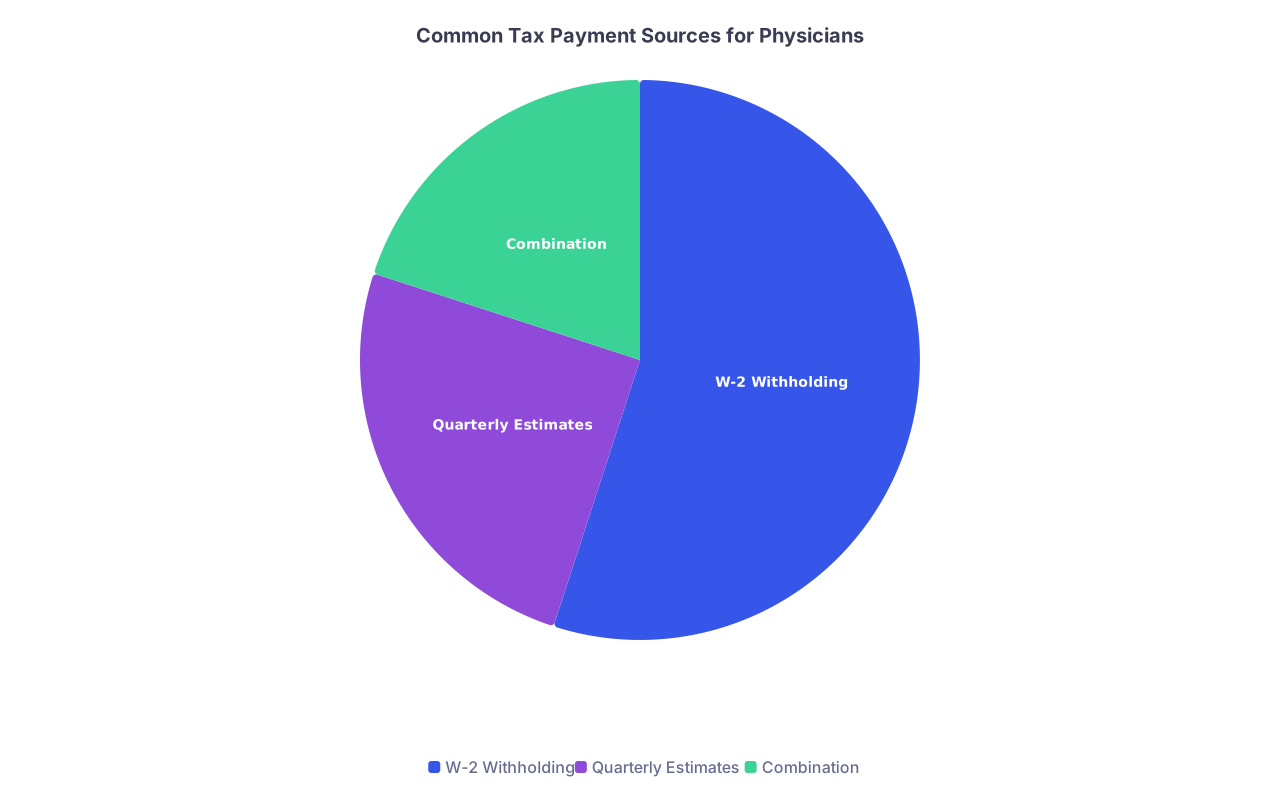
| Category | Value |
|---|---|
| W-2 Withholding | 55 |
| Quarterly Estimates | 25 |
| Combination | 20 |
So the whole decision boils down to: can you realistically cover your tax obligations through withholding alone?
Step 1: Understand the “Safe Harbor” Rules (Your Penalty Shield)
To avoid federal underpayment penalties, you generally need to do one of the following:
- Pay at least 90% of your current year tax, or
- Pay at least 100% of your prior year tax (110% if your AGI last year was > $150,000 married or > $75,000 single)
And those payments must be spread across the year, not all on April 15.
Key point: it does not all have to be from estimated payments. Withholding counts too.
So the decision framework is:
- Can I meet a safe harbor entirely through W‑2 withholding?
→ If yes, you can skip quarterly estimates. - If not, do I want to:
- increase withholding enough, or
- make quarterly estimated payments?
You’re choosing the tool, not the rule. The rule is fixed.
When You’re W‑2 Only: Adjust Withholding, Don’t Bother With Estimates
If all your physician income is W‑2 (typical employed hospitalist, academic attending, large group employee), you usually do not need quarterly estimated payments.
Your simplest path:
- Update your Form W‑4 with your employer(s)
- Use higher withholding to reach safe harbor
Here’s how that looks in practice:
- Pull last year’s tax return.
- Look at “Total Tax” on your 1040 (line 24 on recent forms).
- Decide on your target:
- Prior year safe harbor: that same number (or 110% if high income last year).
- Divide that number by your pay periods this year.
- That’s roughly what you want withheld per paycheck.
Then adjust your W‑4 to:
- Reduce allowances/credits, and/or
- Add an extra flat dollar amount per paycheck in box 4(c) (“Extra withholding”)
For many physicians, the “extra withholding” box is the cleanest lever. Example:
- Last year’s total tax: $90,000
- You’re paid bi-weekly (26 paychecks)
- You want 110% of last year withheld to be safe harbor: $99,000
- $99,000 / 26 ≈ $3,808 per paycheck
If your current withholding is $3,200 per paycheck, you add about $600 extra per check on the W‑4.
No quarterly estimates. No separate payments. You’re done.
When this doesn’t work well:
- Multiple employers who each withhold as if they’re your only job
- Very lumpy income (big year-end bonuses)
- You start the job late in the year but have high annual income expectation
In those situations, you may still prefer to fix it through one primary employer’s W‑4, but you might need to over-withhold pretty aggressively for the remaining months.
When You Have 1099 or Practice Income: You Probably Need Quarterly Payments
If any of this applies:
- Locums work paid on 1099
- Side telemedicine gig
- Consulting, expert witness, speaking, paid content
- You’re a partner in a group / K‑1 income
- You own your own practice or are an independent contractor
Then no one is withholding tax for you on that income. And pretending it will sort itself out at filing time is how people get hit with 5-figure tax bills and penalties.
Here’s the basic playbook I see work well for physicians:
- Estimate your total annual tax (or work with a CPA to do it).
- Subtract what will already be withheld from any W‑2 job.
- Set up quarterly estimates for the difference.
Example:
- Expected total tax this year: $120,000
- W‑2 job will withhold roughly: $60,000
- You expect $200,000 of 1099 income
You need another ~$60,000 paid throughout the year. Easiest: four quarterly payments of $15,000.
Or you could:
- Increase W‑2 withholding by $2,500 per paycheck (for 24 paychecks = $60,000), and
- Skip estimates
That’s legal. Withholding is treated as if paid evenly throughout the year, even if you ramp it up late.
But be realistic: will your W‑2 job’s cash flow support that? If not, quarterly estimates tie the tax obligation more closely to the 1099 income.
Pros and Cons: Quarterly Estimates vs Adjusting Withholding
Here’s how the two approaches really stack up for physicians:
| Method | Main Advantage | Main Drawback |
|---|---|---|
| Quarterly Estimates | Matches irregular 1099 income | Requires discipline & manual payments |
| Adjust Withholding | Automatic and “set it and forget it” | Harder if income is lumpy or from multiple sources |
| Hybrid | Flexible for complex situations | Slightly more to track |
Quarterly estimated payments – good when:
- Significant 1099 income or partnership income
- Income is volatile, and you want to adjust quarterly
- You keep business and personal finances clearly separated
Adjusting withholding – good when:
- You have a strong W‑2 base job
- You want simplicity and automation
- Your 1099/side income is modest relative to W‑2
Hybrid approach – common in real life:
- Use W‑2 withholding to safely cover:
- The prior year safe harbor, and
- All expected tax on your W‑2 income
- Use small quarterly estimates just for the “extra” growth in 1099/practice income
That way, if the business has a bad year, you simply trim the last 1–2 estimated payments. No large over-withholding locked up in the system.
Practical Framework: Which Should You Do?
Here is the decision process I’d actually walk a physician through:

| Step | Description |
|---|---|
| Step 1 | Start |
| Step 2 | Use W4 to reach safe harbor |
| Step 3 | Get tax pro help |
| Step 4 | Increase W2 withholding |
| Step 5 | Hybrid - W2 plus estimates |
| Step 6 | Any 1099 or practice income? |
| Step 7 | W2 only income? |
| Step 8 | W2 high enough to cover all tax? |
Let me break this down plainly.
Case 1: Pure W‑2 Attending
Scenario: Hospital-employed cardiologist, $400k W‑2, no side gigs, no K‑1s.
Answer: Don’t mess with quarterly estimates. Just adjust your W‑4 at HR once a year, or after major life changes (marriage, kids, big raise, spouse’s job change).
Your goal:
- Get withholding to 110% of last year’s tax, or
- Close to what your CPA projects for this year
Case 2: Hospitalist with Locums on the Side
Scenario: $280k W‑2 job plus $80k 1099 locums.
You’ve got three options:
- Make 4 estimates that roughly cover the tax on the $80k
- Increase W‑2 withholding enough to cover both W‑2 and locums tax
- Hybrid
What I’ve seen work best in practice:
- Slightly increase W‑2 withholding to hit safe harbor based on last year
- Make quarterly payments for the locums portion
That gives you penalty protection even if the locums income explodes mid-year.
Case 3: Full 1099 or Practice Owner
Scenario: Independent contractor anesthesiologist, $550k 1099, maybe with an S‑corp.
Do not rely on withholding tricks here. You’re a pure estimated-tax person:
- Use Q1 estimate based on last year’s safe harbor (or projections)
- Adjust Q2–Q4 if income deviates a lot
- Coordinate this with retirement plan contributions and practice deductions
You may still use some withholding via retirement account distributions or payroll from your S‑corp, but quarterly estimates remain central.
How to Actually Implement Quarterly Payments (Without Going Nuts)
If you do need or choose quarterly payments, make them as mindless as possible.
The basics:
Federal quarterly due dates (for calendar year taxpayers):
- April 15
- June 15
- September 15
- January 15 (following year)
Pay via:
- IRS Direct Pay (from bank account)
- EFTPS if you want a more formal account setup
- Your state’s online portal for state estimates
Smart moves I see physicians use:
- Create a separate savings account labeled “TAX”
- Every time 1099/practice income hits your main account, automatically move:
- 30–40% to the tax account (exact percentage depends on your situation)
- On each quarterly due date, pay from that tax account
You remove willpower and memory. The system does the work.
Common Mistakes That Cost Physicians Money
You want to avoid these:
Waiting until tax filing time and hoping there’s no penalty
The underpayment penalty isn’t just a fee; it’s essentially interest on what you should have paid earlier.Ignoring safe harbor and trying to guess “90% of this year” on the fly
Using the prior year safe harbor (100% or 110%) is usually simpler and safer.Not updating W‑4 after major income changes
Big raise, second job, spouse’s job starting or stopping. All require new math.Assuming your CPA will auto-handle everything
Many CPAs will calculate estimates if you ask. They won’t magically change your W‑4 for you. You still have to execute.Massive under-withholding from multiple W‑2 jobs
Each employer assumes they’re your only job. Two $200k jobs can look to the IRS like $400k, and your combined withholding might be way too low unless you adjust one or both W‑4s.
A Quick Comparison Cheat Sheet
Use this to sanity-check yourself:
| Situation | Better Choice |
|---|---|
| Single W-2 job, no side gigs | Adjust withholding only |
| W-2 plus small 1099 ($10k–$25k) | Usually just more withholding |
| W-2 plus large 1099 ($50k+) | Hybrid or estimates |
| Full 1099/practice owner | Quarterly estimates required |
| Highly variable income year-to-year | Estimates with midyear review |
| Multiple W-2 jobs at once | Adjust W-4 on at least one job |
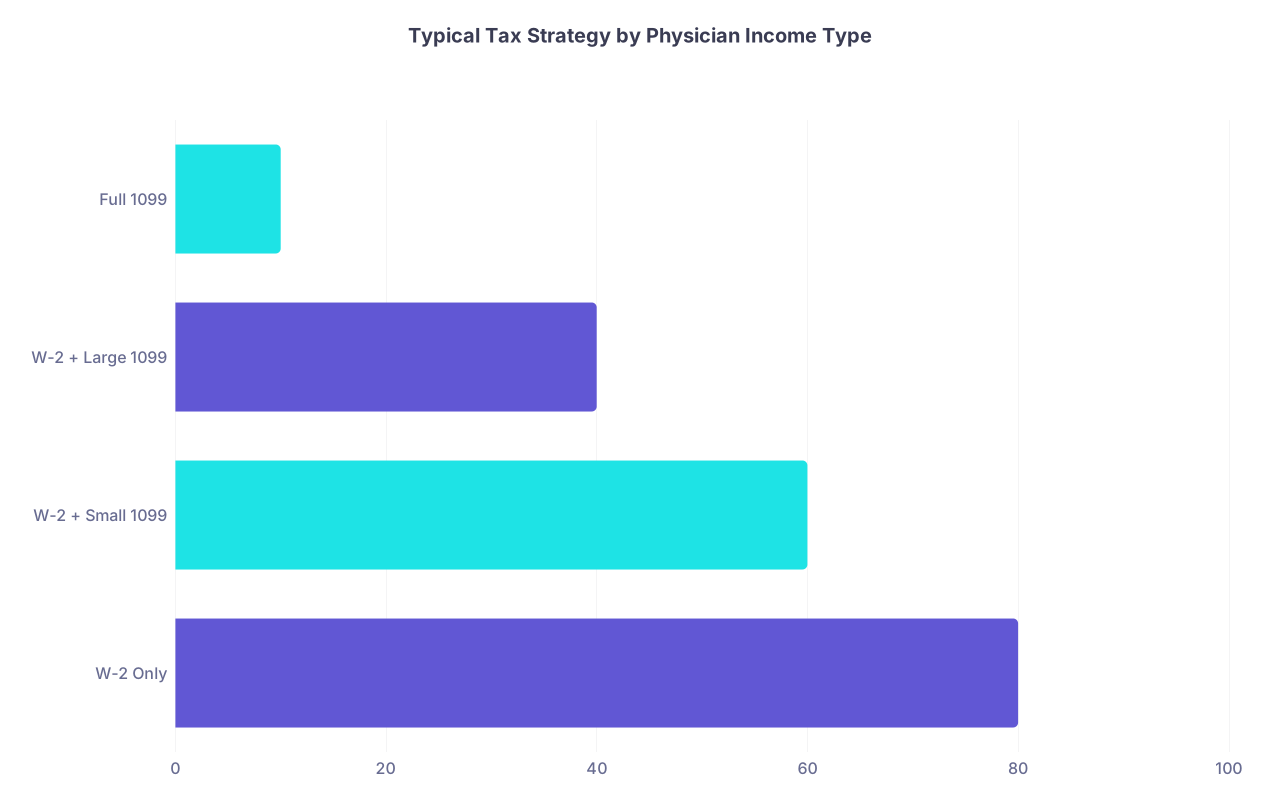
| Category | Value |
|---|---|
| W-2 Only | 80 |
| W-2 + Small 1099 | 60 |
| W-2 + Large 1099 | 40 |
| Full 1099 | 10 |
(Values represent approximate percentage of cases where withholding alone is feasible—low for full 1099.)
FAQs
1. If I just owe a big amount in April but pay it on time, will I get a penalty?
You can still get an underpayment penalty even if you pay your full balance by April 15. The penalty is about when you paid during the year, not just whether you paid by filing time. That is why safe harbor and paying throughout the year matter.
2. Can I avoid penalties by ramping up withholding at the end of the year instead of making earlier estimates?
Often yes. Withholding is treated as if it was paid evenly over the whole year. So if you realize in November that you’re short, you can increase W‑2 withholding heavily in November–December and often avoid or reduce penalties. This trick doesn’t work with estimated payments made late; those are credited on the date paid.
3. Should I over-withhold to guarantee a refund, or aim to break even?
For physicians with complex income, slightly over-withholding is usually fine. You get an interest-free loan to the government, yes, but you avoid penalties and anxiety. Trying to land exactly at $0 due is a nice idea but requires more precision than most busy physicians want to maintain. I’d rather see you comfortably within safe harbor and accepting a moderate refund.
4. How do state estimated taxes factor into this decision?
States follow broadly similar rules, but the details differ. If you have 1099/practice income, you almost always need to make state estimates as well, especially in higher-tax states (CA, NY, NJ, etc.). You cannot assume hitting federal safe harbor protects you from state underpayment penalties. You must look at each state separately.
5. I’m starting my first attending job mid-year. Do I need quarterly estimates?
Maybe, but not always. In your first year, your income might be lower than a “full” attending year. Often you can get away with just increasing withholding in your new job as soon as you start, especially if you had resident/fellow income earlier in the year with some withholding. But if you also pick up substantial 1099 moonlighting, then yes, you likely need at least a couple of quarterly payments.
6. When should I absolutely involve a CPA or tax pro instead of DIY?
At minimum: if you have any K‑1s, an S‑corp, multiple states, or >$50k in 1099 income, get professional help. The complexity and risk of guessing wrong with estimates at that level is not worth it. A competent CPA will run projections, tell you exactly how much to withhold or pay quarterly, and update the plan mid-year if your income changes.
Key takeaways:
- If you are a pure W‑2 physician, crank your W‑4 and skip estimates.
- If you have real 1099/practice income, use quarterly estimates or a hybrid—don’t rely on luck in April.
- Anchor on safe harbor rules, automate the system you choose, and stop letting taxes become an annual surprise.


