
Last week, a hospitalist sent me a text at 11:43 pm: “We just signed my partnership track contract. My accountant says the tax setup is a mess. What did I miss?”
He hadn’t asked a single tax question before signing. Now he was staring at a surprise K‑1, unexpected quarterly estimates, and a buy‑in structure that made no tax sense for him.
If you’re about to join a private group as a partner, you’re in the danger zone right now, before you sign. This is when you must ask the tax questions that everyone else in the group “means to get to later” and never does.
Let’s walk through what you actually need to ask—and what the answers should sound like—before you commit.
1. Start With the Basics: What Exactly Am I Joining?
Before you talk tax, you need to know what animal you’re dealing with.
Ask this, word for word if you want:
“What is the legal entity of the group?”
– Options you’ll commonly hear:- LLC taxed as a partnership (very common)
- Professional corporation (PC) or professional association (PA), often taxed as an S‑corp
- C‑corporation (less common in physician groups, but still out there)
- Multi‑entity structure (management company + professional entity)
“Will I be an owner of this main entity, or of a separate personal entity that contracts with it?”
Why you care:
Partnership / LLC taxed as a partnership
You’ll receive a Schedule K‑1, not a W‑2. Income passes through. You pay self‑employment tax on most of it. Big planning implications.S‑corp / PC as S‑corp
May let you split income between salary (W‑2) and distributions (not subject to self‑employment tax), but you must be paid a “reasonable salary,” and there are payroll implications.C‑corp
Double taxation risk: corporation taxed, then dividends taxed again. Sometimes used for specific reasons (benefits, legacy structure), but rarely the best after‑tax setup for a growing physician group.Multi‑entity structures
I see this a lot: Partners own a “management company” that collects profits, while the professional entity just pays salaries. This can be fine, or it can be a tax and compliance minefield. You need clarity.
At this stage, do not accept answers like “We’re an LLC” without the tax piece. LLC is a legal form, not a tax status. Your follow‑up:
“How is the LLC taxed for federal income tax purposes—partnership, S‑corp, or C‑corp?”
If they don’t know, that’s your first red flag.
2. How Will My Income Be Taxed as a Partner?
This is where things start to hit your actual paycheck.
Ask:
“When I become a partner, how will my compensation be structured?”
Push until you get something like:- Fixed draw + year‑end true‑up
- Pure productivity model (wRVUs, collections, etc.)
- Hybrid: base draw + productivity bonus
- Equity distributions separate from work RVUs
“Will I receive a W‑2, a K‑1, or both?”
Why it matters:
W‑2 income:
– Withholding done for you
– FICA/Medicare split with employer
– Predictable; simpler estimated tax situationK‑1 income (partnership / S‑corp):
– No withholding unless you set it up
– You’re responsible for quarterly estimated taxes
– Can include:- Ordinary business income
- Guaranteed payments
- Distributions
- Possibly capital gains, interest, etc.
- “Am I responsible for self‑employment tax on all of my K‑1 income?”
In a typical physician partnership (LLC taxed as partnership):
- Guaranteed payments and most active income will be subject to self‑employment tax (Social Security up to the cap + Medicare, plus additional 0.9% surtax at higher incomes).
- Some groups try clever structures to label a chunk of comp as non‑SE‑taxable “distributions.” The IRS is not amused by obviously bogus arrangements. You want something defensible, not “that guy in the group who thinks he’s smarter than the IRS.”
If the group says “We structure it so you don’t pay self‑employment tax on anything,” I’d get my own CPA involved immediately.
3. What Happens to Taxes During the Transition Year?
The year you switch from employee to partner is messy if you do not plan it.
Ask:
“What month will my status officially change from employee to partner for tax purposes?”
(Not “socially,” not “on the website,” but in payroll/payor systems.)“Will I have both W‑2 income and K‑1 income in the same calendar year?”
Most people do. That means:- W‑2 income: withholding happening
- K‑1 income: no withholding, but still fully taxable
“Does the group help new partners estimate quarterly taxes, or is that entirely on me?”
You need to know: Are you walking into a known process, or is everyone just winging it?
Here’s the trap I see repeatedly:
- Final year as employee: income is high, with full withholding
- First year as partner: W‑2 income for part of the year + K‑1 for the rest
- No estimated payments for the K‑1 chunk
- The next April: $40–$120k tax bill + underpayment penalties
Ask one more:
“Can you show me a sample K‑1 (with numbers removed) so I can give it to my CPA now?”
If they hesitate to share a redacted K‑1, ask yourself why.
4. Buy‑In, Capital Accounts, and Taxes
This is the part groups love to hand‑wave: “The buy‑in is $200k, but we have a loan, and it all kind of works out.” No.
There are three different things you need to separate:
- Capital accounts / equity
- Buy‑in / purchase price
- Debt obligations / guarantees
Ask:
“What exactly am I paying for in the buy‑in?”
Examples:- Accounts receivable
- Tangible assets (equipment, office, imaging)
- Intangible assets (goodwill, brand, contracts)
- Shares/units in management company vs professional company
“Is my buy‑in paid with after‑tax dollars or pre‑tax dollars?”
Most of the time, it’s after‑tax: you earn income, pay tax, then write a check or have it withheld from distributions. Occasionally, there are ways to structure pre‑tax contributions or retirement plan purchases, but if they claim this, you need it explained in plain English.
- “How is my capital account handled?”
You want clarity on:
- Initial capital account balance when you become a partner
- How profits and losses affect it
- How distributions affect it
- What you get back if you leave
- “If I leave the group, how is my interest valued and paid out—and what are the tax consequences?”
If the agreement says “Board discretion,” assume you may get less than you imagine.
From a tax perspective:
- Buy‑in is usually not deductible as an expense. It’s a capital investment.
- When you leave and get bought out, some of that may be a taxable gain.
- Some portions (e.g., allocated AR) can have special treatment.
You want your CPA to see the exact language here.
5. Benefits, Retirement Plans, and What You Lose as a Partner
Many physicians are shocked that “becoming a partner” actually reduces certain benefits.
Ask:
- “As a partner, which benefits change compared to my employee status?”
Go line by line:
- Health insurance (employer vs employee cost share)
- HSA contributions
- 401(k)/403(b) or profit sharing
- Defined benefit / cash balance plans
- Disability and life insurance
- CME, licensing, and dues
- Malpractice (including who pays tail if you leave)
“How are retirement plan contributions handled for partners?”
Common setups:- The practice makes employer contributions for all partners based on a formula
- Partners can make employee deferrals through payroll (if still on W‑2 for part of comp)
- Separate defined benefit or cash balance plan, with significant contributions but strict rules
“Will I still receive a W‑2 for any portion of my comp so I can do employee 401(k) deferrals, or will all comp be on a K‑1?”
If everything moves to K‑1, you lose employee 401(k) deferrals. You may still get employer contributions, but the planning changes completely.
| Feature | Employee (W-2) | Partner (K-1) |
|---|---|---|
| Tax withholding | Automatic | You handle estimates |
| Social Security/Medicare | Split with employer | You pay full SE tax |
| 401(k) employee deferral | Yes | Maybe/limited |
| 401(k) employer match | Yes | Depends on plan design |
| Health insurance | Pre-tax via payroll | Depends on entity/structure |
If the group has a strong retirement plan structure, partnership can be a huge tax win. If not, you may actually lose tax efficiency.
6. Distributions, Draws, and Tax Surprises
How and when money hits your account matters almost as much as how much.
Ask:
- “How are partner draws calculated and adjusted?”
- Fixed monthly draw based on expected profit
- Quarterly true‑ups
- End‑of‑year reconciliation
- “How do you handle tax distributions?”
This is a big one and most groups do it badly or vaguely.
You want clear answers to:
- Does the group guarantee tax distributions to cover partners’ tax liabilities?
- If yes:
- What assumed tax rate do they use? (e.g., 37% federal + 5% state)
- When are those tax distributions paid? (quarterly? annually?)
- If no:
- You’re on your own to set aside cash and pay quarterlies.
- “Can you walk me through a typical year for a partner—draws, bonuses, tax distributions—with approximate timing?”
You’re trying to avoid this scenario: You live off your draws, forget about taxes, then a massive year‑end K‑1 shows up and you owe six figures.
You want a situation where:
- There is a predictable draw you can budget around
- There are explicit tax distributions or at least an understood practice for partners to pull cash for quarterly estimates
- The group is transparent about prior years’ effective tax rates for partners
7. Multi‑State and Hospital‑Based Complications
If you’re hospital‑based, work locums, or your group covers multiple states, taxes get trickier.
Ask:
“In which states does the group file tax returns?”
“Do partners typically have filing obligations in multiple states?”
“Do you provide any CPA support or guidance for multi‑state filings, or is that fully on each partner?”
If you practice in a high‑tax state (CA, NY, NJ, etc.), or live in one state and work in another, you need to budget for:
- Multiple state income tax returns
- Potentially partial credits, not full ones
- Additional accountant fees each year
If they shrug this off with “our accountant handles it,” push:
“Does your accountant file my personal returns, or just the entity returns and K‑1s?”
Almost always, you’ll need your own CPA.
8. Entity Choice for YOU Personally
Sometimes the group will say: “When you make partner, you’ll form your own S‑corp or LLC, and we’ll pay that entity.”
This can be smart or stupid, depending on how it’s done.
Ask:
- “Does the group require me to form a personal entity (PC, PLLC, S‑corp, etc.) as a partner?”
- “Does the group have a preferred structure for partners’ personal entities, or is it up to my individual tax advisor?”
The key issues:
If you’re paid as an independent contractor to your own S‑corp:
- You’ll be handling your own payroll, 941s, W‑2s, corporate returns
- You may optimize self‑employment taxes by splitting salary vs distributions (within reason)
- Compliance burden goes way up
If you’re a direct equity partner in a partnership:
- You get a K‑1 directly
- No separate corporate tax filings for a personal entity (usually)
- Less flexibility, but simpler
Do not form an S‑corp just because “everyone else did” without having your CPA run real numbers.
9. The Questions You Should Ask the Group’s Accountant Directly
If they’ll let you, you want 20–30 minutes with the group’s CPA. If the CPA refuses to speak to incoming partners, that tells you a lot.
Questions to ask them:
- “Can you describe the partner compensation and tax flow from your perspective, start to finish, for a typical partner?”
- “What do new partners usually misunderstand about their tax situation in year one?”
- “What tax planning opportunities are you currently using for the group that I should be aware of?”
- “Are there major tax risks you’ve flagged to the partners but that haven’t been fixed yet?”
- “If you were joining as a partner yourself, what would you be most focused on from a tax standpoint?”
Listen closely for anything that sounds like, “We’ve always done it this way,” with no justification. Tradition is not a tax strategy.
10. What You Should Take to Your Own CPA Before You Sign
Here’s what you should have in hand before you meet your own advisor:

Gather these:
- Draft partnership or shareholder agreement
- Any compensation policy documents
- Sample (redacted) K‑1 from a current partner
- Summary of benefits and retirement plans as a partner
- Description of buy‑in and buy‑out terms
- Any prior year partner tax distribution memos or examples
Then ask your CPA three blunt questions:
- “If I join under this structure, what will my effective tax rate likely look like over the next few years?”
- “What do I need to change about my cash flow, savings rate, and quarterly estimates to avoid surprises?”
- “Is there anything in this structure that you would consider a red flag or a problem down the road?”
If your CPA doesn’t ask follow‑up questions about entity type, K‑1 categories, or retirement plans, consider upgrading.
11. Red Flags That Should Make You Pause
You do not walk away from good partnership opportunities lightly. But there are tax and structure issues that should make you at least slow way down.
Things that worry me:
- Nobody in leadership can clearly explain whether the entity is taxed as a partnership, S‑corp, or C‑corp.
- No one is willing to show you a sample K‑1.
- There are no written policies on partner draws and tax distributions.
- The buy‑in is large, but there’s no clear explanation of what you’re buying or how you get it back.
- New partners routinely get crushed with surprise tax bills—and everyone treats it like a rite of passage instead of a solvable problem.
- The group discourages you from talking to your own CPA (“our accountant handles everything”).
You can fix knowledge gaps. You can’t fix a culture that treats structure and taxes as irrelevant.
Visual: Typical First-Year Tax Pattern – Employee to Partner
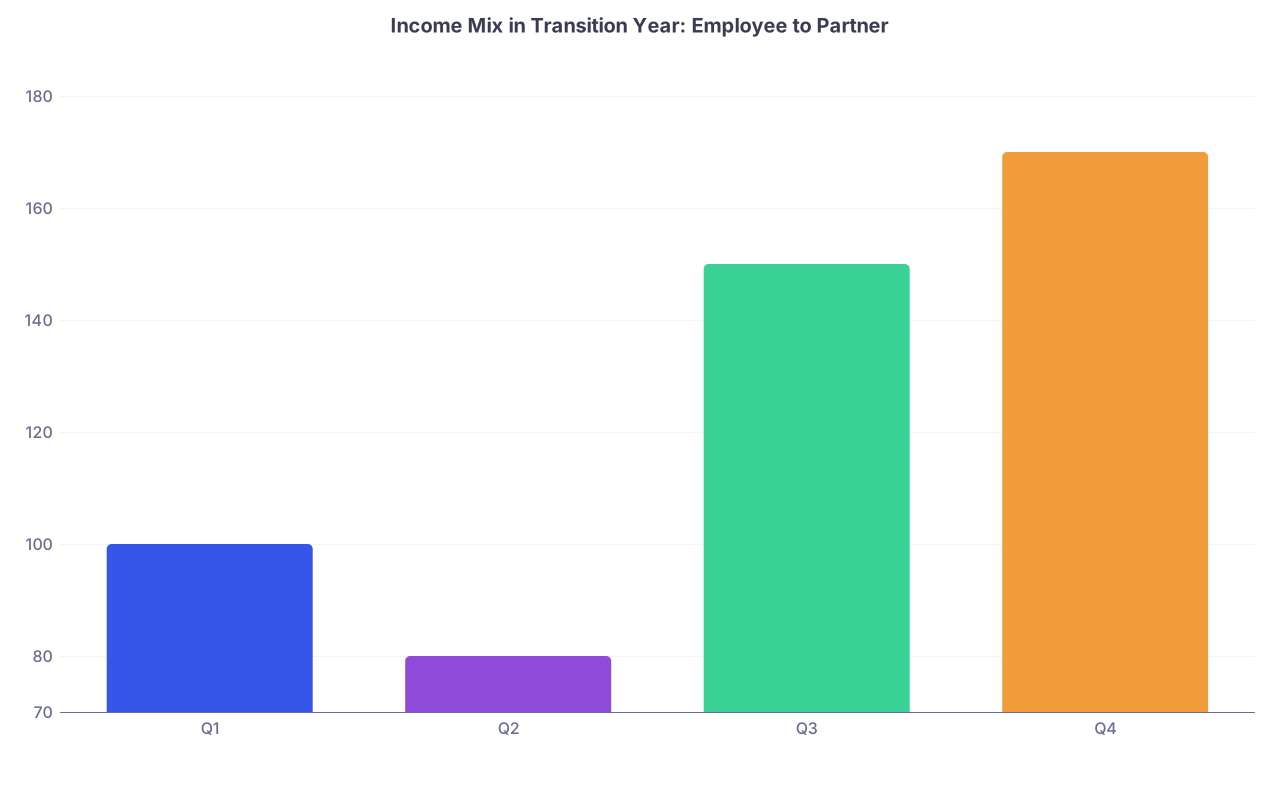
| Category | Value |
|---|---|
| Q1 | 100 |
| Q2 | 80 |
| Q3 | 150 |
| Q4 | 170 |
Interpretation example:
- Q1: Pure W‑2 (heavy withholding)
- Q2: Split W‑2 + small K‑1
- Q3–Q4: Mostly K‑1, no withholding unless you plan ahead
You want your planning to match this reality, not your wishful thinking.
Simple Process Map: How to Vet Tax Issues Before Joining

| Step | Description |
|---|---|
| Step 1 | Receive Draft Partnership Offer |
| Step 2 | Identify Entity Type and Tax Status |
| Step 3 | Request Sample K-1 and Comp Policy |
| Step 4 | Ask Group Leaders Key Tax Questions |
| Step 5 | Call Group CPA for Clarification |
| Step 6 | Meet With Your Own CPA |
| Step 7 | Negotiate Minor Tweaks if Needed |
| Step 8 | Reconsider Joining or Push for Structural Changes |
| Step 9 | Structure Reasonable? |
FAQ (Exactly 3 Questions)
1. Should I still consider partnership if the tax structure is mediocre but the income is high?
Yes, but go in with your eyes open. A mediocre tax setup can be partially offset by strong income, as long as you plan aggressively: higher savings rate, disciplined quarterly estimates, and smart use of retirement/cash balance plans if available. What you should not do is ignore a bad structure, live at the level of your gross income, and then act shocked on April 15. High income doesn’t excuse laziness on structure; it simply gives you more room to fix mistakes.
2. Is forming my own S‑corp always a good idea once I’m a partner?
No. It’s one possible tool, not automatically the right one. The benefits (potential savings on self‑employment tax) have to be weighed against: added admin work, payroll filings, reasonable salary rules, state law restrictions for physicians, and coordination with the group’s entity. For some physicians making $600k+ with a cooperative group and a smart CPA, an S‑corp can be a clear win. For others, especially in complex partnership structures, it just adds friction and audit risk for modest benefit.
3. What’s the single most important document to show my CPA before I sign?
If I had to pick one: a redacted K‑1 from an existing partner, paired with your draft partnership agreement. The K‑1 shows what actually happens in practice—the real tax outputs, not the glossy explanation. Your CPA can look at the categories of income, guaranteed payments, distributions, and state filings and tell you very quickly what your tax life will look like. The partnership agreement then shows whether there is any flexibility to improve things, or whether you’re signing onto a rigid structure you’ll just have to live with.
Key points to keep in your head:
- Do not become a partner until you can explain, in plain English, how money flows to you and how it’s taxed.
- Ask for real documents—K‑1s, comp policies, plan descriptions—and let your own CPA tear through them before you sign.
- Partnership can absolutely be worth it, but “we’ve always done it this way” is not a tax plan. Push for clarity now, or you’ll pay for it later.