
Most physicians sleepwalk into partnership and donate six figures to the IRS along the way.
You do not have to. Partnership is predictable. Your tax bill is predictable. Your planning should be too.
Below is a year‑by‑year, then quarter‑by‑quarter checklist: what to do three years before partnership, two years before, and the final 12‑month sprint. This is written for employed physicians on track to become practice partners (or surgery center partners, radiology group shareholders, etc.), typically moving from W‑2 to K‑1 income.
Use this like a flight plan. At each point in the timeline, you should be doing something specific.
Big Picture: What Changes At Partnership
Before the clock starts, you need to understand what you are marching toward.
At partnership you will usually:
- Shift from W‑2 employee to partner/owner (often taxed as a partner in a partnership or S‑corp shareholder).
- Lose traditional employer “safety net”:
- No more automatic withholding for income and payroll taxes.
- Often no more traditional W‑2 benefits structure.
- Gain:
- K‑1 pass‑through business income.
- Buy‑in obligations (cash, note, or sweat equity).
- Access to business deductions and retirement plans that were not available as an employee.
The mistake I see constantly: people wait until after they get the first K‑1 and huge tax bill to “figure out” tax planning. At that point you are cleaning up a mess, not planning.
So we start three years out.
Three Years Before Partnership: Foundation and Forensics
You are not an owner yet. At this point you should be:
- Gathering data.
- Modeling the partnership structure.
- Fixing obvious tax leaks in your current life.
Months 1–3: Get Oriented and Collect Facts
At this point you should:
Clarify the partnership path on paper
- Ask for:
- Draft partnership agreement (or shareholder agreement).
- Buy‑in terms: amount, schedule, interest rate if financed.
- Expected income range for partners vs current comp.
- You are not being “greedy” or “impatient.” You are doing due diligence.
- Ask for:
Collect your personal financial / tax baseline
- Last 3 years of tax returns (federal and state).
- Current pay stubs and benefit summaries.
- Retirement account balances (401(k), 403(b), 457, IRAs).
- Current debt balances: student loans, mortgage, consumer debt.
Book your tax planning team
- At this point you should:
- Hire or upgrade to a CPA who works with physicians in partnerships. Not a seasonal tax preparer. A planner.
- Identify an estate/asset‑protection attorney if your expected income will cross ~$500k+ as partner.
- Give them:
- Your collected documents.
- Partnership info you got from the group.
- At this point you should:
Months 4–6: Model the Future Tax Picture
Now we start running numbers. This is where most of the value is.
At this point you should:
Model your partner‑level income and tax
- With your CPA, build 2–3 scenarios:
- Conservative partner income (e.g., 25% below what senior partners say).
- Expected “normal” income.
- Optimistic year.
- For each, estimate:
- Federal income tax.
- State income tax.
- Self‑employment or payroll taxes (depends on structure).
- Required quarterly estimate amounts.
- With your CPA, build 2–3 scenarios:
Compare W‑2 vs Partner structure
| Feature | W‑2 Employee | Partner (K‑1) |
|---|---|---|
| Tax withholding | Automatic | You pay estimates |
| Retirement control | Mostly employer set | Much more flexible |
| Business deductions | Very limited | Broad, if reasonable |
| Payroll taxes | Split with employer | Often partly on you |
| Income timing | Fixed paychecks | Variable distributions |
- Identify the “tax shock” number
- Ask your CPA directly:
“If I were a partner at my expected income this year, how much more tax would I have owed compared with what was withheld?” - That difference is your tax shock. Write it down. That is the gap you will start building reserves for now.
- Ask your CPA directly:
Months 7–12: Fix Current Leaks And Prepare Structure
At this point you should:
Max out every efficient tax shelter you already have
- Employer 401(k) / 403(b) – fill the employee limit.
- HSA (if eligible).
- Consider:
- Backdoor Roth IRA (if allowed by your current tax situation).
- The goal: lower current taxable income and build habit of high savings rate before your income jumps.
Standardize your savings rate
- Target: 20–30% of gross income going to:
- Retirement accounts.
- Tax reserve (high‑yield savings).
- Buy‑in fund.
- Set this up as automatic transfers. If you cannot handle 20% yet, move there gradually over 6–9 months.
- Target: 20–30% of gross income going to:
If likely, start examining entity options
- If your group expects you to use a personal professional entity (PC/PLLC/PSC taxed as S‑corp, etc.), your attorney and CPA should:
- Review what other partners use.
- Sketch out when it should be formed (often 6–12 months before partnership).
- You do not need to file yet, but you do need a plan.
- If your group expects you to use a personal professional entity (PC/PLLC/PSC taxed as S‑corp, etc.), your attorney and CPA should:
Create a separate “future partner” bank account
- Use a high‑yield savings account.
- Label it mentally as:
- Tax reserve.
- Buy‑in reserve.
- Start sending a fixed amount every paycheck. Even $1–2k/month now makes partnership much less stressful later.
Two Years Before Partnership: Build the Engine
You now understand the path. Two years out, you start building infrastructure: legal entities, banking, systems. This is where you stop thinking like an employee.
Year −2, Q1–Q2: Lock in Structure and Coverage
At this point you should:
Decide on your ownership / entity structure
- With CPA + attorney, finalize:
- Whether you will own via:
- Direct partner interest in the group’s entity only, or
- A personal professional entity (PC/PLLC) that is the partner/shareholder.
- Whether that entity will elect S‑corp status (if allowed and sensible).
- Whether you will own via:
- Timeline:
- If an S‑corp election is planned, target submitting Form 2553 no later than early in the tax year you expect to start running income through it.
- With CPA + attorney, finalize:
Review asset‑protection basics
- At this point you should:
- Confirm malpractice coverage (tail vs occurrence) and how that changes as partner.
- Title your home appropriately (tenancy by the entirety where available).
- Make sure umbrella liability coverage is in place (often $2–5M).
- This matters because as income rises, you become a bigger target. Avoid being “rich on paper, unprotected in reality.”
- At this point you should:
Refresh your estate planning
- New or updated:
- Will.
- Health care proxy.
- Financial power of attorney.
- If your projected net worth with partnership will cross 7 figures soon, start talking about:
- Basic revocable trust.
- Beneficiary designations lining up with your plan.
- New or updated:
Year −2, Q3–Q4: Build Cash And Tax Systems
At this point you should:
Get your bookkeeping system ready
- If you will use a personal entity:
- Open:
- Business checking account.
- Business savings (for tax reserves).
- Get bookkeeping software (QuickBooks, Xero) or a bookkeeper.
- Open:
- Set default categories:
- Income (distributions, guarantees).
- Reimbursed expenses.
- Deductions:
- CME, professional dues.
- Home office (if truly eligible).
- Phone/internet portion.
- Legal and accounting fees.
- Health insurance premiums (if paid personally).
- If you will use a personal entity:
Intentionally overfund your “future partner” reserve
- Revisit your “tax shock” number from Year −3 and adjust for:
- Updated group income data.
- Higher projected partner draw.
- Goal: by the end of Year −2, you want:
- At least 50–75% of one year of projected extra partner‑tax sitting in cash.
- Typical ballpark I actually see:
- $75–150k in a dedicated taxes/buy‑in account for physicians going into $400–700k income range.
- Revisit your “tax shock” number from Year −3 and adjust for:
Clean up bad debts and ugly cash‑flow items
- Attack:
- High‑interest credit cards – zero them.
- Personal loans with chaotic payments.
- Reason: Quarterly estimated taxes require discipline. You do not want five other fires burning while you adjust.
- Attack:
Rehearse quarterly tax payments while you are still W‑2
- Even if your employer withholds enough, start fake “quarterlies”:
- Move a fixed amount (say, $10k/quarter or more if affordable) from checking to your tax savings account on IRS due dates (April 15, June 15, Sept 15, Jan 15).
- This builds the muscle memory for when those transfers will go to the IRS.
- Even if your employer withholds enough, start fake “quarterlies”:
One Year Before Partnership: Execution Mode
Now you stop rehearsing and start locking in concrete moves. The 12 months before partnership should be structured, not reactive.
Final Year, Q1: Formalize Entity And Elections
At this point you should:
Form your personal professional entity (if applicable)
- File with your state: PC, PLLC, etc.
- Get:
- EIN.
- State tax IDs if needed.
- Open:
- Business checking for income/expenses.
- Separate business savings for tax reserves.
File S‑corp election if using one
- Coordinate with your CPA on:
- Timing (usually effective at the start of a calendar year).
- Reasonable salary vs distribution structure once income begins to flow.
- Do not guess. The “pay yourself $60k salary and everything else as distribution” myth has burned more than a few physicians in audits.
- Coordinate with your CPA on:
Review compensation plan and income timing
- Nail down:
- Expected start date as partner.
- Whether there will be a transition period (e.g., part‑year salary plus part‑year K‑1 income).
- Any signing bonus, buy‑down, or forgivable loan and how it is taxed.
- Nail down:
Final Year, Q2: Retirement And Benefit Optimization
At this point you should:
Map all retirement plan options as partner
- With your group’s administrator and CPA, list:
- Practice 401(k)/profit sharing.
- Defined benefit/cash balance plan, if the group uses one.
- Any separate solo‑401(k) or SEP options for outside 1099 income (locums, consulting).
- Build a target contribution schedule:
- How much you will put into each plan.
- When during the year those contributions will happen.
- With your group’s administrator and CPA, list:
Coordinate retirement contributions with new entity
- If you are paying yourself a salary via S‑corp:
- Confirm minimum salary needed to justify planned retirement contributions.
- Use a simple plan:
- Front‑load contributions if cash flow allows, so that later in the year you can focus on building tax reserves.
- If you are paying yourself a salary via S‑corp:
Review health insurance and HSA strategy
- Ask:
- Will health insurance shift from W‑2 employer plan to group / partner plan?
- If you can choose:
- Compare HSA‑eligible plans vs richer PPO plans.
- Decide deliberately where you want that trade‑off on taxes vs out‑of‑pocket.
- Ask:
Final Year, Q3: Lock In Tax Payment Systems
Now you are close. At this point you should:
Switch fully to quarterly estimated mentality
- With your CPA, set up:
- Specific quarterly estimate amounts for the first partner year, based on:
- Signed comp agreement.
- Expected distributions.
- Specific quarterly estimate amounts for the first partner year, based on:
- Put these dates in your calendar with actual dollar amounts:
- April 15.
- June 15.
- September 15.
- January 15 (following year).
- With your CPA, set up:
Automate tax reserve transfers
- Set a rule:
Every time income hits your personal or business account, a fixed percentage (e.g., 30–40%) automatically moves to the tax reserve. - You can adjust the exact percentage with your CPA, depending on:
- State taxes.
- Deductions.
- Retirement contributions.
- Set a rule:
Refine deductible expense habits
- Begin running legitimate business expenses through your entity:
- CME, board fees.
- Licensing, credentialing.
- Professional memberships.
- Work‑related travel.
- Keep clean documentation:
- Receipts.
- Purpose notes.
- Begin running legitimate business expenses through your entity:
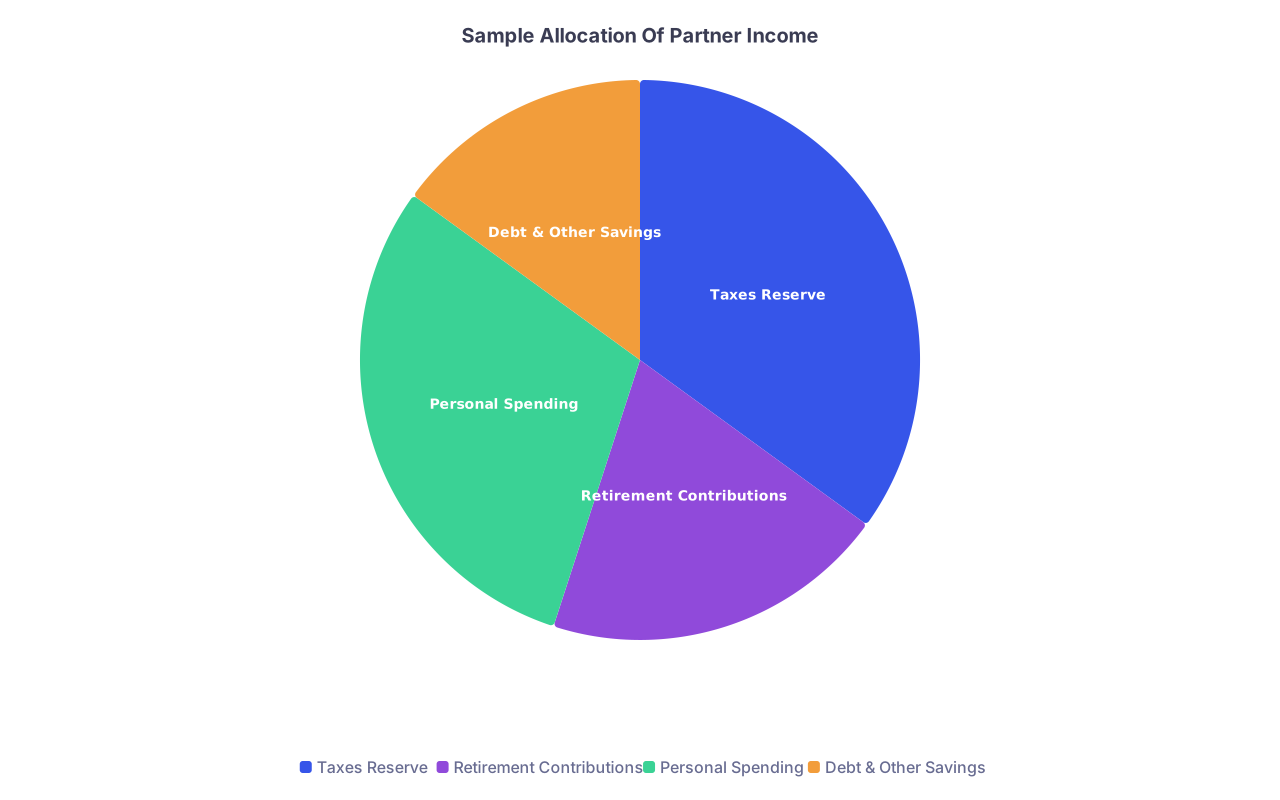
| Category | Value |
|---|---|
| Taxes Reserve | 35 |
| Retirement Contributions | 20 |
| Personal Spending | 30 |
| Debt & Other Savings | 15 |
This is roughly what I see among partners who avoid lifestyle explosion and tax panic.
Final Year, Q4: The 90‑Day Countdown
Now you are inside 3–6 months of partnership. At this point you should tighten everything.
Re‑forecast first partner year income
- Practices change. Volumes shift. Contract tweaks happen.
- Ask leadership bluntly:
- “If I were starting as partner next quarter, what is a realistic income range for year one?”
- Send this updated estimate to your CPA for revised:
- Quarterly estimates.
- Retirement plan contribution targets.
Ensure liquidity for buy‑in and taxes
- By now, target:
- Buy‑in cash portion fully saved or financing arranged.
- At least one full quarter’s worth of expected tax payments sitting in tax reserve.
- If you are short:
- Pause aggressive investing.
- Divert excess cash flow to these immediate obligations.
- By now, target:
Confirm payroll/withholding stop date
- Coordinate with:
- Practice admin.
- Payroll.
- Ensure:
- W‑2 withholding stops the same month your ownership (and K‑1 income) starts.
- There is no accidental “void” where no taxes are being covered.
- Coordinate with:
Document everything in a one‑page “Partner Tax Plan”
- Include:
- Entity details and elections.
- Quarterly estimate amounts and dates.
- Retirement contribution targets and deadlines.
- Bank accounts and which money goes where.
- Keep this on your desk or digital desktop. Seriously. It keeps you from improvising when you are tired and post‑call.
- Include:
First Year As Partner: The Stabilization Year
I know the title stopped at “before partnership,” but I would be doing you a disservice if I did not cover the first 12 months briefly. This is where the planning either proves itself or falls apart.
At this point you should:
Stick ruthlessly to tax transfers
- Every distribution:
- Move the agreed percentage to tax reserve the same day.
- Do not let yourself “borrow” from tax money for lifestyle creep.
- Every distribution:
Quarterly touch‑base with your CPA
- Not annually. Quarterly.
- Each check‑in:
- Compare actual income vs projected.
- Adjust estimated payments as needed.
- Review whether retirement contributions are on track.
End‑of‑year tactical decisions
- In the last 60–90 days, your CPA may advise:
- Accelerating certain expenses into this year.
- Timing equipment purchases or CME.
- Fine‑tuning salary vs distribution if you use an S‑corp.
- In the last 60–90 days, your CPA may advise:
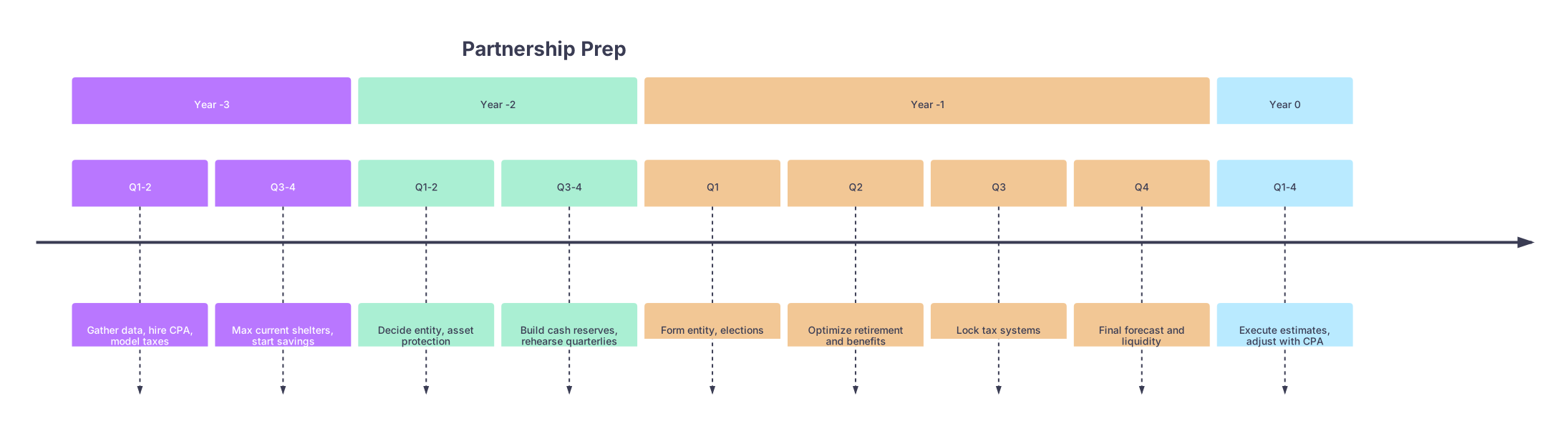
| Period | Event |
|---|---|
| Year -3 - Q1-2 | Gather data, hire CPA, model taxes |
| Year -3 - Q3-4 | Max current shelters, start savings |
| Year -2 - Q1-2 | Decide entity, asset protection |
| Year -2 - Q3-4 | Build cash reserves, rehearse quarterlies |
| Year -1 - Q1 | Form entity, elections |
| Year -1 - Q2 | Optimize retirement and benefits |
| Year -1 - Q3 | Lock tax systems |
| Year -1 - Q4 | Final forecast and liquidity |
| Year 0 - Q1-4 | Execute estimates, adjust with CPA |
Common Pitfalls (And When They Happen)
You avoid a lot of pain by simply knowing when physicians usually screw this up.
| Timing | Mistake |
|---|---|
| 3 years out | No modeling; assume “partners make bank” |
| 2 years out | No cash savings for buy‑in or taxes |
| Final year | Late entity setup, rushed S‑corp choices |
| First partner year | Underpay quarterlies, lifestyle inflation |
| Year 2+ as partner | Never updating estimates as income rises |
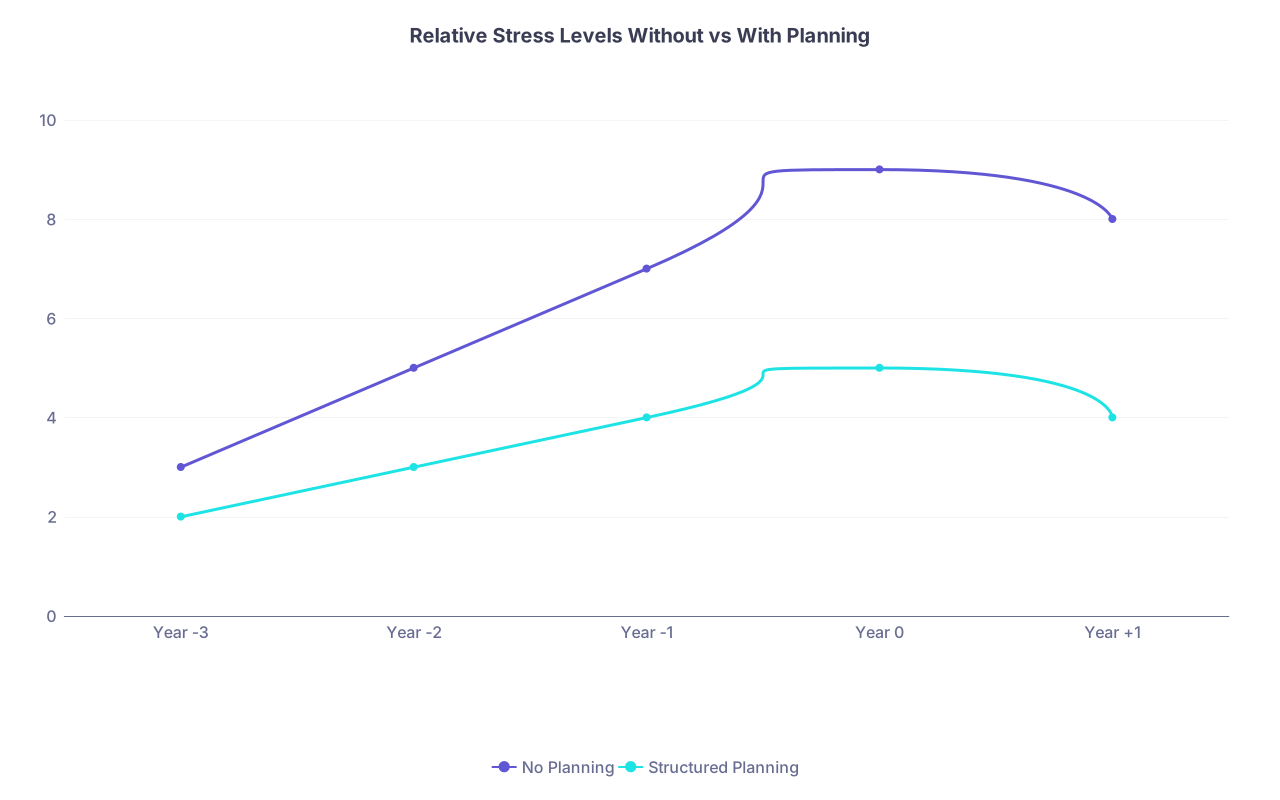
| Category | No Planning | Structured Planning |
|---|---|---|
| Year -3 | 3 | 2 |
| Year -2 | 5 | 3 |
| Year -1 | 7 | 4 |
| Year 0 | 9 | 5 |
| Year +1 | 8 | 4 |
You can guess which line I recommend.
Quick Checklist By Year
Sometimes you just need a compact list. At each point you should be able to say “yes” to most of this.

Three Years Before Partnership
- Partnership agreement and buy‑in terms reviewed.
- CPA with physician partnership experience hired.
- Tax shock number calculated.
- Retirement accounts and HSA being fully used.
- 20–30% savings rate being built.
- Dedicated “future partner” savings account open and funded monthly.
Two Years Before Partnership
- Ownership / entity structure decided in principle.
- Asset‑protection basics in place (umbrella, titling, malpractice details).
- Estate plan updated or at least drafted.
- Business bank structure and bookkeeping plan mapped.
- At least 50–75% of one year’s extra expected taxes saved.
- Practicing quarterly tax “payments” into savings.
One Year Before Partnership
- Entity formally created; EIN and bank accounts open.
- S‑corp election filed if applicable and appropriate.
- Retirement plan integration with new structure planned.
- Health insurance and HSA choices aligned with strategy.
- Quarterly estimate schedule and amounts set with CPA.
- Automated transfers to tax reserve running.
- Buy‑in funds largely or fully available.
First Year As Partner
- Percentage‑based tax reserve on every distribution.
- Quarterly calls with CPA.
- Year‑end tax tactics done before December 31, not after.