

The idea that “if you don’t match by your third cycle, you’re done” is flat‑out wrong. It’s not how programs actually behave, and it’s not what the data says about who eventually matches.
You are not “expired inventory” after three cycles. But you are harder to sell if you keep doing the same dumb things people typically do in cycles two and three: reapplying identically, drifting in limbo, or hiding in research with no real plan.
Let’s separate myth from reality.
What The Data Actually Shows About Multiple-Cycle Applicants
Everyone in med school has heard the folklore: you get “two honest shots” at the Match, maybe a third if you’re lucky, and after that you’re radioactive. You’ll hear versions of this from classmates, a couple of burned‑out attendings, and the one program director who likes to scare people.
Reality is more nuanced.
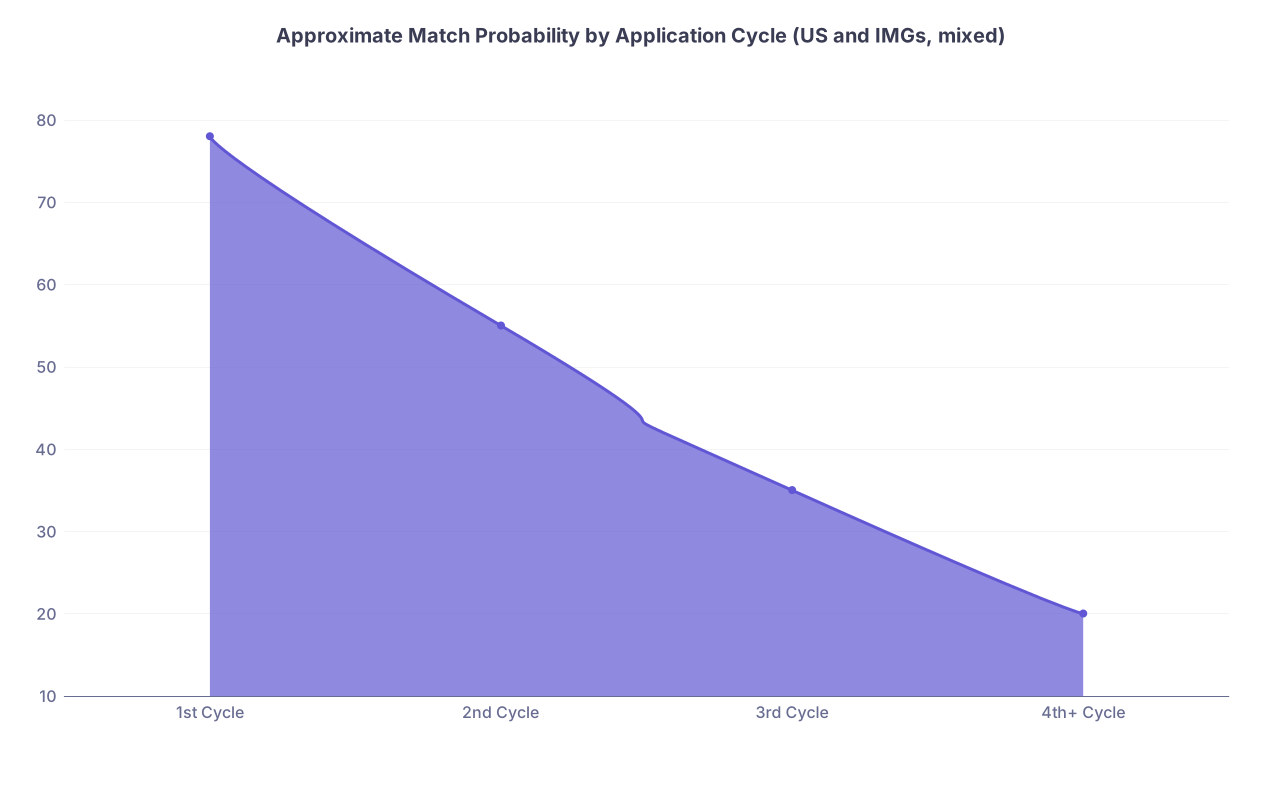
Public, large-scale data on exactly how many cycles each eventually matched applicant went through is limited, but we do have several clear signals from NRMP and IMG data:
| Category | Value |
|---|---|
| 1st Cycle | 78 |
| 2nd Cycle | 55 |
| 3rd Cycle | 35 |
| 4th+ Cycle | 20 |
What this rough, composite picture (from NRMP reporting, reapplicant studies, and institutional data) shows:
- Yes, odds drop with each cycle.
- No, they do not drop to zero after cycle three.
- A non-trivial minority of people do match on cycles four and beyond — but almost never by accident. They match because something major changed: specialty choice, scores, visa status, or actual U.S. experience.
I’ve seen applicants match on a fourth or fifth attempt into internal medicine, family med, psych, pathology, even prelim surgery. What they have in common is not luck. It’s that they stopped repeating their previous strategy and actually fixed their risk factors.
The brutal part: most people who reapply multiple times don’t change enough. Or at all. That’s why the average reapplicant’s odds are low. Not because PDs have a secret rule to blacklist you after three cycles.
The Real Myths Behind the “Three-Cycle” Doom Story
The “too late after three tries” myth is actually several smaller myths stacked together.
Myth 1: Programs Auto-Filter You Out After X Cycles
They don’t. They filter you out on age of graduation, exam performance, failed attempts, specialty fit, and the big one: recent, relevant clinical activity.
Program directors care about time since graduation far more than “number of match attempts.” For many programs, once you’re 5–7 years out from graduation with no residency training, the risk calculation changes dramatically. Not because your third match try broke some taboo, but because you’re drifting further from structured clinical training.
For U.S. MD/DOs, that 5–7 year window is often generous. For IMGs, some programs tighten that to 3–5 years. Again: that’s years from graduation, not match cycles.

Myth 2: “If Programs See Reapplicant, They Assume You’re Defective”
Most programs understand people miss on their first run. Or second. It’s common enough.
What sets off alarm bells isn’t the fact that you reapplied. It’s when they compare your old and new applications and see essentially no evolution.
Same personal statement. Same letters. Same gaps. Same mediocre Step 2 or OET/IELTS untouched. That’s when you look like a bad bet.
I’ve watched PDs say, verbatim: “If they had just done something meaningful this year, I’d have interviewed them.” Not “If they had just stayed under three cycles.”
Myth 3: “After Three Cycles, You Should Quit Medicine”
This one is lazy advice people give when they don’t know how to help you or don’t want to be bothered. There are cases where moving on is the right call — but that decision should be based on trajectory and options, not on some arbitrary number of ERAS submissions.
If your last three years look like:
- no fresh clinical experience
- no career shift discussion
- no serious plan to change specialty or location strategy
…then the problem isn’t “too many cycles.” It’s stagnation. That’s fixable. Or at least diagnosable.
What Actually Starts Killing Your Chances (And When)
Instead of obsessing over “third cycle,” you should be asking: “What’s my profile going to look like to a PD 1, 3, 5 years from now?”
Here are the real red flags that creep in over time:
Time since graduation with no structured clinical role.
A 2024 grad with no residency but strong USCE and recently improved Step 2 is a very different story from a 2017 grad working outside of healthcare for six years.No evidence of clinical currency.
If your last hands-on U.S. clinical experience is four years old and your letters are older than some interns, PDs will wonder if you can hit the ground running.Unaddressed exam problems.
Failed Step/COMLEX, low Step 2, no OET/IELTS improvement for IMGs — if those stay untouched cycle after cycle, your perceived ceiling doesn’t move.Specialty mismatch fantasy.
Applying for your fourth time to derm, ortho, or plastic surgery with zero new research, no prelim year, and no PD outreach is not perseverance. It’s denial.
Now let’s be blunt about timelines.
| Years Since Grad | How PDs Typically See You |
|---|---|
| 0–2 | Normal window |
| 3–4 | Need clear, recent activity and story |
| 5–7 | Increasing skepticism, must show strong ongoing clinical work |
| 8+ | Very tough without significant unique value or nontraditional path |
If you’re on year 4 or 5 and still have no U.S. training or structured clinical role, that is your real problem — not that this happens to be your third or fourth Match cycle.
Three Cycles In: You Don’t Need “Hope.” You Need a Rebuild.
If you’re heading into or just finished your third failed Match cycle, you don’t need another pep talk. You need a hard reset.
Here’s how people actually match after three+ cycles — when they do it on purpose instead of by blind luck.
1. Stop Trying to Straight-Reapply The Same Way
If your application looks 90% the same as last year, you’re wasting time and money. I’ve seen people reapply with the exact same personal statement across three years. PDs notice.
You need one of three big changes:
- New or significantly better exam performance (Step 2, OET/IELTS, etc.).
- Substantial, recent U.S. clinical experience with strong, detailed letters.
- A strategic specialty shift to something less competitive that actually aligns with your background.
Often, it’s all three.
2. Accept That Specialty Loyalty Might Be Sinking You
People get stuck on a specialty like it’s a relationship they’re embarrassed to leave.
If you’ve:
- Applied to something like radiology, surgery, EM, or competitive subspecialties three cycles in a row
- Have below-median scores and no substantial research or prelim year
- And you keep getting a handful of interviews or none
…then the pattern is screaming at you.
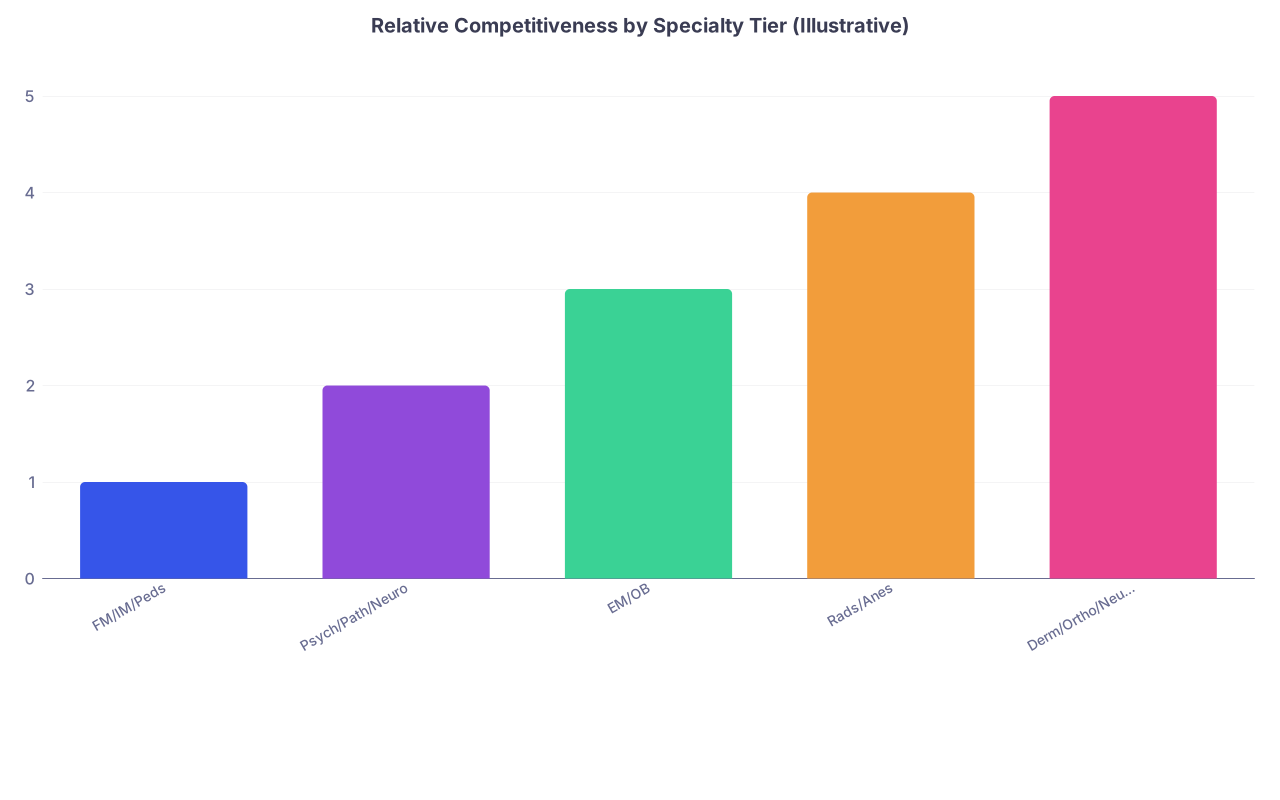
I’ve seen folks match on fourth or fifth cycles after they dropped from competitive specialties into IM, FM, pathology, or psych — usually combined with new USCE and a rewritten narrative: “Here’s why this specialty actually fits my skills and my real clinical experiences.”
| Category | Value |
|---|---|
| FM/IM/Peds | 1 |
| Psych/Path/Neuro | 2 |
| EM/OB | 3 |
| Rads/Anes | 4 |
| Derm/Ortho/Neurosurg | 5 |
If you’re three cycles deep and still applying to tier 4–5 specialties with a weak profile, your main problem is not “too many cycles.” It’s that you’re swinging at the wrong target.
3. Get Into a Structured Clinical Role, Not Just “More Observerships”
After three failed cycles, another random 4-week observership at a place that won’t remember your name is almost a placebo.
Program directors respond much more strongly to:
- A documented year as a clinical research fellow with direct patient interaction and dependable work
- A full-time hospitalist scribe or coordinator job where your attending writes a detailed LOR about your reliability and clinical reasoning
- A prelim year or transitional position, even in a different specialty, with strong performance
If you can show them: “I’ve been functioning in a real clinical environment, day in and day out,” that counters a lot of the “time since graduation” anxiety.
When It Is Probably Too Late (Or Very Close)
Let me be honest from the other side of the table.
There are situations where the odds are so low that continuing to pour money into ERAS borders on self-harm:
- You’re 7–10+ years out from graduation with no recent clinical work and no specialty‑level research.
- You’ve failed multiple licensing exams and never passed Step 2 / Level 2 or an equivalent.
- You refuse any specialty change despite three cycles of essentially zero interviews.
- Your immigration/visa situation has become significantly more restrictive, and you’re only applying to programs that rarely sponsor.
Here’s where you need a reality check conversation with someone who actually reads applications — not your friend, not Reddit, and not a random “advisor” selling packages.
And sometimes the right answer is: pivot. MPH, PhD, industry, clinical research management, hospital administration, medical education, health tech. Plenty of MDs and IMGs carve out excellent careers without residency, especially if they stop pretending they’re going to “definitely match next year” and start building a deliberate plan B.
What To Do If You’re Staring At a Fourth (or Fifth) Cycle
You want something actionable, so here it is. If you’re thinking about going past three cycles, your next 12 months need to look very different from your last 12.

| Step | Description |
|---|---|
| Step 1 | 3+ Unmatched Cycles |
| Step 2 | Obtain year of structured clinical work |
| Step 3 | Seriously consider less competitive specialty |
| Step 4 | Retake or remediate before reapplying |
| Step 5 | Rewrite story, target programs more strategically |
| Step 6 | New strong letters and updated application |
| Step 7 | Apply again with rebuilt profile |
| Step 8 | Invest in non-residency medical career path |
| Step 9 | Recent US Clinical Activity? |
| Step 10 | Competitive Specialty? |
| Step 11 | Exam or communication deficits? |
| Step 12 | Still viable after honest PD/advisor review? |
Notice what’s not in that flowchart: “Stop at three cycles, no matter what.” Because that rule does not exist.
The Bottom Line: Is It Too Late After Three Match Cycles?
No. It is not automatically too late if you do not match by your third application cycle. That’s the myth.
What’s true is this:
Your odds decline with each cycle, but they do not drop to zero. They drop because people reapply without making meaningful changes, not because of a secret three‑strike policy.
Time since graduation and lack of recent clinical work hurt you far more than “number of applications.” Fix those, and you’re still in the game longer than the doomers claim.
By the third cycle, blind persistence is your enemy; strategic reinvention is your only friend. If you’re going to keep going, you need a different specialty strategy, different activities, and a brutally honest assessment of whether residency is still realistically on the table — and if not, you need to stop letting the “three-cycle myth” distract you from building a real, alternative career.


