

The match system does not care that you got sick, your parent was in the ICU, or your kid was diagnosed with cancer. But your life does.
If health or family crises blew up your match year, you’re not ruined. You are on a different track now, and you need to handle it like a project, not like a tragedy.
I’m going to walk you through what actually works when a serious life event derails your application or your match. Not theory. The real conversations, real choices, and real risks.
Step 1: Get Clear on Your Actual Situation (Not the Story in Your Head)
Before you start emailing programs or rewriting your whole career plan, you need a clean, factual snapshot of where you stand.
Here’s what you write down in one place (yes, literally):
What exactly happened
“Mom diagnosed with stage IV lung cancer in October, moved home to be caregiver; missed half of interview season.”
“Hospitalized for severe depression and suicide attempt in November; withdrew from several interviews; needed 3 months off for treatment.”Current status
- Are you medically stable?
- Is your family member’s situation stable, terminal, improving, unknown?
- Are you realistically available for full-time training in July of the upcoming or following year?
Match outcome this cycle
- Did you:
- Not apply at all?
- Apply but not get interviews?
- Get interviews but not rank?
- Rank but not match?
- Match and now cannot start?
- Did you:
Your constraints
- Geography limits (must stay near home for caregiving)
- Financial situation (loans, dependents, visa status)
- Health needs (ongoing treatment, restrictions, need for scheduled days off)
Once that’s written, you can stop catastrophizing and start planning. Programs, deans, and future PDs respond much better to: “Here is what happened. Here is where things stand now. Here is my plan.” than to vague “It was a hard year.”
Step 2: Decide the Timeframe – Take a Year, Take a Half Step, or Push Through
The biggest fork in the road: do you pause, partially pause, or push forward anyway?

| Step | Description |
|---|---|
| Step 1 | Health or family crisis |
| Step 2 | Plan gap year or LOA |
| Step 3 | Reapply next cycle with plan |
| Step 4 | Contact PD about deferral or support |
| Step 5 | Can you safely start 80 hr weeks by July? |
| Step 6 | Do you have a contract? |
Option A: Full Stop – Take a Dedicated Gap Year
This is best when:
- Your health is unstable or you need intensive treatment or rehabilitation.
- You’re primary caregiver for someone seriously ill or dying.
- You’re burned out to the point of functioning poorly.
What this usually looks like:
- Delay applying at all, or sit out a year after not matching.
- Focus year on:
- Treatment / recovery
- Caring for family
- Low-stress clinical or research roles if possible (per-diem scribe, research fellow, part-time telehealth assistant, etc.)
You do not need to “fill every gap” with fancy CV items. For serious health or family crises, residency programs will not ding you for a year spent stabilizing your life—if you present it clearly and show that you’re now solid.
Option B: Partial Pause – Modify, Not Abandon, Your Path
This is for people whose situation is serious but improving or bounded in time.
Examples:
- You had surgery and will be fully recovered 3–4 months before residency start.
- Your parent needed you during chemo but will move to maintenance therapy by summer.
- You had a major depressive episode but now have a therapist, meds, and a stable treatment plan.
Then your focus is:
- Planning your reapplication strategy early.
- Choosing specialties and programs aligned with your new constraints (e.g., close to home, supportive reputation).
- Filling the gap with something that shows reliability and clinical or academic engagement, but not at the cost of your health or family.
Option C: Push Through But With Support
This applies if:
- You actually did match, but your crisis hit late in the year.
- You’re medically cleared, have a care plan, and your family situation is demanding but no longer actively unstable.
Then your next steps aren’t about “post-match options” so much as “surviving PGY-1 without breaking.”
That means:
- Early, transparent communication with your PD.
- Getting FMLA / medical leave / accommodations if needed.
- Aggressive boundary setting around extra shifts, moonlighting, or “just helping out” for everything.
We’ll come back to specific scripts for PD conversations later.
Step 3: Know Your Realistic Structural Options
Here’s where you need to understand what doors are actually open this late in the game.
| Option Type | Best For |
|---|---|
| SOAP / Off-cycle spots | Ready to start soon, crisis resolving |
| Gap year with research | Academic or competitive specialties |
| Gap year with clinical | Primary care / less competitive |
| Full withdrawal / LOA | Major ongoing health or caregiving |
| Specialty or location shift | New geographic or life constraints |
1. SOAP or Off-Cycle Positions (If You’re Late in the Year)
If the crisis hit around interview season or right before rank lists, you might be in one of these scenarios:
- You didn’t match.
- You withdrew from interviews or didn’t rank many programs.
- You’re now kind of available but not fully sure.
If it’s SOAP week:
- Only go after SOAP spots if:
- You’re medically and logistically able to start by July.
- You’re willing to commit to that specialty and location.
If you’re not stable? Do not SOAP yourself into a disaster just because you hate the idea of a gap year. A mismatch plus an ongoing crisis is the fastest way to burnout, remediation, or dismissal.
Off-cycle:
- Some programs pick up residents off-cycle (October/January starts) due to attrition.
- These are harder to find: usually word-of-mouth, program websites, or emails from your dean’s office.
- These can work if:
- Your crisis will calm by fall.
- You can use the spring/summer to recover and fill gaps (research, observership, etc.).
2. Planned Gap Year with Structure
If you accept that you’re sitting out the upcoming July start, your question becomes: what do you do with that year?
Your priorities:
- Recovery or caregiving
- Showing you’re still engaged in medicine
- Being honest but not defined by the crisis in your future applications
Types of roles that work well:
- Research fellow / coordinator in your target specialty.
- Clinical research with some patient interaction.
- Hospital-based non-resident roles: scribe, clinical assistant, quality improvement, informatics projects.
- Public health work, especially if it aligns with your career interests.
You don’t need all of these. One solid anchored role plus a clear narrative is enough.
Step 4: How to Frame the Crisis Without Sinking Yourself
You must talk about what happened. But do it wrong, and you either scare programs or sound evasive.
Here’s the rule:
Be factual, proportional, and forward-focused.
What to Say (and Not Say) About Health Crises
Say:
- Nature of the issue in broad terms (no need for ICD codes): “a major depressive episode,” “a serious autoimmune flare that required hospitalization,” “complications after surgery.”
- What action you took: “I took a medical leave, followed with psychiatry, and entered ongoing therapy,” “I completed rehabilitation and now have regular follow-up.”
- Your current functional status: “I’ve been stable on treatment for 9 months and cleared by my physician for full-time duty,” “I’m able to work at full clinical capacity without restrictions.”
Don’t:
- Overshare gory details or dramatic language.
- Say “I’m totally fine now” with zero evidence of follow-up or treatment.
- Pretend it never happened—gaps scream “something went wrong.”
What to Say (and Not Say) About Family Crises
Say:
- The relationship and basic situation: “My father was diagnosed with terminal pancreatic cancer; I moved home to be primary caregiver.”
- The timeframe: “This occurred from September through March of my application year.”
- The resolution/current status: “He passed away in March,” or “My mother is now in assisted living near my siblings, and the day-to-day care burden is shared.”
- What you learned logistically: time management under stress, boundary-setting, dealing with grief while maintaining professionalism.
Don’t:
- Make it sound like you’ll still be doing 30 hours a week of caregiving during residency.
- Weaponize it for sympathy. PDs respect resilience, not emotional manipulation.
Step 5: Concrete Next-Step Paths for Common Scenarios
Let’s walk through specific situations and exactly what I’d tell you to do.
Scenario 1: You Didn’t Apply Because of a Crisis
Example: Your parent got diagnosed with advanced cancer in August; you postponed ERAS and then never submitted.
Next steps:
- Meet with your dean or career advisor within the next month.
- Decide whether you’re ready to apply this upcoming cycle or need one more full year.
- If applying next cycle:
- From now to June:
- Secure a research or clinical job related to your target specialty.
- Reconnect with key faculty for updated letters.
- Tighten your personal statement around: prior experiences + what happened + why you’re now ready.
- From now to June:
- Plan to address the gap in your application:
- Brief note in ERAS experiences or an addendum letter.
- Speak to it concisely in interviews when asked.
Scenario 2: You Applied, Didn’t Match, and the Crisis Is Still Active
Example: You had a flare of Crohn’s disease requiring multiple hospitalizations from November to March. You missed some interviews, your performance dipped, and you didn’t match.
Next steps:
- Skip SOAP if you’re not stable.
- Take a structured medical leave year:
- Get your disease under control with a specialist.
- Join a research or QI project in IM or your target specialty once you’re well enough.
- For next cycle:
- Rewrite personal statement: “Here’s my training path, what happened, what I did to recover, and how I spent the year.”
- Get a current letter from a physician who can speak to your reliability after your crisis period.
- Make sure you have documentation in case occupational health or program leadership needs it later.
Scenario 3: You Matched But Cannot Start
Example: You matched to surgery, but in April your child is diagnosed with leukemia and you’re the primary parent available.
This one is emotionally brutal, and you need to be very direct and very adult.
What to do:
- Contact your PD as soon as you know you can’t realistically start. Do not wait until June.
- Be honest:
- “My child has been diagnosed with leukemia and will be in active treatment requiring frequent hospital visits through at least the next 12 months. I do not believe I can safely or responsibly commit to residency this year.”
- Ask explicitly:
- “Is there any possibility of deferring my start date by a year?”
- If not possible, ask how they prefer to handle release from the contract.
Some programs can defer. Many cannot. If they can’t, your priority becomes:
- Leaving on professional terms.
- Getting a strong note from that PD for future cycles if you want to reapply.
- Structuring the next year around your caregiving plus some professional engagement when feasible.
Step 6: Strategic Adjustments – Specialty, Location, Competitiveness
Crisis years often expose the lie you were telling yourself: “I’ll go wherever for residency, it’s fine.” Or “I’ll power through anything, I don’t need help.”
Post-crisis, you might need to adjust.
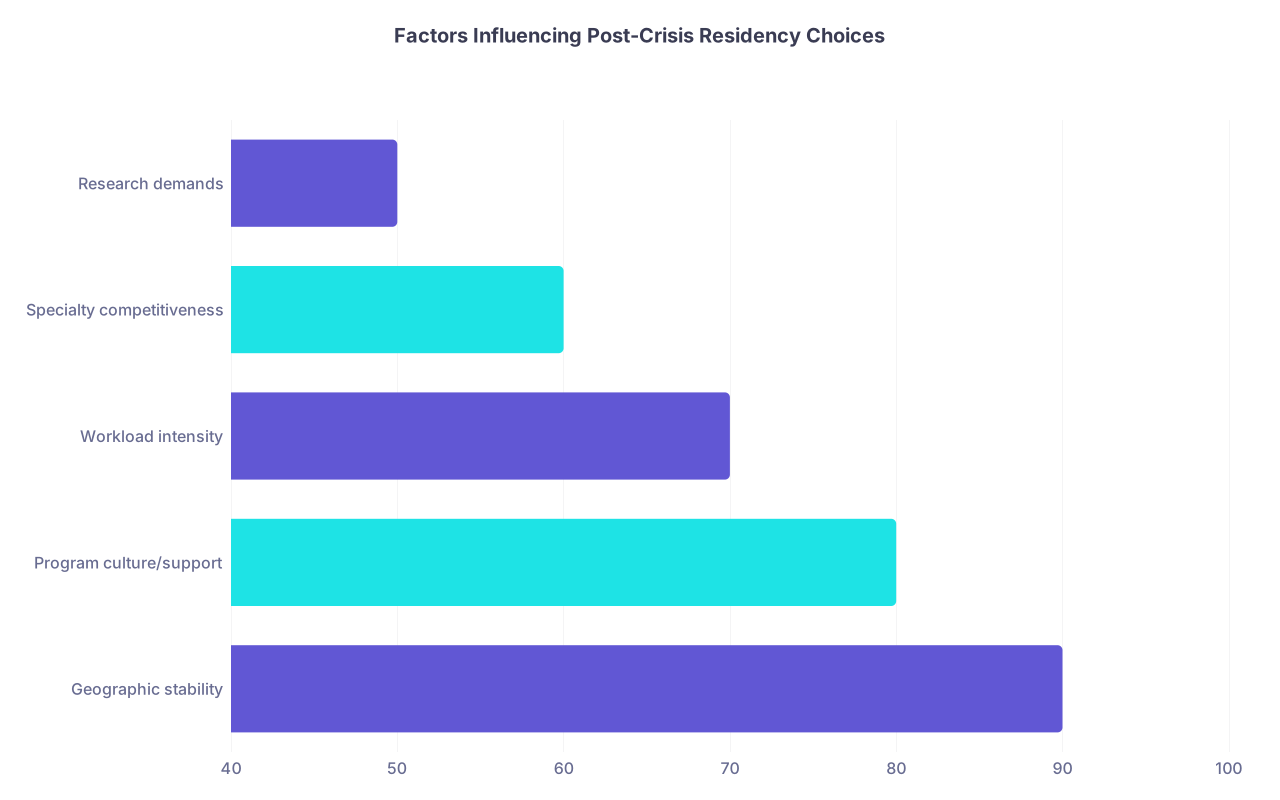
| Category | Value |
|---|---|
| Geographic stability | 90 |
| Program culture/support | 80 |
| Workload intensity | 70 |
| Specialty competitiveness | 60 |
| Research demands | 50 |
Be honest with yourself:
- If you now must stay near family or a specific children’s hospital, your geographic list shrinks.
- If you uncovered a serious chronic illness, certain very high-intensity specialties might no longer be a good fit.
- If you discovered your mental health is more fragile than you thought, you may need programs with stronger wellness infrastructure and flexible scheduling.
Sometimes that means:
- Switching from a hyper-competitive specialty to a more accessible one.
- Doing a transitional or prelim year locally first, then reevaluating.
- Prioritizing mid-tier programs with reputations for humane culture over “big name” ones.
I’ve seen people stubbornly cling to a dream specialty while their life is falling apart. That’s how you end up unmatched again, or matched somewhere that chews you up.
Step 7: Paper Trail, People, and Proof
Three things will make or break how your crisis year is perceived:
Documentation
- For health: visit summaries, letters from treating physicians stating stability and ability to work, discharge summaries if relevant.
- For family: you don’t need death certificates in your ERAS, but having documentation in your own files helps if licensing, disability, or leave issues ever intersect.
People who can vouch for you
- A dean or advisor who can write a contextual letter.
- A research PI or clinical supervisor from your gap year who can say: “They showed up. They were reliable. This person is back on their feet.”
Proof you used the time intentionally
- Doesn’t have to be glamorous.
- Could be: longitudinal volunteer work, consistent employment in a healthcare-adjacent role, remote research, or even structured coursework.
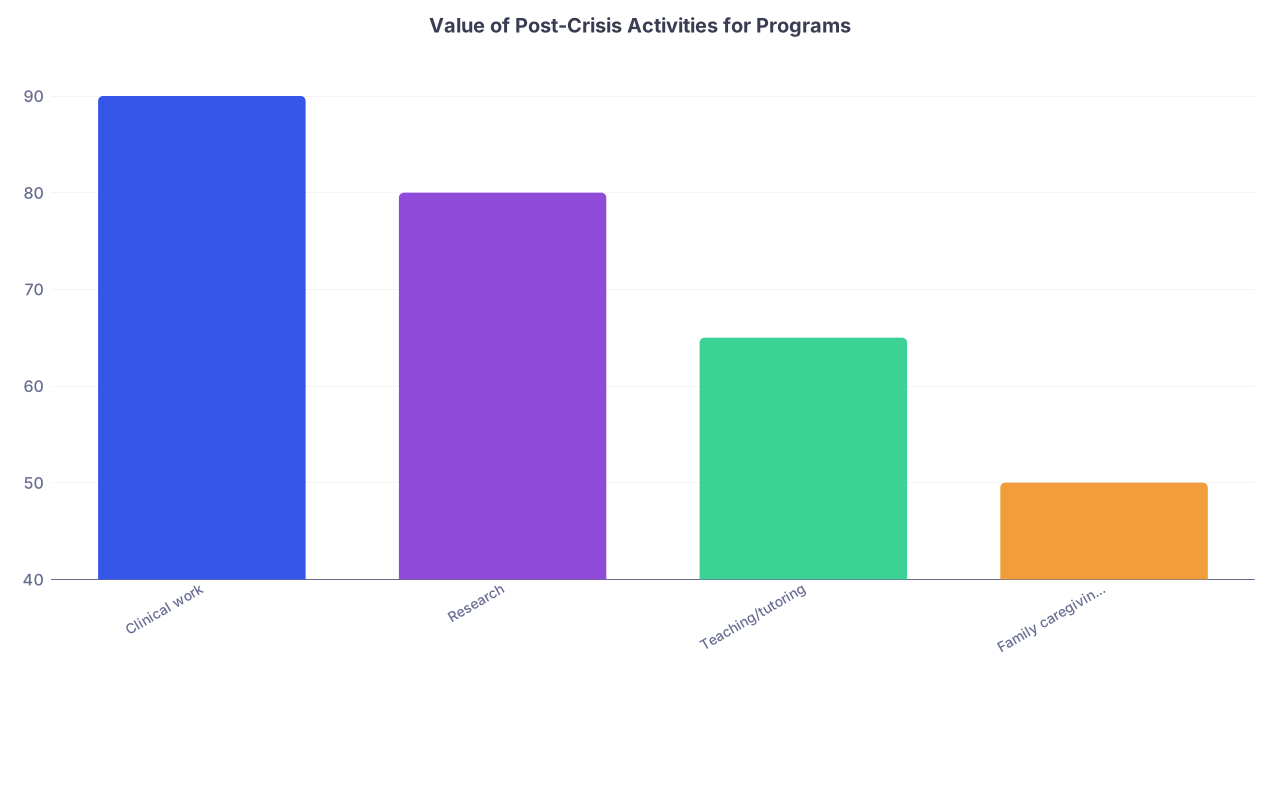
| Category | Value |
|---|---|
| Clinical work | 90 |
| Research | 80 |
| Teaching/tutoring | 65 |
| Family caregiving only | 50 |
Family caregiving alone is not a mark against you, but pairing it with at least a modest professional engagement strengthens your story, if your situation allows it.
Step 8: Mental Game – Grief, Shame, and Looking PDs in the Eye
Let’s not pretend this is purely logistical. You’re probably carrying:
- Grief (for the person you lost or nearly lost, or for your old “perfect” timeline).
- Shame (“Everyone else is moving on; I’m stuck.”).
- Fear (“Programs will think I’m broken.”).
Here’s the reality: every PD has a story of a resident who had a major life crisis during residency. Death of a spouse. New cancer diagnosis. Serious mental health crash. They’ve seen it.
Many actually respect applicants who’ve been through fire and came out with insight and boundaries.
What they don’t want:
- Unacknowledged chaos that will explode during intern year.
- Applicants who minimize or deny issues that clearly derailed them.
Your job in interviews next time:
- Own what happened.
- Demonstrate insight: what you changed, what support you now have.
- Convey stability: concrete follow-up, time since last major event, functioning in current roles.
Practice this answer with a friend or advisor until you can say it without crying or rambling for 10 minutes. The first few times are rough. Do them before you’re sitting in front of a PD.


