

If You Only Got Low-Desirability SOAP Offers: Decline or Accept?
What do you do when SOAP ends, your inbox has offers, and every single one is a program you swore you’d never rank—yet they’re all you’ve got?
Let me be blunt: this is one of the ugliest, most stressful corners of the Match process. You’re exhausted, embarrassed, and trying to decide between a “bad” residency now or rolling the dice on trying again later. And everyone around you has an opinion. Most of them shallow.
You need a clear, no-BS framework for one decision:
Do you accept this low-desirability SOAP offer, or do you walk away and regroup?
We’ll walk through it step by step. I’ll assume you’re post-Match, SOAP is done or almost done, and you’re staring at offers (or potential offers) that feel beneath you, wrong for you, or just plain scary.
Step 1: Get Specific About Why These Offers Feel “Low-Desirability”
“Low-desirability” is vague. You need specifics, because different reasons change the calculation.
Common buckets:
Location problems
Rural you never wanted. Dangerous city. Far from support system. Cost of living too high or too low (yes, that’s a thing—tiny town with absolutely nothing).Program reputation
Historically malignant. High attrition. Poor board pass rates. Scary comments on Reddit / SDN. Known for service-heavy, education-light culture.Specialty mismatch
Example: You wanted categorical IM, but you got prelim surgery. Or you wanted EM and got a transitional year in a random hospital.Career trajectory fears
You’re thinking, “If I go here, I’ll never get a fellowship / competitive specialty / academic job.”Lifestyle and support concerns
Poor work-life balance, terrible call structure, no mentoring, no wellness. Feels like a mental health hazard.
You cannot make a rational decision if all you’re holding is “this feels bad.” Write down the exact reasons for each offer.
Then sort each reason into one of two categories:
- Deal-breakers (ethically unsafe, regularly violating duty hours, systemic abuse, pattern of residents not graduating)
- Deterrents (bad location, low prestige, low fellowship rate, heavy scut)
If what you’re seeing is mostly deterrents, not true deal-breakers, you’re in a different decision zone than if you’ve got credible evidence of harm.
Step 2: Understand the Real Cost of Declining SOAP and Reapplying
People like to toss out “Just reapply next year” like it’s a magic reset button. It’s not.
Here’s the reality of taking no SOAP offer and trying again:

The risk profile if you decline
You need to ask yourself four blunt questions:
How strong were your original stats and application?
- Step/COMLEX scores
- Number and quality of letters
- Clinical performance
- Red flags: leaves of absence, failures, professionalism issues
How many interviews did you get this cycle?
- 0–2: that’s a big signal. The market already told you something.
- 3–5: weak but not dead.
- 6–10: you underperformed expectations somewhat.
- 10+: you probably had a ranking issue or bad interview performance.
Are you realistically going to materially improve your application in 12 months?
- Another degree? Probably not.
- Research with real outputs? Possibly.
- Strong new clinical letters? Yes, if you get real US-based clinical roles.
- Fixing failures? Maybe, if you retake and pass.
What’s your timeline to licensure and income?
- Loans are accruing interest.
- Some states have timelines for completion / training.
- Visa status (if applicable) may not tolerate a gap year.
How programs see reapplicants
Programs are not neutral on this. They have thoughts:
Reapplying for the same specialty after no SOAP match:
- If you added substantial new content (US clinical experience, strong letters, better Step 2, research), you can look more attractive.
- If you did nothing but a random gap year, you can look worse.
Switching specialties:
- If you pivot from, say, EM to IM with clear reasoning and fresh IM letters, you can actually look better than this year.
- If you’re just flailing, it shows.
So declining SOAP is not just “try again.” It’s “I’m betting that a cold market becomes warm enough next cycle to offset the stain of being unmatched this year.”
Step 3: Use This Framework: “Accept vs Decline” in Clear Scenarios
Let’s get concrete. Here’s how I’d think through common SOAP situations.
| Scenario Type | Lean Toward |
|---|---|
| Safe but undesirable categorical | Accept |
| Questionable culture, but residents graduate | Usually accept |
| Truly malignant, safety concerns | Decline |
| Prelim year, no clear path | Depends on record |
| IMG with weak stats, any categorical | Strongly accept |
Scenario A: You are an IMG with modest scores and only low-tier categorical SOAP offers
If you’re an IMG with:
- Step 1: pass (maybe after multiple attempts)
- Step 2: 220–235 range
- Few interviews this year
…and you now have SOAP categorical offers in FM, IM, psych, or peds at unglamorous community programs?
In most cases: you accept. Unless you have credible evidence it’s an actually dangerous or collapsing program.
Why? Because:
- Next cycle will not magically make you more competitive without something extraordinary.
- The IMG funnel is tightening. Every year. Not loosening.
- Once you have US residency training under your belt, your options expand (to some degree), especially if you perform well and network.
Scenario B: You’re a US MD/DO with mediocre stats, only categorical offers in less desired location/specialty
Example: You wanted IM in the Northeast with academic vibe. Instead you have SOAP FM offers in the rural South or Midwest.
Most of the time: you still accept, if:
- The program graduates residents consistently.
- No major red flags about abuse or chronic ACGME trouble.
- You can see yourself tolerating this location for 3 years.
The key mindset shift:
Residency is not about matching your fantasy. It’s about getting solid training, being eligible for boards, and then living your actual life post-residency.
Will you get your dream subspecialty fellowship from a weak FM program? Maybe not. But you will be a board-certified physician earning a real salary, rather than someone in perpetual applicant limbo.
Step 4: When Declining SOAP Actually Makes Sense
There are situations where walking away is the better move. They’re just rarer than people think.
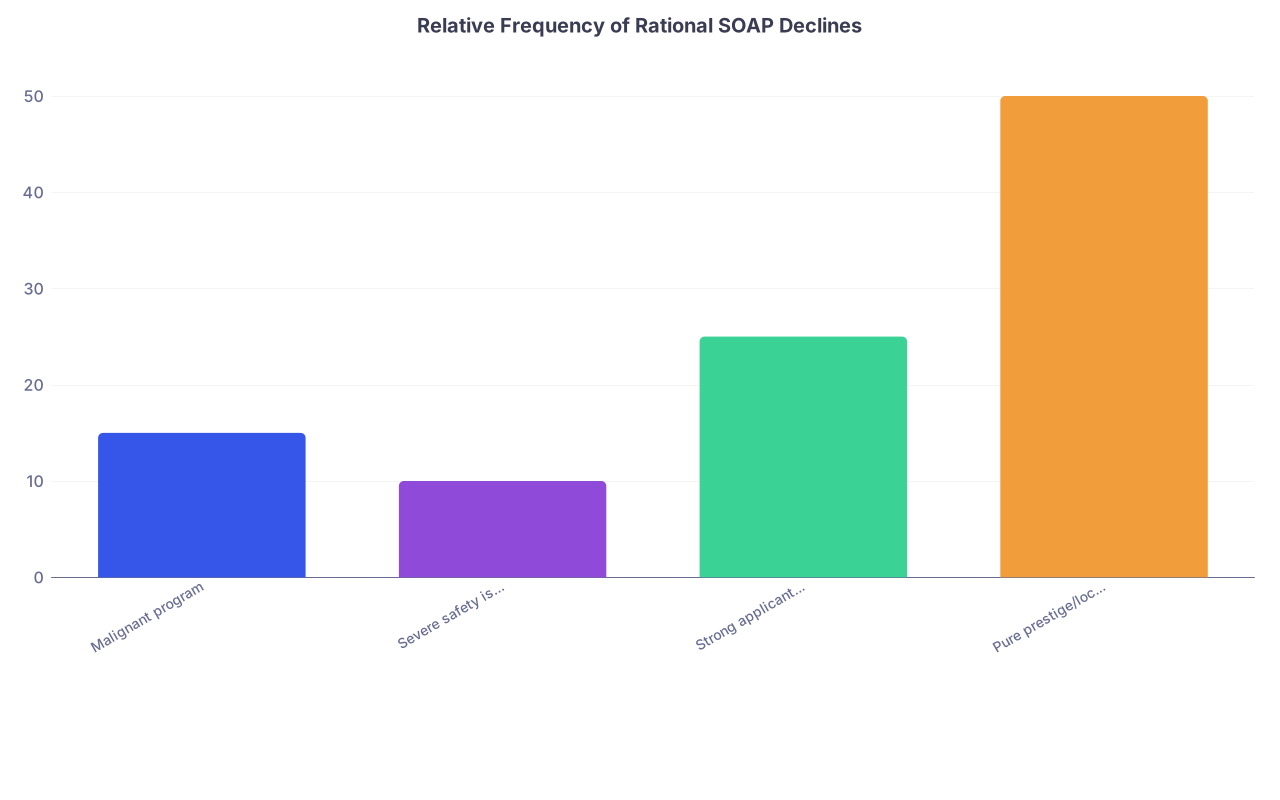
| Category | Value |
|---|---|
| Malignant program | 15 |
| Severe safety issues | 10 |
| Strong applicant misaligned specialty | 25 |
| Pure prestige/location concerns | 50 |
Situation 1: Serious, credible program toxicity or instability
Not “some resident complained once.” I mean:
- Very high attrition (multiple residents leaving each year).
- Consistent failure of residents to pass boards.
- Documented ACGME probation, especially ongoing issues.
- You talk to current residents and they literally say: “If you can avoid coming here, do not come.”
If you can back this up with actual conversations and data, declining may be smart. A genuinely malignant program can wreck your mental health, derail your training, and make you less matchable later if you quit or get fired.
Situation 2: Prelim offers that do not fit your realistic next steps
Classic example:
You wanted anesthesia or radiology. You didn’t match. You SOAP into prelim surgery at a hardcore program with no clear pipeline to advanced positions.
Should you accept? Depends:
- If your scores are strong (e.g., Step 2 240+), decent number of interviews this year, and you can spend the next 6–12 months networking for an advanced spot, a prelim year can be a decent bridge.
- If your scores and interviews were weak, and there’s no realistic path to an advanced position in your desired specialty, a brutal prelim year might just give you scars, not opportunities.
If you already have signs you’re not competitive for that advanced specialty, taking an unrelated or excessively abusive prelim for no clear reason can be a waste of a year and your sanity. In that case, a structured reapplication plan—possibly into a different, more realistic specialty—may be smarter.
Situation 3: You are genuinely strong and simply had a fluke year or narrow application
This is less common than people tell themselves.
It might apply if:
- You had strong scores, strong letters, good clinical performance.
- You applied too narrowly (few programs, geographic limitations, or only super competitive specialty).
- You now have SOAP offers only in specialties or locations you truly do not want and never did.
Example: You’re a competitive IM candidate with 245+ Step 2, strong research, and you only applied to 40 big-name university IM programs. You under-ranked, then didn’t match. SOAP offers are limited to prelim surgery or categorical FM in an area that will wreck your family situation.
If—and this is key—you are willing to:
- Apply much more broadly next year,
- Fix whatever went wrong (rank list strategy, geographic myopia, letters),
- Possibly switch to a more available specialty that still fits your long-term goals,
then declining a bad-fit SOAP choice can be reasonable.
But be honest: if you were truly strong and broad, you probably wouldn’t be here. You’d have matched.
Step 5: Run Your Personal Decision Through This 3-Question Filter
Now we get to your actual situation. Ask yourself, and answer in writing:
If I accept this SOAP offer and complete residency here, will I be a board-eligible physician with a reasonable shot at a tolerable job?
- If yes, that’s a massive plus in favor of accepting.
If I decline and spend a year reapplying, what is going to be substantially different next time?
- List concrete changes: new scores, new letters, new specialty choice, US clinical experience, research, networking.
- “Try again with same application plus one poster” is not a real plan.
If next year goes the same or worse, will I regret not taking this SOAP offer?
- Imagine yourself 12 months from now: still unmatched, maybe fewer interviews because now you’ve got the “unmatched once” label. How does that feel compared to “I’m in a mediocre but okay residency right now”?
Step 6: Emotional Reality Check (Without Letting It Drive the Bus)
A lot of people reject SOAP offers out of bruised ego, not strategy.
You hear versions of:
- “I’m better than this program.”
- “I didn’t work this hard for that city.”
- “Everyone from my school matched at better places.”
I’ve watched people walk away from SOAP FM spots because they were “set on derm” with no realistic derm path. They are now years out, still not residents, patchworking jobs, and the bitterness just grows.
I’ve also seen the opposite: someone took a “trash” community IM SOAP spot, worked hard, got stellar letters, and ended up in a solid cardiology fellowship. Not at Harvard, but very respectable. And they’re practicing cardiology now while the “I’m reapplying for something better” crowd is still stuck.
Your feelings are valid. They just are not a good primary decision-maker.
This decision should be 80% strategy, 20% emotion. Not the other way around.
Step 7: Concrete Next Steps for Each Path
Let’s be extremely practical. Here’s what you do depending on which way you’re leaning.

| Step | Description |
|---|---|
| Step 1 | End of SOAP with offers |
| Step 2 | Strongly consider decline |
| Step 3 | Assess long term viability |
| Step 4 | Prelim only |
| Step 5 | Accept offer |
| Step 6 | Consider reapply if clear plan |
| Step 7 | Accept prelim |
| Step 8 | Consider reapply |
| Step 9 | Any true safety or abuse red flags? |
| Step 10 | Offer is categorical? |
| Step 11 | Application weak this cycle? |
| Step 12 | Realistic path to advanced spot? |
If you are going to ACCEPT a low-desirability SOAP offer
Do this in the next 1–2 weeks:
- Commit mentally: “This is my residency. I am going to squeeze every drop of value out of it.”
- Contact PD and chief residents:
- Ask for resources to prepare.
- Ask about schedule, expectations, and any summer reading / modules.
- Strategize your first year:
- Be dependable. Show up early. Do your notes. Be the resident others want on their team.
- Identify 1–2 faculty who seem supportive and invested. Start building those relationships; they’ll write your letters later if you want fellowship or a job elsewhere.
- Control what you can:
- Save money. Pay down interest if possible.
- Take care of your health. Crumble here and everything else collapses.
- Plan your eventual exit strategy if this isn’t a long-term place (fellowship, different hospital job, different state).
Your goal in a mediocre program: become un-ignorable in your competence and professionalism. That travels with you.
If you are going to DECLINE and reapply
You are not “taking a year off.” You are entering the most structured, high-accountability year of your life.
Over the next 2–4 weeks:
Write a brutally honest post-mortem:
- Scores, number of apps, number of interviews, where you got interviews, what feedback (explicit or implied) you received.
- Identify at least three specific weaknesses.
Build a year plan that addresses those weaknesses directly:
- Low clinical credibility? Find US clinical experience (observer, research assistant with clinical exposure, hospital job).
- Weak letters? Work with clinicians who can actually see you in action and write strong letters.
- Poor specialty choice? Decide if you’re willing to pivot to something with more positions (FM, IM, psych, peds, pathology in some cycles).
Talk to at least two program directors or APDs in your target specialty:
- Ask explicitly: “Given my profile, if I spend a year doing X, Y, Z, does that meaningfully change my competitiveness for next cycle?”
- If both essentially shrug, that’s data.
Lock in structure:
- Get a real position (clinical research, scribe, hospital-based role, teaching, etc.).
- Build a timeline: when you’ll take any additional exams, when you’ll get letters, when applications will go out, and how many programs you’ll target.
This is not a “vibes” year. It’s a project year.
What I’d Tell You If We Were Sitting In A Call
Strip away the noise. Here’s my stance:
- If you’re an IMG or low-stat US grad and you’ve got any reasonable categorical SOAP offer in a core specialty that isn’t obviously malignant: take it.
- If you have credible, repeated evidence a program is dangerous or residents are not graduating/boarding: seriously consider walking away and reapplying.
- If you’re turning it down purely because it doesn’t match the prestige or lifestyle fantasy you had in MS2: you’re likely making an emotional decision that future-you will resent.
Residency is a launching pad, not your final form. Your first job, your fellowship, where you eventually live and practice—those matter more long-term than whether your SOAP program logo looks good on Instagram.
FAQ (Exactly 5 Questions)
1. If I accept a low-tier SOAP spot, am I stuck there forever?
No. You’re not signing away your entire career. You are committing to complete residency there (barring transfers, which are rare but possible). After you’re board-eligible, you can move for jobs, fellowships, or different practice settings. Many physicians trained in low-name-recognition programs and now work in nice hospitals or private practices in desirable locations.
2. Can I reapply to a different specialty while I’m in a categorical SOAP residency?
Possible, but tricky. Programs expect commitment; applying out as a PGY-1 upset some PDs. But it happens—especially when people pivot to another field early and do it transparently and professionally. If you even suspect you’ll want to switch, focus on excellent performance and discreetly seek mentorship to see if a transfer is realistic. Do not bank on this as your primary plan.
3. Does taking a prelim SOAP year help or hurt my chances of matching later?
Depends how you use it. A strong prelim year with good evaluations and recent letters can help, especially if you’re aiming for IM, anesthesia, or another field where prelim exposure is relevant. A prelim in a program where you barely survive, burn bridges, or fail exams can hurt. Also, if there’s no clear advanced spot on the horizon, you may just delay the inevitable reapplication problem.
4. How bad is it, really, to be unmatched two years in a row?
Significantly worse than being unmatched once. Programs start wondering about underlying issues: professionalism, interview skills, clinical performance, or unrealistic specialty targeting. You can still match on a second or third try, but each unmatched year raises the bar for what you must show in growth and productivity. That’s why tossing away a SOAP offer casually is dangerous—there’s no guarantee of a better result next time.
5. My family is pressuring me to accept anything; I feel miserable about these options. What should I prioritize?
You should prioritize long-term viability: becoming a trained, board-eligible physician without destroying your mental health. Family usually cares about stability and income, which matter, but they don’t feel the call schedule or toxic culture. If a program is merely unglamorous, I’d lean toward accepting. If it’s truly harmful or you have a credible plan to do markedly better next year, you can justify declining. Just be honest with yourself: are you protecting your future or your pride?
Open a blank page right now and write two short paragraphs: one describing your life in three years if you accept your best SOAP offer, and one describing your life in three years if you decline and strike out again next cycle. Which future, honestly, feels more survivable and more likely? Start from that answer and build your decision.


