
What mistake do smart, well‑trained clinicians keep making that gets them labeled “political,” “unsafe,” or “unprofessional” when they talk about public health laws?
Let me be blunt: good intentions do not protect you. In this space, misjudgment does real damage—to patients, to communities, and to your own credibility and career.
You are not just “sharing your views.” You are stepping into a minefield where law, ethics, epidemiology, and politics collide. People lose jobs here. Boards file complaints here. Communities lose trust here.
Let’s walk through the common mistakes and how to avoid stepping on the same landmines.
1. Confusing Evidence With Opinion Warfare
The first big misjudgment: believing that because you have data, you are automatically on safe ground.
No. You can be 100% correct on the science and still 100% wrong in how you present it.
Typical patterns I see:
- Quoting R0 values and confidence intervals to an angry school board that wants to talk about liberty and livelihoods
- Throwing a single study at a community group that has 20 years of lived experience being ignored
- Dismissing concerns about religious or cultural practices as “anti‑science” in front of people who have repeatedly been harmed in the name of “science”
The mistake: acting as if more data automatically equals more persuasive and more ethical.
What you should do instead:
Anchor in public health ethics first, evidence second:
- Respect for autonomy
- Beneficence
- Nonmaleficence
- Justice
Then connect how the evidence affects each of those.
Translate, do not bludgeon:
- “This mandate reduces hospitalization by 30%”
- Then: “That means fewer parents missing work, fewer kids without caregivers, and less ICU rationing.”
Explicitly acknowledge trade‑offs. People smell one‑sided framing:
- “Yes, there are real costs to this quarantine policy—economic, psychological, family disruption. The ethical question is whether the lives saved and long‑term harm prevented justify that intrusion. Here is what we know so far.”
If you skip the ethical framing and jump straight to “the science says…”, do not be surprised when half the room stops listening. You sound like another partisan, even if your numbers are flawless.
2. Pretending the Law Is Just “A Medical Question”
Second misjudgment: acting like controversial public health laws are just extended treatment guidelines.
They are not.
Vaccine mandates, mask requirements, abortion restrictions, safe‑injection sites, quarantine powers—these are primarily legal and political instruments that intersect with health, not the other way around.
I have watched residents in a public forum confidently say things like:
“We simply must mandate this; the evidence is clear.”
(Ignoring that courts may interpret “must” very differently.)“That law is unethical and should be ignored.”
(Congratulations, you just casually recommended civil disobedience as a licensed professional, on camera.)
The mistake: talking as if clinical evidence automatically dictates legal and policy obligations. It does not.
Avoid this by:
Separating clearly:
- What the evidence supports
- What the law currently says
- What your ethical assessment is
- What your professional role allows you to do
Using language that respects legal reality:
- “The current evidence suggests X would better protect population health.”
- “Under the law as it exists, we are required to do Y, which creates these ethical tensions for clinicians and patients.”
Never publicly urge colleagues to disregard laws in vague terms:
- If you are talking about conscientious objection or civil disobedience, name it, define it, and emphasize process and risk, not slogans.
You are allowed to criticize laws. You are not ethically free to pretend they do not exist or to tell patients and colleagues to ignore them on the basis of “I disagree.”
3. Overlooking Power, History, and Who Gets Hurt
The third misjudgment is especially common among clinicians who “just want to keep politics out of it.”
You cannot ethically discuss public health laws without talking about power and history. Refusing to do so is itself a political stance—one that usually favors the already powerful.
Classic red flags:
- Discussing stop‑and‑frisk, drug policy, or quarantine powers without mentioning racialized enforcement
- Talking about mask mandates or business closures as if everyone has the same baseline income, housing, or social safety net
- Defending “neutral” policies that you know hit undocumented patients, disabled people, or unhoused patients far harder
That “I am just being neutral” posture is not neutral. It is blindness. And it is ethically sloppy.
What you need to do instead:
Ask the simple question: Who pays the price of this law most heavily?
Name it out loud:
- “Historically, quarantine and policing powers have fallen hardest on marginalized racial groups. If we support this law, we must confront that risk directly and build in safeguards.”
- “This enforcement mechanism—fines, policing, child protective referrals—will reliably target poorer families first.”
Distinguish policy intent from impact:
- “I do not doubt the intention is to protect children. But the impact, as written, means more reports to child protective services in already over‑surveilled neighborhoods.”
You are not being “too political” by naming inequity. You are being clinically honest about social determinants of health. Ignoring this is the misjudgment that will come back to haunt you, especially when communities you serve stop trusting you.
4. Forgetting Your Role and Your Audience
Another recurring mistake: acting the same way on Twitter, in the clinic, at a legislative hearing, and in a classroom.
Different arenas. Different obligations.
I have seen:
- A junior physician testify before a state legislature using the same sarcastic tone they use on social media. Legislators stopped listening after the second sentence.
- An attending tell medical students, “Of course we all know this law is a disaster,” as if dissent were stupidity. Students with different views simply shut down.
The core misjudgment: assuming your personal stance is your professional duty everywhere.
You have to be very clear on which hat you are wearing:
At the bedside: Your primary obligation is the patient’s welfare, autonomy, and informed consent within the law. This is not your stage for broad political advocacy.
In public testimony: Your obligation is to bring accurate evidence, identify foreseeable harms, and clarify ethical tensions. You must expect misquotation and distortion. Choose words like a lawyer, not like a friend venting at dinner.
On social media: This is where people ruin careers. Fast. Confusing personal venting with “public health education” is a common and dangerous misjudgment.
A quick rule:
- If you would be uncomfortable seeing your exact words as a headline with your name and institution—rewrite it or do not say it.
5. Sliding Into Shaming, Not Explaining
Public health laws almost always involve restricting something: movement, behavior, access, autonomy.
People do not react well to being told they are foolish, selfish, or “anti‑science” for questioning those restrictions. Yet I keep watching clinicians do this on panels, in town halls, and online.
Shaming patterns:
- “People who refuse this mandate are the reason we are still in this mess.”
- “There is no legitimate ethical objection to this law.”
- “If you read the science, the debate is over.”
That last one is particularly naïve. Ethical debates are rarely “over.”
The mistake: treating disagreement as ignorance or malice, rather than as a predictable clash of values.
Better approach:
Acknowledge plural values without caving on evidence:
- “Reasonable people can disagree on how much individual liberty should be limited for community protection. The question is where we draw that line, and on what basis.”
Swap blame language for risk language:
- Instead of: “You are endangering others.”
- Try: “This choice raises the risk to immunocompromised people who cannot protect themselves as effectively.”
Distinguish between understandable fear and intentional disinformation:
- Treat the first with patience.
- Treat the second as a separate ethical problem.
You are allowed to be frustrated. You are not allowed, if you care about ethics, to turn vulnerable or misinformed people into villains to win an argument.
6. Ignoring the Limits of the Data—and Overpromising
Another misjudgment that gets clinicians in trouble is overselling certainty.
You see a law whose intentions you support. You want it to pass. You start talking as though the outcomes are guaranteed.
This is how you end up saying things like:
- “This law will save thousands of lives.”
- “There is no downside to this policy.”
- “This will definitively end the outbreak.”
Then the law passes. Real life is messier. And your credibility evaporates.
You need to be honest about uncertainty. That is not weakness. It is integrity.
Watch for these traps:
- Treating a short‑term randomized trial as if it proves long‑term societal outcomes
- Ignoring unintended consequences because they are inconvenient to your advocacy stance
- Claiming “no evidence of harm” when you mean “we have not looked carefully yet”
A cleaner, more defensible way:
“Based on current evidence in settings similar to ours, we expect this policy to reduce hospitalizations by roughly X%. That is a projection, not a guarantee.”
“We do not yet know the full mental health impact of long‑term enforcement. If we implement this, we should pair it with surveillance for those harms and be prepared to adjust.”
This is how you avoid being remembered as the person who “promised this law would fix everything.”
7. Underestimating Enforcement and Real‑World Implementation
Too many discussions about public health laws stay at the whiteboard level.
People argue about “mandates,” “bans,” or “requirements” like they are abstract, when in reality they come with:
- Police
- Fines
- Child protective services
- Deportation risk
- Loss of housing or employment
Ignoring the enforcement machinery is a serious ethical blind spot.
A few questions you must ask, out loud, when discussing these laws:
- Who enforces this? Police? Employers? Schools? Clinicians themselves?
- What is the penalty? Fine? Jail? Loss of services? Public listing?
- Is there an appeals process that real humans can actually access?
- How has similar enforcement played out historically for minoritized groups?
If you support a law in theory but blanch when you imagine it enforced on your most vulnerable patient, you have more thinking to do.

Support or opposition to public health laws without any attention to enforcement is shallow ethics. You will miss who gets hurt first and worst.
8. Failing to Separate Personal Morality From Professional Ethics
Controversial laws about abortion, end‑of‑life decisions, drug use, sex work, or LGBTQ+ rights trigger strong personal beliefs.
The misjudgment: talking as if your personal religious or moral view is the medical ethical position.
I have seen:
- A clinician say at Grand Rounds, “As physicians, we must oppose this law because life begins at conception,” as if that were universally accepted and professionally required.
- Another say, “Any conscientious objection to providing this legal service is unethical,” as if the debate in bioethics did not exist.
Professional ethics is about:
- Respect for a broad range of conscientious positions
- Focusing on patient welfare and autonomy within legal constraints
- Minimizing harm even when you personally disapprove of a patient’s choices
You must be precise in your language:
- “From my personal moral perspective, I oppose this law.”
- “From a professional ethics standpoint, I see these specific risks to patient autonomy, fairness, and harm reduction.”
If you blur those levels, you will alienate colleagues, confuse trainees, and misrepresent the field.
9. Treating Public Communication Like a Private Seminar
Public health law debates play out in:
- Town halls
- TV interviews
- Radio shows
- Social media
- Legislative hearings
And yet clinicians speak as if they are in a protected academic seminar where nuance is safe and context is assumed.
Wrong environment.
You have to assume:
- Your comments will be clipped out of context.
- Headlines will exaggerate your position.
- People with agendas will selectively quote you.
So you must discipline your phrasing. No throwaway lines. No clever but ambiguous quips.
A few defensive habits:
State your main ethical concern in one clean sentence:
- “My core ethical concern with this law is that it disproportionately harms people who are already medically and economically vulnerable.”
Flag what you are not saying:
- “I am not saying no restrictions are ever justified. I am saying this particular restriction, as written, fails basic standards of fairness and proportionality.”
Prepare 2–3 phrases you would be comfortable seeing isolated as quotes. Use those repeatedly. That repetition is not boring; it is protection.

| Step | Description |
|---|---|
| Step 1 | Invited to speak on law |
| Step 2 | Clarify role and audience |
| Step 3 | Review evidence and uncertainties |
| Step 4 | Identify ethical tensions |
| Step 5 | Anticipate enforcement impacts |
| Step 6 | Craft 2-3 core messages |
| Step 7 | Check for legal/prof standards |
| Step 8 | Deliver public comments |
10. Not Recognizing When You Are Out of Your Depth
Last misjudgment: assuming that because you are an expert in medicine, you are automatically competent to engage deeply with constitutional law, religious doctrine, social theory, or community trauma.
You are not.
I am not either, without help.
The most ethical thing you can sometimes say is:
- “This question crosses into legal / theological / historical territory I am not qualified to adjudicate. Here is what I can say from a public health and clinical standpoint.”
And then—stop. Or step back and invite others in.
You should not:
- Pronounce on constitutionality unless you are actually trained in law
- Tell communities what is or is not racist if you have never listened seriously to those communities
- Declare whole religious objections invalid because you personally find them unpersuasive
Humility is not optional here. Overconfidence is how you end up in front of an ethics committee or a board hearing replaying your own words to you.
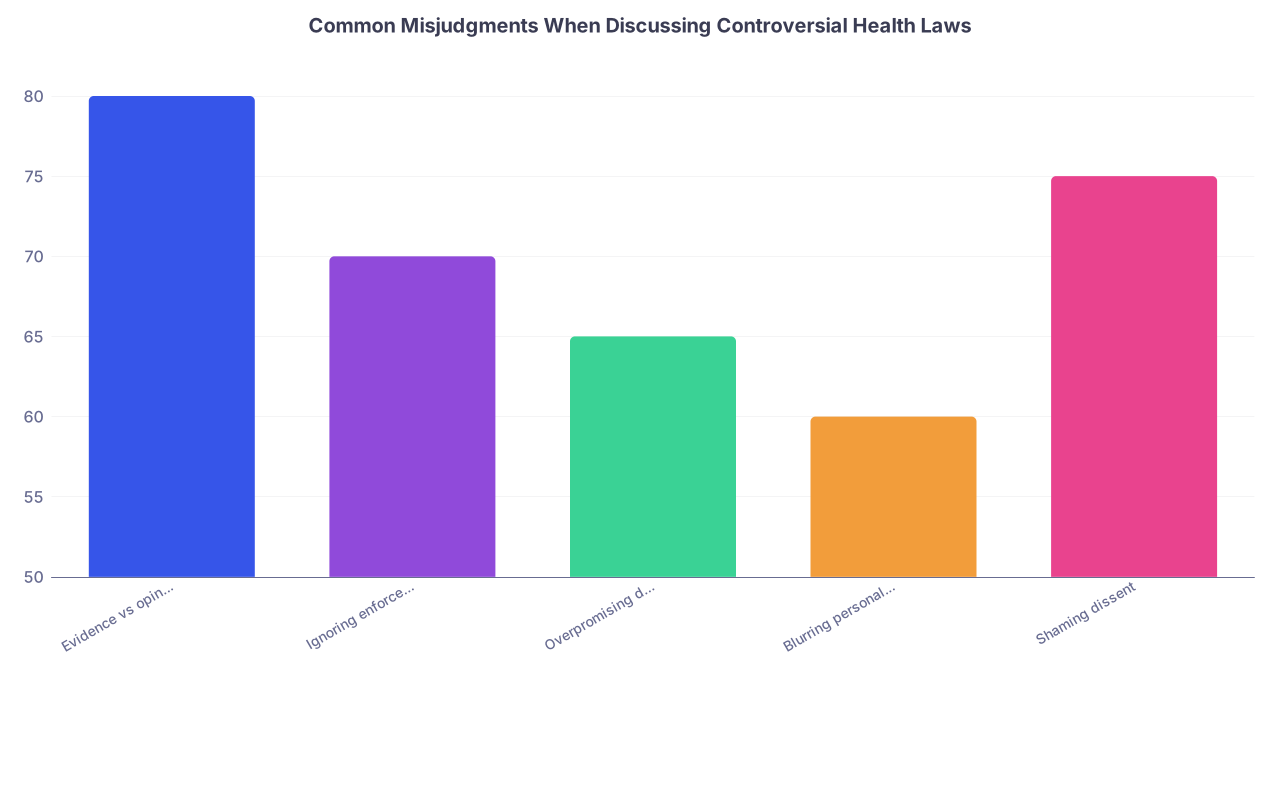
| Category | Value |
|---|---|
| Evidence vs opinion | 80 |
| Ignoring enforcement | 70 |
| Overpromising data | 65 |
| Blurring personal morals | 60 |
| Shaming dissent | 75 |
| Situation | Risky Phrase | Safer Phrase |
|---|---|---|
| Critiquing a mandate | "Anyone opposing this is anti-science." | "This mandate aligns with current evidence, but I recognize people weigh risks and values differently." |
| Questioning law impact | "This law will save thousands of lives, period." | "Models suggest this could prevent many deaths, although real-world impact will depend on enforcement and access." |
| Addressing enforcement | "We just need stricter penalties." | "Any enforcement must avoid disproportionate harm to already marginalized groups." |
| Expressing personal beliefs | "As physicians, we must oppose this law." | "From my personal moral view I oppose this law; professionally, my concern is its impact on patient autonomy and equity." |

FAQs
1. How do I talk about a controversial public health law with patients without imposing my politics?
Stay anchored in the patient, not the policy. Your aim is:
- Explain what the law requires or restricts
- Clarify options that remain legally available
- Explore how the law affects this patient’s risks, values, and goals
You can say, “The law limits what I am allowed to offer. Here is what is still possible. Here are the medical risks and benefits as I understand them.” If asked directly about your personal stance, you may give a brief, honest answer, but pivot back: “My role here is to support you in making the best decision within what is legally allowed, even if my personal view differs.”
2. What if I believe a public health law is profoundly unethical—do I have to stay neutral?
No. But you must be disciplined. You can, and sometimes should, speak against laws you believe produce serious, preventable harm. Do it by:
- Naming specific harms to health, autonomy, and equity
- Distinguishing your personal morality from shared professional ethical standards
- Avoiding calls for lawbreaking unless you are explicitly discussing conscientious objection or civil disobedience with full awareness of risks
Neutrality is not always virtuous. Sloppiness is never virtuous.
3. How can I avoid getting in trouble on social media when discussing these laws?
Assume your licensing board, employer, and patients are reading. A few guardrails:
- Do not disclose identifiable patient stories to “prove your point.”
- Avoid demeaning language about groups you disagree with.
- Stick to evidence, clear ethical concerns, and your professional scope.
- If you are angry, draft the post, then wait 24 hours. Most regretful posts are sent in the first 24 seconds.
If you would be uncomfortable defending the post verbatim in front of your hospital’s ethics committee, do not post it.
4. How do I prepare for speaking at a community or legislative forum on a controversial law?
Before you show up:
- Clarify your role: clinician, researcher, community member, or official representative.
- Identify 2–3 key evidence points and 2–3 key ethical concerns.
- Map who is harmed, who benefits, and who enforces the law.
- Write one sentence you want quoted and stick to it.
Practice aloud. Ask a colleague to push back from multiple angles (legal, social justice, patient autonomy). If you cannot withstand that rehearsal, you are not ready for the real event.
Key points to walk away with:
- Do not treat controversial public health laws as simple “science questions.” They are ethical, legal, historical, and power questions wrapped around science.
- Separate clearly: evidence, law, ethics, and your personal morality. Blurring them is how trust and careers get wrecked.
- Always ask: who pays the real‑world price when this law is passed, enforced, or ignored—and are you willing to say that out loud?