
The moment your public health research becomes a political weapon, you are no longer dealing with “science communication.” You are in a live-fire zone.
This is not hypothetical. Mask studies turned into cable news talking points. Gun violence data dragged into congressional hearings. Abortion, gender-affirming care, overdose prevention – whole careers have been blown up because findings annoyed the wrong people.
If your work is being twisted to fuel someone’s political agenda, you need a playbook. Not a philosophy seminar. A step‑by‑step, “what do I do this week so I still have a career and a conscience?” plan.
That’s what this is.
1. First 72 Hours: Stop Reacting, Start Documenting

| Step | Description |
|---|---|
| Step 1 | Notice your research is politicized |
| Step 2 | Contact institution leadership and legal |
| Step 3 | Document everything |
| Step 4 | Clarify your own messaging |
| Step 5 | Decide on media and social strategy |
| Step 6 | Is it harming your safety or job now |
The worst thing you can do in the first 72 hours is panic-react on Twitter. You’re angry, misquoted, and feel personally attacked. Of course you want to “set the record straight.” That’s how people end up feeding a news cycle that would have died in two days.
Here’s what to do instead.
1. Screenshot and archive everything.
Any time your work is mentioned:
- News articles (hostile, friendly, or clueless)
- Politician tweets, press releases, floor speeches
- Advocacy group statements
- Quote-tweets and dogpile threads targeting you
Use a folder with time-stamped PDFs or screenshots. Do not rely on links that can change or disappear. Save originals of any emails you send or receive about this. Forward abusive or threatening emails to a separate folder.
You’re not paranoid. You’re building a record for:
- Institutional protection
- Potential legal action
- Future corrections or clarifications
2. Tell your department chair and one trusted senior person – in writing.
Short, factual, no drama:
“I wanted to flag that my recent [paper/report] on [topic] is being used in [X politician’s speech / Y news segment]. Some of the characterizations are inaccurate and are generating pushback online, including personal attacks. I’m documenting everything and would appreciate your guidance on how best to respond (or not respond) in line with institutional policies.”
You’re doing three things here:
- Time-stamping that you raised the issue early.
- Showing you’re trying to act professionally.
- Creating witnesses if this escalates.
3. Do a 30-minute clarity check on your own work.
This is uncomfortable but necessary. Ask:
- Are my main findings clearly separated from speculation or policy suggestions?
- Did I accidentally write a line in the abstract or press release that can be easily ripped out of context?
- Are there obvious phrases that can be (mis)used as a political slogan?
You’re not blaming yourself. You’re identifying landmines so you can defuse them in your next steps.
4. Pause all impulsive social media responses.
If you’re already in the replies arguing with random accounts, stop. Close the app. At minimum, hold off on new posts until you:
- Talk to someone with media/communications experience
- Decide on a coherent strategy
- Have at least one person read what you plan to say
You don’t need to be silent forever. But you do need to stop throwing fuel on a fire you don’t control.
2. Clarify Your Ethical Ground: What You Will and Won’t Do

Before you fight a political storm, you need your own internal compass squared away. Otherwise, you’ll bend toward whatever pressure is loudest that week.
Here’s the ethical core for most public health research, whether you work on vaccines, opioids, guns, or reproductive health:
- You are responsible for the rigor and transparency of your methods.
- You are responsible for presenting your findings accurately and in context.
- You are not responsible for every political use of your work.
- You are responsible for correcting clear misrepresentations when feasible and safe.
Draw a few personal red lines. For example:
- “I will not allow my name or affiliation on op-eds that cherry-pick my own data.”
- “I will not appear in campaign ads or partisan materials.”
- “I will agree to testify or brief policymakers, but only with full context of limitations.”
- “I will not tailor conclusions to fit a party’s desired narrative.”
Now tie this back to core professional codes – AMA ethics, APHA code of ethics, your institution’s conflict-of-interest policies. That way, when someone pressures you to “clarify” your position in a way that distorts your findings, you can say:
“That would compromise my ethical obligations as a researcher and clinician. I can explain the data and limitations, but I can’t change the message to fit a political line.”
That’s not grandstanding. It’s cover. You’re not just being “difficult”; you’re following established ethical standards.
3. Decide: Engage, Correct, or Go Quiet
Not every misrepresentation deserves a response. Some absolutely do. The trick is knowing which is which.
A. When to ignore it
You can usually ignore:
- Low-follower accounts stirring outrage
- Comment-section fights
- One-off hot takes that don’t travel
If the misrepresentation:
- Has limited reach
- Isn’t being amplified by major outlets or officials
- Doesn’t threaten your safety or position
…then silence is often smarter. Every time you quote-tweet something ridiculous, you help it spread.
B. When to correct it – and how
You should consider correcting when:
- Your findings are reversed (“Study shows masks don’t work” when you found the opposite)
- Your name is used to legitimize a claim you did not make
- Policies are being justified “based on your research” in ways your data doesn’t support
Use layered responses:
Primary channel: an official, calm clarification.
This might be:- A short statement on your lab’s or institution’s website
- A thread on a professional account (not your personal rant account)
- A letter to the editor or brief comment submitted to the outlet
Example language:
“A recent [speech/article] has cited our study on [topic] as evidence that [claim]. This is not an accurate representation of our findings.
Our study found:
• [One sentence finding 1]
• [One sentence finding 2]We did not examine [policy X], and our data cannot be used to conclude [politician’s claim]. Full text and methods are available here: [link].”
You’re not arguing policy. You’re correcting data use.
Secondary channel: targeted communication, not public brawls.
When possible, contact:- The journalist, with clear, sourced corrections
- The office of the politician, in writing, with your clarification
- The advocacy group, if they’re usually evidence-respecting and simply overreached
If they ignore you, fine. You still have a written record showing you attempted correction.
Tertiary channel: professional networks.
Quietly alert:- Co-authors
- Relevant professional societies
- Mentors who have been through similar messes
They can sometimes amplify your clarification through institutional channels that get taken more seriously than a lone researcher’s tweet.
C. When to go quiet on your own platforms
Sometimes the safest and most effective move is strategic silence while your institution or society speaks. Go quiet when:
- You’re getting doxxed or threatened
- Your employer’s media team explicitly asks you to route all comments through them
- You’re exhausted to the point of making mistakes
Silence is not surrender. It’s resource management.
4. Dealing with Institutional Cowardice (or Support)
| Scenario | What You Can Do |
|---|---|
| Strong support from leadership | Coordinate messaging, let them front media |
| Neutral / hands-off stance | Ask for specific, limited help; document everything |
| Subtle pressure to back down | Invoke ethics policies; get issues in writing |
| Open hostility or retaliation | Consult ombudsperson, union, or outside counsel |
Some institutions will stand up for you. Some will throw you under the bus if a state senator frowns in their direction. Assume nothing. Test and see.
If you have support
If your dean, chair, or media office actually backs you:
- Insist on one main spokesperson or coordinated message.
- Let them handle hostile media whenever possible.
- Ask for concrete things: media training, talking points, a prepared statement.
Use their institutional weight as a shield. That’s one of the very few perks of being part of a large system that loves bureaucracy.
If they’re neutral and vague
The classic line: “We support academic freedom but have no comment on political matters.”
Fine. Translate that.
You can respond:
“I understand. I’m getting significant attention and some misrepresentation of our findings, including personal harassment.
Could you help in three specific ways:
- Review a short public clarification for accuracy and tone.
- Point me to any legal or security resources if threats escalate.
- Confirm institutional expectations about my speaking to the media.”
If they say no to all of that, you know where you stand. At that point, protecting yourself becomes priority one.
If they pressure you to “clarify” in a biased way
This is where ethics and self-preservation collide.
Example: Your study shows clear benefit of a harm reduction measure. A politically skittish administrator says:
“Can you emphasize how there’s still a lot of uncertainty and that it might not be appropriate everywhere?”
Translation: “Tone it down so we don’t get attacked.”
Your response:
“I’m happy to clearly state limitations and uncertainty. But I can’t minimize findings in a way that conflicts with the data. That would violate basic research integrity and our own institutional policies.”
Get that tension in writing if possible. If things get ugly later, you’ll want proof you refused to manipulate findings.
If retaliation starts – funding pulled, teaching reassigned, promotion slowed – do not wait a year. Talk to:
- An ombudsperson
- A faculty senate or union, if you have one
- Outside legal counsel if stakes are high (grants, tenure, termination)
5. Protecting Yourself Personally: Safety, Online and Offline

When research becomes political, harassment is not theoretical. I’ve seen:
- Home addresses posted in comment threads
- Voicemail boxes filled with threats
- Coordinated email floods to department leadership calling for firing
- Targeted attacks on minor errors to claim “fraud”
You need a safety checklist:
Lock down personal info.
- Scrub your home address from public registries as much as possible (data broker opt-outs).
- Remove personal phone and private email from anywhere public.
- Use institutional or professional contact details whenever possible.
Tell someone explicitly if you’re feeling unsafe.
Email security or HR:“I’ve started receiving threatening messages related to my research on [topic]. Some messages mention my location. I’m attaching examples. Can we discuss personal safety guidance and whether any additional steps are recommended?”
Separate personal and professional online identities.
If you didn’t already, now is the time:- Lock personal accounts or change handles.
- Use a professional account for public statements with minimal personal details.
- Don’t engage from your private personal spaces.
Keep a threat log.
Not every nasty comment is a threat. But some are. Log:- Date/time
- Platform/source
- Content (screenshot)
- Any identifying details
If anything mentions violence, call in law enforcement and institutional security. Do not minimize it to “probably just trolls.” Let professionals make that call.
6. Long-Game: Adjusting How You Communicate Future Research
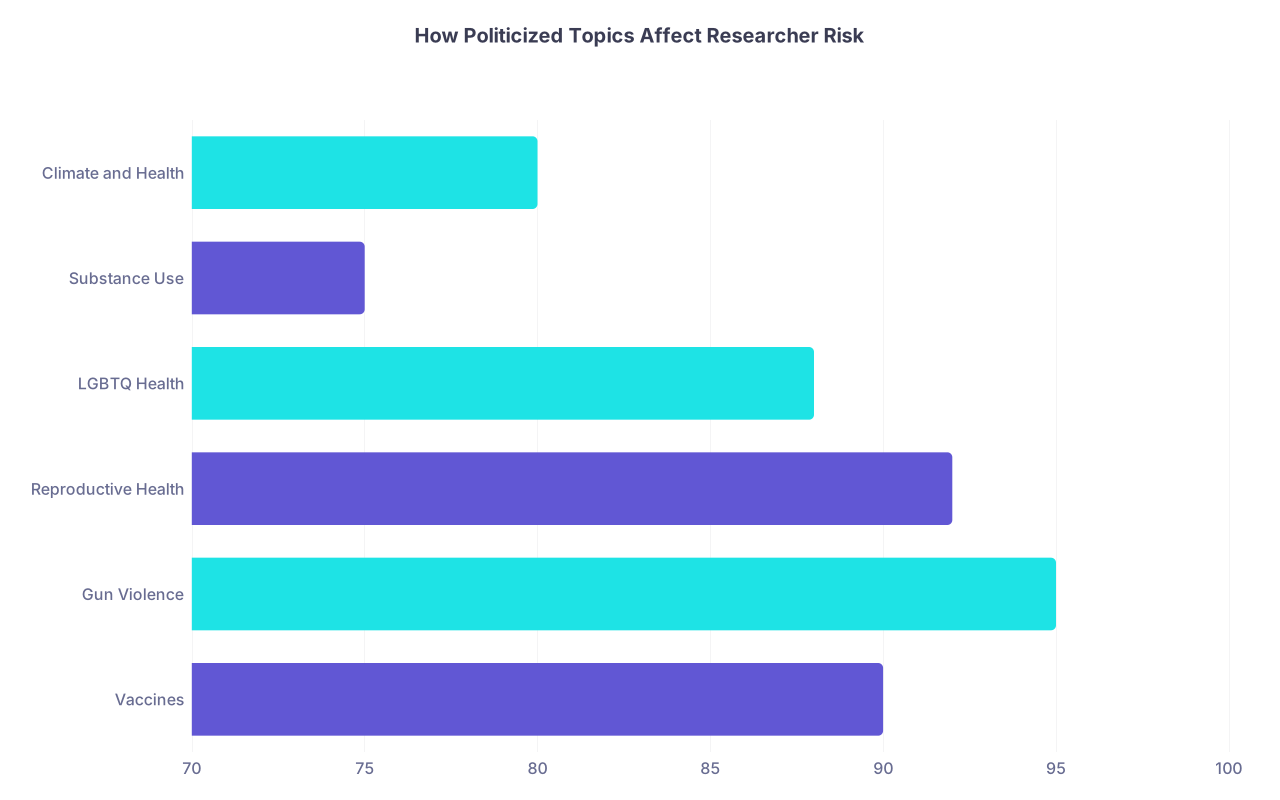
| Category | Value |
|---|---|
| Vaccines | 90 |
| Gun Violence | 95 |
| Reproductive Health | 92 |
| LGBTQ Health | 88 |
| Substance Use | 75 |
| Climate and Health | 80 |
One ugly truth: If your work lives in “culture war” zones, this may not be a one-time event. You need to adapt without censoring yourself.
Here’s how to shift your approach while staying honest.
1. Rewrite abstracts and conclusions with hostile readers in mind.
Before you submit a paper, ask:
- If a politician who hates this topic wanted to cherry-pick, what sentence would they grab?
- If a politician who loves this topic wanted to exaggerate, what line would they stretch?
Then adjust. You’re not watering down. You’re removing cheap, out-of-context soundbites.
2. Be explicit about what your data cannot say.
Make negative scopes loud:
- “This study does not evaluate the broader social or legal implications of [policy].”
- “Our data do not speak to the morality or legality of [practice]. They address only [outcome].”
If you later need to push back on misuse, those sentences are gold.
3. Build relationships with serious journalists before crises.
Identify a few reporters who consistently cover your field responsibly. Reach out when things are calm:
“I liked your coverage of [X]. If you ever need someone to walk through data on [my area], happy to be a resource off or on the record.”
When your work gets weaponized, these are the people who may actually listen to nuance.
4. Train yourself for hostile questions.
Don’t wait for a live TV ambush to realize you have no idea how to respond to:
- “So are you saying this policy kills people?”
- “Why are you pushing a partisan agenda under the guise of science?”
- “Isn’t it true that your funders benefit from this conclusion?”
Practice simple, repeatable lines:
- “What I can tell you is what our data show, which is…”
- “I can’t speak to motives or politics. I can speak to the evidence we gathered.”
- “Funding sources are fully disclosed in the paper, and the methods are transparent and reproducible.”
That may sound canned. Good. You need a few canned lines when you’re under fire.
7. Protecting Your Integrity Without Burning Out

You’re not a machine. You’re a person trying to do actual good, getting punched for it. If you stay in public health for more than five minutes, you will face a collision between what’s right, what’s safe, and what pays your salary.
Here’s how people last:
- They pick their battles. You don’t correct every blog post. You correct the ones that materially distort your work and matter to real-world decisions.
- They pace themselves. It’s okay to say, “I’m not available for comment this week” and let someone else take a media hit.
- They connect with peers in similar trenches. Gun violence researchers. Reproductive health folks. Vaccine communication teams. They’ve seen the pattern; they’ll help you spot it earlier next time.
- They keep receipts. Always. When the political winds shift – and they do – having a consistent record of integrity matters.
At some point, you’ll face the question: Do I soften this finding to avoid another political storm, or do I publish what’s true and deal with fallout?
My answer is blunt: if you repeatedly distort your own work to stay “safe,” you’re not doing public health anymore. You’re doing PR for the status quo.
That doesn’t mean you must be reckless. It means when the choice is between clean data and clean politics, your job is to protect the data – and then protect yourself as best you can.