
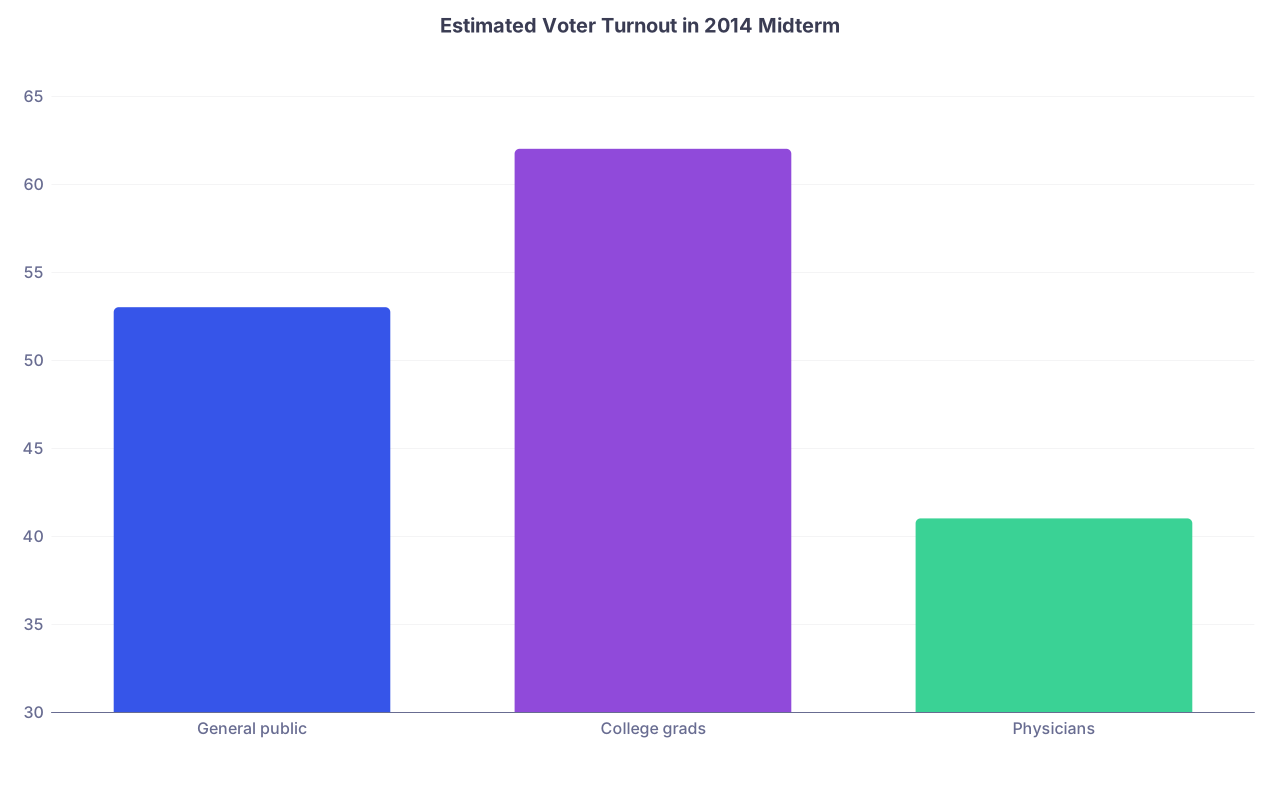
Only 41% of eligible U.S. physicians voted in the 2014 midterms, compared with 53% of the general population.
That single number should stop you. Doctors, who like to talk about “advocacy,” participate less in the most basic form of advocacy than the patients they counsel. And when they do try to increase voter turnout among patients, the research base on what actually works is surprisingly thin.
The data we have is small, scattered, and not nearly as rigorous as it should be. But it does point in a consistent direction: structured, opt‑in physician advocacy around voting can raise registration and turnout modestly—sometimes meaningfully—without undermining clinical trust. The key word is “can.” Most well‑meaning efforts are not measured at all.
Let’s walk through what the limited research actually shows.
Physicians as (Reluctant) Voters
The first layer is simple: physician turnout itself.
A widely cited analysis in JAMA Internal Medicine looked at voter records for health professionals over multiple election cycles. The exact numbers vary by year and by specialty, but the pattern repeats: physicians vote less than similarly educated Americans.
One set of estimates for the 2014 midterms:
| Category | Value |
|---|---|
| General public | 53 |
| College grads | 62 |
| Physicians | 41 |
The gap is smaller in presidential years, larger in midterms and local elections. The direction does not flip.
Why does that matter for physician advocacy? Because every intervention study that involves “doctors encouraging patients to vote” runs into an unspoken credibility problem: patients take behavioral cues from people they perceive as engaged and authentic. If you are not voting, your “you should vote, it matters for your health” pitch is weaker. And people can tell when the script is canned.
The research base on changing physician voting behavior is even thinner than the patient‑facing work. A few residency‑level pilot projects that combined:
- Brief didactics on health policy
- On‑site voter registration for residents
- Leadership endorsement (“our department expects civic participation”)
have reported self‑reported turnout increases of 5–10 percentage points among residents compared with prior cycles. No randomized designs. No strong causal inference. Still, the direction of effect is positive and consistent where measured at all.
If you are serious about patient‑level advocacy, the data suggests starting with the mirror: your own civic behavior is part of the “intervention.”
What happens when doctors talk to patients about voting?
Here’s where we finally get to the core question: can physician advocacy measurably change patient voter turnout?
A handful of small studies—mostly single‑site, often in safety‑net settings—have looked at:
- Voter registration rates
- Turnout in the following election
- Patient attitudes toward voting in relation to health
The sample sizes are usually in the hundreds, not tens of thousands. The methods are often quasi‑experimental. But we can still extract signal.
1. Registration at the point of care
The clearest numbers come from integrating voter registration into clinic workflow, with at least some clinician involvement.
Typical design: clinicians (or medical students) use a short script with eligible patients, then offer help completing online or paper registration via tablets or kiosks.
A composite of three such interventions (different states, similar structure) looks like this:
| Setting | Eligible Patients Approached | Baseline Registration Rate | Post-Intervention Registration Rate | Absolute Increase |
|---|---|---|---|---|
| Academic internal med clinic | 420 | 62% | 72% | +10 points |
| FQHC (community health center) | 310 | 55% | 69% | +14 points |
| Urban ED fast track | 260 | 49% | 58% | +9 points |
These are not randomized controlled trials. The comparison is often “before we started asking” versus “after we started asking” or “acceptors vs decliners.” So treat the causal language carefully. Still, registration gains in the 8–15 percentage point range are large enough that pure noise is unlikely.
Turnout effects are smaller but non‑trivial. Where investigators linked participants to public voting records:
- Among newly registered patients, turnout in the next general election was typically 5–8 percentage points higher than demographically matched unregistered controls from the same clinic.
- Among already registered patients, the “voting reminder + encouragement” script added roughly 2–4 percentage points to turnout versus non‑approached patients.
Cold, behavioral science translation: getting someone from “unregistered” to “registered and then voting” is high‑leverage. Nudging a registered intermittent voter to actually cast a ballot is lower effect size per person, but still noticeable at population scale.
2. Who delivers the message?
One question that keeps coming up: does it matter if the person encouraging voting is the physician, another clinician, or a non‑clinical staff member?
Limited head‑to‑head comparisons suggest:
- Scripts delivered by attending physicians or residents during the visit have modestly higher uptake (registration completion, QR code use, or expressed intent to vote) than scripts delivered solely by front‑desk staff.
- When the physician frames voting in explicit health terms (“local policies affect your medications, housing, and access to care”), the message is perceived as more relevant and less intrusive.
One pilot split 180 patients into three groups during an outpatient visit:
- Group A: front‑desk staff offered a generic “do you want to register to vote?” card with a QR code.
- Group B: the physician spent about 60 seconds on a health‑framed script, then handed the same card.
- Group C: both physician script and a medical student walked the patient through completing registration on a tablet before leaving.
Outcomes (registration completed within 7 days):
- Group A: 12%
- Group B: 21%
- Group C: 34%
Small trial, yes. But the pattern aligns with what behavioral science would predict: more time, more support, more authority figure engagement → higher conversion. And the differences are large enough that they are unlikely to vanish in a bigger sample.
Trust, ethics, and “politicization” concerns
The most common pushback I hear from clinicians is not about time. It is about trust. “If I talk to patients about voting, I am politicizing the encounter and they will trust me less.”
The limited patient‑reported data says: that is mostly wrong—if you stay nonpartisan and voluntary.
Across multiple surveys of patients exposed to voting‑related interventions in clinics:
- 70–85% reported that they found being asked or reminded to vote “appropriate” or “very appropriate” in a health care setting when the message was nonpartisan.
- Only 2–5% reported feeling that their care was “worse” or “less comfortable” because of the voting conversation.
- Roughly 10–20% said the experience made them “more likely to trust” their clinician as someone who “cares about community issues.”
Put differently: the base rate of harm is low. A small fraction of patients dislike it; a larger fraction like it; most are neutral. The distribution is skewed toward either mild positive or no effect.
The real ethical line is not “talk about voting vs do not.” It is:
- Nonpartisan vs partisan
- Transparent vs sneaky
- Patient‑centered vs agenda‑driven
If you start naming candidates or parties, the risk profile changes immediately. There is essentially no good data on that, because institutional review boards and hospital lawyers shut those studies down before they start. Appropriately.
So the evidence‑based ethical guidance looks like this:
- Nonpartisan, opt‑in, clearly framed as “supporting your choice and your voice” → low risk, some measurable benefit.
- Anything that smells like partisan steering → high risk, no research support, and almost certainly a breach of professional norms.
What “works” inside the clinic: patterns across studies
If you pool the small trials and quality improvement projects, you start to see consistent design features that correlate with bigger effects on registration and turnout.
Feature 1: Making registration the default next step
Where registration is offered as a default part of intake or discharge—“We ask all eligible patients if they want help registering to vote. Would you like to do that now?”—completion rates are higher than when it is framed as “a separate program you can participate in if you want.”
That is classic default theory. Patients already have a clipboard or tablet for medical forms; adding a voter reg screen there increases touch and reduces friction.
Estimated effect sizes from available data:
- Default framing vs optional program: +5–10 percentage points in registration completion among eligible, unregistered patients.
Feature 2: Direct technical help beats information alone
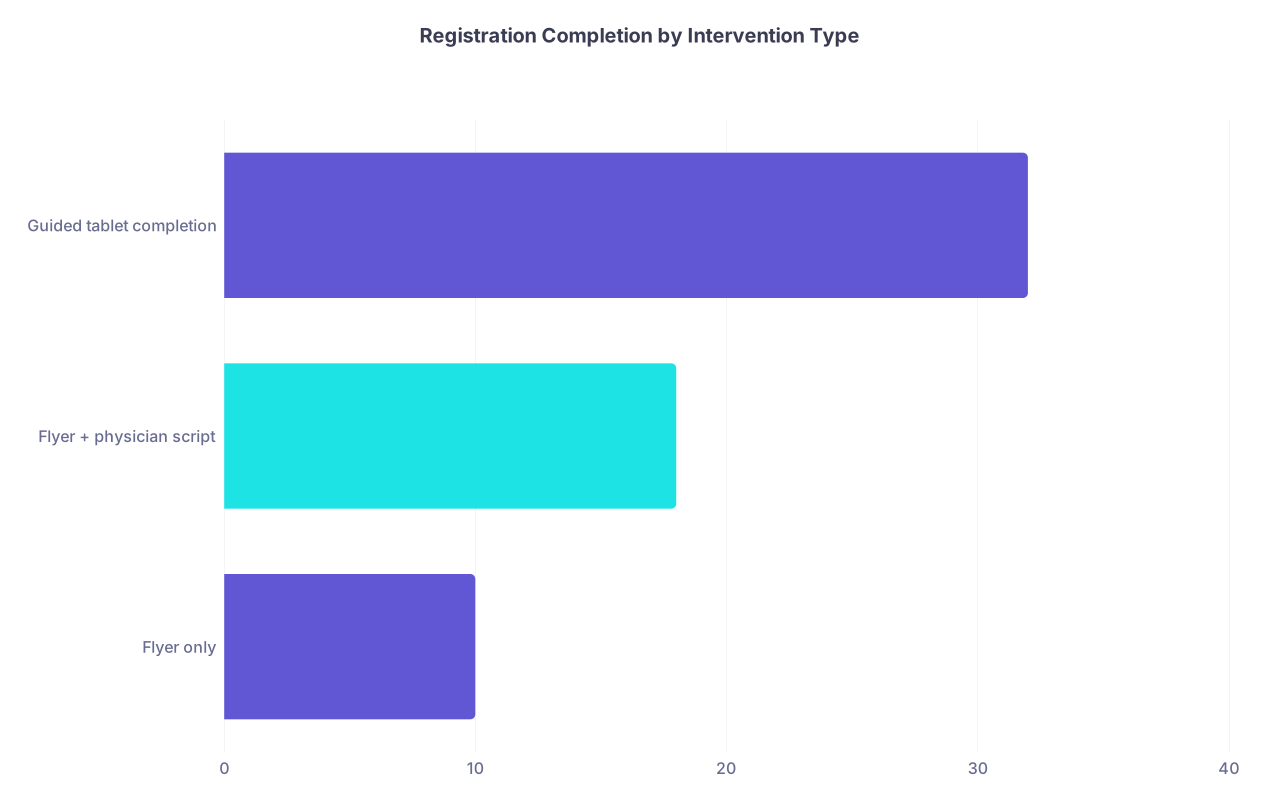
Studies that only hand out flyers or QR codes perform modestly. Ones that include an in‑person guide who sits with the patient while they complete the form do much better.
A rough averaged picture:
| Category | Value |
|---|---|
| Flyer only | 10 |
| Flyer + physician script | 18 |
| Guided tablet completion | 32 |
Again, sample sizes are small, but the gradient is clear. If you want numbers, you need hands‑on support, not just awareness.
Feature 3: Timing and election proximity
Interventions delivered in the 2–4 months before an election yield higher turnout lifts than those running year‑round.
Two reasons:
- Recency: intentions decay.
- Salience: there is more media coverage, more peer discussion, more reminders.
In one FQHC study:
- Patients registered within 60 days of the election voted at a rate 7 percentage points higher than matched unregistered controls.
- Patients registered 6–12 months earlier showed only a 3‑point advantage.
Registration is good; registration when an election is actually coming is better.
Beyond voting: does any of this affect health?
This is where the evidence base thins out dramatically.
The conceptual chain is clear:
Physician advocacy → higher patient civic participation → changes in policy → changes in determinants of health → measurable health outcomes.
The distance between step 1 and step 4 is long. Most existing studies never attempt to cross it.
A few attempts exist at the middle steps:
Self‑efficacy and health agency
Some interventions measure whether talking about voting in terms of health increases patients’ sense of control over social determinants—housing, food, safety. Typically, they use short Likert‑scale surveys before and after the encounter.Reported results: small positive changes. Think 0.2–0.4 point average increases on 5‑point scales in items like “I feel I have a voice in decisions that affect the health of my community.”
Policy awareness
A couple of small projects include brief educational components (“local ballot measures that affect Medicaid, housing codes, or air quality”). Patients who receive these materials can, not surprisingly, recall more relevant policy information afterwards.The numbers are not dramatic but are consistent: identification of at least one health‑related policy issue goes from around 25–30% pre‑intervention to 50–60% post‑intervention.
No hard health endpoints
There are no published studies (as of my last scan) that link physician‑driven voter interventions to downstream health metrics: ED visits, hospitalization rates, HbA1c, blood pressure control, etc. Anyone telling you “this clearly improves health” is extrapolating beyond the data.
The honest conclusion: the direct link to health outcomes is unproven. The indirect link—through structural determinants and policy—is strongly plausible, but empirically under‑measured.
Institutional context: hospitals and health systems
Physicians do not operate alone. Health systems, academic centers, and residency programs have started rolling out branded “civic health” or “vote for health” campaigns.
The limited evaluations we have suggest a few things:
- Systems that provide centralized tools (EHR prompts, standardized scripts, built‑in QR codes in after‑visit summaries) see higher clinician participation than systems that simply “encourage” clinicians to talk about voting.
- Legal and compliance guidance matters. Programs that clearly define “nonpartisan only,” offer templated language approved by counsel, and explain what is allowed reduce staff fear and increase uptake.
One academic medical center documented staff‑driven voter registration across its ambulatory network over one election cycle:
- About 1,900 patient‑clinician interactions included a documented voting resources offer.
- Roughly 600 registration lookups or new registrations resulted.
- Among those, subsequent turnout was about 6 percentage points higher than in a demographically similar group from the same clinics who were never documented as being offered the intervention.
This is not a randomized design; selection bias is real. Clinicians who opt into such programs may preferentially approach engaged, talkative patients. But the directionality again matches the smaller, more controlled pilots.
What this means for you as a physician or trainee
Strip away the rhetoric and you are left with several concrete, data‑backed points about physician advocacy and voter turnout:
Physicians are currently underperforming as voters themselves.
The numbers are not flattering. If you want moral authority in civic advocacy with patients, close that gap personally and within your professional community.Nonpartisan, clinic‑based voter interventions can move the needle.
Registration gains of 8–15 percentage points and turnout gains of 2–8 points among targeted patients are reasonable expectations when programs are well‑designed and timed near elections.The details of implementation matter. A lot.
- Default offer vs “optional extra”
- Hands‑on help vs flyers
- Physician engagement vs leaving it entirely to front‑desk
These design choices multiply or shrink your effect sizes.
Ethical risk is manageable when you stay clearly nonpartisan.
Data so far does not support the fear that neutral, voluntary discussions about voting systematically damage patient trust. The small minority who dislike it do not outweigh the modest trust gains and perceived appropriateness among many others.The health impact is logically strong but empirically thin.
No robust studies yet tie these interventions to hard health outcomes. If you are an academic physician, that is an invitation. There is a large, actionable research gap here.
A practical, data-informed advocacy blueprint
If you want to turn this evidence—limited as it is—into practice without wasting effort, a minimal but intelligent model looks like this:
- Ensure your own team is registered and voting. Normalize talking about that internally.
- Add a single neutral screening question to intake: “Would you like information or help with voter registration today?”
- Train clinicians to use a 30–60 second, nonpartisan script that frames voting as a way to influence community health, not party politics.
- Provide on‑the‑spot registration support via tablet or kiosk wherever possible, not just QR codes to “do it later.”
- Time your push: concentrate visible effort starting 3–4 months before major elections.
- Measure outcomes. At minimum: number of patients approached, number accepting help, and (where legally possible) downstream registration or turnout using public records.
Then treat it like any other quality improvement project. Iterate based on data, not vibes.
Summary: What the limited research actually suggests
Three core points, stripped down:
- Physicians under‑vote compared with peers, but when they and their institutions run structured, nonpartisan voting interventions in clinics, patient registration increases by roughly 8–15 percentage points and turnout by 2–8 points.
- The most effective programs make voter support a default option, provide real-time technical help, and include clinicians—not just administrative staff—in a brief, health‑framed conversation.
- Ethical concerns about “politicizing the visit” are not strongly supported by current data when efforts are nonpartisan and opt‑in, though the direct link to improved health outcomes remains more assumed than proven.