

The way most MD/PhD applicants sell their research to residency programs is wrong. Clinically focused programs don’t care how many figures you had in your Cell paper. They care if you can take sign-out at 6:45 a.m. without falling apart.
If you’re a dual‑degree applying to mostly clinical residencies (IM, EM, anesthesia, general surgery, OB/GYN, psych, peds, etc.), you’re in an odd spot: you’ve spent years branding yourself as a scientist, and now you’re trying to convince programs you’re not going to disappear into a lab and dump all the scut work on your co-residents.
Let’s fix that.
You’re the Situation: MD/PhD, heavy research, applying to residencies that aren’t inherently research‑heavy. You’re worried:
- “Will they think I’m too research-y and not committed to patient care?”
- “How do I talk about 5–8 years of research without sounding like I’m applying for a postdoc?”
- “Do I hide the PhD? Lean into it? Pretend it was a long gap year?”
Here’s exactly how to position yourself so clinically focused programs see you as an asset, not a risk.
1. Understand What Clinically Focused Programs Really Worry About
Before you “sell” anything, you need to understand what the buyer is scared of.
For MD/PhD applicants, the fears are very consistent. I’ve heard PDs say versions of all of these in conference rooms after interviews.

Here’s what they’re actually thinking:
“Will this person actually show up for the work?”
Are you going to show up for nights, weekends, floor work, ED admits, consults…or are you constantly trying to carve out time for your K-award that doesn’t exist yet?“Are they rusty clinically?”
You probably finished your PhD 1–4 years ago. They’ve seen MD/PhD grads who forget basic clinical stuff on day one. They do not want to remediate you when everyone else is hitting the ground running.“Are they going to leave after PGY-1?”
MD/PhDs sometimes jump to fellowships, physician‑scientist tracks elsewhere, or pivot to industry. Programs invest in you; they don’t want a flight risk.“Are they going to be a culture mismatch?”
Residents complain loudly if someone acts “above” the work, or constantly reminds everyone they did a PhD at a big‑name lab. PDs have been burned by this.
Your job in every part of the application—personal statement, ERAS experiences, letters, interview answers—is not to show how brilliant your science is. It’s to directly counter these fears while still making your PhD an obvious value add.
So stop thinking: “How do I show I’m ‘research heavy’?”
Start thinking: “How do I prove I’m a safe clinical bet who happens to bring research superpowers?”
2. Decide Which Version of Yourself You’re Actually Selling
You can’t be everything to everyone. You need a primary “storyline.”
Roughly, there are three realistic lanes for dual‑degree folks applying to clinically focused programs:
| Lane | Primary Identity | Research Positioning |
|---|---|---|
| 1. Clinician-first | Future practicing doc, maybe side research | Research as past training/toolbox |
| 2. Clinician–educator with methods depth | Teacher/leader with analytics edge | Research as credibility + content |
| 3. Clinician–investigator lite | Mostly clinical with targeted projects | Research as niche expertise in program needs |
You need to pick one. Waffling in the middle (“I love research and clinical equally and could see myself…” etc.) just makes you sound unfocused.
If you’re Lane 1: Clinician-first with a PhD
This is you if:
- You’re honestly tired of bench work.
- You love being on the wards, in the OR, or in the ED.
- You still like data, but you don’t want your identity to be “that researcher.”
Your pitch:
“I did intensive research that trained my thinking and discipline, but going back to the clinical years made it crystal clear: I want to be a busy clinician who uses that background to improve care and teach others—not to live in a lab.”
If you’re Lane 2: Clinician–educator with methods depth
This is you if:
- You enjoy explaining complex ideas.
- You like QI, curriculum design, or evidence-based medicine conferences.
- You naturally end up tutoring others or leading small groups.
Your pitch:
“I’m going to be the resident who makes journal clubs sharper, helps co-residents understand study design, and eventually builds curricula/QI projects that actually use good methods.”
If you’re Lane 3: Clinician–investigator lite
You’re not going for a hardcore PSTP, but you still want research to be a serious side of your career.
Your pitch:
“I want a primarily clinical residency with room to keep a small but focused research portfolio, ideally aligned with X niche that your program already cares about.”
Pick a lane. Then filter every application choice—what to highlight, what to cut—through that lens.
3. Rewrite Your ERAS Experiences So They Read as “Clinical Asset,” Not “Bench Rat”
Most MD/PhDs list their research like they’re submitting a postdoc CV. That lands badly for clinically focused PDs.
Your research entries need to answer one question:
“What did this experience teach you that makes you a better resident?”
Not a better scientist. A better resident.
How to restructure a research experience entry
Bad version (what I actually see all the time):
“Conducted experiments on murine models of sepsis, including Western blotting, ELISA, and immunohistochemistry. Presented data at three national conferences and published two first‑author manuscripts in high‑impact journals.”
Clinically attractive version:
“Led a 4‑year translational sepsis project in a busy lab, managing 3 junior students and coordinating weekly data reviews with our PI and ICU attendings. Learned to handle long-term projects with constant setbacks, synthesize complex data quickly, and communicate results to clinicians who didn’t live in the lab.”
Same project. Totally different signal.
You want explicit links to:
- Long‑term ownership of projects → you can own a patient panel, a QI project, a consult service.
- Managing people → you can lead a team on rounds.
- Handling failure and stress → you’ve already built resilience.
- Translating data for non-specialists → you’ll be good with patients, nurses, and cross‑discipline teams.
What to de‑emphasize in those entries
- Technical minutiae (list of assays, programming languages, obscure methods). One line max.
- Name‑dropping big journals in a braggy way. Let the citation line speak for itself.
- Overuse of “novel,” “groundbreaking,” “high‑impact.” It sounds like you’re auditioning for tenure, not residency.
If a PI reads your experience and thinks, “This sounds like a very serious scientist,” but a PD reads it and thinks, “This person can own the overnight admit list,” you’ve hit the right balance.
4. Fix Your Personal Statement: From “Science Story” to “Residency Story”
Most MD/PhD personal statements read like an NRSA proposal wrapped in a sentimental origin story. That’s a problem.
You’re not applying for more training in research. You’re applying for a clinical job with supervision.

| Step | Description |
|---|---|
| Step 1 | Draft PS |
| Step 2 | Strip technical detail |
| Step 3 | Add concrete clinical stories |
| Step 4 | Link PhD skills to residency tasks |
| Step 5 | Ensure PhD isnt minimized |
| Step 6 | Science-heavy? |
Structure that actually works
Open with a clinical moment that crystalizes why this specialty, not why you love pipettes.
Short, concrete, not melodramatic. Something like the ICU night where you realized you love managing sick patients, not the paragraph about high‑school chemistry inspiration.Briefly acknowledge your research path but tie it to a clinical question.
Example: “That question followed me into my PhD years, where my thesis focused on X, but the more time I spent in the lab, the more I missed sitting with actual patients during Y.”Hit the “I am clinically committed” point directly.
Do not assume they’ll infer it. Say it in plain language.
“I’m applying to residency because I want my primary professional identity to be as a clinician. Research will remain part of my work, but not at the cost of patient care or team responsibility.”Translate PhD skills into residency skills.
Two or three concrete skills: leading teams, handling setbacks, detailed documentation, thinking systematically about problems.End with what you’re looking for in their program that matches this identity.
“A program that values…” and then name real things they actually do (QI, strong inpatient training, journal club, resident‑led research with guardrails).
Lines that help you, lines that hurt you
Helpful:
- “I’m excited to be on a busy inpatient service where I can develop strong clinical instincts before layering back in research.”
- “My happiest days now are on the wards, where the pace, uncertainty, and teamwork feel like home.”
Damaging (for clinically focused programs):
- “I plan to pursue a physician‑scientist career with 70–80% research focus.”
- “My long‑term goal is to lead an independent lab while maintaining a small clinical practice.”
If that last line is actually true, you should be targeting PSTPs or research‑heavy programs. If you’re applying mostly to classic clinical residencies, do not say you want to be 80% in the lab. You’re telling them, “I won’t be happy doing what this job requires.”
5. Letters of Recommendation: Control the Narrative Before It Controls You
Your PhD PI can sink you or save you.
You need letters that scream: “This person shows up. This person finishes things. This person is not too precious for grunt work.”
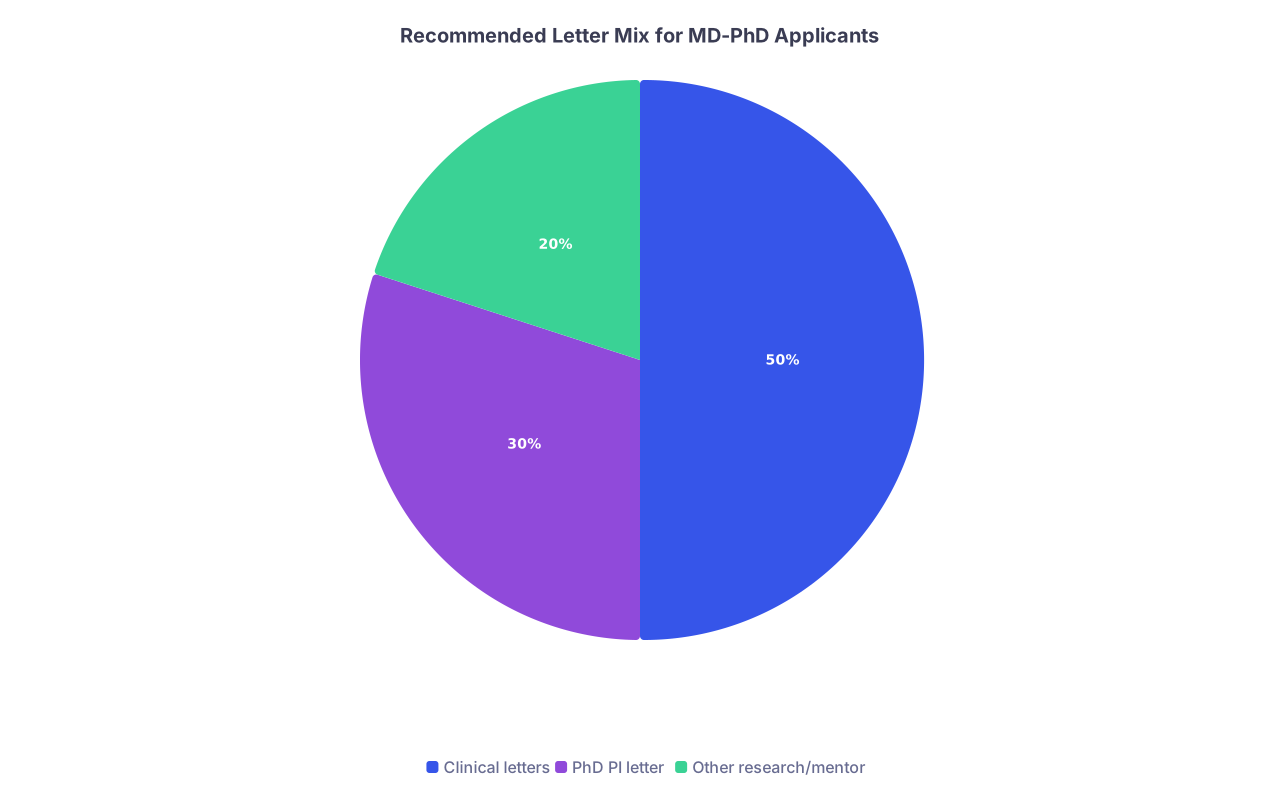
| Category | Value |
|---|---|
| Clinical letters | 50 |
| PhD PI letter | 30 |
| Other research/mentor | 20 |
Who you need letters from
For most clinically focused programs:
- Two strong clinical letters in the specialty (or closely related)
- One PhD PI or primary research mentor
- Optional: One additional letter (sub‑I, away rotation, or another clinical faculty who saw you work)
If your PhD PI is going to write a generic “brilliant scientist” letter and say nothing about your reliability, maturity, or interpersonal skills, that’s a problem. Talk to them.
You can say, explicitly:
“I’m applying to mostly clinically focused programs. It would help me a lot if your letter could speak to how I handle setbacks, take responsibility, work on teams, and show up consistently—even more than focusing just on scientific creativity.”
Also, hand them your updated CV and a one‑pager that includes:
- A brief “career vision” paragraph (clinically oriented, in human language).
- A reminder of specific moments where you handled tough situations well (equipment failure before a big deadline, mentoring a struggling junior student, dealing with negative data).
You don’t script the letter, but you absolutely guide the frame.
6. Dealing With the “Rusty Clinician” Problem Head‑On
If you graduated MD years ago and you’re now applying after a long PhD, programs will worry about your clinical rust even if you were a rockstar as an MS4.
So you don’t wait for them to ask about it. You show them what you’ve done.

Concrete things that help:
- Doing a sub‑internship or AI close to application season, with a strong, recent letter.
- Taking and doing well on Step 2 CK relatively close to applications (if possible).
- Getting involved in any clinically adjacent work: call‑backs, free clinics, QI, chart reviews.
And then explicitly saying in interviews:
“I took my PhD time seriously, but I also knew I needed to come back strong clinically. That’s why I did X, Y, and Z to refresh and then stress‑test my clinical skills. My recent rotation in A confirmed I’m ready to be a full‑time resident again.”
They will test this with questions. Basic bread‑and‑butter management questions, sometimes even on “non‑technical” interviews. That’s fine. Prepare like you’re about to start intern year: review your specialty’s basic algorithms, common calls, and night‑float scenarios.
7. Interview Day: How to Talk About Your PhD Without Losing the Room
Interviewers at clinically focused programs often don’t know what to ask you beyond:
- “So tell me about your PhD work.”
- “How do you see research fitting into your career?”
- “Are you sure you’ll be happy with a heavy clinical load?”
You need pre‑planned, 60–90 second answers that are human, not jargon.
Explaining your PhD in resident language
Use the “Grandma + Intern” rule: your answer should make sense to your grandmother and a tired PGY‑1.
Bad answer:
“My work focused on characterizing epigenetic modifications in macrophage populations in a murine sepsis model using single‑cell RNA sequencing and…”
Good answer:
“I spent four years trying to answer one question: why do some patients with overwhelming infection respond to treatments and others don’t, even when everything looks the same on paper? We used mouse models and genetic tools to see how certain immune cells behave differently under stress. The details are geeky, but the big takeaway for me was how messy biology is—and how important it is, as a clinician, to stay humble about what we think we ‘know’ from trials.”
Then, pivot:
“That’s part of why I’m excited about residency. I want to be the person at the bedside who can look at a paper and say, ‘Here’s how this does—or doesn’t—apply to the patient in front of us.’”
Answering “How much research do you want in residency?”
This is where MD/PhDs blow it by saying what they think sounds impressive instead of what matches the program.
You’re applying to a clinically focused residency. Your answer should sound like:
“My first priority is becoming an excellent clinician. I expect the first year to be almost entirely clinical. Once I’m comfortable and meeting expectations, I’d like some structured time—maybe a half‑day a week or elective blocks—to work on targeted projects that intersect with [their program’s strengths: sepsis outcomes, ED throughput, peri‑op care, etc.]. But I’m not coming in expecting guaranteed protected time in PGY‑1. I know the job is clinical.”
That tells them:
- You’re realistic.
- You’re not planning to be perpetually “in the lab” while your co‑residents cover your patients.
- You want your research to plug into their existing system, not demand they build something from scratch around you.
8. Choosing Where to Apply: Don’t Just Chase Name Brands
Not every “top” program is good for MD/PhDs who want a primarily clinical track with optional research.
Some “middle‑tier” or regional powerhouses are actually ideal: busy clinical volume, a few faculty who care about research, and no pretense of being an NIH factory.
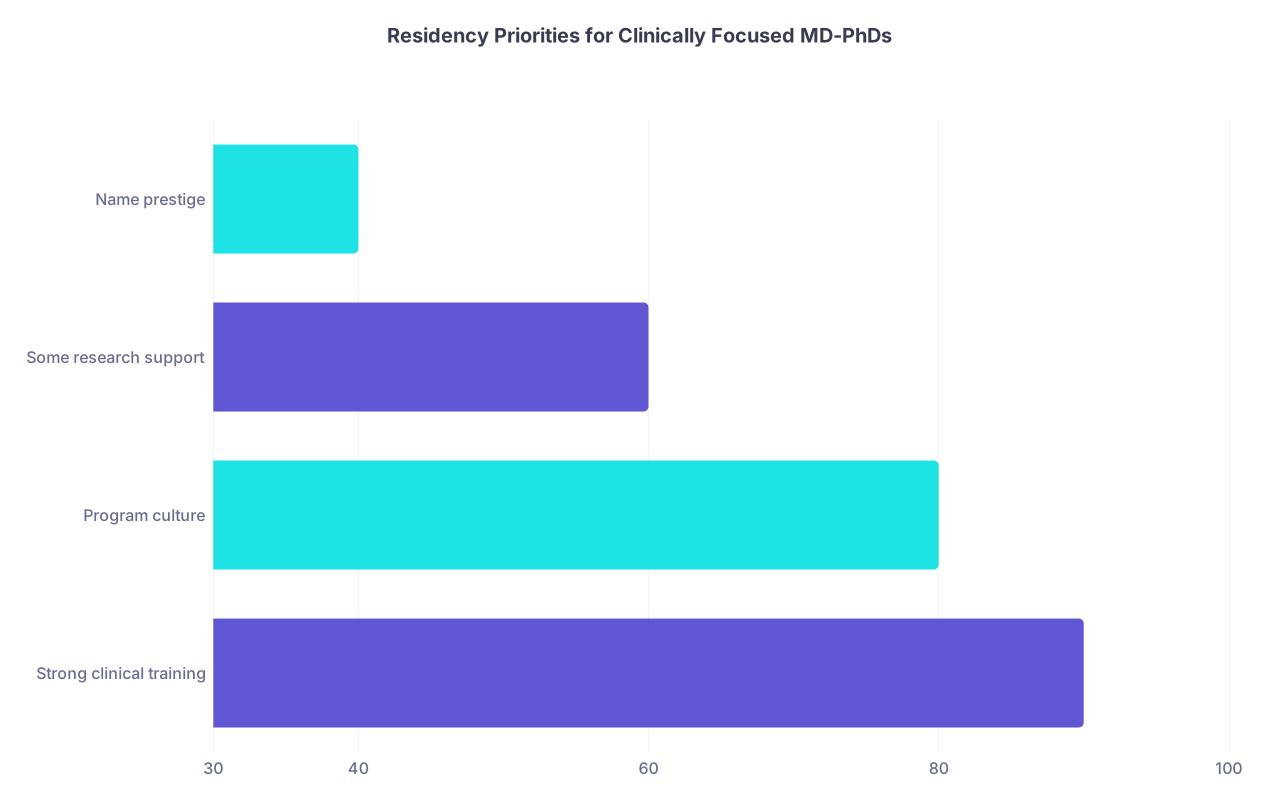
| Category | Value |
|---|---|
| Strong clinical training | 90 |
| Program culture | 80 |
| Some research support | 60 |
| Name prestige | 40 |
For each program, look explicitly for:
- Evidence that resident research exists but is optional (not “if you aren’t on a K by PGY‑3, why are you here?”).
- Alumni who have gone into a mix of fellowships and straight practice.
- Website language that emphasizes things like “clinical excellence,” “community,” “patient access,” rather than only “NIH ranking,” “R01 funding,” “T32.”
If their only selling point is the number of R01s in the department, and you keep saying you want to be a workhorse clinician with occasional research, that’s a mismatch. They’ll smell it on interview day.
9. Red Flags You Need to Clean Up Before You Hit Submit
A few patterns set off alarms instantly for clinically focused PDs reviewing dual‑degree applications.

Watch out for these:
Publications everywhere, but weak or vague clinical evaluations.
If your clinical comments are just “pleasant, punctual” and nothing about responsibility or clinical acumen, that’s a problem. You need at least one rotation where someone wrote, “functions at or above the level of an intern.”Gap between PhD end and application with no clear explanation.
Spell it out briefly in your experiences or additional info: job, family, visa issues, research completion, etc. Don’t leave a mysterious 9‑month hole.Personal statement that sounds like a grant abstract.
If your first page has more method words than patient words, rewrite it.CV cluttered with 25 separate “research experiences” but almost no clinical engagement.
Merge redundant entries. Highlight quality and leadership over sheer volume.
Clean these up before applications go out. You do not fix them in a 15‑minute interview.
10. How to Use Your PhD as a Quiet Superpower, Not a Costume
You don’t need to perform “PhD identity” all the time. In fact, please don’t.
Where it helps most in residency:
- You’ll be fast at reading and critiquing new literature. Use that on rounds and in journal club.
- You know how to design a QI project that’s not garbage. Volunteer to help when the program wants real metrics.
- You’re used to frustrating, multi‑year work. Residency is exactly that, just with more pagers.
But the day‑to‑day way you win people over is boring:
- You answer your pages.
- You pre‑chart.
- You sign your notes.
- You help your co‑intern who’s drowning with admissions.
If your co‑residents describe you as “the MD/PhD who somehow is always there to help and doesn’t make a big deal out of their background,” you’ve nailed it.
Key Takeaways
- Stop selling yourself as “a great scientist.” Sell yourself as a reliable, clinically committed resident who happens to bring serious research skills as a bonus.
- Rewrite everything—ERAS, personal statement, letters, interview answers—to directly address PD fears: clinical rust, flight risk, culture mismatch.
- **Pick a clear lane (clinician‑first, clinician‑educator, or clinician‑investigator lite) and apply only to programs that genuinely match that lane, not just the shiniest name brands.


