

It’s August. ERAS is about to open. You took 6–12 months “research time” that’s sitting loud and obvious on your CV… and you have exactly zero publications in PubMed to show for it. Maybe you’ve got one abstract accepted, maybe a poster, maybe nothing at all. Your friends are tossing around “my paper just got accepted” while you’re staring at “Manuscript in preparation” and wondering if programs will think you wasted a year.
You’re not alone. And you’re not doomed.
Here’s what to do next, step by step, so this gap does not become the red flag you’re afraid it is.
1. Get Honest About What You Actually Have
Before you spin the story, you need the facts. No self-delusion, no vague “almost done.”
Sit down and list every project from this time off:
- Title / topic
- Role (1st author, middle author, data grunt, whatever)
- Current status (be brutal: “drafting intro” is not “almost submitted”)
- Concrete outputs (data collected, analysis complete, abstract submitted, poster presented, IRB approved, etc.)
Now separate them into buckets:
| Category | Examples |
|---|---|
| Ready / almost ready | Manuscript in final revisions |
| Mid-stage | Data analyzed, draft partial |
| Early-stage / stalled | Data collection incomplete |
| Non-manuscript outputs | Posters, abstracts, talks |
What you’re doing here is turning “no publications” into “here’s what I DO have.” Programs care a lot more about evidence of work than they do about the random timing of PubMed IDs.
If your list is depressingly short, do not panic. But do stop lying to yourself about “it’ll be done any day now.” You need a plan that assumes these papers won’t be published before interviews.
2. Decide How You’ll Present the Time Off on ERAS
You have two overlapping problems:
- How to explain the time off
- How to explain the lack of publications
Those are related but not identical.
On your CV / ERAS
You are going to frame this as a research position with specific responsibilities and outputs, not “I sat around waiting for a paper.”
For each major project, add concrete bullets under Experiences:
- “Retrospective cohort study of X (n=354) – performed data extraction, managed REDCap database, conducted multivariable logistic regression in R.”
- “Developed standardized data collection forms and trained 4 medical students in chart review methods.”
- “First-author abstract accepted to [Conference], presented poster.”
If you truly have nothing accepted anywhere, then:
- “Completed IRB submission and protocol development for multi-center study of X.”
- “Performed literature review and designed survey instrument on Y.”
- “Led weekly research meetings, coordinated with biostatistics core on analysis plan.”
Is that as shiny as “JAMA, first author”? No. But it’s infinitely better than a vague “Research fellow, worked on projects.”
On ERAS, do not list “In preparation” manuscripts as if they’re accepted. You can use a “Submitted” or “In preparation” line in the “Other Scholarly Activities” or in project descriptions, but keep it obviously separate from peer-reviewed publications.
3. Craft the Story: Why Time Off, Why No Pubs (Yet)
Programs are not stupid. They will see a research year and zero publications. They will ask about it, explicitly or implicitly.
You need a tight, honest, practiced 3-part story:
- Why you took time off for research
- What you actually did and learned
- Why there are no publications yet and what’s happening with them
Example skeleton you can adapt:
Why the year:
“I took a dedicated research year between MS3 and MS4 because I was interested in academic [specialty] and wanted more depth in [specific area]. My goal was to get rigorous training in study design and stats and be involved in larger projects than I could during the regular curriculum.”What you did:
“During that year, I worked with Dr. X on two main projects: a retrospective cohort study on [topic] and a QI project on [thing]. I was responsible for data extraction, cleaning, and running the analyses with our biostatistician. I also helped write the introduction and methods for the main manuscript.”Why no pubs yet / where things stand:
“The primary manuscript is currently in revision / being prepared for submission to [journal]. Our abstract was accepted to [conference], and we presented a poster in [month]. The projects have moved more slowly than I’d hoped because [brief, non-whiny reason: IRB delays, multi-site data collection, COVID disruption, PI on sabbatical, etc.]. That said, I came out of the year very confident in [concrete skills], and I’m continuing to work with the group to push the paper through.”
You’re not apologizing the whole time. You’re explaining the delay, anchoring it in real-world research realities (which every academic PD knows all too well), and emphasizing what you did gain.
4. Fix the Next 4–8 Weeks: Get Something Tangible Out
You can’t manufacture a NEJM paper in a month. But you can:
- Turn half-finished work into something concrete
- Get your name on one thing that’s actually submitted or accepted
- Build a demonstrable trajectory instead of a black box
Here’s what that looks like, practically.
A. Triage your projects
Look at your list and ask: “What can realistically get to a submittable or presentable stage before interview season?”
You’re looking for:
- A small retrospective dataset that’s already collected
- A survey you already deployed and have responses for
- A case series or case report with complete charts available
- A QI project with pre/post data
Pick one main project to push hard. Not three. One.
Then, with your PI:
- Email or meet and say directly:
“I’m applying this cycle and I’d really like to have at least one concrete output (submitted manuscript / abstract) from my research year before interviews. Could we prioritize wrapping up [Project X] enough to submit an abstract or short communication?”
Most PIs respond well to a clear, time-limited ask. Some won’t. If yours stonewalls or is permanently “too busy”: that’s information. You’ll lean less on that project in your narrative.
B. Aim for the fastest reasonable output
Hierarchy of speed:
| Output Type | Typical Timeline |
|---|---|
| Local talk / presentation | 1–4 weeks |
| Abstract / poster submission | 2–6 weeks |
| Case report / case series | 4–10 weeks |
| Short communication / letter | 4–12 weeks |
Conferences and local presentations can give you tangible lines on your CV before interviews, even if the paper comes later. Yes, abstracts “count” in the real world of residency applications.
If you have a case report sitting half-written, finish it. Today. Case reports won’t impress a hardcore research PD, but they credibly show you can complete and submit something.
C. Document everything
Even if nothing gets accepted in time, you want to be able to say:
- “Submitted X abstract to Y conference on [date].”
- “Manuscript submitted to [journal] in [month].”
You can put that in ERAS as “Submitted” or “Under review.” Not as “Published,” obviously, but it’s substantially better than “We’re thinking of maybe writing something eventually.”
5. How to Talk About This in Your Personal Statement
You do not need to write a confessional essay about your missing publications. But you also cannot pretend the year didn’t happen.
If the research time is central to your story (for many applicants it is), weave it in like this:
- Focus on what you learned and how it shaped you clinically
- Mention outcomes briefly, without overpromising
- Acknowledge the slower-than-hoped timeline in one clean line if needed
Example language:
“I took a dedicated research year in [Department] focused on [topic]. Working with Dr. X and our biostatistics team, I learned how to formulate a clear clinical question, design a feasible study, and wrestle with messy real-world data. Our primary project, a retrospective analysis of [topic], is now in revision for submission to [journal], and the process forced me to become meticulous about data quality and honest about limitations.”
If you feel the lack of publications is glaring, one line like this is enough:
“While the projects moved more slowly than I initially expected and are still in the pipeline, that year solidified my interest in [specialty] and gave me practical skills I now use on the wards: framing questions, interpreting evidence, and thinking beyond individual patients.”
Then move on. Do not linger in apology mode.
6. What to Say When They Grill You in Interviews
You will almost certainly get some version of:
- “You took a year for research—what came out of that?”
- “I see ongoing projects but not many publications. Tell me about that.”
- “How do you feel about the productivity from that year?”
Have your answer rehearsed but not robotic. Here’s a structure that works well.
Own it without defensiveness.
“Yeah, that’s fair to ask.”State what you did.
“During that year, I worked primarily on two larger projects: [brief 1 sentence each]. I was responsible for [specific tasks].”Admit the mismatch between time and visible output, then explain why without whining.
“The progress has been slower than I’d hoped, partly because [one or two realistic reasons: multi-site data agreements took months; IRB approvals lagged; COVID disrupted clinic volumes; PI switched institutions]. We do now have [X: complete dataset / full draft / abstract submitted].”Highlight what you gained and how it makes you better as a resident.
“What I came out with, though, is a much sharper sense of how to ask answerable questions and how messy clinical data really is. On my sub-I in [specialty], I found myself using those skills almost daily when we discussed studies on rounds—questioning methodology, thinking about bias. I also learned how to keep a long-term project moving even when progress is slow, which I think maps very directly to residency.”Show ongoing commitment.
“I’m still meeting with the team monthly, and our goal is to submit the main manuscript this fall. I expect at least one paper will come out of the work, but I’m also realistic now about timelines.”
If they press—“Would you do it again?”—you can be honest but strategic:
- “I would, but I’d be more careful up front about picking a project with a realistic timeline for completion within a year. I learned that the hard way.”
Program directors appreciate that kind of reflection. They live in the land of IRB purgatory and endless revisions too.
7. How This Plays Specialty-by-Specialty
Let me be blunt: the impact of a zero-publication research year is not the same for every specialty.
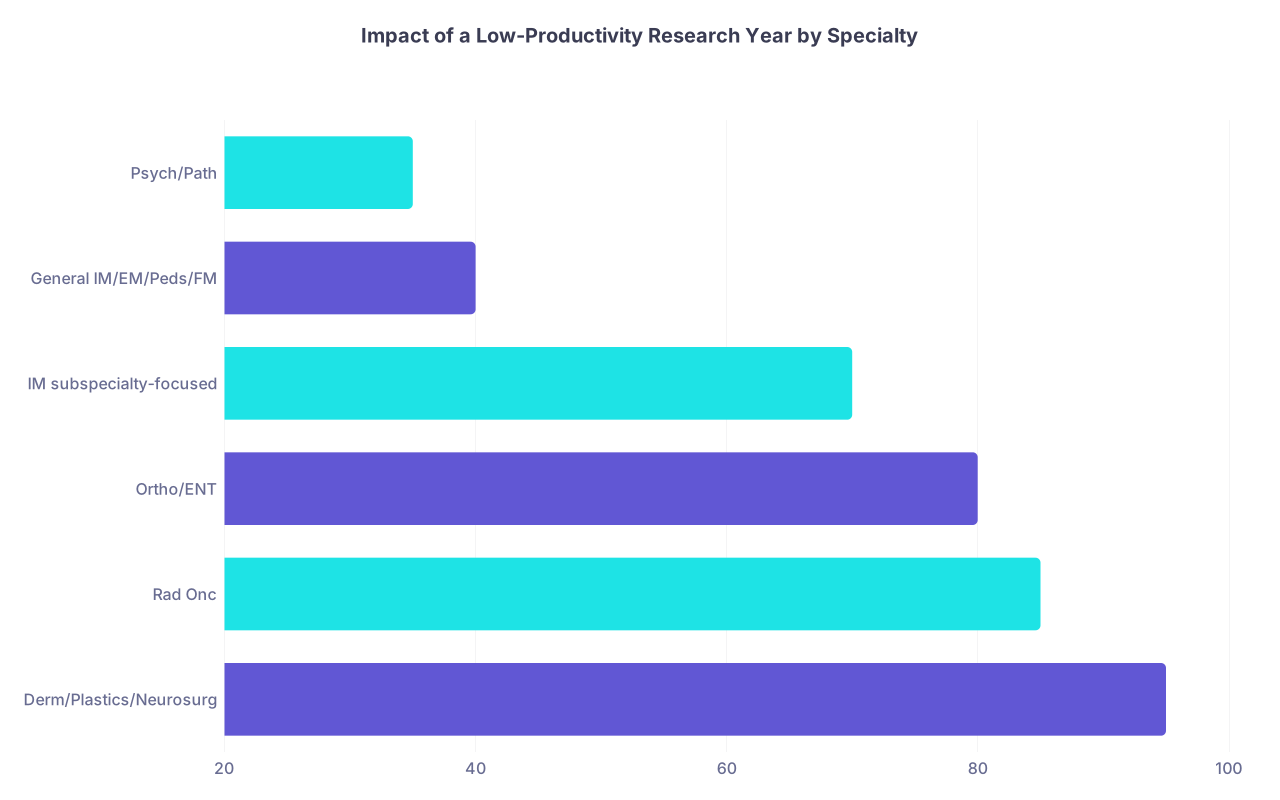
| Category | Value |
|---|---|
| Derm/Plastics/Neurosurg | 95 |
| Rad Onc | 85 |
| Ortho/ENT | 80 |
| IM subspecialty-focused | 70 |
| General IM/EM/Peds/FM | 40 |
| Psych/Path | 35 |
(Values are a rough “how much PDs care” index out of 100, not actual statistics.)
- Hyper-competitive fields (Derm, Plastics, Neurosurg, some Ortho, ENT): They expect something tangible from a research year. A completely blank PubMed is a problem. That doesn’t mean automatic rejection, but you need every other part of your application strong and your story airtight.
- Academic-heavy but broader fields (IM with subspecialty ambitions, Rad Onc): They care, but they also understand multi-year timelines. Strong abstracts, posters, and in-progress manuscripts are more acceptable.
- General IM, EM, Peds, FM, Psych, Path: A research year with few outputs may raise an eyebrow but isn’t terminal, especially if you can clearly connect skills gained to clinical performance and have good letters.
If you’re in a hyper-competitive field and this year truly produced nothing: you need to have a serious conversation with someone who will tell you the truth (not your friend who matched derm, not your mom). You may need to:
- Apply more broadly and include a few adjacent or backup specialties
- Consider a research-heavy prelim / transitional year plus reapplication
- Or accept that your path to that specific niche will be nonlinear
Harsh, but real.
8. Use Your PI and Letter Writers Strategically
One of the strongest ways to neutralize a low-productivity research year is a great letter from your research mentor.
You want that letter to say:
- You showed up reliably
- You did real work (not just “observed”)
- The lack of publications is about project scope / timing, not your effort or competence
- You learned and grew; you’d be an asset in an academic environment
You can nudge this by:
- Sending your PI a short summary of what you did, including concrete tasks, before they write
- Having an honest conversation:
“I know our projects are still in progress and I don’t have publications yet. For residency applications, it would really help if your letter could speak to my work ethic, the complexity of the project, and how the timeline reflects the project rather than lack of effort.”
Good mentors get it. They’ve seen this. I’ve watched many letters explicitly say, “The project is large and not yet published, but [Student] has been one of the most diligent and capable trainees I’ve worked with. The delay reflects the scope of the work, not their productivity.” That can completely change how a PD reads your gap.
9. Protect Against the “Wasted Year” Narrative (In Your Own Head Too)
One of the more destructive things I see is students who feel ashamed of their research year because there’s no PubMed entry, and they start carrying themselves like they failed. That leaks into interviews, emails, everything.
You need a more accurate frame:
Research is slow, political, and often inefficient. A 12-month block is not a guarantee of a paper. A lot depends on:
- How far along the project already was
- Your PI’s bandwidth
- IRB / data access
- Pandemic disruptions
- Pure bad luck
Programs know this.
So your job is not “pretend it was wildly productive.” Your job is:
- Be clear what you actually did
- Show insight into what you’d do differently
- Connect that experience to concrete skills and mindsets that help you as a resident
- Demonstrate you’re not stuck in the past—you’re moving
If you walk into interviews radiating embarrassment, PDs will smell it. If you walk in saying, “Here’s what happened, here’s what I learned, and here’s how I use that now,” they move on.
10. Concrete Moves You Can Make This Week
Do not just read this and nod. Pick at least three of these and actually do them:
- Email your main PI and set up a 20–30 minute meeting specifically to discuss getting one project to a submittable stage before interviews.
- Draft a 1-paragraph “research year story” in the 3-part structure (why year, what you did, where things stand). Out loud, it should take 60–90 seconds.
- Identify the lowest-hanging fruit for a quick abstract, poster, or case report. Block 3 focused writing sessions this week just for that. Phones off.
- Update your ERAS experiences to include concrete, specific tasks and outcomes from your research work. Remove vague fluff.
- If you haven’t already, ask your research mentor directly for a strong letter and send them a bullet list of your contributions.
- Write 2–3 sentences for your personal statement that mention your research year honestly but confidently. No drama, no self-flagellation.

| Step | Description |
|---|---|
| Step 1 | Research year, no publications |
| Step 2 | Inventory projects & outputs |
| Step 3 | Pick 1 primary project to push |
| Step 4 | Meet with PI, set concrete goal |
| Step 5 | Submit abstract/case or finalize manuscript |
| Step 6 | Rewrite ERAS entries with specific tasks |
| Step 7 | Craft research year story |
| Step 8 | Prepare for interview questions |
FAQ (Exactly 4 Questions)
1. Should I delay my application a year to wait for publications to come out?
Usually, no. Delaying a whole application cycle just to turn “submitted” into “accepted” rarely changes your life unless you’re aiming for the absolute most competitive specialties and your entire strategy depends on high-impact papers. In most fields, strong in-progress work plus solid clinical performance and letters is enough. If your advisor in that specific specialty tells you that waiting a year will materially change your competitiveness, listen—but get a second opinion from someone not invested in your research lab.
2. Can I list “manuscripts in preparation” on ERAS, or does that look desperate?
You can list them, but they belong under descriptions of research projects or “Other Scholarly Activities,” clearly labeled as “In preparation” or “Submitted,” not with your peer-reviewed publications. One or two such entries are normal. A long list of “manuscripts in preparation” with nothing ever submitted looks like padding. If you haven’t even finished a draft, don’t call it “in preparation.” That’s wishful thinking, not scholarship.
3. Will programs think I’m lazy if I have no publications from a research year?
Some might wonder, yes—but your job is to give them evidence to the contrary. Detailed descriptions of your responsibilities, a strong letter from your research mentor, and a clear, thoughtful explanation in your interviews can shift the interpretation from “lazy” to “big, slow-moving project” or “unlucky with timing.” I’ve seen applicants with zero papers and stellar mentor letters get ranked highly; I’ve also seen people with more papers but bad work-ethic reputations sink. The narrative and the letters matter a lot.
4. What if my PI is unresponsive and I can’t get anything out before applications?
Then you control what you can. Document what you actually did and describe it concretely in ERAS. Ask someone else on the team (senior fellow, co-PI) for a letter if they know your work better. Be honest in interviews: “My PI’s schedule made it challenging to move the manuscript forward as quickly as I’d hoped, but I remained involved by [specific actions].” And next time you commit to research—during residency or beyond—be more selective about mentors. A bad or absent PI can sabotage even the most motivated student; that’s not a personal failure, but you do need to show you learned from it.
Open your ERAS draft and find the entry for your research year. Right now, rewrite that description into 3–5 specific, concrete bullets that capture exactly what you did—no fluff, no vague “participated in research.” That’s your first step in turning this from a liability into an asset.


