

The fantasy that your residency will “care about wellness” will hurt you more than your call schedule.
If your program has zero formal wellness support, you cannot wait for them to grow a conscience. You build your own system or you burn out. Those are the options.
I’m going to assume the worst-case scenario:
No wellness committee. No protected time. No free therapy. Toxic “we survived, so you should too” seniors. Maybe a PD who says “Door is always open” but is never in their office.
Here’s how you survive that environment without losing your license, your relationships, or your mind.
1. First, Get Ruthlessly Clear on What You’re Dealing With
You are not just “a bit tired.” You’re in a structurally unhealthy system with no guardrails.
Common red flags in zero-wellness programs:
- Chiefs joke about “eating what you kill” and “only weak people need days off.”
- Nobody knows what the GME mental health resources are. Including leadership.
- People brag about not using their vacation. Ever.
- You’re routinely working 80+ hours and everyone just shrugs.
- When someone cries on rounds, the attending keeps going like nothing happened.
Do not normalize that. This isn’t “just residency.” It’s an unsafe setup for long-term functioning.
So you start by making three decisions:
- I will not rely on this program to protect my wellbeing. Because they won’t.
- I will treat myself as my own attending for wellness. That means planning, boundaries, and sometimes saying no.
- I will quietly build a support system that does not depend on my institution.
You stop waiting to be saved. You start acting like the only adult in the room when it comes to your own life.
2. Build a “Shadow Wellness System” Outside Your Program
If your hospital won’t create wellness structure, you create your own. Off the books. Off the EMR. Off their radar as much as possible.
Think of this like your personal call schedule: not optional, pre-planned, and specific.
A. Lock in Healthcare for Yourself Like a Complex Patient
You are your own complicated ICU patient. Treat it that way.
Bare minimum, you need:
- A PCP you actually see
- A therapist (or at least a shortlist)
- A way to refill chronic meds without drama
Do it like this:
PCP:
- Pick someone outside your hospital system if possible. You don’t want your co-resident rooming you on a visit about panic attacks or SSRI titration.
- Schedule an annual visit and one follow-up. Put both on your calendar now. You will not magically “find time later.”
Therapist:
- Filter search by evening/weekend availability and experience with healthcare workers or trauma.
- Send 3–5 initial inquiry emails in one sitting. Expect only half to respond.
- Aim for telehealth—no commute, no waiting room, easier to hide during off days or golden weekends.
Medications:
- If you’re on anything at all (stimulants, SSRIs, thyroid, whatever), set refill reminders 10–14 days before they run out.
- Get 90-day fills when possible. Middle of wards month is not when you want your pharmacy refusing a refill over some technicality.
You would not let a DKA patient leave without insulin and follow-up. Stop doing that to yourself.
3. Micro-Recovery: Fix the 24 Hours You Actually Control
You can’t control the call schedule. You can’t control who’s attending. You can control 20–90 minutes of every day if you’re deliberate.
This is where most residents screw up. They aim for “balance” and fail because their goals are vague and huge. You’re working with scraps of time. So you act like it.
A. Create a 3-Item Daily Non-Negotiable List
Not 10 items. Not a whole “morning routine.” Three.
Categories that actually change your burnout trajectory:
- Body
- Mind
- Connection
Example on a heavy wards month:
- Body: 10-minute walk outside after sign-out (even if it’s dark, even if it’s just around the block).
- Mind: 5 minutes of “unhooking” time—no phone, no EMR, just sit and stare or breathe before bed.
- Connection: Text one non-med friend or family member something non-work-related each day.
You do not wait until you “have time.” These become as routine as brushing your teeth.
B. Use Commutes and Transitions Like Therapy Sessions
You are losing hours each week to dead space: elevators, parking lots, walking from one building to another.
Turn them into structured decompression:
Walk out of the hospital:
No phone out for the first 3–5 minutes. Let your brain register, “I am leaving work.” That sound dramatic? I’ve watched residents sleep better just from doing this.Car/train ride home:
- First half: “Download” – name 3 things that sucked, 3 things that went okay, 1 thing you learned.
- Second half: shift topics to anything non-medical—podcast, music, planning weekend, whatever.
That’s how you avoid bringing the ICU into your bed every night.
4. Deal With Toxic Culture Without Becoming Its Next Victim
Your program might not be just neglectful. It might be actively hostile to the idea of wellness.
You can’t fix the culture as a PGY-1 or 2. But you can stop it from rewriting your personality.
A. Stop Participating in Misery Olympics
You know the game:
- “I only slept two hours last night.”
- “Oh yeah? I haven’t had a day off in three weeks.”
- “I did 14 LPs on my last call.”
This is how people justify abuse: by wrapping it in pride.
When that starts, don’t feed it. You don’t have to argue. Just don’t one-up. You can say:
- “Yeah, it’s been rough. I’m trying to not make it a competition.”
- Or just: “Yeah, that sounds brutal,” and change the subject.
You’re quietly opting out. People notice.
B. Strategic Vulnerability: Who You Actually Talk To
You cannot vent to everyone. Some people will weaponize it or gossip. You learn quickly who’s unsafe:
Red flags in a co-resident or attending:
- “Everyone’s burned out. That’s what you signed up for.”
- “This is nothing compared to fellowship/real practice.”
- “If you can’t handle this, maybe you picked the wrong field.”
Those people get surface-level information only. “Yeah, tired week, but hanging in.” That’s it.
Pick 1–3 people in your program who are:
- Capable of saying “Yeah, this is messed up”
- Not overidentifying with martyrdom
- Not speaking in constant toxic positivity
Those are your in-house allies. You do not need many. You need the right ones.
5. Set Boundaries That Don’t Get You Labeled “Unreliable”
You’re not going to suddenly refuse all extra work. You still need decent evals and letters. But there’s a way to protect yourself without lighting yourself on fire.
A. Know Where the Line Actually Is
Certain things are protected, even in bad programs:
- Duty hour violations (on paper, at least)
- FMLA-level health issues
- Pregnancy/postpartum accommodations
- Official sick calls (if your hospital has any process at all)
Learn the actual policies—GME handbook, resident contract, etc. Not the folklore.
| Situation | How Hard You Can Push |
|---|---|
| Chronic 90+ hr weeks | High (document, GME, RRC risk) |
| Unsafe fatigue post-24+ hr call | Moderate–High |
| Being denied all vacation | High |
| Extra unpaid “volunteer” shifts | Moderate (learn to say no) |
| Social guilt for leaving on time | Low–Moderate (ignore it) |
You are not being “soft” by following the rules your program is supposed to follow.
B. Scripted “No” for Extra Abuse Disguised as Teamwork
You need stock phrases. Under fatigue, you’ll default to “Okay, I’ll do it.”
Use lines like:
- “I can help with X, but I won’t be able to stay beyond my shift today.”
- “I’m already at my duty hours cap for the week—if we need more coverage, we should loop in chief/GME.”
- “I can pick up extra once I’ve had a day off—right now I’m unsafe to add more.”
Calm. Factual. You’re not debating whether you’re “dedicated.” You’re stating a limit.
6. When You’re Already Burning Out Hard: Emergency Protocol
Sometimes you’re not in prevention mode. You’re in crisis. You’re crying in the stairwell, fantasizing about a car accident so you can be admitted instead of going to work, or numb in a way that scares you.
That’s not “tired.” That’s a problem.
A. Quick Triage: Where Are You on the Burnout Spectrum?
Use something brutally simple:
- Tier 1: Exhausted but still feel like yourself. You complain, but you still care about patients and the future.
- Tier 2: You’re cynical, detached, starting to hate everyone. You make mistakes you’d never make before.
- Tier 3: You’re thinking “If I disappeared, it’d be easier” or fantasizing about self-harm, quitting medicine overnight, or you’re so numb you don’t care if a patient crashes.
Tier 3 is not a “push through” situation. It’s a safety situation.
B. Your Immediate Steps if You’re at Tier 3
Tell one person you trust.
Not “I’m a bit stressed.” Actual words:
“I am not okay. I’m having thoughts that scare me. I need help.”Same day professional help:
- If your hospital has confidential resident support—use it. Yes, even if the wellness office is performative; the actual clinician might not be.
- If not, crisis lines, local urgent psych clinics, or your own PCP/therapist if already established.
Short-term protection moves:
- Ask to be pulled from call or reduce acute responsibilities. Frame it as “I’m not safe right now to be responsible for acute patient care.” It’s not a character flaw. It’s risk management—for you and patients.
- Involve GME, not just your program, if your immediate leadership is dismissive.
I’ve seen residents hauled back from the edge only because they finally said out loud, “I am not safe” instead of “I’m a little burned out.”
7. Use the System Against Itself (Quietly and Strategically)
You don’t have official wellness, but you do have rules, accreditation standards, and optics. Programs care about those. Use that.
A. Document, Don’t Whine
If duty hours are constantly violated or the service is chronically unsafe, write things down:
- Keep a simple log: date, start/end time, number of patients, major unsafe events.
- Do not keep this on the hospital’s computers or email. Use your own device.
When you speak to GME or your PD, you’re not “complaining.” You’re presenting specific data:
- “Over the past 4 weeks, I’ve had X days over 16 hours, Y shifts with no meal break, and Z events where I was too fatigued to safely work.”
You sound very different from “This rotation sucks.”
B. Use the Annual Survey as a Pressure Point
That ACGME resident survey your program begs you to fill out? That’s leverage.
- Answer it honestly, especially on questions about duty hours, supervision, and “would you recommend this program.”
- Coordinate with co-residents. You’re not plotting a coup; you’re deciding to stop protecting an unsafe status quo.
Programs freak out over bad survey results because it threatens accreditation. Sometimes, change only comes when their status is on the line.
8. Protect What’s Left of Your Non-Work Life
Burnout is not just caused by work. It’s amplified when work is all you have left.
You must protect one or two small pieces of your identity that have nothing to do with medicine.
A. “Tiny but Sacred” Rituals
On heavy rotations, you cannot sustain full hobbies. But you can sustain rituals:
- Sunday morning 20-minute coffee with your partner, no phones.
- Weekly 30-minute video call with that one friend from college.
- One TV episode or 15 pages of a book before sleep on post-call days. No med shows. No doctor memoirs.
These tiny, repeated things are glue. They remind your brain: I exist beyond this badge and these scrubs.
B. Stop Apologizing for Needing Rest
You are not lazy for sleeping on your golden weekend. You are repairing organ systems.
Ignore people who frame any non-productive time as weakness. They’re usually one bad rotation away from crashing themselves.
9. Decide: Survive Here vs. Get Out
Sometimes, you can survive a bad culture with strong personal systems. Sometimes the program is so toxic, the healthy move is to plan an exit.
You do not have to blow everything up overnight. But you should at least ask:
- Is this harming my mental health to the point of long-term damage?
- Are there realistic levers for improvement here?
- Do I have enough internal and external support to finish without breaking?
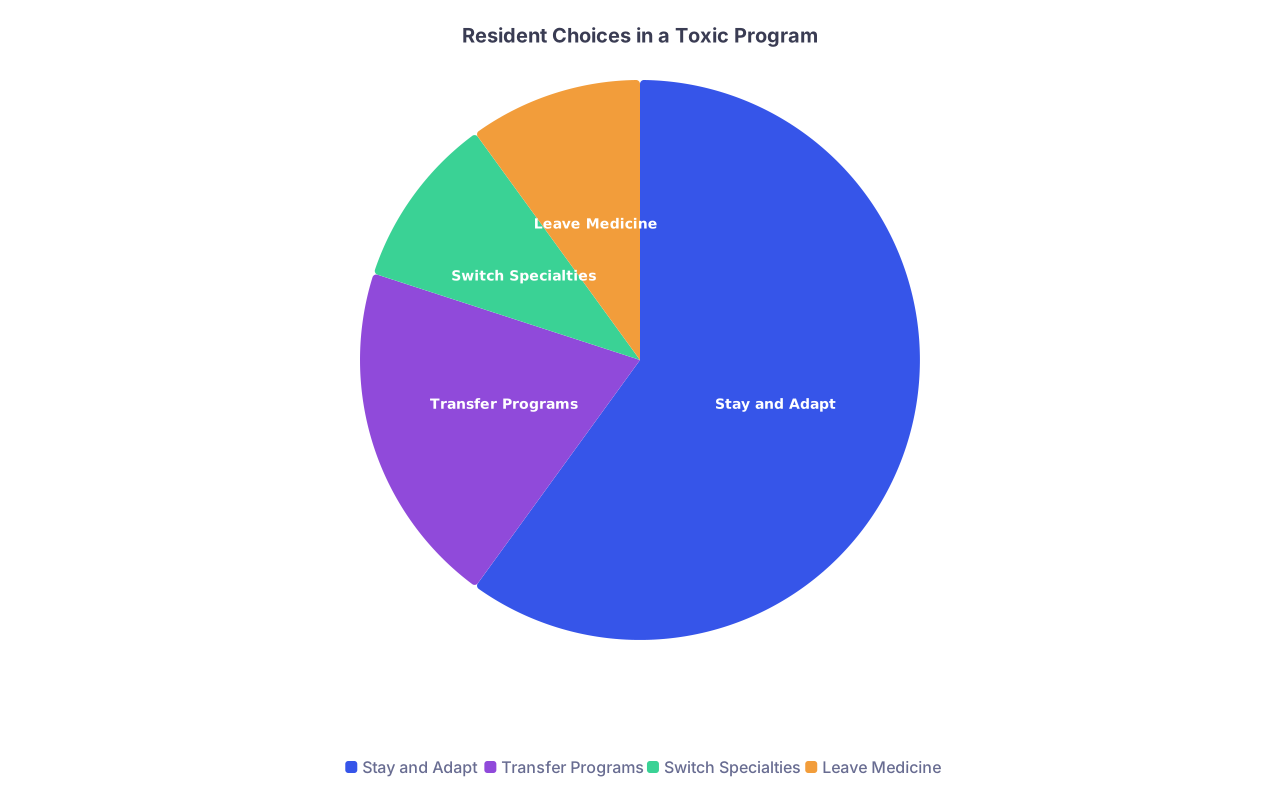
| Category | Value |
|---|---|
| Stay and Adapt | 60 |
| Transfer Programs | 20 |
| Switch Specialties | 10 |
| Leave Medicine | 10 |
Those numbers aren’t from a formal study. They’re roughly what I’ve seen over years of residents in trouble. Most stay and adapt. Some move. A small but real group changes fields or leaves.
If you’re even entertaining transfer or switching, you need:
- A confidential conversation with a mentor outside your program.
- A reality check on timing, visas (if applicable), and finances.
- A clear read on: is this “any residency will be hard,” or “this specific place is uniquely unhealthy.”
10. A Concrete 4-Week Plan to Pull Yourself Back From the Edge
You’re exhausted; you do not need more philosophy. Here’s a practical sketch you can start this month, even in a brutal program.
Week 1: Stabilize Basics
- Schedule: one PCP visit (if you don’t have one, start booking), and send 3 therapy inquiries.
- Sleep: pick a consistent “no screens 20 minutes before sleep” rule for 5 nights a week.
- Connection: text or call one non-med person twice this week.
Week 2: Add Micro-Recovery
- Start the 3-item daily non-negotiable list (body, mind, connection).
- Use commute “download” routine at least 3 days.
- Identify 1–2 reasonably safe co-residents to be honest with.

| Step | Description |
|---|---|
| Step 1 | Week 1 Stabilize |
| Step 2 | Week 2 Micro recovery |
| Step 3 | Week 3 Boundaries |
| Step 4 | Week 4 Reassess |
| Step 5 | Book PCP and therapy |
| Step 6 | Daily 3-item list |
| Step 7 | Practice saying no |
| Step 8 | Decide adapt vs exit |
Week 3: Start Boundary Experiments
- Practice one scripted “no” to extra work that’s not mandatory.
- Leave on time at least one day this week, even if people side-eye you.
- Start logging egregious duty hour or safety issues.
Week 4: Reassess and Choose
- Triage yourself: Tier 1, 2, or 3 burnout.
- If Tier 2 or 3, explicitly tell someone you trust and your PCP/therapist.
- Decide: for the next 3–6 months, am I in “survive and adapt here” mode or “actively explore exit” mode?
You’re not fixing your whole life in a month. You’re turning the ship 5 degrees. That’s enough to change your destination.
11. What to Ignore Completely
There’s a lot of “wellness” noise online. In your situation, some of it is useless or harmful.
You can safely ignore:
- Any wellness advice that assumes you have predictable evenings or weekends.
- People telling you to wake up an hour earlier to meditate or journal. You need sleep more than you need a sunrise gratitude practice.
- Attending physicians who brag about “back in my day” suffering without acknowledging duty hours or mental health.
- Residents on social media who look perfectly balanced, shredded, and always happy. You’re not seeing their call nights, their crying, or their meds.
You do not need to win wellness. You need to still be standing in 3–5 years with your values and sanity mostly intact.
12. The Core Reality You Have to Accept
Your program might never become “wellness focused.” The chiefs might never start caring about your sleep. The PD might always think burnout is a personal weakness.
You can’t wait for them.
You treat yourself as your own wellness program:
- You’re the committee.
- You’re the policy.
- You’re the enforcement.
You protect 20 minutes today. You make one hard phone call this week. You say no once where you used to say yes. You decide which pieces of yourself are non-negotiable.
That’s how you handle burnout in a place that gives you nothing.
Keep these three points in your pocket:
- Stop waiting for your program to fix burnout; act like your own attending for wellness and set non-negotiable basics (PCP, therapist, sleep, micro-recovery).
- Opt out of the toxic culture quietly but firmly—document abuse, enforce small boundaries, and lean on 1–3 safe people instead of the whole system.
- If you’re at the point of scary thoughts or total numbness, treat it as a medical emergency, not a character flaw—speak up, get professional help, and seriously consider whether staying in that exact environment is worth your life.


