

The standard advice about “work‑life balance” in residency completely collapses once you add a newborn.
If you’re a new parent in residency, you are playing a different game. Different rules. Different risks. And if you try to live like your co‑residents without kids, you will burn out. Or your relationship will crack. Or both.
Here is how you actually prevent burnout at home and at work when you’re a resident with a new baby—step by step, scenario by scenario.
1. First Reality Check: Your Life Is Now a Capacity Problem
You don’t just “get more efficient” and suddenly everything fits. It doesn’t. Your capacity just got cut, overnight.
Before we talk tactics, accept these two things:
You cannot be:
- the perfect resident,
- the perfect parent,
- the perfect partner,
- and the perfect friend
all at the same time. Choose who gets your best, on purpose.
If you don’t proactively design your weeks, the system will design them for you—and the system does not care that you have a baby.
So the project for the next 6–12 months is simple: ruthlessly protect your limited bandwidth.
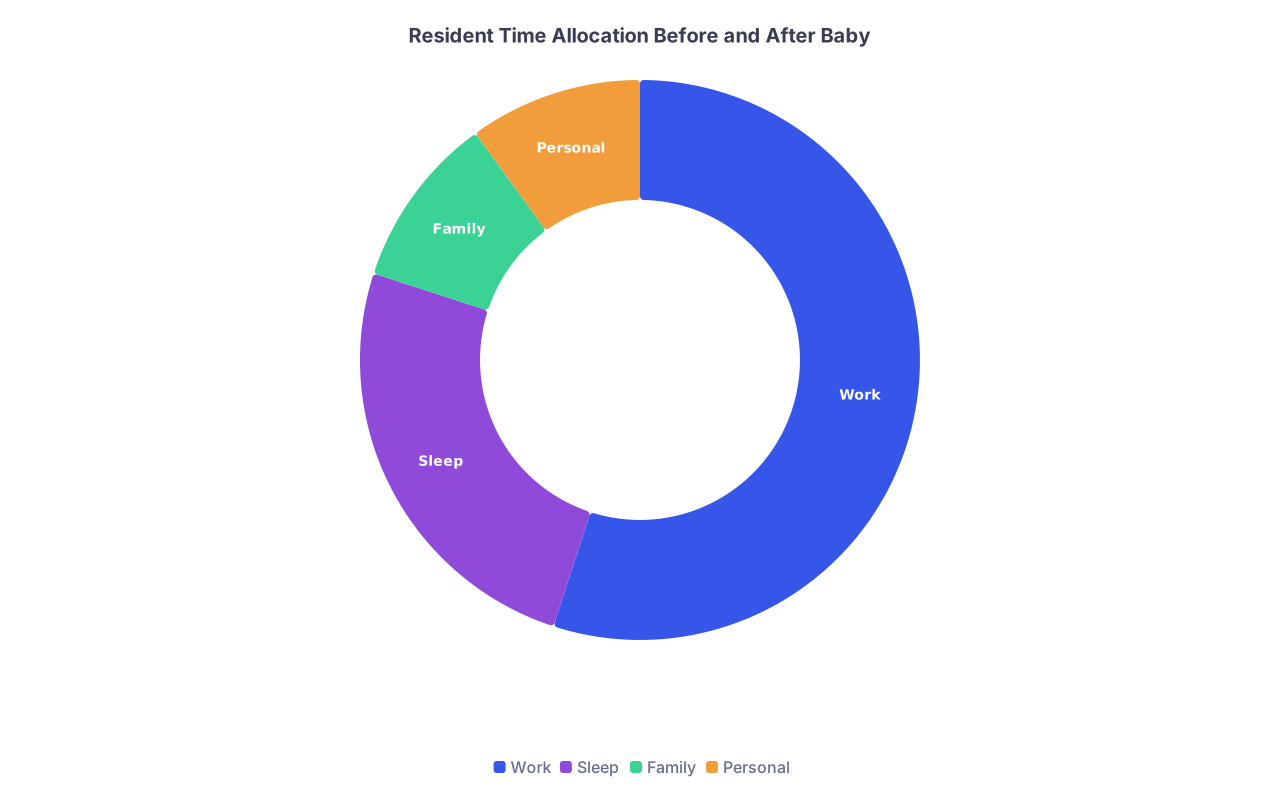
| Category | Value |
|---|---|
| Work | 55 |
| Sleep | 25 |
| Family | 10 |
| Personal | 10 |
Look at that rough breakdown. The “personal” slice is tiny. If you waste it, you’re done.
2. Fix the One Thing That Breaks Everything: Sleep
Burnout and new parenting have a common accelerant: chronic sleep debt. If you get this wrong, everything feels impossible—clinic, rounds, diaper changes, your own impulse control.
You are not going to sleep “well.” But you can sleep strategically.
Build a “Sleep Protection Plan” with Your Co‑Parent
If you have a partner at home and you’re both randomly taking turns at 2 am, that’s a recipe for two zombies.
Switch to block scheduling of sleep:
Night before a heavy call / long OR day:
- You get protected sleep block (10 pm–3 am or 11 pm–4 am).
- Your partner handles all baby needs in that block unless there is an actual emergency.
- Then you trade for an early‑morning shift when you’re up anyway.
Post‑call day:
- You sleep first thing when you get home for a strict 3–4 hour block.
- Your phone is on DND. Partner knows not to wake you.
- You join parenting after that, present and less dangerous behind the wheel.
If you’re breastfeeding, modify:
- Pump right before the protected sleep block.
- Partner bottle feeds during that window.
- If that’s not logistically possible, partner handles everything except the actual feeding: changing, burping, getting baby back down, bringing baby to you and taking them away.
This is not romantic. It’s logistics. You are managing a scarce resource (parental capacity).
Micro‑Sleep at Work Without Getting in Trouble
On some rotations, you will not be able to fix the schedule. But you can steal energy back:
- 10–15 minutes of eyes‑closed rest on a call room bed during a lull is better than scrolling. Don’t be a hero; lie down.
- Waiting for CT? If your presence is not actually needed, sit, close your eyes for 3–5 minutes. You’ll feel ridiculous. Do it anyway.
- If your program has a quiet or lactation room, use it occasionally for a 10‑minute reset even if you’re not pumping.
The rule: you never drive home post‑call if you’re nodding off. Grab a 20‑minute nap at the hospital or call a ride. Pride kills people.
3. Control What You Can at Work: Boundaries, Not Excuses
New parents in residency often make the same mistake: they tell everyone they’re “fine” and then silently drown.
You can’t expect your program to read your mind. You also can’t expect them to rebuild the schedule around you. But there is a middle ground.
Have a Direct, One‑Time Conversation with Your PD
You do this early—during pregnancy or right after the baby is born. Something like:
“I’m committed to pulling my weight. I also want to be proactive so I don’t burn out or compromise patient care. Here’s what would help me stay functional…”
Ask for specific, reasonable things:
- Avoid back‑to‑back 28‑hour calls in the first 4–6 weeks postpartum.
- Try not to schedule you on the heaviest rotation the exact month you return.
- Allow you to stack some clinic half‑days instead of a brutal inpatient month if coverage allows.
Some programs will say yes to all. Some will say no to most. But now they know you’re trying to manage capacity, not game the system.
Set Clear Expectations with Co‑Residents
Do not be the person who weaponizes their baby: “Well I have a kid so I can’t stay late.” That breeds resentment fast.
Instead, be explicit and fair:
- Offer to trade: “I can cover your late shift post‑call this week; can you swap and take mine in two weeks when my partner is out of town?”
- Be upfront: “I have drop‑off on Tuesdays, so I’m usually in by 7:10, not 6:55. I’ll pre‑chart from home and stay a bit later.”
People will work with you if:
- You communicate.
- You pull your weight when you’re there.
- You don’t constantly play the “I’m more tired than you” game. Everyone is tired.
Use Systems, Not Memory
Burnout loves chaos. Reduce it.
At minimum:
A shared family calendar (Google Calendar or similar) with:
- Your call schedule
- Rotation changes
- Partner’s key work obligations
- Pediatrician appointments, daycare deadlines, etc.
A work checklist for each rotation:
- Med rec done
- Notes signed
- Discharges completed
- Orders co‑signed
You’re too tired to “just remember.” Outsource to paper or your phone.
| Day Type | Main Focus | Non-Negotiable Block |
|---|---|---|
| Pre-call day | Home logistics | 30 min family planning |
| Call day | Survive + patient care | 10 min check-in text |
| Post-call day | Sleep + baby time | 3-4 hr sleep block |
| Clinic day | Efficiency at work | 10 min prep night before |
| Golden weekend | Relationship + recovery | Half day off screens |
4. Stop Trying to Be Two People at Once
What destroys new‑parent residents isn’t just exhaustion. It’s fragmentation—trying to mentally be at home while at work and at work while at home.
You need hard switches.
“Doorway Rituals” So You Don’t Take the Hospital Home
Pick a 1–2 minute ritual you do every time you leave work:
- Sit in your car. Set a 90‑second timer. Eyes closed, 3 slow breaths in and out, ask: “What do I need to put down from today?” Name 1–2 things. Then literally say (in your head is fine), “Done for today.”
- Or a quick walk around the block before you drive.
Same when you leave home for work:
- 30 seconds where you look at your baby, actually look, and tell yourself: “I’m a good parent even when I’m not physically here. Right now my job is to do safe medicine and get back home alive.”
Sounds corny. It works. Your brain needs cues that the context has changed.
One “Non‑Negotiable” in Each Domain
At work, choose one identity to protect:
- “I’m the resident who closes the loop on every discharge instruction.”
- “I’m the intern who always knows my patients’ vitals and labs.”
At home, choose one identity to protect:
- “I’m the parent who does bedtime whenever I’m not on call.”
- “I’m the partner who checks in once each day, no matter how short.”
This replaces the vague pressure of “be a great doctor and a great parent” with something you can actually execute even on awful days.
5. Make Your Relationship an Asset, Not Another Stressor
New baby + residency is infamous for relationship blow‑ups. It’s almost formulaic: one partner feels abandoned, the other feels unappreciated, both are exhausted.
You prevent that systematically, not by hoping you’re “strong enough.”
Weekly 20‑Minute “Logistics Meeting”
Not a date. Not deep emotional processing. Just logistics.
Once a week, ideally on the same day:
- Open the shared calendar.
- Review upcoming calls, nights, clinic, partner’s obligations.
- Decide:
- Who does which pick‑ups / drop‑offs.
- Who owns which nighttime blocks on which days.
- When each of you gets one protected hour alone that week (gym, nap, walk, whatever).
This meeting should be boring. If you skip it, the week will not be.
The 5‑Minute Emotional Check‑In
Separate from logistics. Once a day if you can, but at least a few times a week.
Rules:
- No problem‑solving unless asked.
- Each person gets 2–3 minutes to say how they are actually doing.
- The default response is: “That makes sense,” not “Here’s what we should do.”
Example:
“I feel like I’m doing everything with the baby when you’re on call and I’m getting resentful.”
Wrong answer:
“That’s not fair, I’m working 28 hours and…”
Better answer:
“I get why you feel that way. Let’s look at what we can shift on my post‑call days.”
You will not do this perfectly. But couples who build some kind of check‑in survive this phase more intact than the ones who just “wing it.”
6. Home Operations: Lower the Bar, On Purpose
You cannot run a Pinterest household and survive residency with a newborn. If your expectations don’t drop, your stress will rise until something breaks.
You need a “good enough” home operating system.
Ruthlessly Outsource or Eliminate
If you can afford even one of these, do it for 3–6 months:
- Housecleaning every 2–4 weeks.
- Grocery delivery or curbside pickup.
- Prepared meal delivery once or twice a week.
If money is tight, then simplify instead:
- Rotate 3–4 simple meals that you can cook half‑asleep: pasta + frozen veg, rotisserie chicken + salad kit, slow‑cooker soup, eggs + toast.
- Paper plates for a few months? Fine. You’re not being graded.
Build Default Routines, Not Perfect Ones
- Bath every other night is fine.
- Laundry twice a week: baby stuff in one load, everything else whenever.
- One “reset” time daily:
- 10–15 minutes to clear dishes, throw toys in bins, pack diaper bag for the next day. Set a timer and stop when it rings.
Your goal is not a showcase house. It’s a functional base camp.

7. Mental Health: Don’t Wait Until You’re Falling Apart
Residents are great at ignoring their own suffering until it becomes a problem for someone else. New parents are the same. Combine them and you’ve got a mental health time bomb.
You are not weak if this is hard. This phase is legitimately brutal.
Know the Red Flags
At least consider you’re in trouble if:
- You dread both going to work and going home.
- You feel emotionally numb around your baby.
- You have frequent thoughts like: “Everyone would be better off without me.”
- You’re snapping at co‑residents or your partner over nothing.
- You stop caring about patient care details you usually would obsess over.
That’s not you “failing at adulting.” That’s likely depression, anxiety, or burnout moving from mild to significant.
Use the Resources That Actually Help
Most programs have:
- Confidential counseling or an employee assistance program.
- Someone in GME or wellness whose entire job is to connect you to resources.
Do not wait for a catastrophic moment to reach out. A simple email like:
“I’m a PGY‑2 who just became a parent. I’m noticing I’m more irritable and exhausted than usual and it’s affecting both home and work. I’d like to talk with someone about coping strategies and see if this might be postpartum depression/burnout.”
That’s enough to start.
And if you’re having thoughts of self‑harm or hurting your baby:
- This is an emergency, not a character flaw.
- You contact a crisis line, your on‑call attending, or go to the ED. You can sort out the rest later. Staying alive comes first.
8. Protect One Tiny Sliver of “You” Each Week
The fastest way to burnout is to become nothing but “the resident” and “the parent.” If there is no “you” left, everything feels meaningless.
You are not getting an hour every day. But you can usually steal 60–90 minutes once or twice a week.
Realistic ideas:
- Quick run or walk with a podcast between daycare drop‑off and work if it’s safe and close.
- Reading something non‑medical in bed for 10 minutes before you pass out.
- A short call with a friend on your commute home once a week.
- 20 minutes of a hobby on a golden weekend.
The point is not the activity. It’s the message to your brain: “I still exist outside of my roles.”
9. If You’re Doing This Solo (Single Parent Residents)
Your situation is harder, full stop. You don’t get a magical motivation speech to fix that. You get structure.
Key realities:
- You must build a support web fast: friends, co‑residents, neighbors, family, church/mosque/temple community, whoever is safe and reliable.
- You need redundant childcare: primary option + backup options.
| Scenario | Primary Plan | Backup Plan |
|---|---|---|
| Daycare closed | Trusted friend | Emergency sitter list |
| You stuck post-call | Neighbor pickup | Co-resident + Uber for kid |
| Night float | Overnight sitter | Family member visit |
Have 2–3 names you can text for urgent help. Yes, that’s vulnerable. Do it anyway. People are usually more willing to help than you expect if you’re straightforward and not always asking last minute.
You also have more leverage with your program than you think, because your margin for error is thinner. Use it thoughtfully:
- Ask about childcare stipends.
- Ask for scheduling that clusters your longest days rather than scattering them.
- Ask how other single‑parent residents have managed and whether there’s precedent.
10. This Phase Is a Season, Not a Life Sentence
The newborn + residency overlap feels endless when you’re in it. It is not.
Within 6–12 months:
- Your baby will sleep longer stretches.
- You’ll be more efficient at work.
- The logistics that feel impossible now will turn into routine muscle memory.
Right now your job is not to create an ideal life. Your job is to:
- Avoid true burnout and mental health collapse.
- Keep your relationship and home “good enough” to recover later.
- Stay safe and competent for your patients.
If you do those three, you are winning at a game most people wouldn’t even dare to play.
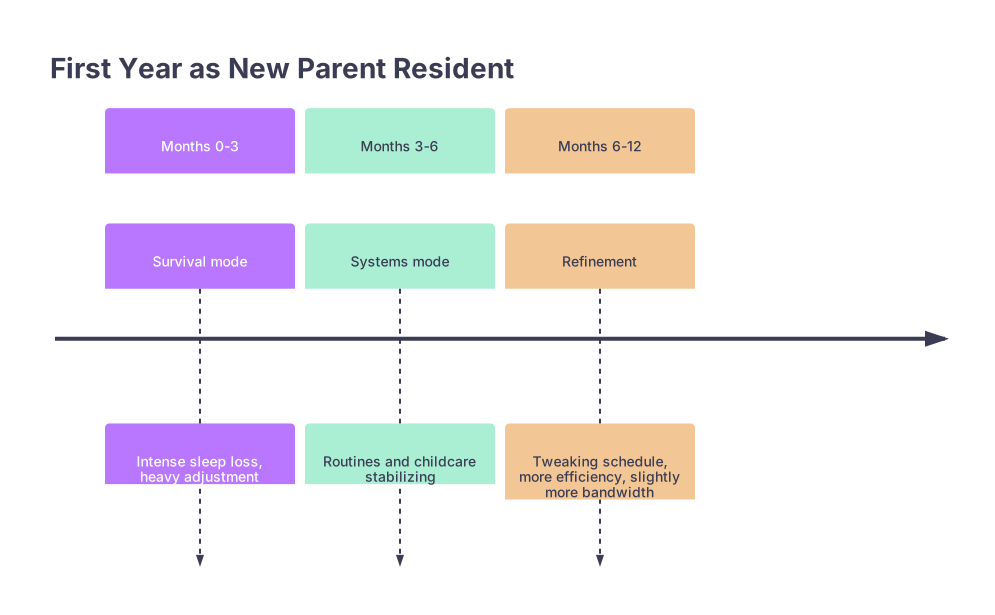
| Period | Event |
|---|---|
| Months 0-3 - Survival mode | Intense sleep loss, heavy adjustment |
| Months 3-6 - Systems mode | Routines and childcare stabilizing |
| Months 6-12 - Refinement | Tweaking schedule, more efficiency, slightly more bandwidth |


