

The moment your partner says, “You’re never home,” you’re not in a feelings conversation. You’re in a risk conversation—about burnout, resentment, and whether this relationship survives residency.
Let me walk you through what to do. Step by step. No fluff.
1. Understand What That Sentence Really Means
“You’re never home” almost never literally means: “Your physical body is not in this apartment enough hours per week.”
It usually means one (or more) of these:
- “Our life doesn’t feel shared anymore.”
- “I feel second to your job.”
- “I’m lonely and I don’t know how to say it without sounding needy.”
- “I’m scared this is just how it’s going to be forever.”
- “I can’t tell where residency ends and you begin.”
You’re exhausted, paged constantly, behind on notes, barely keeping your eyes open on rounds. So your brain hears:
- “You don’t appreciate how hard I’m working.”
- “I can’t control my schedule; why are you mad at me?”
- “Do you want me to abandon my patients?”
Two completely different conversations. That’s how resentment grows.
Your first move (and what not to do)
Do NOT start by defending your schedule.
Not:
“I was literally home two nights this week.”
“I can’t just leave the hospital.”
“You knew what you were getting into.”
Those are gasoline on the fire. True or not, they land as: “Your feelings are invalid.”
Instead, your first sentence should sound like one of these:
- “Okay. That’s not how I want you to feel. Tell me what ‘never home’ feels like from your side.”
- “I hear that as ‘I feel alone.’ Is that close, or am I missing it?”
- “I’m obviously not getting something. Help me understand what hurts the most right now.”
You’re not surrendering. You’re gathering data. You cannot fix what you refuse to understand.
2. Separate Three Problems: Time, Presence, and Predictability
Most residents try to solve this with one lever: “I’ll try to be home more.”
You don’t control that lever nearly enough. You do control others—if you’re honest about what’s actually broken.
There are three separate variables:
- Time – actual hours at home
- Presence – how emotionally/mentally present you are when you are home
- Predictability – how well your partner can plan around your chaos
Usually, your partner is hurting from at least two of these. Sometimes all three.
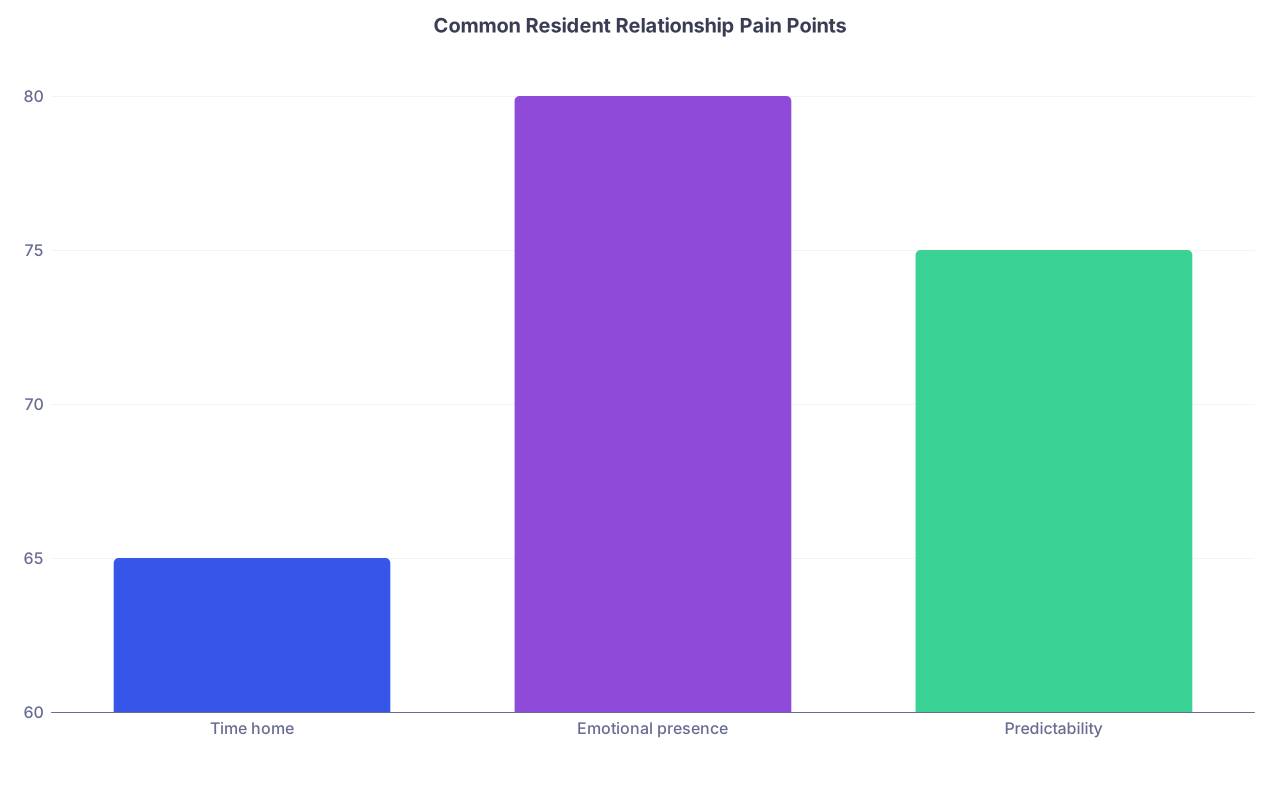
| Category | Value |
|---|---|
| Time home | 65 |
| Emotional presence | 80 |
| Predictability | 75 |
When you talk, ask explicitly:
- “Is the core issue that I’m barely physically home?”
- “Is it that when I’m home, I’m a zombie and useless?”
- “Or is it that you never know when I’ll be around, so you can’t plan anything?”
You’ll usually hear a mix like: “It’s that I never know when I can count on you for anything. And when you’re here, you’re dead on the couch.”
Good. Now you have something you can actually work with.
3. Have One Structured Conversation (Not 17 Fights)
You need one intentional, sit-down conversation when you’re both relatively functional. Not post–24-hour call. Not during pre-rounds texts. Actually scheduled.
Say something like:
“I’ve been thinking about what you said — that I’m never home. I don’t want this to slowly poison us. Can we set aside 30–45 minutes this weekend to talk about it and make an actual plan?”
Not “talk about our feelings in general.” Make a plan.
How to structure that talk
Think of it in four phases:
- Their reality
- Your reality
- Shared minimums
- Concrete systems
1) Their reality (you mostly shut up)
Ask:
- “What has been the worst part of this for you?”
- “When you say ‘never home,’ what moments are you thinking of?”
- “What do you miss the most about how things were before?”
Let them talk. Don’t explain. Don’t justify. Take notes if you have to.
You’re listening for specific pain points:
“I eat dinner alone every night.”
“I go to bed not knowing if you’ll be there.”
“I feel like a single parent even though you technically live here.”
2) Your reality (no martyrdom)
Then you share your side—but frame it as constraints, not excuses.
“I feel constantly behind. I leave the hospital late, I’m still worried about patients, and by the time I get home my brain is shot. I’m not ignoring you; sometimes I genuinely have nothing left. And it scares me because I don’t want that to be our entire story.”
You’re allowed to be honest that residency is brutal. Do not act like you’re fine and just need to “do better.” That’s how burnout sneaks up.
4. Set “Minimums” So Your Life Doesn’t Feel Like Random Chaos
The couples who survive residency are rarely the ones with the best schedules. They’re the ones who set clear minimums and actually follow them.
You need relationship minimums in three categories:
- Communication
- Time together
- Shared responsibilities
A. Communication minimums
These are the floor, not the ceiling. Things like:
- “One check-in text per day where I’m not just complaining about work.”
- “If I’m going to be more than an hour later than expected, I text ‘running late, new ETA is X.’”
- “One ‘how are you, really?’ conversation per week that’s not just logistics.”
Turn them into actual agreements:
“Okay, on inpatient, I can commit to: one text mid-day, one quick call on the drive home if I’m not post-call, and telling you when I know I’ll miss dinner. Is that meaningful, or does that just sound like more noise?”
Let them say if it helps or not. Don’t guess.
B. Time-together minimums
On busy rotations you might not get much. But you still set something.
Examples by rotation type:
| Rotation Type | Realistic Weekly Minimum |
|---|---|
| ICU/Night Float | 1 meal + 1-hour couch/TV block |
| Busy Inpatient | 2 meals + 1 walk/coffee |
| Outpatient/Clinic | 2 real dates + 1 long check-in |
| Elective/Vacation | 3+ dates + 2 deep talks |
Phrase it clearly:
- “On this ICU month, the best I can realistically promise is: one shared meal and one no-phones couch hour weekly. I know that sounds tiny, but I want us to start with what’s actually real.”
Important: these are non-negotiable unless someone is literally dying or you’re on call. Treat them like you treat a mandatory conference or sign-out.
C. Shared responsibilities minimums
If your partner is quietly doing 95% of the housework or parenting because you’re “never home,” resentment is already fermenting.
You can’t fix the schedule. You can absolutely rebalance effort.
Ask:
- “What are 2–3 tasks that would make the biggest difference if I took them reliably? Even if they’re small.”
Then pick things that work with your life:
- Always handle trash/recycling on X days.
- Handle one weekend morning kid duty when on lighter rotations.
- Always order the groceries / do the Instacart.
- Pay the bills, handle insurance nonsense, schedule car maintenance.
Stuff you can do half-asleep, late at night, or from the call room counts.
5. Build Simple Systems So You Don’t Have to “Remember” Everything
Residents who try to “just be more thoughtful” fail. You’re cognitively fried. You need systems that run even when your brain is mush.
System 1: The rotation briefing
Every time a new block starts, you do a 10–15 minute “rotation briefing” at home.
Outline:
- Typical schedule: start/end time, call days, worst-case scenarios
- Your predicted capacity: “I’ll be a zombie on Tues/Thurs”
- Realistic time-together minimums this month
- Specific asks: “I’ll need you to drive more this month” / “I can handle X on weekends”
This is basically pre-rounding on your relationship. No surprises.
System 2: Shared calendar with emotional meaning
Not just shifts. Layer three things:
- Your schedule (shifts, call, post-call)
- Protected relationship time blocks (marked clearly)
- Major partner events (presentations, exams, family things, social events)
Color code them.
You train yourself to treat “date night” on the calendar like “M&M conference.” Not optional. If you have to blow it up, you reschedule immediately like you would a missed patient appointment.
System 3: “Tiny touch” habits
You do not have 45 minutes for heartfelt texts from the stairwell. You do have 30 seconds, three times a day.
Examples of repeatable “tiny touches”:
- Morning: 10-second text – “Good luck on your [thing today]. I’m rooting for you.”
- Midday: quick “Thinking of you. How’s your day going on a scale of 1–10?”
- Evening: voice memo on the drive home if it’s safe – “Exhausted but can’t wait to say hi, ETA 8:15.”
You can literally template them in your phone if you have to. This is not fake. This is using tools to keep your brain from dropping the ball.
6. Protect Yourself from Burnout While You Protect the Relationship
If you sacrifice your last scraps of energy to keep the relationship afloat but never refill yourself, you’ll eventually have nothing left for either.
You need boundaries around how you use the little you have.
A. Stop bringing your worst self home every time
On brutal days, message before you walk in:
- “Today was rough. I want to see you, but I’m at 5% battery. Can we do low-key tonight?”
This gives your partner expectations. They can meet you where you are instead of feeling blindsided by your shutdown.
Also: build a 10-minute decompression routine before you engage at home:
- Sit in the car, 3 slow breaths, quick mental download of work.
- Quick shower first thing at home, then hug them. Not the other way around.
- One minute of “this stays at work” ritual: writing a few lines in Notes, saying a phrase, whatever.
Point is: you shift states on purpose. Don’t just leak the hospital into every corner of your house.
B. Don’t make your partner your only emotional ventilation system
If the only thing you bring home is stress, complaints, and trauma stories, your partner will associate your presence with dread, not connection.
You need other outlets:
- Co-residents
- Therapy (yes, schedule it like a rotation requirement)
- A group chat that actually gets it
- Journaling in the call room for 5 minutes
Then at home, you give a curated version:
“I had a really hard case today. I don’t want to dump all the gory details, but emotionally I’m feeling [X].”
Let them choose how much they want to hear. That’s respect.
7. Have the Hard Conversations About the Future (Before It’s a Ultimatum)
Often the real fear behind “you’re never home” is: “Is this what being with you will always feel like?”
You can’t promise the future. But you can do better than shrugging and saying “Fellowship will be worse” (which residents love to say like it’s a joke…it’s not funny to the person at home).
You owe your partner:
- A clear sense of your timeline (years of residency left, thoughts on fellowship)
- Your values (do you actually value family time, or is work always first?)
- The direction of change (will attending life be a little better? a lot?)
Spell it out:
“This year and next are probably my worst for hours. If I do [X fellowship], it’ll be rough again for [time frame]. What I’m working towards is [job vision] with about [rough hours]. That matters to me because I do not want our whole life to be like this.”
If you don’t know—say that. But then commit to updating them as you figure it out.
Consider sketching it visually together:
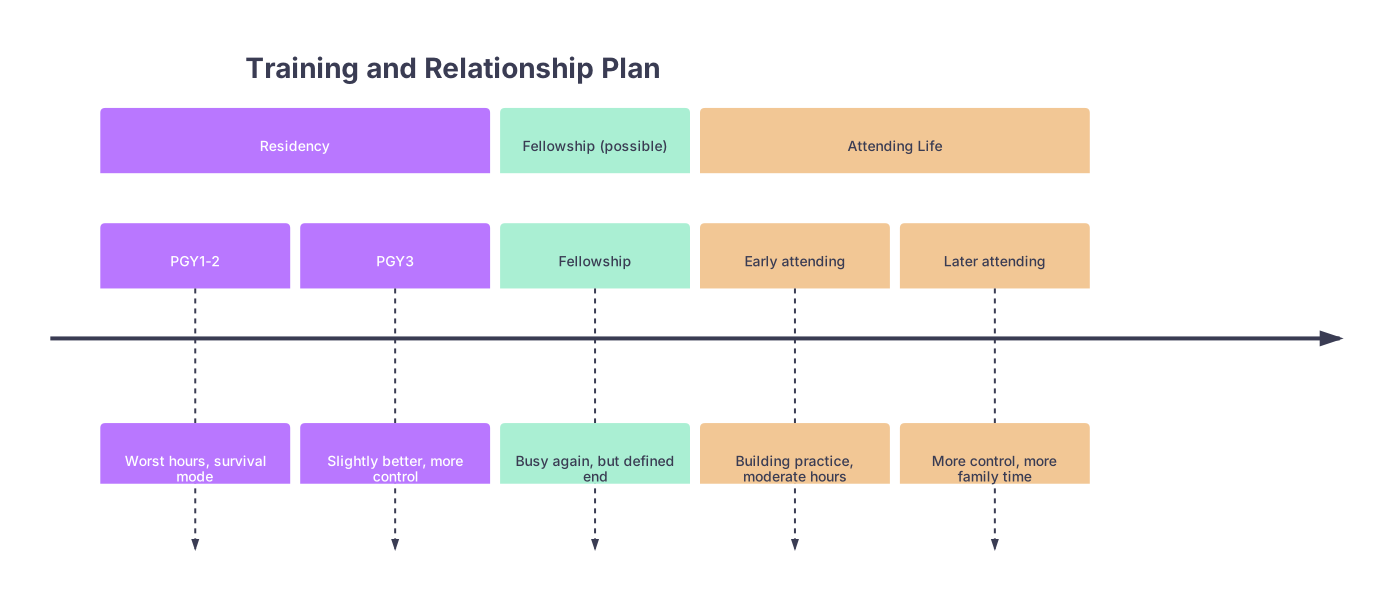
| Period | Event |
|---|---|
| Residency - PGY1-2 | Worst hours, survival mode |
| Residency - PGY3 | Slightly better, more control |
| Fellowship (possible) - Fellowship | Busy again, but defined end |
| Attending Life - Early attending | Building practice, moderate hours |
| Attending Life - Later attending | More control, more family time |
That simple alignment can defuse huge resentment. People can tolerate hardship if they believe it’s time-limited and shared.
8. If The Conversation Goes Badly: Triage, Don’t Defend
Sometimes you’ll do all of this and your partner will still be angry and say things like:
- “This isn’t enough.”
- “I don’t know if I can do this.”
- “I feel like I’m always second place.”
Your instinct will be to convince them. Don’t.
You’re not winning a debate. You’re assessing viability.
Questions to calmly ask:
- “What would ‘enough’ look like to you over the next 6–12 months?”
- “Are you hoping I’ll leave medicine or completely change specialties?”
- “If nothing about my schedule changed, is there anything that would make this feel better?”
If their honest answers are completely incompatible with training (e.g., “I need you home for dinner every night,” “I need you to never work weekends”), you’re at a decision point.
Then you have to ask yourself:
- Am I willing to fundamentally change my path?
- Is this relationship able to tolerate training reality?
- Are we both choosing this, or is someone being dragged?
That’s harsh, but necessary. Staying in a relationship where one person secretly hopes your job will magically become 9–5 is a straight road to burnout and bitterness.
A neutral couples therapist who has worked with medical couples can help sort this out. Yes, during residency. No, it’s not overkill.
9. What To Do This Week If You Just Heard “You’re Never Home”
You don’t need a five-year strategy tonight. You need first steps.
Here’s a concrete 7-day plan.
In the next 24 hours:
- Acknowledge the comment directly: “I’ve been thinking about what you said — that I’m never home. I don’t want that to sit and rot between us.”
- Ask for a short conversation time: “Can we talk for 30 minutes this weekend and try to make a plan together?”
Before that talk:
- Map your current rotation schedule honestly. Where are the small pockets?
- Decide: what’s your realistic minimum this month? One meal? One date? Two walks?
- List 2–3 things you can reliably own at home (trash, bills, groceries).
During the talk:
- Listen first. No defense.
- Separate time vs presence vs predictability.
- Propose: communication minimums, time-together minimums, task shift.
- Agree to do a “rotation briefing” before the next block.
Over the next week:
- Follow through on whatever you committed to. Even if it’s tiny.
- Send 1–2 small, concrete appreciation messages: “Thank you for handling [X] while I’m on nights. I see it.”
- Notice if your own resentment is rising. If yes, that’s your signal to get support—co-resident, mentor, therapist—not to silently white-knuckle it.
Final Thoughts: What Actually Keeps You From Burning Out and Resenting Each Other
Three takeaways, and then you can get back to your work list:
“You’re never home” is not about minutes; it’s about meaning. Stop arguing the clock and start understanding the loneliness, unpredictability, and unequal burden underneath that sentence.
Tiny, consistent systems beat vague promises. Rotation briefings, shared calendars, “minimums” for communication and time together, and simple habits of checking in will do more than grand speeches about how much you care.
Your relationship and your career both survive when you respect reality. You can’t pretend residency is normal, and you can’t pretend your partner will tolerate feeling abandoned forever. Face the constraints together, build routines that honor both of you, and be honest about whether this version of life is one you’re both actually choosing.


