
The honest answer: most residents are working too many night shifts in a row to be truly safe.
The Short, Direct Answer
If you want a number, here it is:
- For 12–16 hour nights: 3–4 nights in a row is the upper limit if you care about safety and performance.
- For true 24–28 hour call: 1 at a time, with at least a full day off or a light day after, is the safest pattern.
- Beyond 4 consecutive nights, your risk of serious error, needle sticks, car crashes, and cognitive mistakes goes up fast.
That’s not just my opinion. It matches what sleep medicine data, flight and transportation safety rules, and multiple residency fatigue studies are all pointing toward.
The problem? A lot of residency schedules still blow past those limits.
Let’s break it down in a way you can actually use when you look at your rotation schedules or talk to your chief.
What Do Official Rules Actually Say?
There’s a big gap between what’s allowed and what’s safe.
ACGME Rules (US-based programs)
ACGME work-hour rules focus on total hours, not specifically on number of nights in a row:
- Max 80 hours per week (averaged over 4 weeks)
- One day off in 7 (averaged)
- In-house call no more than every 3rd night on average
- Max in-house call (traditional) up to 24 + 4 hours of transition activities
- Night float systems: no explicit national limit on number of consecutive nights, just “appropriate” frequency of days off
Translation: your program can legally schedule 5, 6, even 7 night shifts in a row as long as the weekly hours math works and you get a day off somewhere.
That’s legal. It is not automatically safe.
What fatigue and safety data say
From sleep medicine, transportation safety, and shift work research:
- Performance significantly worsens after 2 consecutive nights with disrupted sleep.
- After 3–4 consecutive nights, your cognitive performance can mimic being legally intoxicated.
- Accident risk driving home after a night shift is 2–3x higher than after a day shift.
- Episodes of “microsleep” (you briefly fall asleep without meaning to) increase after about 16–18 hours awake.
So if you’re stacking long nights plus commute, you’re playing with fire by night 4 or 5.
Safe Ranges by Type of Night Work
Residency doesn’t have one type of night shift. You’ve got float, night medicine, ICU nights, 24-hour calls, “home” call that really isn’t home. They’re not equal.
Here’s a realistic, safety-first range you should aim for.
| Shift Type | Typical Length | Safer Max in a Row |
|---|---|---|
| Standard night float | 10–12 hours | 3–4 |
| Heavy ICU nights | 12–14 hours | 3 |
| ED night shifts | 8–12 hours | 3–4 |
| 24–28 hour in-house call | 24–28 hours | 1 at a time |
| Home call with frequent pages | Variable | 2–3 |
Standard night float (10–12 hours)
Pattern: 7 p.m.–7 a.m., or 8 p.m.–8 a.m.
Reality: codes, frequent pages, minimal real sleep.
Safer upper limit:
3–4 nights in a row, then a true 24-hour break from clinical duties.
If your program is doing:
- 5–7 nights in a row, especially multiple weeks back-to-back
- “Black cloud” assignments where one person gets hammered with admissions
…you will see more errors. I’ve seen residents on night 6 not remember orders they placed an hour earlier.
ICU nights
Everything bad about nights, plus:
- Continuous high-acuity patients
- Vent management, titrating drips, end-of-life discussions at 3 a.m.
- Very little downtime
Safer upper limit:
3 ICU nights in a row. If they’re 14+ hour “nights” with no real downtime, even 3 is pushing it.
I know many ICUs do 5–7 nights straight. That’s a systems-choice, not a safety choice.
ED night shifts
Emergency departments love 8–12 hour night blocks.
They may feel different because:
- Bright environment
- Constant activity
- You’re physically up and moving
But the circadian hit is the same. Your physiology does not care that the ED lights are bright.
Safer upper limit:
3–4 nights, ideally with a day off or very light shift after, and avoid flipping back and forth between days and nights every 2–3 days. The flip is brutal.
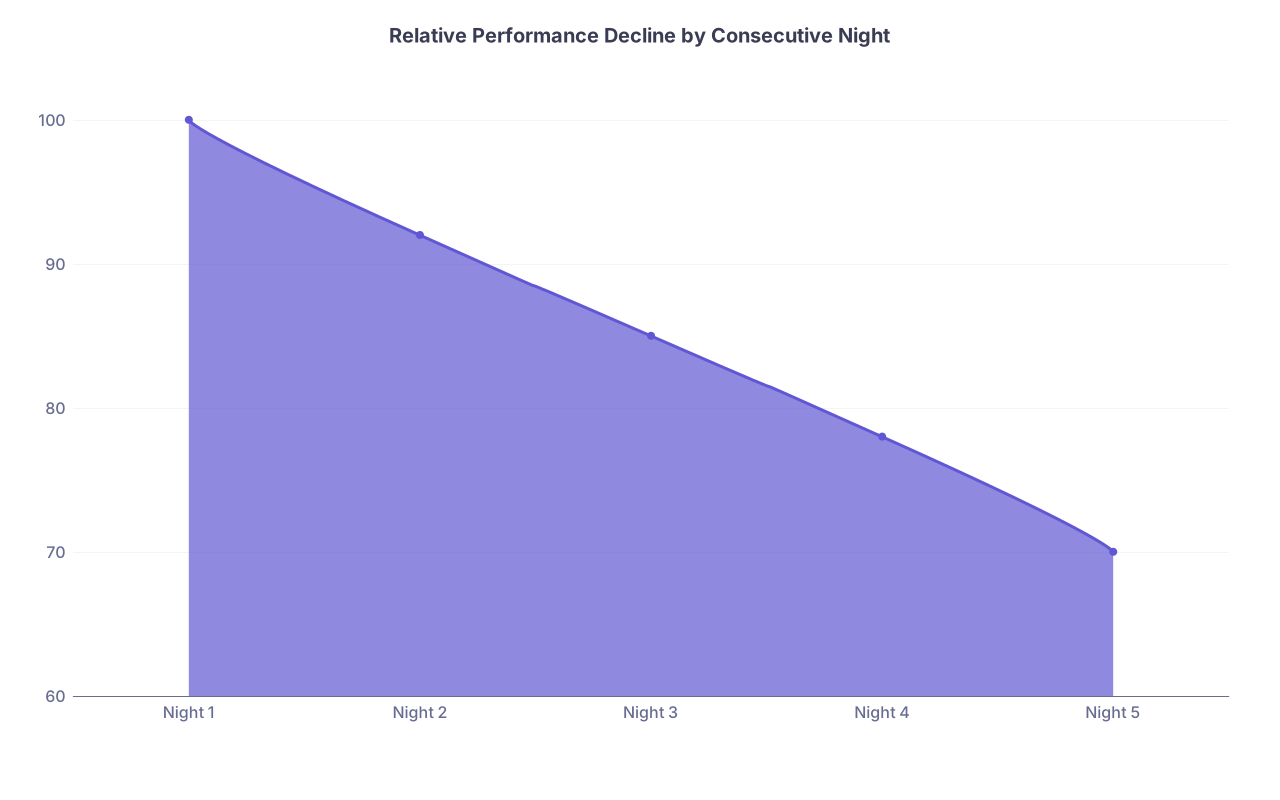
| Category | Value |
|---|---|
| Night 1 | 100 |
| Night 2 | 92 |
| Night 3 | 85 |
| Night 4 | 78 |
| Night 5 | 70 |
(Conceptual scale: 100 = day-shift baseline. The point is the trend, not the precise numbers.)
Why Too Many Nights in a Row Becomes Unsafe
You’re not lazy. You’re not “weak” if you struggle on night 4. You’re human.
Here’s what’s actually happening to your brain and body.
1. Circadian misalignment
Your internal clock is hardwired to want sleep at night, wakefulness in the day. When you flip it:
- You get lighter, more fragmented daytime sleep
- You get less deep (slow wave) and REM sleep
- You build “sleep debt” even if you’re spending 8 hours in bed
By night 3–4, that debt shows up as:
- Slower reaction time
- Worse memory and attention
- More impulsive decisions (you say “yes” to riskier plans without noticing)
In clinical terms: you miss subtle exam findings, mis-hear orders, click through alerts, and forget to follow up on labs.
2. Continuous partial sleep deprivation
This isn’t one all-nighter. It’s chronic partial sleep loss.
Even dropping from 7–8 hours to 5–6 hours of real sleep, across multiple days, tanks performance.
The data:
- After about a week of sleeping 4–6 hours/night, performance looks like someone awake 24 hours straight.
- Your self-assessment is terrible. People feel “adapted” but their objective testing shows big declines.
Residents are infamous for saying “I’m fine.” The EEGs and error rates say otherwise.
3. Microsleeps and zoning out
You know that feeling where your eyes are open, but later you realize you have no memory of the last 5 minutes? That’s microsleep or micro-off-task episodes.
On multiple nights in a row, especially by night 4–5:
- Risk of these episodes jumps
- They’re more likely when you’re doing low-stimulation tasks (charting, order review, driving home)
Terrifyingly, you often don’t realize they happened in the moment.
Different Patterns: What’s “Less Bad”?
If you can’t avoid nights (you can’t), you can at least push for patterns that are less dangerous.

| Step | Description |
|---|---|
| Step 1 | Schedule Nights |
| Step 2 | High fatigue and errors |
| Step 3 | Moderate-high risk |
| Step 4 | Safer pattern |
| Step 5 | Add recovery day |
| Step 6 | Consecutive Nights |
Better patterns
If you’re stuck with nights, these patterns are relatively safer:
3–4 nights on, then 2 days off, repeat
Works best if:- You try to stay partially on a night schedule between blocks (late sleep/wake)
- You protect those days off (no extra admin / mandatory noon “education”)
2 nights on, 1 off, 2 on
Less common but can work when patient volume supports it.Single 24-hour calls with protected post-call days
Brutal but safer than stacking 3 calls in 5 days.
Worse patterns
Red flags in a schedule:
- 5–7 nights in a row with only one “day off” that’s really half used for flipping back to days
- Alternating day-night-day-night within the same week
- Night shifts ending at 7–8 a.m. followed by required noon conferences or mandatory clinic
These are the schedules that breed near-misses and then surprise when something serious finally happens.
How to Decide If YOUR Schedule Is Reasonable
Use these simple filters.
Ask yourself for any rotation with nights:
How many nights are stacked in a row?
- 1–2: reasonable
- 3–4: acceptable but you need serious sleep protection
- 5+: high risk, especially if back-to-back weeks
How long are the shifts really?
A “12-hour” shift that routinely runs 13–14 hours plus sign-out plus documentation is not a 12.Do I get true post-night recovery?
Post-night day with:- No clinic
- No required teaching
- No meetings
If you’re doing “post-night conference” regularly, that’s not recovery.
How often am I flipping day ↔ night?
Frequent flips are worse than staying on one pattern for a short block.

What You Can Actually Do About It
You probably can’t rewrite the call schedule. But you’re not powerless either.
1. Know your breaking point
Most people:
- Start feeling it by night 2
- Notice real performance drops by night 3
- Are unsafe by night 5+
Pay attention:
- Are you rereading the same note three times?
- Missing meds on med rec?
- Forgetting who’s in which room?
That’s not just “being tired.” That’s functional impairment.
2. Protect sleep like it’s a medication
Daytime sleep hygiene for nights:
- Blackout curtains and/or eye mask
- White noise (fan, app) to block daytime noise
- Phone on do-not-disturb with only truly critical numbers allowed through
- Caffeine only in the first half of your shift; cut off 6–8 hours before you plan to sleep
You will not “catch up” fully, but you can keep from crashing.
3. Don’t drive home drowsy
If you consistently feel:
- Heavy eyelids on the drive
- Memory gaps about parts of your commute
- Swerving, lane drift, or jerky corrections
You are at real risk. Dying in a post-call car accident is depressingly common.
Better options:
- Carpool with another resident (take turns being the driver/sleeper)
- Power nap for 20–30 minutes before leaving
- Public transit / ride-share when you’re dangerously sleepy
Yes, it costs money. So does a totaled car and an ICU stay.

How to Talk to Your Program About Unsafe Night Schedules
You’re not going to get far walking into the PD’s office and saying, “This is awful.” You need specifics.
Bring:
Concrete examples
- “We are scheduled for 6 consecutive 14-hour ICU nights with only one day off between week blocks.”
- “On medicine nights, the ‘12-hour’ shift regularly runs 13.5–14 hours, averaged over weeks.”
Safety framing
- “People are falling asleep driving home.”
- “We’ve had X near-misses on nights 5–6.”
- “We are consistently missing labs and critical imaging results after night 4.”
Alternative patterns
You do not need a perfect solution, but offer options:- 3–4 night blocks instead of 6–7
- Redistributing nights across residents
- Shortening shift length if nights must be more consecutive
You’re speaking their language when you position it as a patient safety and accreditation risk issue, not a “we’re tired” complaint.
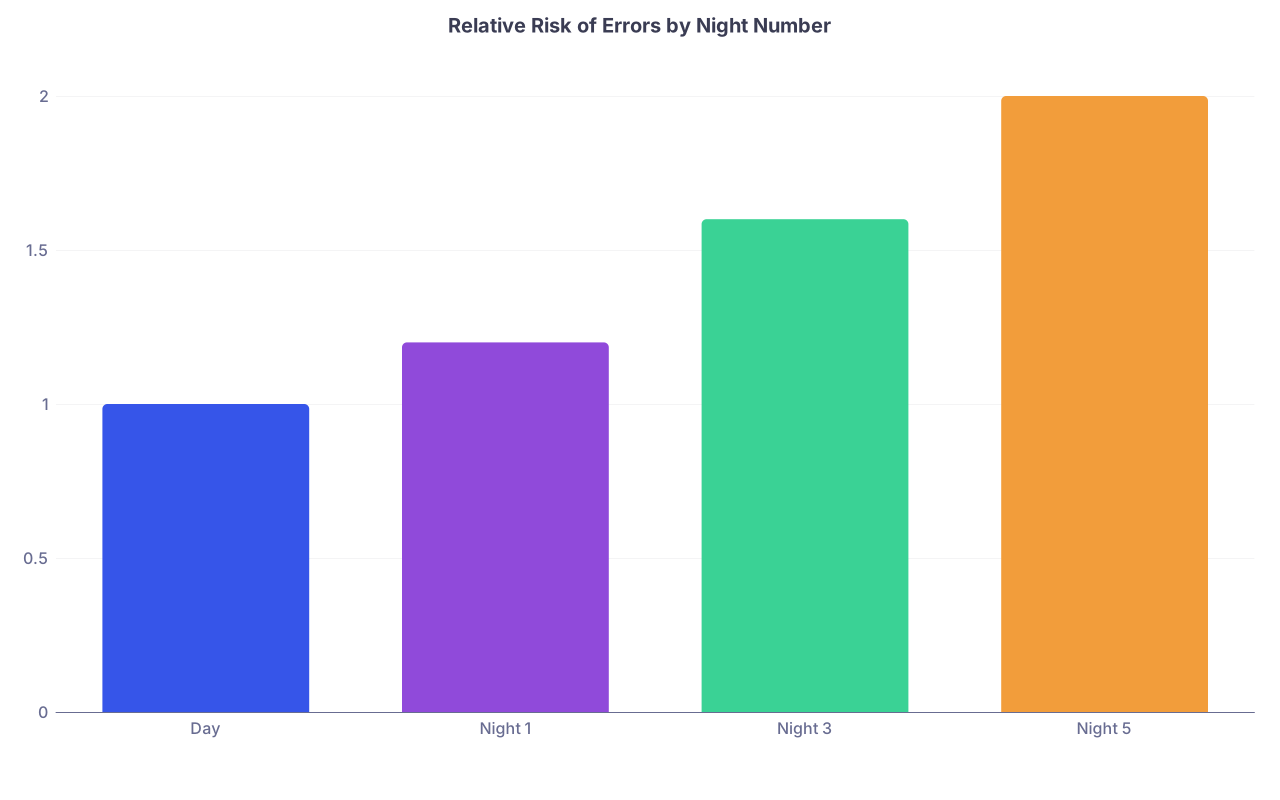
| Category | Value |
|---|---|
| Day | 1 |
| Night 1 | 1.2 |
| Night 3 | 1.6 |
| Night 5 | 2 |
Bottom Line: A Practical Rule of Thumb
Here’s the 10-second rule you can remember:
- If you’re doing >4 consecutive nights, it’s likely not safe.
- If you’re doing >3 consecutive ICU or brutal high-acuity nights, it’s likely not safe.
- If you’re doing multiple 24-hour calls in a short window, each one should stand alone, with real recovery after.
Residency will never be a 9–5 job. But pretending residents can grind through endless night blocks without consequence is fantasy—and dangerous fantasy at that.

FAQ: Night Shifts in Residency
1. Is 7 night shifts in a row safe during residency?
No. Seven consecutive night shifts, especially 10–12 hours or longer, is not safe from a fatigue standpoint. It may be legal under ACGME rules if total hours and days off are averaged correctly, but performance and safety data show sharp declines after 3–4 nights. Residents on 7-night blocks accumulate heavy sleep debt, making clinical errors and commute accidents more likely.
2. What’s the safest number of 24-hour calls to do in a week?
Ideally: one. Once you layer in conference, notes, and commute, a 24-hour call is realistically a 28–30 hour wake period. Doing that more than once in a 7-day window without true recovery in between is unsafe. If your program does Q4 or Q5 call, you should at least have protected post-call days and lighter days between calls.
3. Are shorter night shifts (8–10 hours) much safer than 12s?
They’re safer, not magically safe. An 8–10 hour night shift still disrupts your circadian rhythm and compresses daytime sleep. But the shorter the shift, the less total time you’re awake, and the lower the cumulative fatigue. For repeated consecutive nights, 8–10 hour shifts are clearly preferable to 12–14 hour ones, especially in high-acuity settings.
4. Is it better to do many nights in a row or flip frequently between days and nights?
Neither is ideal, but frequent flips are usually worse. Constantly changing your sleep-wake schedule (day-night-day-night) prevents any adaptation and leads to continuous jet-lag-like symptoms. A short, contained block of 3–4 nights with a recovery period is generally safer than ping-ponging between days and nights every couple of shifts.
5. What signs tell me I’ve hit my limit on nights?
Red flags: rereading the same orders or notes repeatedly; forgetting active patient issues; making simple calculation errors; zoning out during sign-out; nearly falling asleep at the wheel driving home; snapping at patients or staff more than usual. If you start seeing those on nights 3–4, you’re at or beyond your safe limit for that pattern.
6. Can I refuse a schedule I think is unsafe?
You can and should raise concerns, but flat refusal can have political fallout. Start by documenting specific patterns and incidents, then bring them to your chief, wellness committee, or program director framed around patient safety and regulatory risk. If your concerns are ignored and the schedule is clearly outside ACGME standards or blatantly unsafe, escalate to your GME office or anonymous reporting channels. Just be strategic and specific rather than emotional and vague.
Key things to remember:
- For most residents, 3–4 consecutive night shifts is the realistic safety ceiling—less for ICU-level acuity.
- Legal according to ACGME is not the same as safe for you or your patients. You’re allowed to question that gap.