The honest answer: most residents are running on less sleep than is safe—for them or their patients.
You’re not a superhero. You’re a human with a nervous system that stops working properly when you dip below 6–7 hours of sleep for more than a couple days. Medicine likes to pretend otherwise. That doesn’t make it true.
Let’s cut through the myths and talk about what you actually need to function safely, what happens to your brain when you don’t get it, and how to be strategic when your schedule makes “8 hours a night” sound like a joke.
The Real Number: How Much Sleep Do Residents Need?
Here’s the bottom line based on actual data, not residency folklore:
- Optimal for safety and learning: 7–8 hours per 24 hours
- Minimum to function reasonably safely short-term: 6 hours
- Below 6 hours for multiple nights: performance and judgment start to look like mild intoxication
- Below 5 hours, repeatedly: you’re kidding yourself; your brain is not doing what you think it’s doing
Most healthy adults need 7–9 hours. Residents are not biologically special. You’re just more conditioned to ignore how bad you feel.
The twist in residency is that you often don’t get this in one chunk. You might get:
- 4–5 hours overnight on call
- A 1–2 hour post-call nap
- Then 7 hours the next night
So the better question is: how much total sleep over 24 hours do you need to not be dangerous?
Answer: aim for at least 7 hours in any rolling 24-hour period, absolute floor of 6 hours, and don’t string multiple <6-hour days together if you can help it.
What Chronic Sleep Loss Actually Does to You
You already “know” sleep deprivation is bad. Let me translate that into residency reality.
Here’s what happens when you consistently get less than 6–7 hours:
Attention and vigilance tank
You miss labs. You overlook subtle exam findings. You forget that you ordered something. That “I’ll just remember this” thought? No, you won’t.Decision-making gets lazier and riskier
You anchor harder on your first diagnosis. You’re slower to reconsider. You’re more likely to “just continue home meds” without really looking. You default to habits instead of critical thinking.Procedural skills suffer
Line placement, LPs, intubations—your fine motor control and reaction time slip. You may not notice. The nurse watching your third failed IV attempt definitely does.Emotional control falls apart
You snap at nurses. You cry in stairwells. You ruminate about minor feedback all weekend. Sleep-deprived brains handle stress badly.You completely misjudge your own impairment
This one is huge. Studies show residents and attendings think they’re performing fine after call. Objective tests say otherwise. Subjective confidence goes up; actual performance goes down.
And the scary part: your brain adapts to feeling tired as “normal.” You forget what fully rested even feels like. That’s how you slide into chronically impaired functioning without realizing it.
What the Evidence and Rules Say (Not Just Vibes)
Let’s anchor this in some numbers.
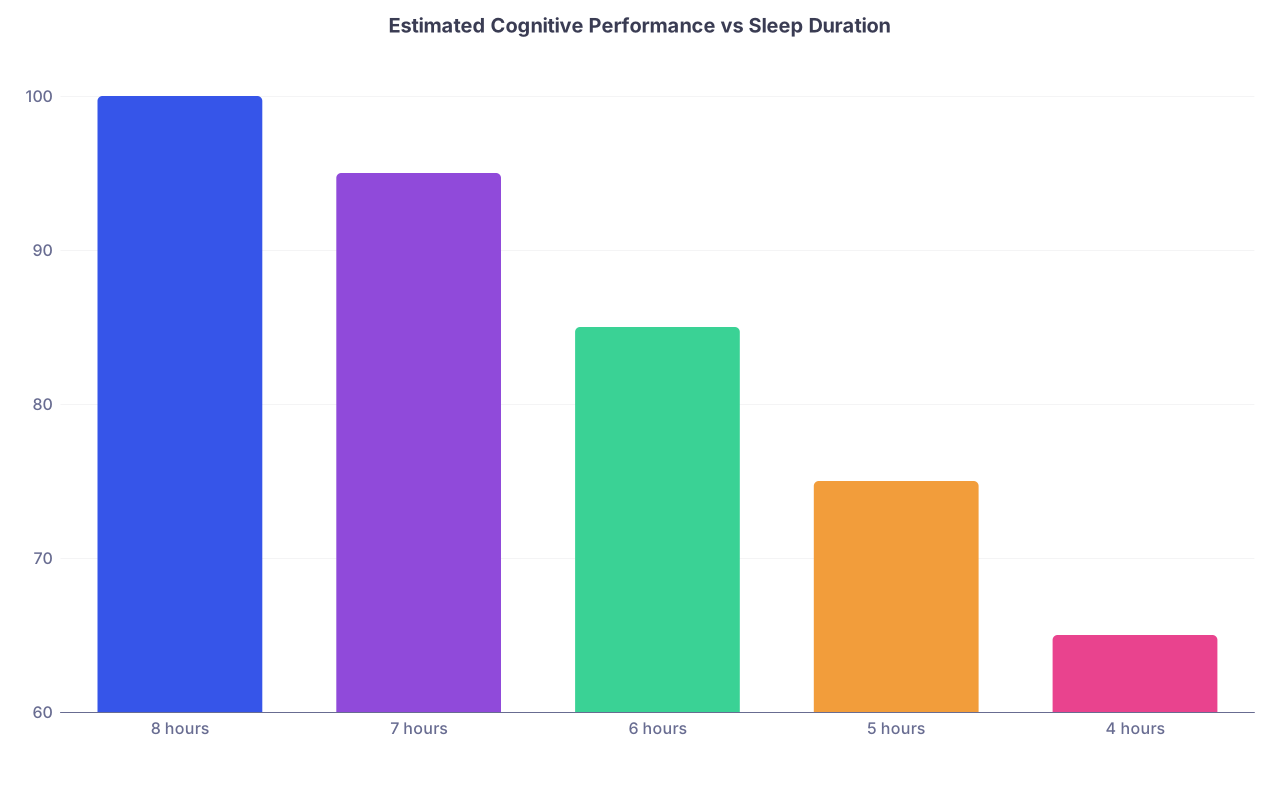
| Category | Value |
|---|---|
| 8 hours | 100 |
| 7 hours | 95 |
| 6 hours | 85 |
| 5 hours | 75 |
| 4 hours | 65 |
That’s a conceptual view, but it matches what real studies show: sharp drop-offs as you go below 7, then again below 6.
A few key findings from resident and sleep research:
- Staying awake 17–19 hours straight (classic overnight call) produces impairment similar to a blood alcohol level of 0.05–0.08. That’s borderline drunk.
- Performance after a single 24-hour call is worse on:
- Attention
- Working memory
- Psychomotor speed
- When residents cut sleep from ~7.5 hours to ~6 hours per night for a week:
- They felt “a bit tired”
- But objective testing showed major deficits, similar to pulling an all-nighter once
Regulators noticed this. That’s how we got the ACGME rules: 80-hour weeks, 16-hour max for interns (in some eras), 24+4 hour rules, etc. Imperfect, often ignored in spirit, but they’re built on the assumption that fatigue is a safety risk.
Does that mean if you stay under 80 hours you’re safe? Obviously not. You can stay under 80 hours and still get shattered sleep, nights, flipping schedules, and long commutes. Hours are a crude cap, not a guarantee.
So What’s “Safe Enough” in Real Residency Life?
You’re not getting textbook-perfect sleep. Let’s talk about realistic targets—what to actually aim for on different types of rotations.
1. Daytime, No Call Rotations (Clinic, lighter electives)
What you should aim for:
- 7–8 hours per night, consistently
- Fixed-ish sleep window (e.g., 11 pm–6 am or 10 pm–5:30 am)
If you’re on a “cush” rotation and still not getting 7 hours, something’s off. You’re overstudying, overcommuting, over-Netflixing, or over-volunteering.
This is where you bank sleep. Because the ICU month is coming.
2. Inpatient Days with Long Hours (e.g., 12–14+ hour shifts)
Realistic goal:
- 6.5–7.5 hours on most nights
- Absolute floor: 6 hours, and try not to dip below that more than 1–2 nights in a row
This is tight but usually doable if you’re ruthless about your post-work routine. What kills you here is the “just one episode / just 30 minutes of scrolling” at midnight.
3. Traditional 24-Hour Call or 24+4 (where still used)
These are rough. The key is to think in 48-hour windows, not individual days.
Your goal over 48 hours:
- Total of 14–16 hours of sleep across pre-call, call (naps), and post-call recovery
Example “safe-ish” pattern:
- Pre-call night: 7–8 hours (non-negotiable)
- On-call: 1–3 hours of fragmented sleep if possible
- Post-call: 3–4-hour nap + 6–7 hours that night
If you walk into call already sleep-deprived, you’re stacking risk.
4. Night Float
Here the target is 7–8 hours per 24 hours, even if moved to the daytime.
A solid pattern is:
- Get home around 9 am
- Wind down quickly
- Asleep by 10 am
- Sleep until 4–5 pm (6–7 hours)
- Optional 60–90 minute nap before shift if you run short
The trap: treating post-night-float downtime like “real daytime life” and cutting your sleep short so you can “do things.” That’s how you quietly lose 1–2 hours of sleep per day and feel progressively more wrecked by the end of the block.
What Happens When Residents Consistently Sleep Too Little?
Let’s list it cleanly, because this is where “I’m fine” usually dies.
| Domain | What You Actually See |
|---|---|
| Clinical Care | More charting errors, missed orders |
| Diagnostics | Anchoring bias, slower reconsideration |
| Procedures | Slower, more failed attempts |
| Mood | Irritability, emotional volatility |
| Learning | Poor retention, weaker test scores |
You don’t notice this from inside your own head. But the system does:
- Attendings say, “You seem off.”
- Nurses double-check your orders more.
- Co-residents quietly stop asking you for help at 3 am.
This isn’t a moral failing. It’s your brain under-resourced.
How to Protect Yourself When Full Sleep Isn’t Possible
You’re still in residency, not fantasyland. So here’s the pragmatic side: how to get “enough” sleep to be safe most of the time when your schedule is garbage.
1. Treat sleep like a procedure with a checklist
Same way you don’t wing a central line, don’t wing your sleep.
Your “sleep protocol” should include:
- Fixed target sleep window whenever possible
- Digital cutoff time (e.g., no phone after 30 minutes in bed)
- Pre-sleep routine: shower, light snack, something calming
- Room environment: dark, cool, quiet, blackout curtains, earplugs if needed
This sounds basic. It’s not. It’s cognitive offloading so that when you’re tired, you don’t need willpower to do the right things.
2. Use naps strategically
Naps are not a weak move in residency. They’re survival tools.
Best use cases:
- Pre-call: 60–90 minutes before a 24-hour shift if your previous night was short
- On-call: 20–30-minute power naps between pages if the floor is quiet
- Night float: short nap before the shift if your daytime sleep was fragmented
Avoid 2–3-hour naps late in the post-call day that wreck your ability to sleep that night. Post-call, either:
- Take a short nap (60–90 minutes) then go to bed early
- Or skip the nap, go to bed very early, and sleep 9+ hours
3. Don’t sacrifice sleep for “productivity” every day
Yes, you need to study. Yes, you have notes to write. But if your choice for the third day in a row is:
- 2 hours of studying, 5.5 hours of sleep
- Or 30–45 minutes of focused studying, 7 hours of sleep
Pick the second. Every time. A slightly less-studied but functional brain will learn better and be safer with patients than a thoroughly read but chronically wrecked one.
Dealing With Culture: When Your Program Glorifies Being Tired
You’ve heard the lines:
- “You can sleep when you’re an attending.”
- “We all did this; you’ll be fine.”
- “If you can’t hack 28-hour calls, maybe this isn’t for you.”
Most of that is insecurity, tradition, and bad role-modeling.
Your counter-strategy isn’t to lecture people on sleep science. It’s quieter:
- Protect your sleep windows without fanfare
- Don’t brag about being destroyed or pulling heroic no-sleep shifts
- Normalize comments like, “I’m signing out and getting some sleep so I’m safe tomorrow”
- Back co-residents who prioritize sleep reasonably
You’re not going to fix the culture alone. But you can stop actively feeding it.
Red-Flag Situations: You’re Too Tired to Be Safe
There are times when you need to stop pretending you’re fine and actually act.
Huge red flags:
- You almost fall asleep driving or can’t remember parts of the commute
- You catch yourself writing nonsensical notes or orders
- You’re double-reading the same vitals or labs and still not processing them
- You’re having repeated small errors (wrong patient, wrong time, missed sign-outs)
- You feel like you’re floating outside your body on rounds
When that happens:
- Tell a co-resident or chief: “I’m more wiped than I should be; I need a quick 20–30-minute reset.”
- Ask for help on high-risk tasks (codes, procedures, complex orders).
- If you’re post-call and can’t safely drive, don’t drive. Sleep in a call room or ask someone to drive you.
No patient benefits from you powering through with a brain that’s essentially drunk.
The Short Answer You’re Looking For
You want a number. Here it is.
If you’re a resident who wants to function safely:
- Aim for 7–8 hours of total sleep per 24 hours whenever your schedule allows.
- Do not make a habit of going below 6 hours per 24 hours. One night is survivable; several in a row is where real risk starts.
- On heavy or call rotations, think in 48-hour blocks and make sure you total at least 14–16 hours across those two days.
You won’t hit this perfectly. No one does. But if you use it as your baseline standard instead of pretending 4–5 hours is “just how residency is,” you’ll make better choices—about studying, about post-call plans, about saying no.
Bottom line:
- Your brain needs 7–8 hours to be reliably sharp; 6 hours is the bare minimum, not the goal.
- Chronic sleep loss quietly wrecks your judgment, mood, learning, and patient safety—even when you feel “used to it.”
- You can’t control the schedule, but you can control how aggressively you protect sleep around it. Treat it like part of your job, because it is.