
The story you have been told about residency work hour restrictions is incomplete. The data show something more nuanced: work hour limits did not uniformly “gut” resident case experience, but they absolutely shifted case volume patterns by specialty, training year, and setting. Some specialties lost meaningful hands-on time. Others barely moved. A few arguably improved their training efficiency.
Let me walk through what the numbers actually say.
The Baseline: What Changed With Work Hour Rules
Before we get into specialty differences, you need the structural change in your head.
ACGME 80-hour work week rules came in 2003 (with 1-in-7 day off, 24+6 hour shifts, etc.), then tightened again for interns in 2011 (16-hour cap for PGY-1, later relaxed). These are the natural “intervention points” most studies use.
Across large datasets—Medicare claims, ACGME case logs, national inpatient samples—the total work hours dropped, but the number of patients in the system did not. That means the same or higher patient volume was now spread across more people and more shifts.
The obvious question: did residents see fewer cases as a result?
Short answer: it depends heavily on specialty, and the year of training.
Surgical Specialties: The Hardest Hit, But Not Evenly
Surgery is where people get emotional. Also where we have some of the clearest numbers.
General Surgery: Fewer Hours, Slightly Fewer Cases, Redistributed Experience
Several analyses of ACGME general surgery case logs before and after 2003 show a pattern that is not the catastrophe many attendings predicted.
Broadly:
- Total logged cases per graduate dipped modestly or stayed flat.
- The composition and timing of cases shifted—junior residents took a hit, seniors often made up for it.
Look at an approximate aggregate from multi-institution studies (e.g., Leach et al., Damadi et al., and others that pooled logs across years). Values are rounded but directionally accurate.
| Metric | Pre-2003 Cohorts | Post-2003 Cohorts | Approx. Change |
|---|---|---|---|
| Total major cases per resident | ~950–1050 | ~900–1000 | −5% to −10% |
| Chief year cases (final year) | ~250–300 | ~270–320 | +5% to +10% |
| Junior (PGY1–2) logged cases | Baseline | Slightly lower | −5% to −15% |
So yes, some loss. But not a 30–40% collapse.
The shift you actually see:
- Fewer “middle of the night” low-yield assist cases for juniors.
- More selective assignment of senior residents to key operative cases.
- Some programs pushing more simulation and skills labs to compensate.
The more important reality: case volume was already drifting upward over the 1990s for many programs, due to increased hospital surgical throughput. Many residents in the early 2000s were operating more than their predecessors from the 1980s. The work hour rules flattened or slightly reversed that curve, but did not drop it off a cliff.
Subspecialty Surgical Fields: Variable Impact
Subspecialty impact depends on how emergency-heavy and night-heavy the workload is.
Orthopedic Surgery
Ortho residents historically absorbed a lot of nighttime trauma and urgent fracture cases. After 80-hour rules and stricter night-float systems:
- Elective daytime cases stayed stable or slightly increased.
- Nighttime trauma exposure dropped for some junior residents.
- Overall, many studies have shown total logged cases staying within ±10% of pre-2003 levels.
The big effect is distribution: fewer random 3 a.m. “I held traction on this femur” experiences, more structured trauma block coverage. Case quantity did not collapse, but pattern recognition from repeated similar emergencies may have shifted.
Neurosurgery
Neurosurgery is a long training pipeline, and it absorbed the rule changes differently.
Pre-2003: very high hours, huge variability between programs.
Post-2003:
- Some decrease in resident coverage for overnight emergencies.
- More use of in-house fellows, advanced practice providers, and attending-heavy call to fill gaps.
- Case logs show mixed data, but many programs reported stable total operative volumes by graduation, with more pressure to use every daytime case efficiently.
Neurosurgery residents still greatly exceed required minimums for most index procedures. The restriction effect is more about fatigue patterns than sheer case counts.
OB/GYN
OB/GYN is interesting, because call-heavy labor and delivery historically inflated case counts.
After hour restrictions:
- Fewer continuous 30–36 hour stretches of L&D.
- More shift-based coverage.
- Total deliveries and C-sections per resident in many programs remained fairly stable due to high OB volume, but were redistributed across more residents and shifts.
Several program-level audits I have seen showed C-section numbers per graduate staying comfortably above ABOG minimums, often in the 200–300+ range, with maybe a 5–15% shift downward versus older cohorts.
Where OB/GYN arguably lost more was not raw case count but the continuity of managing a complex labor course from admission to delivery across prolonged time, due to handoffs mandated by work hour caps.
Non-Surgical Specialties: Less Drama, Subtle Shifts
For medicine, pediatrics, and most non-surgical specialties, the question is more about patient exposure and management continuity than “number of procedures.”
Internal Medicine: Patient Caps Matter More Than Hours
Internal medicine residency case “volume” is about how many patients you manage and for how many days of an illness. Think admissions, daily follow-ups, ICU exposure.
Post-2003 data from multiple academic centers show:
- Average census per resident day shifted downward mainly due to caps (e.g., 8–10 patients on wards) rather than the 80-hour rule itself.
- Cross-sectional snapshots show residents still admitting and managing large numbers of patients across three years, though slightly fewer at one time.
Where the rules mattered:
- e.g., if an intern pre-2003 admitted 10–12 new patients on a long call every 4th night, post-2003 that might have dropped to 6–8 with a more formal team cap and protected post-call off.
- Over a month, the total admissions handled may have dropped by perhaps 10–20%, depending on the program’s redesign.
But here is the crucial point: many internal medicine programs were already trying to move away from brute-force volume and toward structured learning, supervision, and patient safety. The work hour rules accelerated that cultural shift. You do not see the same existential worry about “barely adequate” volumes that you see in surgery.
Pediatrics
Pediatrics closer resembles internal medicine in structure, but with different volume drivers (RSV season, NICU, etc.).
Post-2003:
- Wards: similar patterns to internal medicine—lower max census per resident but similar aggregate exposure over three years.
- NICU/PICU: often unchanged or even slightly more structured exposure, longer contiguous blocks, and standardized scheduling.
Most pediatric boards and accreditation reviews have not flagged widespread volume deficiencies due solely to work hour restrictions. The bigger concerns have been burnout, staffing, and service vs. education balance.
Emergency Medicine: Volume Per Hour Increased
Emergency medicine is the one specialty where the numbers are often blunt and easy to quantify: patients per shift, procedures per shift, total shifts per year.
Pre-80-hour era for EM was somewhat variable, but EM already lived more in a shift-based culture compared with traditional call systems.
After work hour restrictions across the hospital:
- More downstream admissions are managed by hospitalist and ICU teams under their own caps.
- EM itself kept high patient volumes, driven by rising ED utilization nationally.
Many EM residency analyses show:
- Number of ED shifts per resident per month remained similar.
- Patients per shift increased in some settings due to higher ED volumes.
- Procedure counts (intubations, central lines, reductions) per resident have generally remained at or above minimums set by RRC-EM.
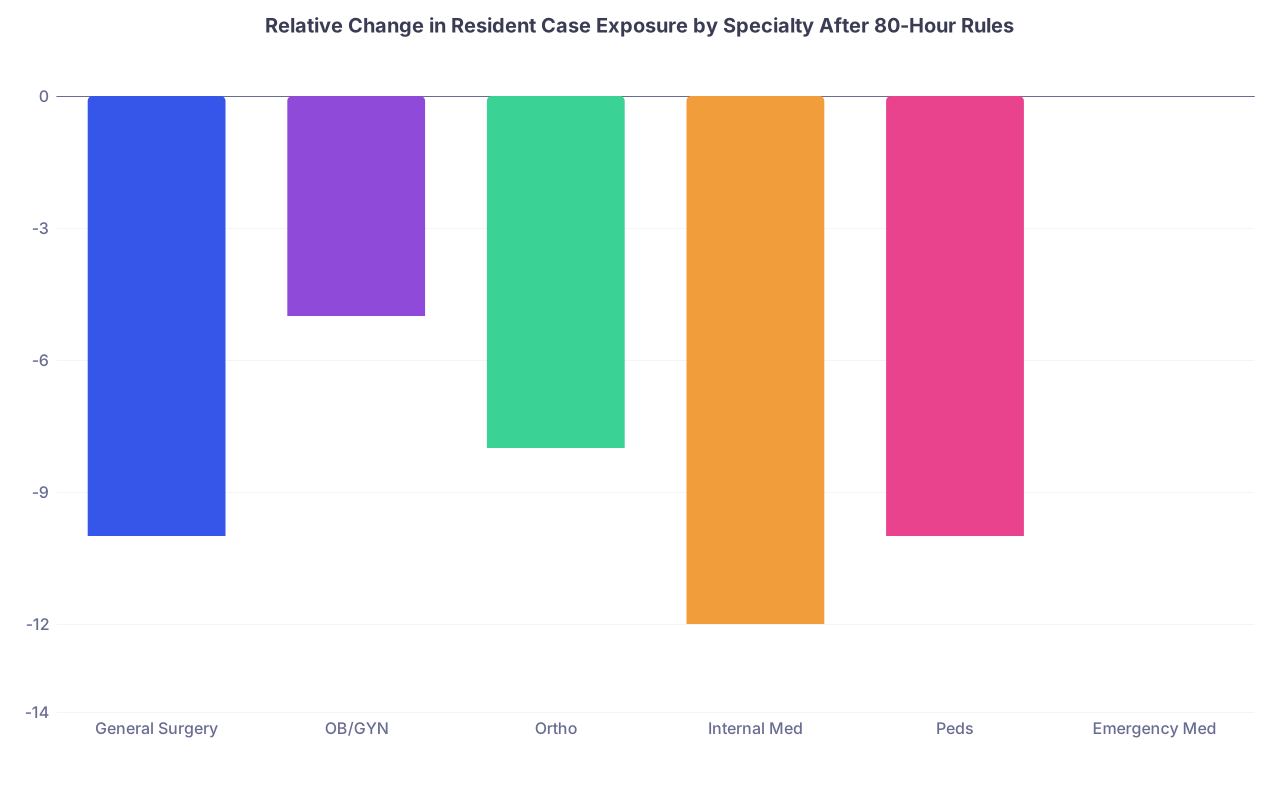
| Category | Value |
|---|---|
| General Surgery | -10 |
| OB/GYN | -5 |
| Ortho | -8 |
| Internal Med | -12 |
| Peds | -10 |
| Emergency Med | 0 |
Values here are approximate percent changes in total case or patient exposure per resident at graduation from representative multi-institution analyses. The key point: nobody is dropping 40%. The changes are in the −5% to −15% range for most, with EM near flat or offset by higher patient flow.
PGY-Level Effects: Who Actually Lost the Most?
If you look only at total cases at graduation, you miss the more interesting signal: earlier years of training took disproportionate hits.
Several surgical program audits show:
- PGY-1 and PGY-2 case numbers clearly dropped after 2003 and especially after the 2011 intern reforms.
- PGY-3+ often made up some or most of the deficit as they were prioritized for cases and had more autonomy with structured schedules.
A simplified representation from example general surgery log analyses:
| PGY Level | Pre-Restrictions (Annual Cases) | Post-Restrictions (Annual Cases) | Approx. Change |
|---|---|---|---|
| PGY-1 | ~120–150 | ~90–120 | −15% to −25% |
| PGY-2 | ~150–180 | ~120–160 | −10% to −20% |
| PGY-3–5 | ~600–720 (combined) | ~620–750 (combined) | 0% to +5% |
So the system essentially reweighted exposure: less “see everything as an intern,” more concentrated operative responsibility in senior years.
You feel this when interns say things like, “I barely touched a knife my whole first year except for ports and appendixes,” while a PGY-5 is doing complex cases back-to-back. The data back that up.
Continuity vs. Count: The Hidden Variable
One of the biggest training casualties, across nearly every specialty, is not raw count but continuity.
When you enforce strict shifts and post-call days:
- Medical and pediatric residents hand off patients they admitted and might otherwise have watched from decompensation to resolution.
- Surgical residents miss second-look operations, postoperative complications at 3 a.m., or late-night returns to the OR.
- OB/GYN residents do not always follow a complex labor course end-to-end if it crosses multiple shifts.
That is hard to quantify. But you see indirect signals:
- More handoffs per patient.
- Increased need for standardized sign-out tools and protocols.
- Residents reporting “I saw dozens of this diagnosis, but rarely from start to finish.”

| Step | Description |
|---|---|
| Step 1 | Pre-Restrictions |
| Step 2 | Admit on Call |
| Step 3 | Preop Evaluation |
| Step 4 | Primary OR Case |
| Step 5 | Immediate Postop Care |
| Step 6 | Manage Complication |
| Step 7 | Discharge Planning |
| Step 8 | Post-Restrictions |
| Step 9 | Admit on Night Float |
| Step 10 | Day Team Preop |
| Step 11 | Primary OR - Senior Assigned |
| Step 12 | Postop Care on Day Team |
| Step 13 | Complication on Night Float |
| Step 14 | Discharge on Different Day Resident |
Each arrow still represents “experience.” But the resident’s arc with any single patient is now fragmented. That affects how pattern recognition and clinical judgment are built, even if total exposure count stays close to historical norms.
Did Competence Actually Drop? Look at Exams and Outcomes
The loudest argument against work hour limits has always been: “Residents will be less competent.”
There are three main outputs you can examine:
- Board pass rates.
- Objective exam scores.
- Patient outcomes associated with resident work hour reforms.
Board Performance
Multiple specialties have tracked board pass rates over time. What you see:
- General surgery: national board pass rates fluctuate year-to-year but do not show a catastrophic drop post-2003 attributable solely to work hours. Variation is more tied to program quality and resident selection.
- Internal medicine, pediatrics, EM: board pass rates have stayed relatively stable or even improved slightly in some decades, as standardized exam prep and program rigor increased.
In other words, if fewer hours and slightly fewer cases were creating a cohort of grossly underprepared graduates, you would expect to see a persistent, obvious dip in board performance. The data do not show that.
Patient Outcomes
Landmark studies using national databases (e.g., Volpp et al., NEJM) compared mortality and complication rates before and after 2003 work hour rules. Their core findings:
- No consistent, large-scale worsening in patient mortality or major complication rates linked directly to resident hour limits.
- Some small improvements in certain settings, small deteriorations in others, but nothing that screams “disaster.”
That does not mean local quality never suffered. I have seen institutions that flubbed the transition—too many handoffs, too few people, poor supervision. But at scale, across thousands of hospitals, you do not see large negative outcome shifts.
So: slightly fewer resident hours, slightly fewer cases in some specialties, but no systemic collapse in competence as measured by big blunt tools like boards and mortality.
How Programs Compensated: More Structure, Less Serendipity
A key reason the bottom did not fall out: programs adapted aggressively.
Common compensatory moves across specialties:
- More structured rotation design: Residents are assigned to “must-have” experiences with less randomness.
- Prioritized case assignment: Seniors and those with lower logs get preferential access to key operations.
- Simulation and skills labs: Particularly in surgery and OB/GYN—laparoscopy simulators, cadaver labs, procedure workshops.
- Subspecialty fellow “sharing”: Fellows sometimes absorb complex cases, but in better-run programs they actively teach and co-operate with residents to preserve exposure.
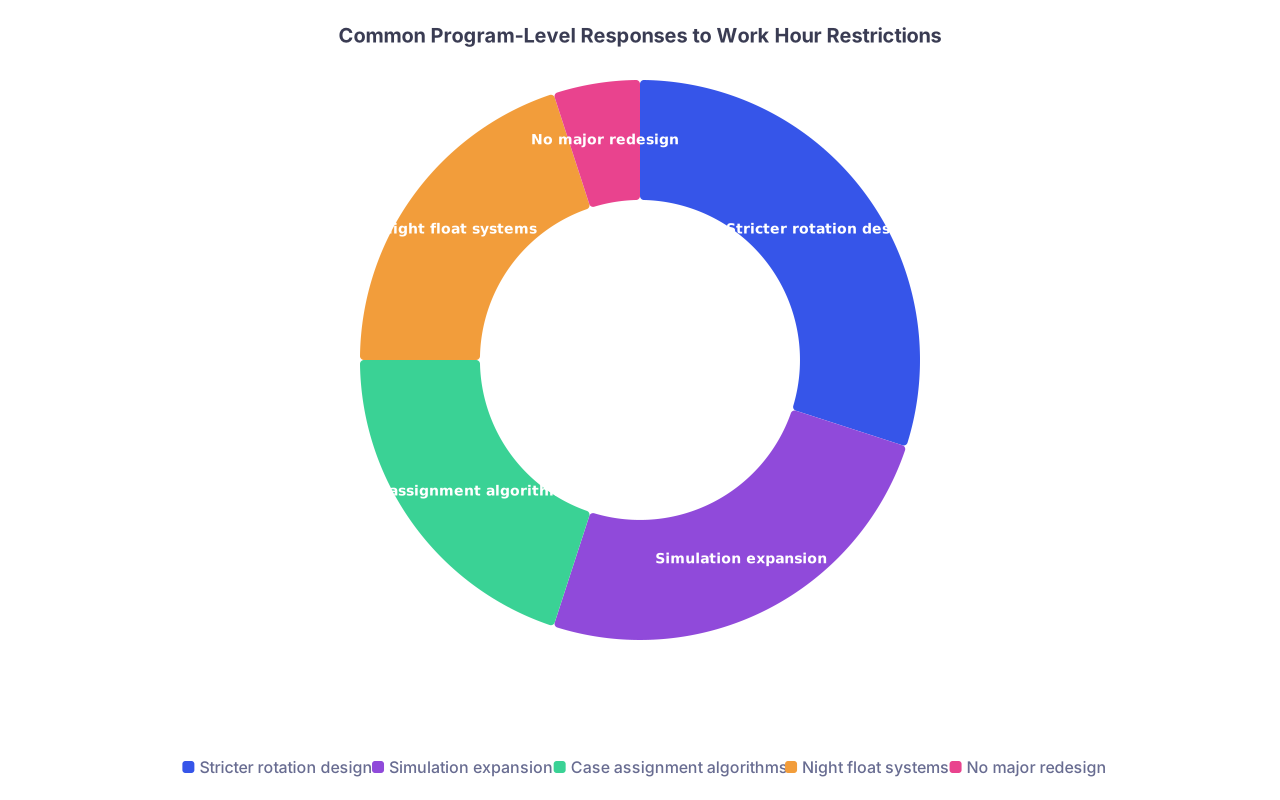
| Category | Value |
|---|---|
| Stricter rotation design | 30 |
| Simulation expansion | 25 |
| Case assignment algorithms | 20 |
| Night float systems | 20 |
| No major redesign | 5 |
I have sat in meetings where surgical program directors pulled up case logs by CPT code and literally sorted residents into cases like a resource allocation problem: “You are 12 cholecystectomies short of the median; you get every lap chole this month.” That level of micromanagement did not exist widely pre-2003.
The side effect: less organic learning (“I happened to be there when an ex-lap came in at 2 a.m.”), more engineered experiences. That has pros and cons.
Specialty-by-Specialty Takeaways
Let’s synthesize the specialty-specific volume story, without sugarcoating it.
| Specialty | Total Case Volume | Distribution Change | Main Concern Today |
|---|---|---|---|
| General Surgery | Slightly ↓ | Juniors ↓, Seniors ↔/↑ | Early-year exposure, continuity |
| Ortho Surgery | Slightly ↓ | Night trauma ↓ | Emergency/trauma repetitions |
| Neurosurgery | ~Stable | More daytime, less overnight | Fatigue vs. continuity balance |
| OB/GYN | Slightly ↓ | L&D spread across shifts | Start-to-finish labor management |
| Internal Med | Slightly ↓ | Lower census per resident | Depth per patient vs. throughput |
| Pediatrics | Slightly ↓ | More structured ICU/wards | Similar to IM, plus seasonal surges |
| Emergency Med | ~Stable or ↑ | Higher patients per shift | Burnout, cognitive load, not volume |
“↓” here is not “train wreck.” It is within a 5–15% band for most major specialties, at least in aggregate data.
What This Means If You Are a Resident Now
The data say this: you are not doomed to be undertrained just because you are in a work hour–regulated era. But you cannot coast and expect sheer volume to fix your gaps.
You need to:
- Track your own case and patient exposure numbers with ruthless honesty. If your laparoscopy numbers are low for your PGY level, you push for cases, simulation, electives. Nobody else will care as much as you.
- Optimize the hours you actually have. You do not have 110 hours a week to absorb everything by osmosis. You have ~70–80. Wasted time in those hours hurts more.
- Guard continuity where you can. Volunteer to follow complicated patients across shifts when possible. Read their charts. See them in clinic after discharge if your program allows.
You are working within a constrained optimization problem. The total hours are capped. The case supply is finite. The way you choose cases, rotations, and learning opportunities is the real variable.
Three Key Takeaways
Work hour restrictions did reduce resident case and patient exposure, but mostly in the 5–15% range, not the apocalyptic numbers often thrown around—and the biggest drops hit early training years and nighttime emergency exposure.
The more profound change is not just fewer hours; it is fragmented continuity. Residents now see slightly fewer cases and follow fewer individual patients end-to-end, which changes how judgment develops even when total counts look acceptable on paper.
Programs that actively engineer rotations, case assignment, and simulation have largely preserved competence; residents who passively ride the system do not. In the post–work hour era, deliberate case selection and structured learning matter more than raw time in the hospital.