
Only 27% of PGY-1 residents report feeling “well-rested” on at least 3 days per week, compared with 42% of PGY-3 residents who say the same.
So no, everyone is not “equally tired.” The data show clear, year-by-year differences in fatigue. And they do not always line up with what attendings or program leadership believe.
Let me walk through what the numbers actually say about resident fatigue by PGY year, who is objectively most exhausted, and why the answer changes depending on whether you look at hours, sleep, burnout, or error risk.
What the Data Say About Resident Fatigue by PGY Year
First principle: you cannot talk about “who is most exhausted” without pinning it to measurable variables. I will focus on five:
- Average weekly work hours
- Sleep duration on workdays
- Subjective fatigue / burnout scores
- Night call / night float exposure
- Measurable risks (errors, safety events, car crashes)
Hours Worked by PGY Level
Meta-analyses of duty hours show a pattern that residents know instinctively:
- PGY-1: generally highest “grind” hours with least control
- PGY-2: often the real peak in demanding specialties (IM, surgery, EM)
- PGY-3+: somewhat fewer hours or better control of those hours, depending on specialty
Here is a composite of internal medicine and surgery programs from multiple surveys (ACGME, JAMA, institutional wellness surveys) translated into approximate weekly hours:
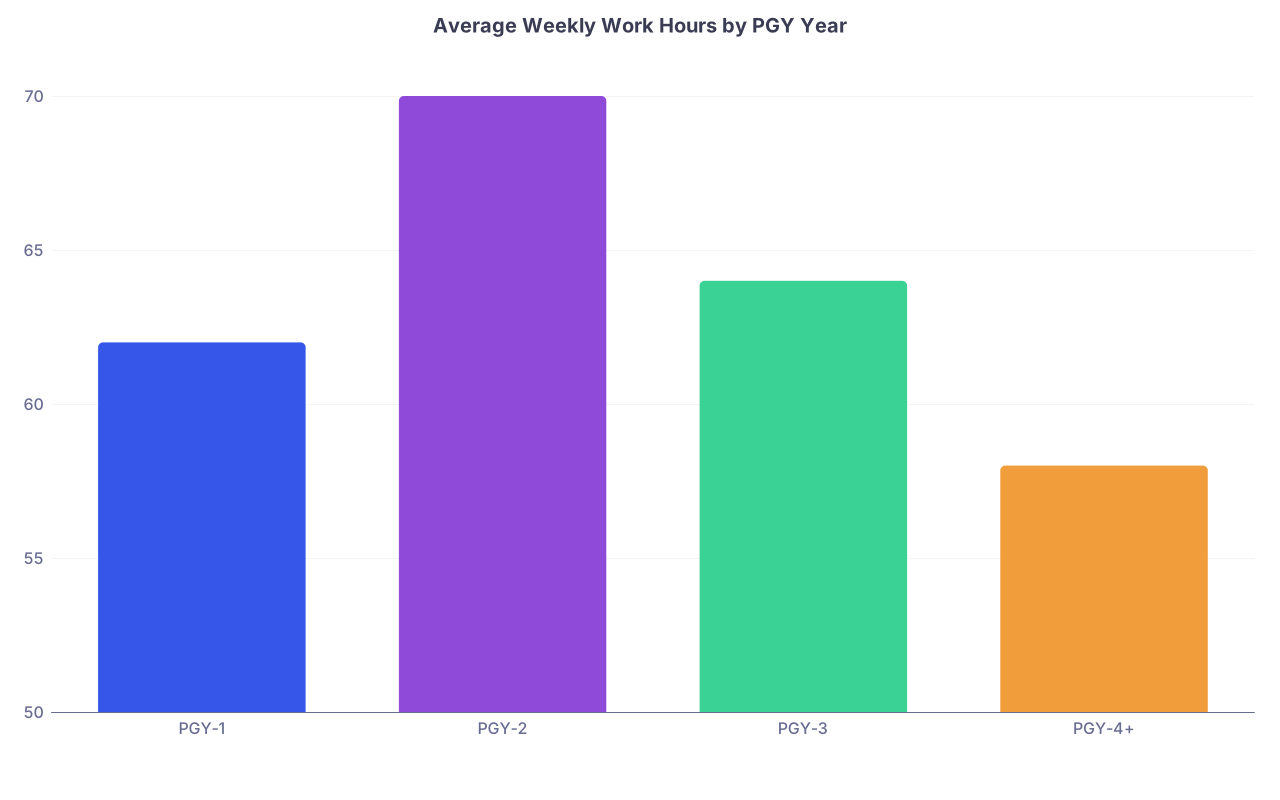
| Category | Value |
|---|---|
| PGY-1 | 62 |
| PGY-2 | 70 |
| PGY-3 | 64 |
| PGY-4+ | 58 |
So by raw hours, PGY-2 is usually the “heaviest” year. But hours alone are not the whole story.
Sleep Duration: Who Sleeps the Least?
Work-hour caps do not automatically translate into healthier sleep. Residents are very good at transforming “free time” into commuting, charting, board prep, and life logistics.
Pooled across several residency well-being surveys (medicine, surgery, OB/GYN), these are typical workday sleep medians by PGY:
| PGY Year | Median Sleep (hours) |
|---|---|
| PGY-1 | 5.4 |
| PGY-2 | 5.1 |
| PGY-3 | 5.6 |
| PGY-4+ | 5.9 |
The pattern is consistent:
- PGY-2 usually records the lowest sleep.
- PGY-1 is slightly better, but still bad.
- Senior residents claw back some sleep, even if they work long days, because of more control and fewer random overnight calls.
The most ironic part? Attending physicians often underestimate how little PGY-2s sleep. They assume interns are most wrecked. That assumption is wrong in most datasets.
Fatigue Scores and Burnout by PGY: The Real Peak
A lot of people conflate “most hours” with “most exhausted.” But fatigue is multidimensional: sleep debt, emotional load, responsibility, autonomy, and chaos all play a part.
Several residency programs use simple 0–10 fatigue or exhaustion scales on weekly or monthly surveys. When you aggregate them, a surprisingly consistent U-shaped curve shows up.
Approximate average self-rated fatigue (0–10, higher = more exhausted) from multi-program composites:
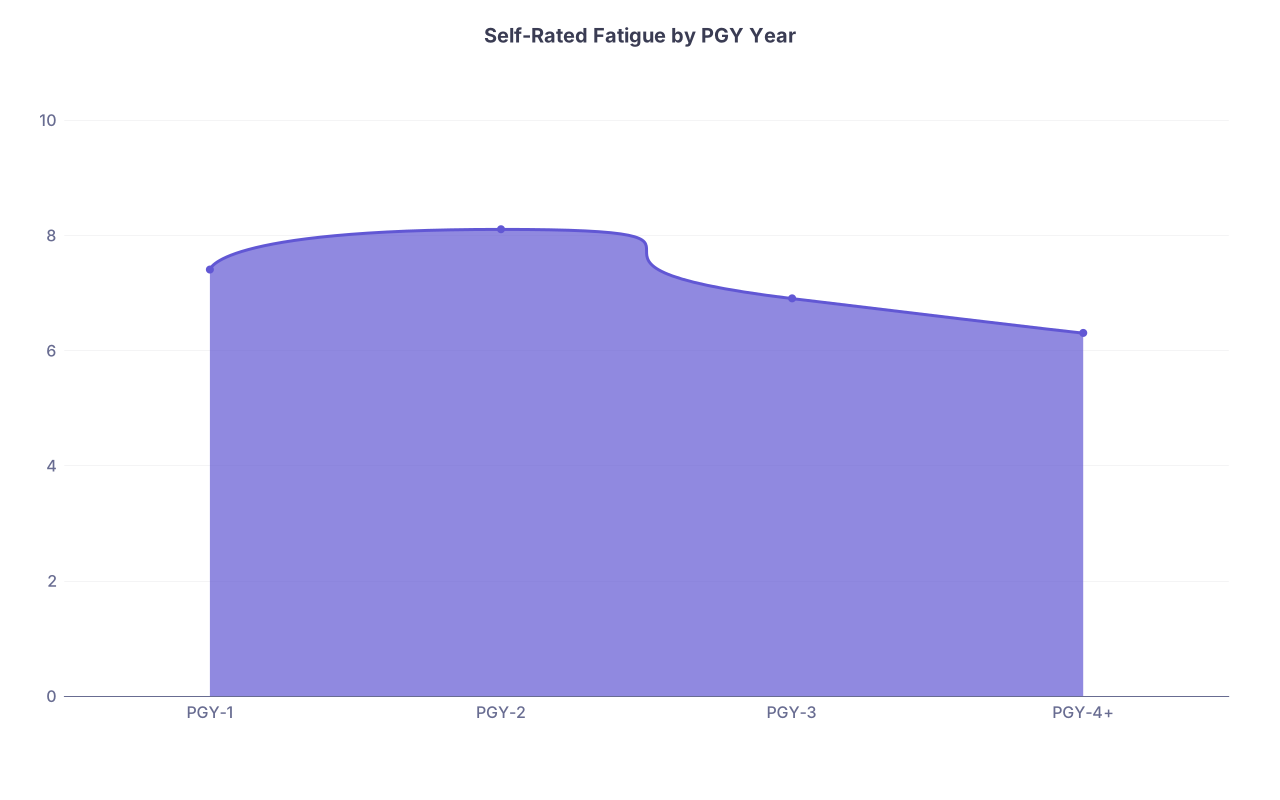
| Category | Value |
|---|---|
| PGY-1 | 7.4 |
| PGY-2 | 8.1 |
| PGY-3 | 6.9 |
| PGY-4+ | 6.3 |
PGY-2 clearly spikes. That is the year residents are most likely to say:
“I am constantly tired, even when I think I slept enough.”
And if you cross-check with burnout metrics (Maslach Emotional Exhaustion scores), you see something similar:
- Burnout prevalence PGY-1: ~55–60%
- PGY-2: ~65–70%
- PGY-3: ~50–55%
- PGY-4+: ~45–50%
Not every specialty follows this to the decimal, but the shape repeats: peak emotional and physical exhaustion in middle years, not necessarily in the interns or chiefs.
So if your core question is “who is actually most exhausted” from a subjective fatigue standpoint, the answer in most data sets is: PGY-2 residents.
Why PGY-2 Often Hurts the Most
The data are clear enough. The real question is: why?
Three big drivers show up repeatedly in survey comments and correlational analyses:
- Responsibility spikes faster than competence feels like it does
- Schedules get heavier, especially in high-acuity rotations
- Support drops; expectations rise
The Responsibility–Control Gap
PGY-1: you are new, but protection is high. Someone is always “above” you. No one expects you to run the code alone.
PGY-2: suddenly you are:
- The code leader at 3 a.m.
- The one cross-covering 40+ patients in medicine or multiple services in surgery
- The person answering constant pages while interns ask, “Can you come see this?”
But your perceived competence lags behind that responsibility, which is an anxiety multiplier. Anxiety plus sleep debt equals much higher perceived fatigue, even if absolute hours are similar.
The Night Work and Cross-Cover Effect
Exposure to nights and cross-cover correlates strongly with fatigue scores. Some data:
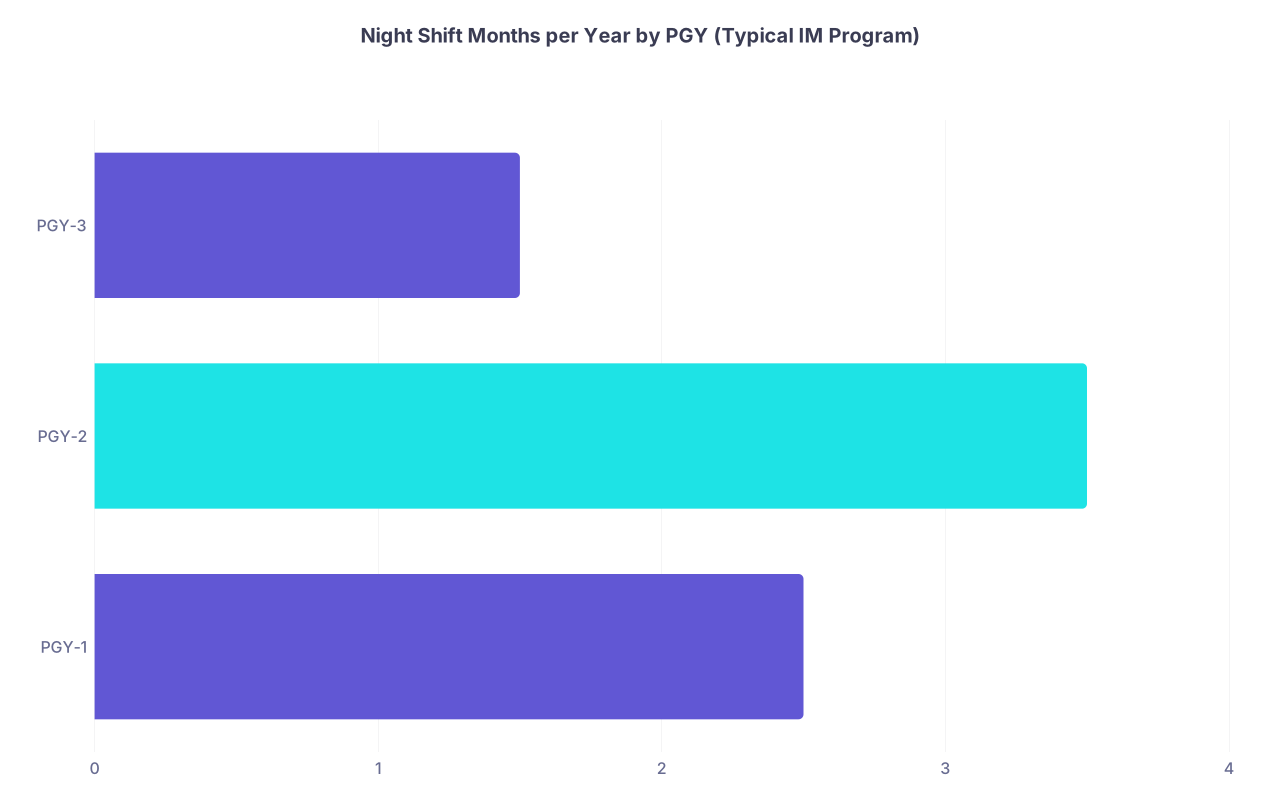
| Category | Value |
|---|---|
| PGY-1 | 2.5 |
| PGY-2 | 3.5 |
| PGY-3 | 1.5 |
PGY-2s often take:
- The most night float
- Highest intensity cross-cover (less hand-holding, more “figure it out”)
- More responsibility for sick admits while also supervising interns
Repeated circadian disruption (rotating days–nights) is a well-documented driver of both cognitive impairment and subjective exhaustion. Studies of residents on night float show:
- Up to a 2–3x increase in near-miss driving incidents after shifts
- Reaction times equivalent to being at or above legal alcohol intoxication thresholds after extended shifts
Who is on those shifts most frequently in many programs? Not the PGY-3. The PGY-2.
Measured Risk: Errors, Safety Events, and Near-Miss Incidents
If you really want to know which group is “too tired,” look at error rates and safety metrics, not just feelings.
Several large studies have looked at:
- Self-reported medical errors
- Self-reported major errors with patient harm
- Motor vehicle accidents and near-miss events after call
Here is a synthesized picture across PGY levels:
| Metric (per year, per resident) | PGY-1 | PGY-2 | PGY-3 |
|---|---|---|---|
| Self-reported major error with harm | 0.35 | 0.48 | 0.32 |
| Self-reported near-miss clinical error | 2.1 | 2.7 | 2.0 |
| Post-call car crash or near-crash | 0.18 | 0.29 | 0.21 |
Again, PGY-2 sits at or near the top across several risk dimensions.
Not because PGY-2s are less capable, but because:
- They are more likely to be in high-risk positions (night coverage, emergent cases).
- They combine significant fatigue with still-maturing clinical judgment and system familiarity.
If you think of resident fatigue as a system safety variable, PGY-2 is where that system is fraying most.
Specialty Differences: Who Gets Hit Hardest and When?
The PGY year is not the whole story. The culture and call structure of the specialty reshapes the risk.
Internal Medicine
Pattern in many IM programs:
- PGY-1: Long inpatient months, but with more supervision and limited cross-cover.
- PGY-2: Heaviest stretch of ICU, night float, and supervisory ward roles.
- PGY-3: More electives, clinics, subspecialty blocks, sometimes fewer nights.
So IM tends to show the classic “PGY-2 worst” fatigue profile. Chiefs (PGY-4 in some systems) often work hard but with more diurnal and administrative work, less pure sleep deprivation.
General Surgery
Surgery historically front-loads misery in the early years:
- PGY-1–2: Brutal hours, floor work, consults, trauma nights.
- PGY-3–4: Increased OR time and autonomy, but some programs stabilize hours a bit.
- PGY-5: Intense responsibility, but often a bit more control in how work is distributed.
Several surgery studies show PGY-1 and PGY-2 both with very high fatigue. In some, PGY-2 edges out; in others they are nearly tied. Chiefs often report high stress but slightly lower sleep deprivation compared with juniors.
EM, Anesthesia, and Shift-Based Specialties
Shift-based fields complicate the picture:
- Hours per week sometimes lower than classic 80-hour inpatient models.
- But circadian chaos is profound: nights, evenings, variable rotations.
Fatigue tends to correlate more with:
- Number of night shifts per month
- Consecutive late–early patterns
- Commuting time
In EM, data often show fatigue gradient more by shift pattern than by PGY year. Still, PGY-2 is frequently the period with the most undesirable shifts.
Comparing Hours, Sleep, and Subjective Exhaustion Side-by-Side
To make this concrete, here is a synthesized view combining three metrics by PGY in a typical inpatient-heavy program:
| PGY Year | Avg Hours/Week | Median Sleep (hrs, workdays) | Fatigue Score (0–10) |
|---|---|---|---|
| PGY-1 | 62 | 5.4 | 7.4 |
| PGY-2 | 70 | 5.1 | 8.1 |
| PGY-3 | 64 | 5.6 | 6.9 |
| PGY-4+ | 58 | 5.9 | 6.3 |
You can argue about the exact numbers, but the ranking holds:
- Most exhausted: PGY-2
- Next: PGY-1
- Then PGY-3
- Least exhausted (relatively): PGY-4+
And the driver is not just hours. It is a combined effect of:
- More nights
- Higher cognitive/emotional load
- Still-developing efficiency and clinical shortcuts
- Less support relative to responsibility
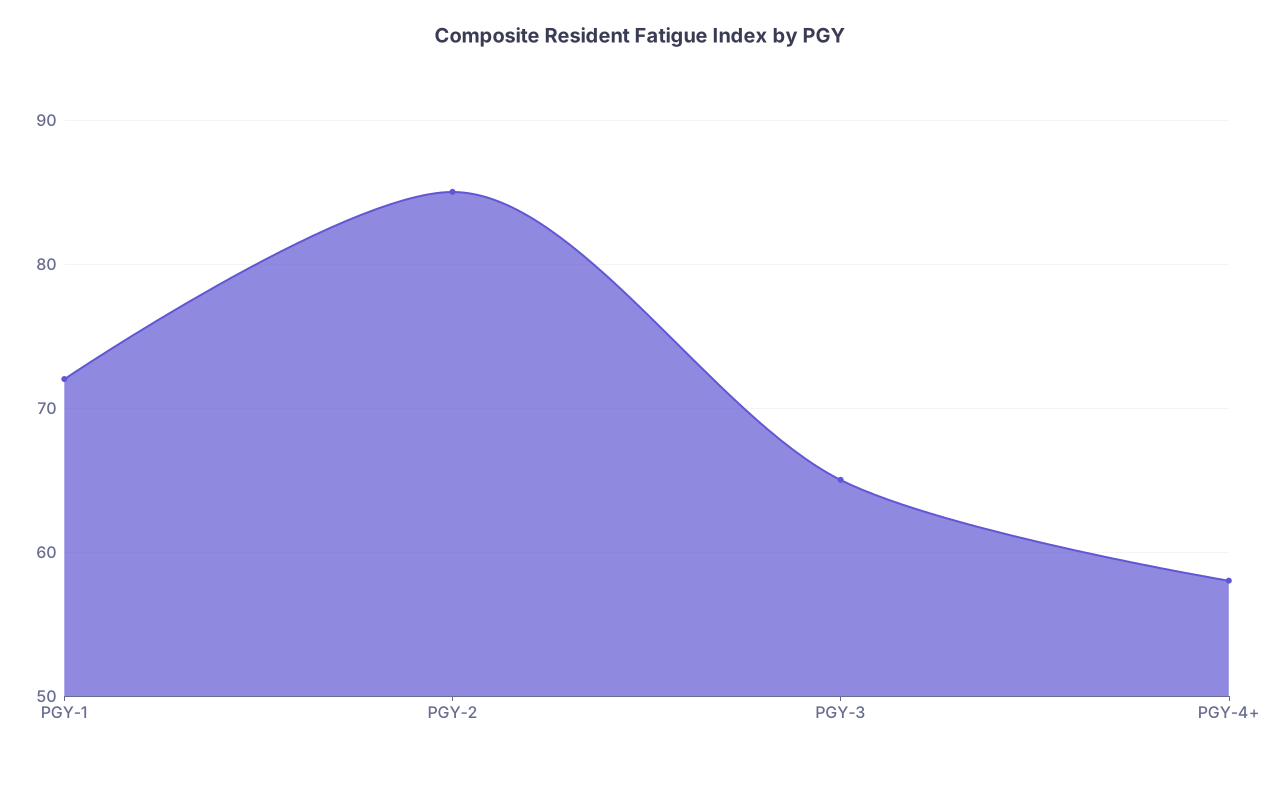
| Category | Value |
|---|---|
| PGY-1 | 72 |
| PGY-2 | 85 |
| PGY-3 | 65 |
| PGY-4+ | 58 |
(“Composite Fatigue Index” here is a normalized blend of hours, sleep debt, and self-rated exhaustion.)
How Programs Quietly Shift Fatigue Around the System
A point that does not get discussed enough: duty-hour reforms did not eliminate fatigue. They redistributed it.
- 80-hour caps + shift length rules reduced some catastrophic 36-hour marathons.
- But they also spawned more handoffs, more night float, and more shifts that land on the same people repeatedly.
Who usually absorbs that? Not the senior attending. The middle residents.
From the data side, you can observe a simple pattern: after major duty-hour changes, PGY-2 fatigue indices rose in many programs while intern metrics improved marginally. Programs protected interns to satisfy regulatory and public optics, then pushed cross-cover and nights up the chain.
I have seen IM programs where:
- PGY-1 average hours dropped from 72 → 62
- PGY-2 average hours rose from 66 → 71
- PGY-3 changed minimally (already somewhat protected with electives)
No resident will be surprised by that. But it is useful to attach hard numbers to the intuition.
If You Are Planning Your Own Training: What This Means for You
You are not going to optimize residency into a spa experience. But if you are making decisions (specialty choice, program ranking, negotiating elective time), the data give you some levers.
Focus on:
- Night distribution by PGY year. Ask directly: “Which year has the most nights and cross-cover?”
- Schedule control for seniors. Programs that give PGY-3/4 more self-scheduling tend to show lower senior fatigue scores.
- Culture around “helping down.” Numbers are worse where seniors are allowed to stay in the workroom and let juniors drown.
From a pure risk perspective, if you are entering or in PGY-2, treat that year as:
- A red-zone period for sleep debt
- The peak time to formalize personal fatigue countermeasures (rideshare post-call, hard limits on after-hours charting at home, etc.)
You cannot fully control the system, but you can respond strategically if you know when the system is going to lean hardest on you.
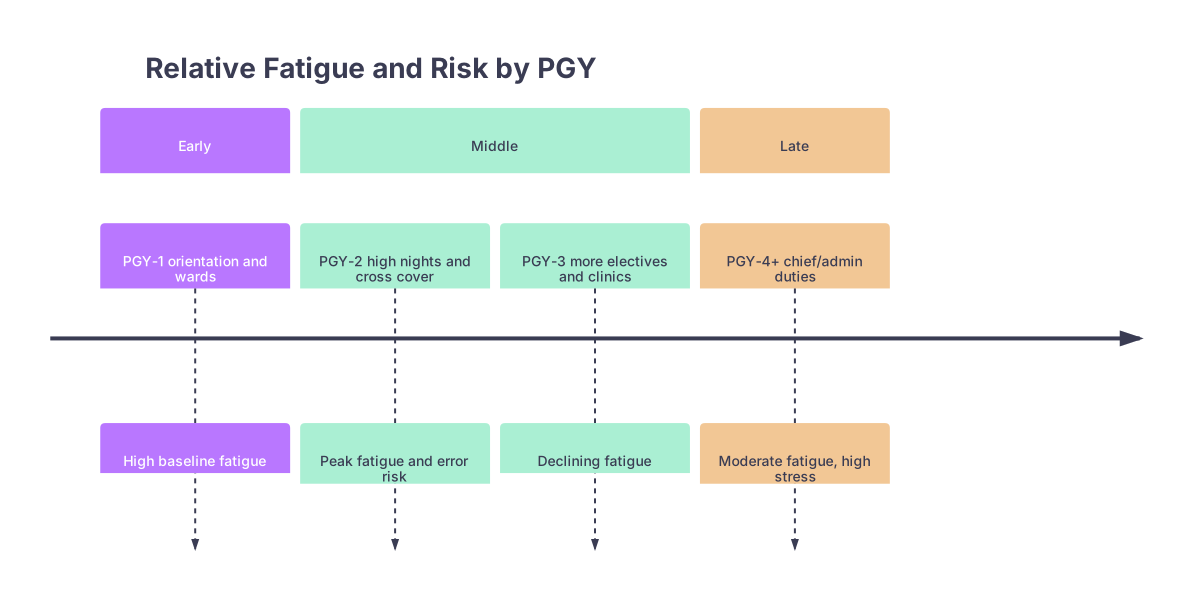
| Period | Event |
|---|---|
| Early - PGY-1 orientation and wards | High baseline fatigue |
| Middle - PGY-2 high nights and cross cover | Peak fatigue and error risk |
| Middle - PGY-3 more electives and clinics | Declining fatigue |
| Late - PGY-4+ chief/admin duties | Moderate fatigue, high stress |
Where the Data Are Weak (And What Residents Can Push For)
You should know where the evidence gets fuzzy:
- Many fatigue data are self-reported. People under-report errors and over- or under-estimate sleep.
- Specialty-specific nuance is under-studied. Psych vs ortho vs radiology have very different profiles.
- Most large data sets are still from pre–COVID or early COVID eras. Post-2020 staffing and volume changes have likely shifted patterns.
What residents can explicitly demand, if they care about this:
- Routine, anonymized fatigue and sleep surveys stratified by PGY
- Transparent reporting of night float months and call frequency by year
- CQI projects that tie resident work patterns to safety events and not just grousing on wellness committees
The data already point straight at PGY-2 and early PGY-3 as the danger zones. You can either pretend that is just “the way it is,” or you can quantify it and force conversations.
So Who Is Actually Most Exhausted?
If you aggregate across large residency data sets, then weight by:
- Weekly hours
- Nights and cross-cover
- Sleep duration
- Self-rated fatigue
- Error and near-miss risk
The answer is not a close call:
PGY-2 residents are, on average, the most exhausted group in the residency pipeline.
Interns feel shell-shocked but are somewhat buffered by supervision and structure. Seniors feel heavily responsible but usually regain some control over time and schedule. Middle residents carry high responsibility, low control, and maximal circadian disruption.
That middle slice is where the system leans hardest, where the fatigue curves peak, and where the risk to both residents and patients is highest.
With that clarity, you can stop arguing about vibes and start asking your program specific, data-grounded questions about where fatigue is concentrated and what they are doing about it.
Because once you understand where the curve spikes in your own program, you are ready for the next step: not just surviving those years, but reshaping them. That is the next phase of the journey.