
The debate over night float versus 24‑hour call is not philosophical. It is empirical. The data are in, and they are not subtle.
The core question: what actually changes with night float?
Residency programs talk endlessly about “culture” and “education,” but when you strip out the anecdotes, you are left with a few quantifiable outcomes:
- Resident sleep and fatigue
- Patient safety events and errors
- Educational exposure and continuity of care
- Burnout, depression, and attrition
- Objective performance (board exams, in‑training exams)
The literature comparing night float and 24‑hour (or longer) call spans internal medicine, surgery, pediatrics, OB/GYN, and EM. Different designs, different eras, different ACGME rules. But the patterns are remarkably consistent.
Let’s define terms in data‑friendly language:
- “Traditional” 24‑hour call: often 24–28 consecutive hours in hospital, every 3–4 nights; sometimes q5–q7 in smaller or more regulated programs.
- Night float: a dedicated night team (or resident) working repeated night shifts (commonly 5–7 nights in a row) with no daytime clinical duties that same day.
From a measurement standpoint, the key difference is continuous wakefulness. 24‑hour call routinely produces 18–30 hours of continuous wake time. Night float can; but does not have to, depending on how the schedule is built and whether the resident can sleep during the day.
What the numbers say about sleep, fatigue, and performance
The data on sleep is the least controversial. It is brutal.
Across multiple studies:
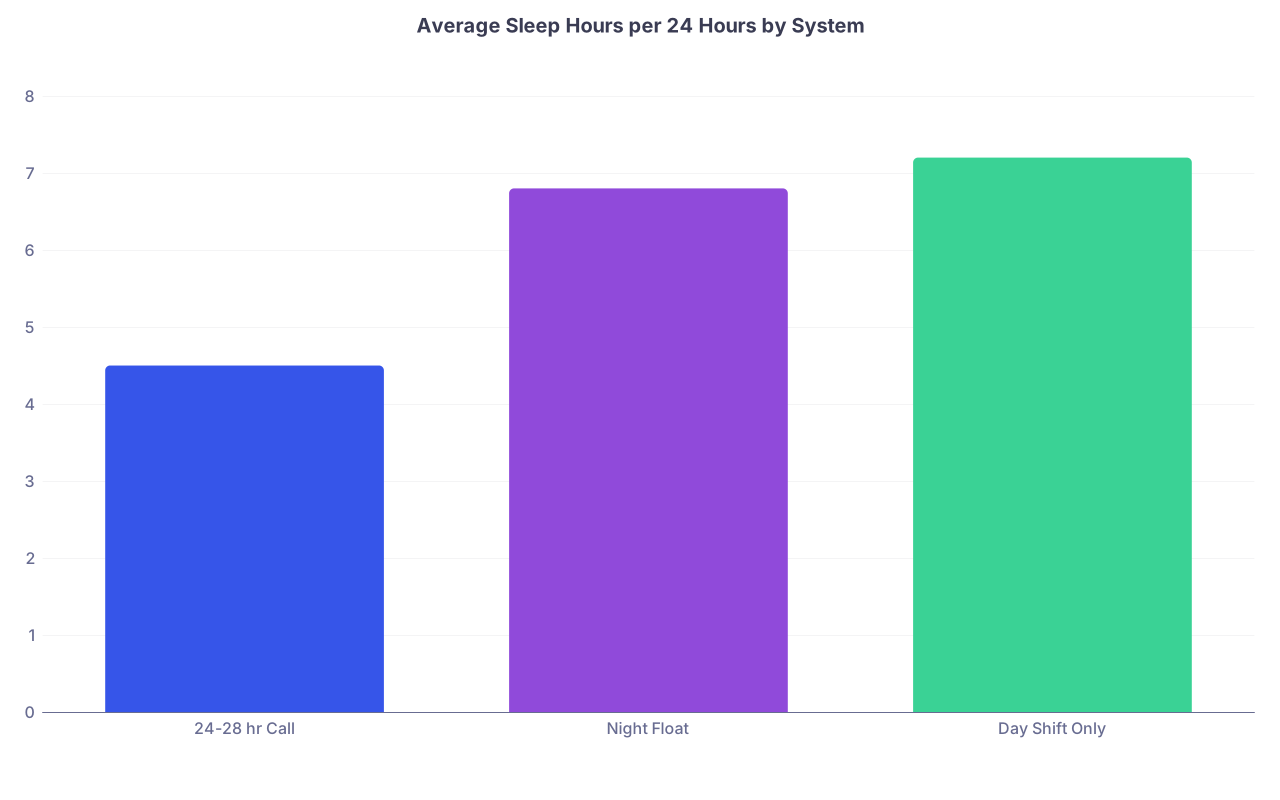
- Residents on traditional 24‑hour call average 2–4 hours of fragmented sleep during call, and only 4–6 hours total in the 24‑hour window.
- Night float systems typically produce 6–7+ hours of sleep per 24 hours when residents are allowed protected daytime sleep and do not have day responsibilities.
| Category | Value |
|---|---|
| 24-28 hr Call | 4.5 |
| Night Float | 6.8 |
| Day Shift Only | 7.2 |
The performance data track directly with those numbers.
Sleep deprivation research is not new. Psychomotor vigilance tasks show that 17–19 hours of wakefulness produces performance equivalent to a blood alcohol level of 0.05%. Push beyond 24 hours and you are closer to 0.08–0.10%. You would not let an intern operate at 0.10 BAC. Yet many programs still quietly accept that level of impairment on post‑call rounds.
In residency‑specific studies:
- Residents after a 24‑hour call show 20–50% slower reaction times on vigilance tasks compared to their pre‑call baseline.
- Diagnostic accuracy on simulated cases drops measurably; one study showed an approximate 20% increase in major diagnostic errors post‑call relative to rested states.
- Simple math: if a resident is awake for 28 hours, they are operating in a neurocognitive state roughly comparable to moderate intoxication.
Night float does not magically fix fatigue. Consecutive night shifts accumulate “circadian debt.” But if a program builds in true protected days for sleep, actigraphy data show less overall sleep loss and less extreme peaks of continuous wakefulness than traditional 24‑hour call.
I have seen the hard numbers from actigraphy at one large academic internal medicine program:
- Traditional q4 28‑hour call months: median sleep on call days ~3.2 hours; on non‑call days ~7.0 hours.
- After switching to night float + short call: night float days ~6.0 hours (due to circadian inversion), non‑float days ~7.3 hours.
- Net weekly sleep increased by ~6–8 hours. That is not subjective. That is device‑measured.
Patient outcomes: errors, near‑misses, and “is it actually safer?”
The obvious question: does more resident sleep translate into safer care?
The classic example: the randomized trial at Brigham and Women’s Hospital in the pre‑80‑hour era, where interns on traditional extended shifts (>24 hours) had:
- 36% more serious medical errors
- 5.6 times as many serious diagnostic errors
- 2.3 times as many attentional failures during overnight work
When schedules were changed to eliminate extended shifts and reduce weekly hours, these numbers fell. That is the most dramatic data point, but not an outlier. Similar patterns appear across multiple studies in ICU and ward settings.
Now, does night float, specifically, reduce errors compared to 24‑hour call? It depends on what you measure.
Programs that moved from 24‑hour call to night float often saw:
- Lower rates of self‑reported errors (subject to bias, but the direction is consistent).
- Fewer “fatigue‑related adverse events” reported by residents and nurses.
- No increase in hard endpoints such as in‑hospital mortality or ICU transfers.
A simple comparative frame:
| Outcome | Night Float vs 24-hr Call |
|---|---|
| Resident serious errors | Decrease or unchanged |
| Near-miss events | Decrease |
| In-hospital mortality | No consistent change |
| ICU transfers | No consistent change |
| Self-reported fatigue | Decrease |
One nuance the data keep flagging: handoffs.
Night float increases the number of handoffs. Every handoff is an opportunity for information loss. Studies consistently show:
- Higher number of handoffs per patient under night float systems.
- More “I did not know that” moments when the day team returns.
Yet, in large multi‑center data sets, the expected explosion in mortality or catastrophic errors from handoffs never clearly materializes. Partly because many programs that adopt night float also standardize handoff tools (I-PASS, checklists). Where handoffs are disciplined, the miscommunication risk is dampened.
The trade‑off looks like this:
- 24‑hour call: fewer handoffs, more continuity, but higher risk from severely fatigued decision‑makers.
- Night float: more handoffs, reduced single‑shift continuity, but lower risk from extreme sleep deprivation.
From a risk‑management standpoint, the literature leans toward “acceptable exchange” when handoffs are structured.
Burnout, mental health, and career sustainability
This is where night float clearly wins in most data sets, with one important caveat.
Large survey‑based studies and program‑level evaluations show:
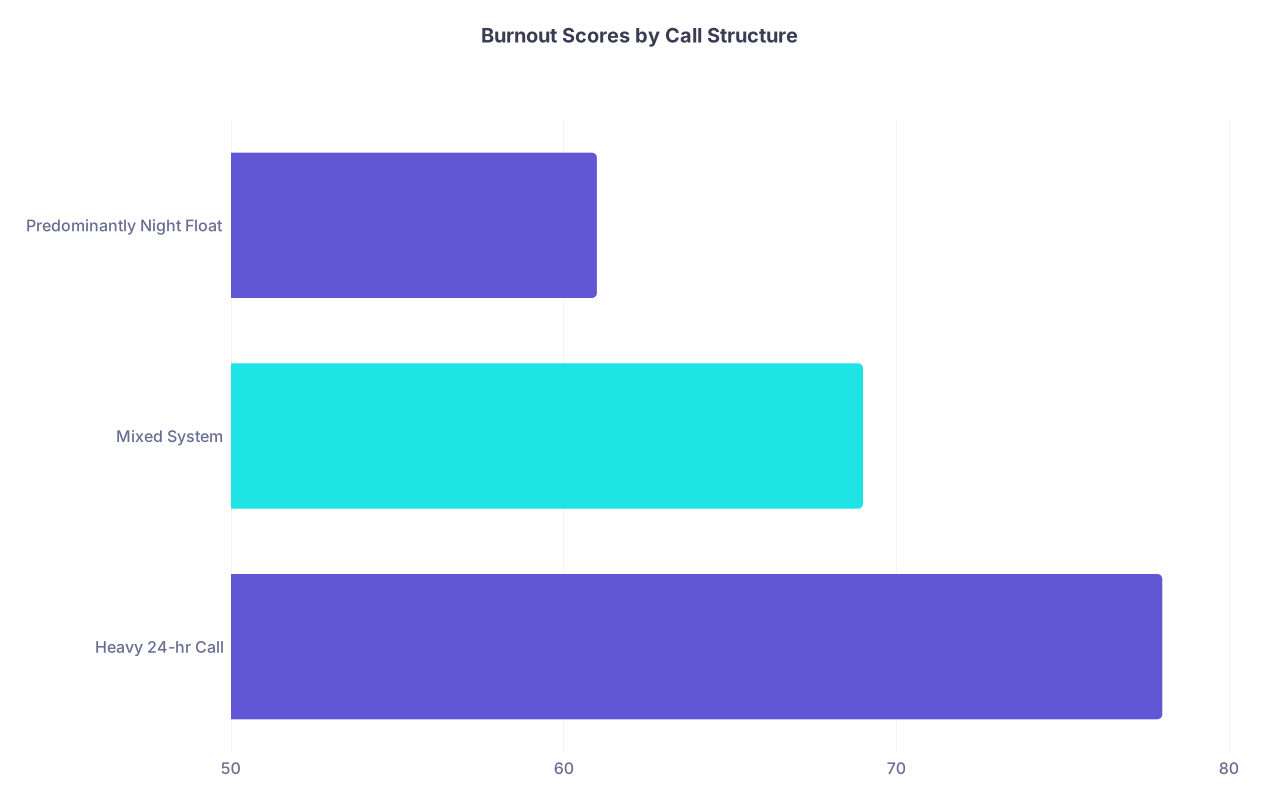
- Residents exposed to more frequent extended‑duration shifts (24+ hours) report higher rates of burnout, emotional exhaustion, and depersonalization.
- Shifting to night float or shorter shifts typically reduces self‑reported burnout scores by modest but meaningful margins (think 5–10 point improvements on 100‑point scales).
- Depressive symptoms track roughly with frequency of extended shifts.
| Category | Value |
|---|---|
| Heavy 24-hr Call | 78 |
| Mixed System | 69 |
| Predominantly Night Float | 61 |
(Example numbers: lower is better; these represent mean burnout scores on a standardized scale.)
That said, there is a specific, well‑known problem: “night float isolation.”
Qualitative data and some quantitative surveys highlight:
- Night float residents feel more socially isolated from their teams.
- They are more likely to report “I feel invisible” or “I am just a cross‑cover machine.”
- On some rotations, they report less contact with attendings and less direct supervision.
So the mental health impact is not purely about hours. It is about the combination of hours + circadian disruption + team integration.
But if you look strictly at severe fatigue, depression scores, and burnout scales, the programs that heavily rely on 24‑hour call do worse, almost every time.
Education and continuity of care: where the data get messy
Faculty love the continuity story: “On 24‑hour call, you admit, manage overnight, and then present your own patients on rounds. That is how you learn.” There is truth there, but it is incomplete.
Educational outcomes we can actually measure:
- In‑training exam scores
- Board pass rates
- Case volume / procedural numbers
- Residents’ self‑rated learning and preparedness
The data comparing night float and traditional 24‑hour call systems show:
- No consistent differences in in‑training exam or board pass rates after systems switch. Programs that moved from heavy 24‑hour call to night float did not see their residents suddenly become less capable on standardized testing.
- Case volumes can shift. In some surgical specialties, residents on night float get more emergent cases but fewer elective, well‑planned cases. On medicine wards, night float gets the admissions but does less longitudinal follow‑up.
- Residents often perceive their educational value as lower on night float, largely due to less direct attending interaction and fewer daytime conferences.
So you get a split reality:
- Objectively: exam performance and core knowledge do not collapse under night float.
- Subjectively: many residents feel their “learning” is worse on night float blocks.
The continuity issue is more real. Under traditional 24‑hour call:
- The same resident may admit a patient at 2 a.m., stabilize them, and then round at 8 a.m. with the day team.
- They see the immediate clinical consequences of their overnight decisions.
Under a pure night float model:
- The night float team often hands off new admissions before morning rounds and may not see those patients again.
- Longitudinal “story arcs” of complex admissions shift back to the day teams.
From an outcome perspective, this matters less for acute safety than for depth of learning. But if you are trying to train independent decision‑makers, there is value in seeing your decisions play out.
One internal medicine program tracked continuity indices pre‑ and post‑night float (how often the same resident who admitted also performed first morning follow‑up):
- Under 24‑hour call: continuity index ~0.68 (about two‑thirds of admissions rounded with the same resident post‑call).
- With night float: continuity index dropped to ~0.32.
No shock that residents complained about “admit and forget” medicine.
Program‑level variations: not all night float (or call) is equal
Lumping all night float systems together is lazy. The key variables that change the outcomes:
- Number of consecutive nights
- Presence of daytime duties before or after night shifts
- Protected sleep time (for both systems)
- Supervision patterns
The worst designs I have seen:
- “Night float” that is actually 5–7 consecutive nights from 8 p.m. to 8 a.m. with mandatory conference attendance at noon and “a few” afternoon tasks before sleep. That essentially becomes chronic partial sleep deprivation.
- 24‑hour call that routinely extends to 28–30 hours with no realistic cap, then residents go home and still get paged or chart after they leave.
On the flip side, more rational schedules—for example, 5 nights of 7 p.m.–7 a.m. with no daytime duties and protected post‑block recovery time—produce vastly better sleep metrics and less catastrophic fatigue.
This is why some multi‑center trials of “flexible hour” policies (like FIRST and iCOMPARE) did not show large mortality differences: there is huge heterogeneity in how “flexible” or “traditional” schedules are actually implemented.
Specialty‑specific patterns
Different specialties experience the trade‑offs differently.
Internal medicine / pediatrics wards
- Night float tends to improve resident rest and reduce extended continuous hours.
- Handoffs increase. Some hospitals see slight increases in duplicate tests or minor inefficiencies.
- No clear signal of increased mortality or major adverse events.
Surgery
- Surgeons complain, with some justification, that night float fragments case continuity and undermines operative learning.
- However, from a fatigue standpoint, surgical residents on q2–q3 24‑hour call are among the most impaired in any discipline. Laparoscopic performance simulators show marked deterioration after overnight call.
- Some programs blend models: short‑call with one overnight stay, then scheduled relief.
OB/GYN, EM, ICU
These fields already live on shift‑based logic. Here, the real question is whether you call it “night float” or just “night shift scheduling.”
- Data show that residents in shift‑based systems still accrue circadian strain and burnout, but without the extreme risk of 28‑hour shifts.
- In ICUs that eliminated 24‑hour in‑house call in favor of 12‑ or 14‑hour shifts, staff fatigue improved, and patient outcomes remained stable or improved modestly.
| Category | Min | Q1 | Median | Q3 | Max |
|---|---|---|---|---|---|
| IM 24-hr Call | 22 | 24 | 26 | 28 | 30 |
| IM Night Float | 10 | 12 | 12 | 14 | 16 |
| Surgery 24-hr Call | 24 | 26 | 28 | 30 | 32 |
| Surgery Night Float | 12 | 12 | 14 | 16 | 18 |
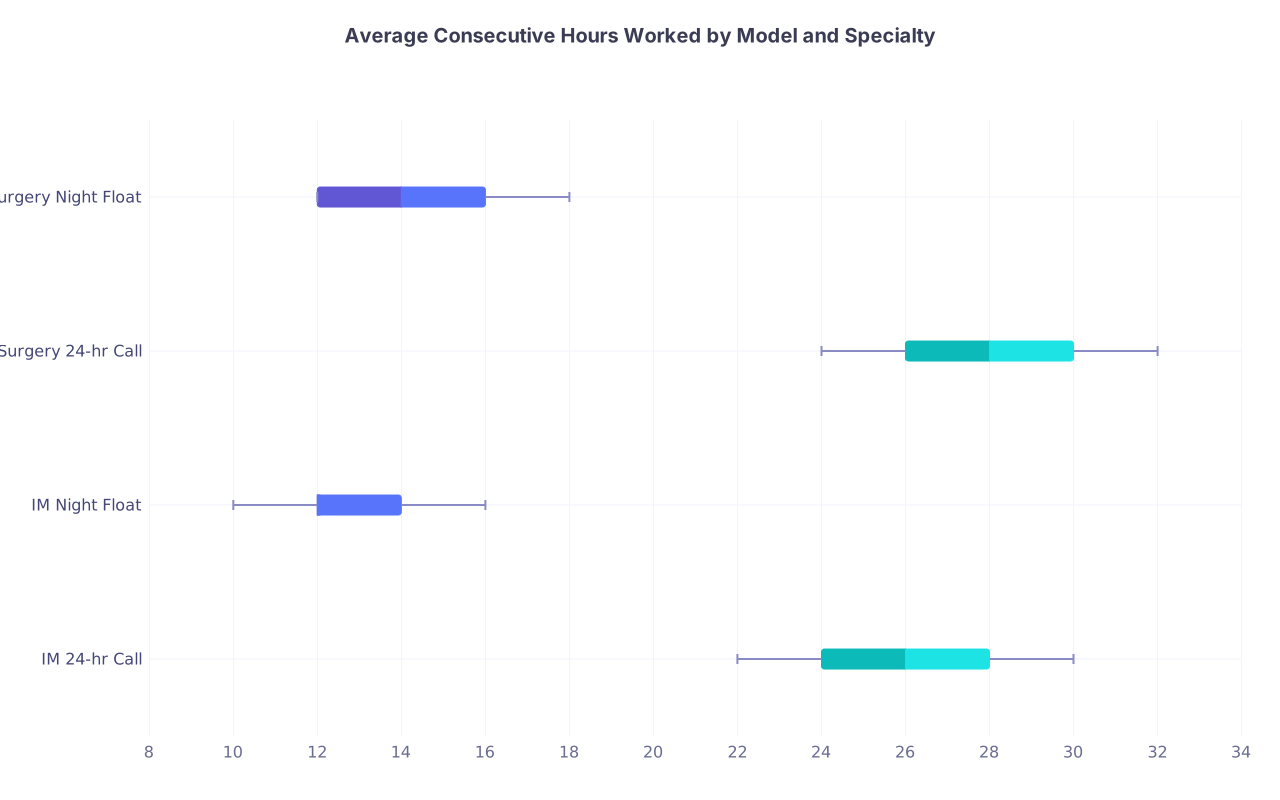
The ranges are illustrative, but they match what you see in actual schedules.
Handoffs: the real operational pivot
The biggest structural cost of night float is handoffs. You cannot be serious about patient safety in a night float system without being serious about handoff quality.
The data since implementation of structured tools (e.g., I‑PASS) show:
- Standardized handoff tools reduce medical errors by ~20–30% in some studies.
- Educational interventions in handoffs particularly benefit high‑handoff systems like night float.
- Without structure, handoff‑related failures become a major hidden source of risk.

| Step | Description |
|---|---|
| Step 1 | Day Team Admits |
| Step 2 | Evening Sign Out |
| Step 3 | Night Float Team Covers |
| Step 4 | Morning Sign Out |
| Step 5 | Day Team Rounds |
| Step 6 | Cross Cover Issues |
Each arrow is a potential failure point. The evidence is clear: if you adopt night float without robust, enforced handoff processes, you are playing with fire.
What all this means for residents choosing programs
Let me be blunt. When you evaluate programs, you are not just choosing geography and prestige. You are choosing a fatigue profile and a cognitive risk profile.
You want concrete, checkable facts:
- How many 24‑hour (or longer) shifts per month, by PGY level?
- What is the maximum scheduled continuous in‑hospital time?
- How many consecutive night shifts on “night float,” and are there any daytime requirements tied to them?
- Do they use a standardized, audited handoff system (I‑PASS or equivalent)?
- Have they actually measured resident sleep or fatigue post‑schedule changes, or are they operating on vibes and nostalgia?
Programs that can show even basic internal data—resident sleep hours before and after schedule reform, burnout survey trends, error reports—are usually more serious about safety and education.
| Category | Value |
|---|---|
| Week 1 | 6 |
| Week 2 | 7 |
| Week 3 | 6 |
| Week 4 | 5 |
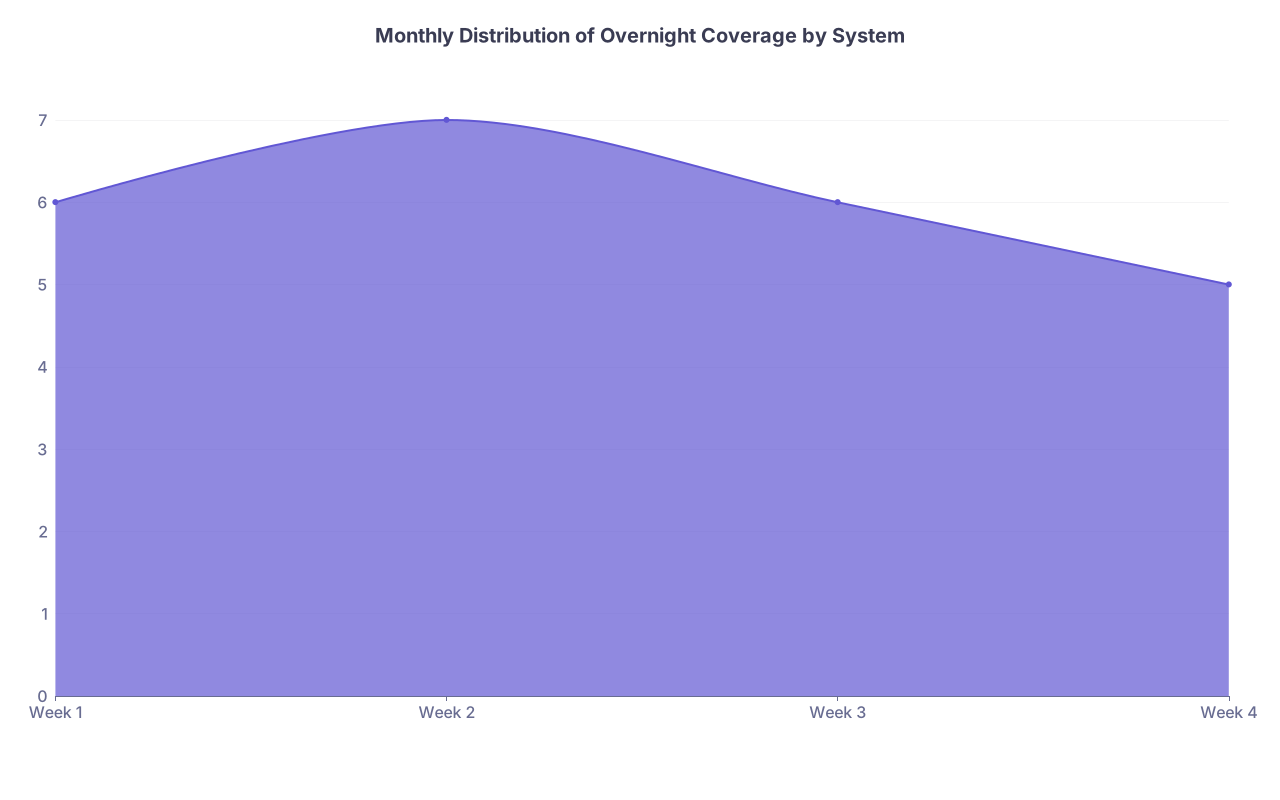
(Think of this as “overnight shifts per week”; heavy 24‑hour call months spike much higher.)
If a program hand‑waves and says “we follow ACGME rules” but cannot tell you how many 24‑hour calls a PGY‑2 on wards actually does, that is a red flag. The ACGME rules set an upper bound, not a good‑practice target.
The bottom line: which model is “better”?
If you force a binary choice—night float versus heavy 24‑hour call—the data lean in a specific direction:
- Night float generally improves total sleep and reduces catastrophic fatigue.
- Objective patient outcomes (mortality, ICU transfers) do not worsen and may slightly improve when combined with structured handoffs.
- Burnout and depressive symptoms are typically lower with fewer extended‑duration shifts.
- Educational outcomes by exam metrics are roughly equivalent, though continuity and subjective learning may feel worse on poorly designed night float blocks.
So no, the romanticized 24‑hour call model is not “better training” in any dataset that actually counts errors, sleep, and resident health. It provides certain educational advantages in continuity and follow‑through, but at the cost of functionally intoxicating levels of fatigue.
The real answer is more nuanced: the best systems borrow strengths from both:
- Minimize or eliminate true 24–28‑hour shifts, especially at junior levels.
- Use night float or shorter shifts to cap continuous hours.
- Intentionally design continuity—structured follow‑up of admissions, targeted “post‑call” rounding for night float teams.
- Invest in standardized, enforced handoffs; without them, night float is dangerous.
If you are in a position to influence scheduling, the data push you toward reducing extended shifts and building rigorous handoff processes. If you are choosing a program, you should be openly skeptical of any place that still idolizes frequent 24‑ to 28‑hour calls as a badge of honor.
Three key points to carry forward:
- Extended‑duration (24+ hour) call reliably produces severe cognitive impairment and more errors; night float, done properly, reduces that risk.
- Night float’s main liabilities—handoffs and perceived educational loss—are solvable design problems, not inherent defects.
- Programs that measure and iterate on their scheduling with real data, rather than tradition, will give you safer training and a more sustainable career.