
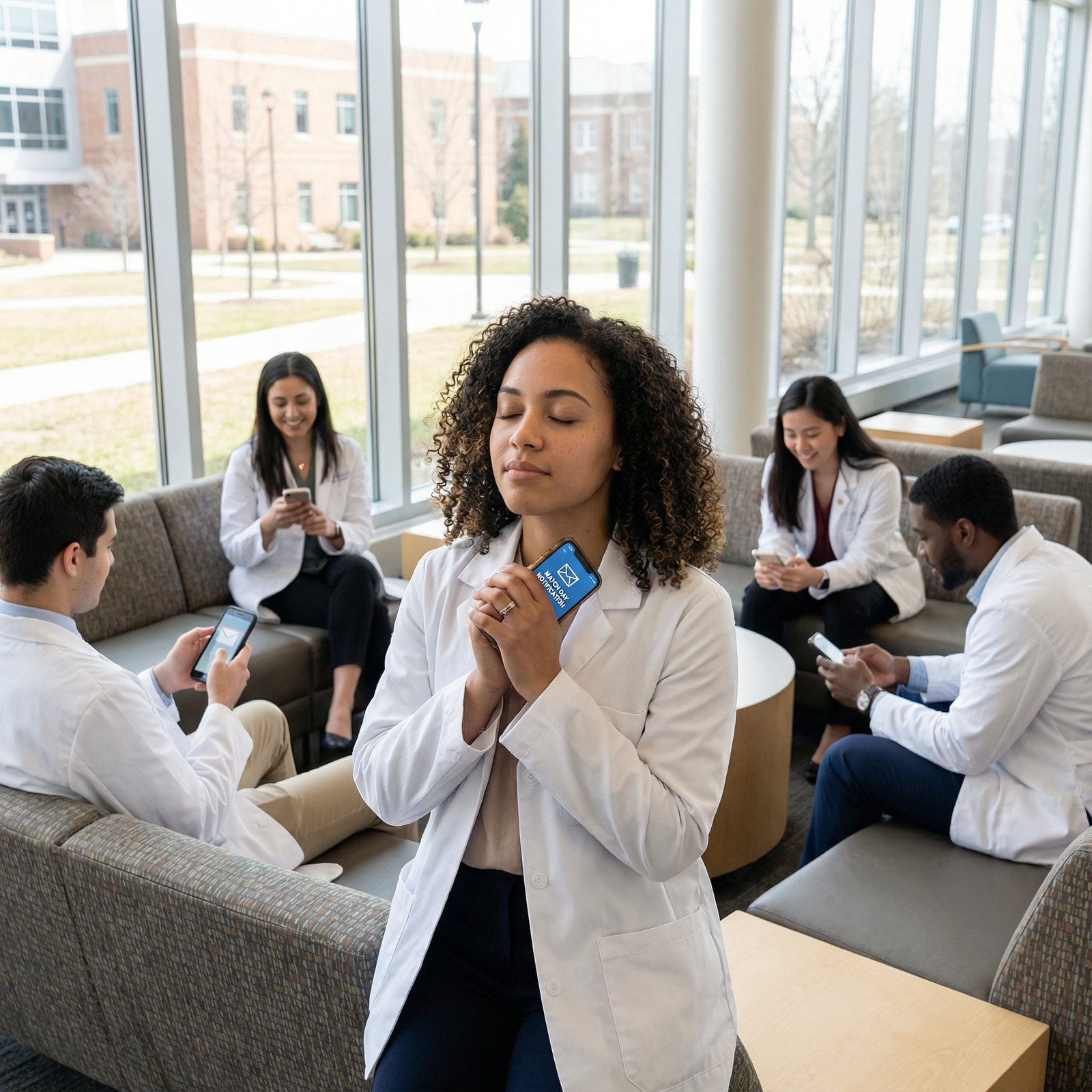
You’re here: Match Day is coming, and you kind of want to hide
It’s Match Week. Group chats are blowing up with plans for watch parties. Your class Facebook page is full of “Match Day photo inspo” and coordinated outfits. Someone’s making a hashtag. Someone else hired a photographer.
And you’re sitting there thinking: I don’t even know if I matched yet, and people are planning balloon arches.
Your stomach drops when you imagine the moment the email hits. You opening it in a room full of people. Cameras out. Parents staring. Classmates screaming. You having to smile on command. What if your result isn’t what you hoped? What if you don’t match at all? Are you supposed to pose with an empty envelope?
You start to realize something you don’t really want to admit: you don’t want the big party. You don’t want the staged photos. You’re not even sure you want anyone else in the room when you open that email.
And then the guilt kicks in.
“Am I being ungrateful?”
“Will my family be disappointed if I don’t invite them?”
“Will my classmates think I’m weird or antisocial?”
“Is it bad luck to not do all the traditions?”
Let me just say this plainly: you are allowed to want a quiet Match Day. You are allowed to dread the photos and the parties. That doesn’t make you less excited, less worthy, or less professional. It probably just means you’re a human who gets overwhelmed.
Let’s talk about what that quieter version can look like. For real. With specifics. Not the fluffy “self-care!” stuff people toss at you when they don’t know what else to say.
Why the typical Match Day can feel awful if you’re anxious
On paper, Match Day is supposed to be joyous and communal. In reality, if you’re an anxious person—or just private—it can feel like a setup.
The whole thing is designed around being seen.
You’ve got:
- Everyone physically together at some event space or auditorium
- A literal countdown to opening the emails
- People filming themselves and each other
- Parents, partners, siblings, faculty, maybe even media
- Immediate pressure to share your result on social media
If you’re already spinning about whether you matched or where you’ll end up, throwing an audience into that moment can make your brain go full disaster-mode. I’ve seen people shake so hard they could barely tap their phone. I’ve watched someone freeze because they didn’t want to show their parents the email yet and didn’t know how to say it in the chaos.
And then the photos. Forced “candid” shots. Matching outfits. Someone yelling “hold up your envelope and smile!” even if your envelope contains a specialty or location that just broke your heart a little.
You are not broken for wanting out of that.
You’re actually being pretty reasonable: this is one of the highest-stakes emails of your life. Wanting a little privacy for the first 60 seconds of it is not weird.
Step one: Decide what you actually want that morning
Forget for a second what your school, your friends, or your family want. Strip it down to this:
If no one else had expectations, how would you want to experience the moment you see your result?
Not the whole day. Just that 30-second window when your brain registers: “I matched at X in Y.”
Some people, if they’re honest, would say:
“I want to be completely alone.”
Others:
“I want one person with me—someone I trust not to react louder than I do.”
Or:
“I want to be on FaceTime with my partner but not physically in the big room.”
You’re allowed to pick any of those. You can separate “moment I open my email” from “later celebrations.” You don’t have to do every part of Match Day the way everyone else does.
If the idea of opening the email in a crowd gives you that sinking, nauseous feeling, listen to it. That’s information. Not weakness.
Quiet alternatives for the exact moment you open the email
Let’s get very specific and concrete, because vague “just do what’s best for you” isn’t actually helpful when you’re anxious.
Here are some low-key setups I’ve seen work well for people who hate the spectacle.
1. The “solo, then join” plan
You open your email by yourself, in a quiet place, then join others after you’ve processed.
How it can actually look:
- You tell your school you won’t be at the main countdown but might come later. Or you go to the event space early, slip out to a side room / bathroom / car right before the email time, and open it there.
- You give yourself 5–10 minutes to just sit with whatever you see. No one asking “what did you get!?” while your brain is buffering.
- Then you decide: do I want to walk back in? Do I want to meet just my close friends? Or do I want to go home?
This is probably the best compromise if you feel some FOMO but also a lot of dread. You get privacy for the most intense part, but you’re not completely off the grid.
2. The “one safe person” room
You open your email with exactly one or two people you completely trust.
Key detail: pick someone whose reaction won’t be bigger than yours. You don’t want the friend who screams and jumps on chairs. You want the person who can hold space if you’re happy or quietly devastated.
Could be:
- A partner who understands your rank list and your fears
- A sibling who knows your anxiety is real and doesn’t make fun of it
- A classmate who also doesn’t want the big party and wants to do a low-key thing
You can do this at your apartment, in your car, in a study room, even in a quiet corner of the official event. But the rule is: small circle, no live-streaming, no immediate posting unless you initiate.
3. The “FaceTime but physically alone” setup
If your partner or main support isn’t in the same city, you can still do a quiet version.
Phone on Do Not Disturb. One FaceTime window. One laptop or phone. That’s it.
You can tell your family ahead of time: “I’m going to open it with [partner] on FaceTime. I’ll call you afterwards once I’ve had a chance to breathe.” If they push back, repeat: “I want to remember this moment feeling calm, not overwhelmed. This helps with that.”
You don’t need a more sophisticated excuse. You needing to be okay emotionally is enough.
4. The “completely solo, no live reaction” choice
Yes, this is allowed. Despite what your class group chat might make it seem like.
You open the email alone. No one sees your face when you read it. No one hears what you say.
You then take as long as you want before you text or call anyone. Could be 5 minutes. Could be 2 hours. You are not obligated to perform your reaction in real-time for other people’s benefit.
If you’re someone who’s had bad news in public before and still flinches at the memory, this can be incredibly protective.
What about the pressure for photos and social media?
The photo culture around Match Day has gotten… intense. Matching outfits, balloons, chalkboards, slick Instagram posts with filters and long captions about “grateful for the journey.”
Here’s the ugly little secret: a lot of people hate it and do it anyway because they feel like they “have to.”
You don’t.
You can:
- Take zero professional photos.
- Take a couple of simple shots on your phone later in the day when you feel more stable.
- Not post on social media at all that day, and instead send personal texts to the people you actually care about.
- Post something later—days or weeks later—when the adrenaline dump has passed and you’re not numb.
If your school has a photographer roaming around the event and that stresses you out, you can literally say, “I’d rather not be in pictures, thank you.” Step slightly away. It’s awkward for 0.4 seconds and then they move on.
If your parents are very “photo or it didn’t happen,” you can negotiate: “Let’s do a couple of pictures this evening once I’ve processed everything. I don’t want cameras when I first open it.” Again, you don’t owe them your raw, unfiltered reaction.
You get to protect that.
Planning scripts so you’re not scrambling day-of
One of the worst parts of being anxious is trying to explain yourself in real time while your brain is melting. So write your boundaries now, when you’re semi-sane, not on Match morning.
Here are some straightforward phrases you can use with different people.
With family: “I’m really excited for Match Day, but I get overwhelmed easily. I’m planning to open my email quietly first, then call you afterward so we can celebrate properly. That’ll help me actually be present with you instead of just panicking.”
With classmates: “I’m not great with big crowds when I’m anxious, so I’m probably going to open it on my own and then swing by later / text you. But I want to hear how you guys do.”
With school administration (if they explicitly encourage attendance): “I’m grateful for the event, but I’m planning to open my email separately for personal reasons. I may come by afterwards.”
You don’t owe anyone a TED Talk about your anxiety disorder or your worst-case-scenario thinking. “For personal reasons” is a full sentence.
Handling the worst-case scenarios your brain keeps replaying
Let’s name them, because your brain is already doing it at 2 a.m.
“What if I don’t match?”
First, that’s handled earlier in the week with SOAP. By Match Day, if you truly didn’t match, you will already know from the Monday email. Match Day is not the surprise “you didn’t match” email. It’s “where did you match.”
But say you matched somewhere far from family. Or in a program you ranked lower. Or in a specialty that was your backup. The fear under all of this is: “What if I have to process disappointment in front of other people?” Which is exactly why quieter alternatives are actually smart.
Best case scenario: you’re thrilled and you get a calm, private, deeply happy moment. Worst case: you need to cry, or sit in silence, or say “oh” and stare at your screen for a bit. That’s not something you want on livestream.
“What if everyone is ecstatic and I’m just… not?”
That happens. A lot more than people admit. I’ve seen students match their technical “top choice” and still feel off because reality suddenly hit: new city, new cost of living, new call schedule. Your emotional reaction might be complicated, even if the result is objectively good.
If you’re alone or with one trusted person, you can actually have that complex reaction without feeling guilty that your face doesn’t match the Instagram version of joy. No one’s going to zoom in on your expression and interpret it.
“What if people are upset I didn’t do pictures?”
Most will get over it in 24 hours. You know what lasts longer? The memory in your body of whether Match Day felt like a trauma or a milestone.
You’re not responsible for managing other people’s nostalgia. You’re responsible for not wrecking yourself for the sake of aesthetics.
Building a quieter Match Day that still feels meaningful
Quiet doesn’t have to mean empty or bitter. You’re allowed to want “small but intentional.”
Some things that can make a simple, low-stimulation Match Day still feel like a real occasion:
- A short walk before you open your email, just to get out some adrenaline. Yes, this is corny. Yes, it actually helps.
- One small ritual that’s just for you: a favorite coffee, a playlist you like, a certain place you sit. Something that tells your nervous system, “We’re okay. This is our space.”
- Scheduling a call later that evening with your “safe people” to actually talk about what this all means, instead of shouting over a crowd.
- Writing down, right after you open the email, three sentences about how you feel—so your version of the moment exists somewhere other than Instagram captions.
You can also do something totally non-medical that day on purpose: cook with a partner, watch a movie, get takeout, walk by a lake, whatever. The match is enormous, but it doesn’t have to consume every waking minute of that day unless you let it.
One more thing about being “the quiet one”
There’s this insidious idea in medicine that the people who are loudest, most outwardly hyped, most “on” socially are the ones who are winning. That if you’re not screaming and posting and hashtagging, you’re not as happy or grateful.
I disagree.
You can be deeply, fiercely proud of yourself and still want that pride to be private. You can care about this more than anyone knows and still not want your celebration to look like a commercial.
You’re about to enter residency, which is one long test of listening to your limits or bulldozing them. Match Day is one of your first chances to practice: “What actually works for me? What leaves me feeling more whole instead of more shredded?”
If leaving your phone in Do Not Disturb, opening the email alone, and quietly texting two people is what preserves your sanity, that’s not weird. That’s wise.
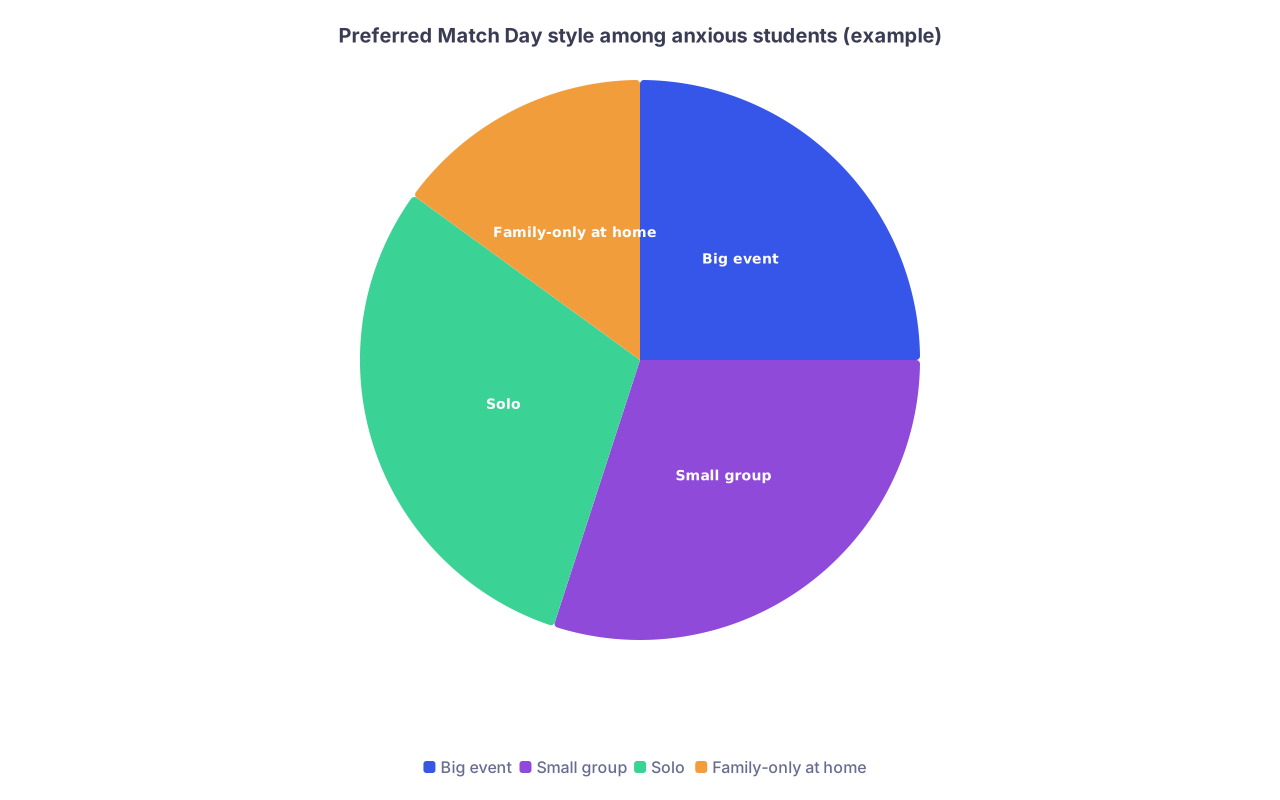
| Category | Value |
|---|---|
| Big event | 25 |
| Small group | 30 |
| Solo | 30 |
| Family-only at home | 15 |

| Step | Description |
|---|---|
| Step 1 | Match Day coming |
| Step 2 | Attend big event |
| Step 3 | Small room or home with safe person |
| Step 4 | Open email alone |
| Step 5 | Decide photos or no |
| Step 6 | Share news later on your terms |
| Step 7 | Crowds feel ok |
| Step 8 | Want 1-2 people |
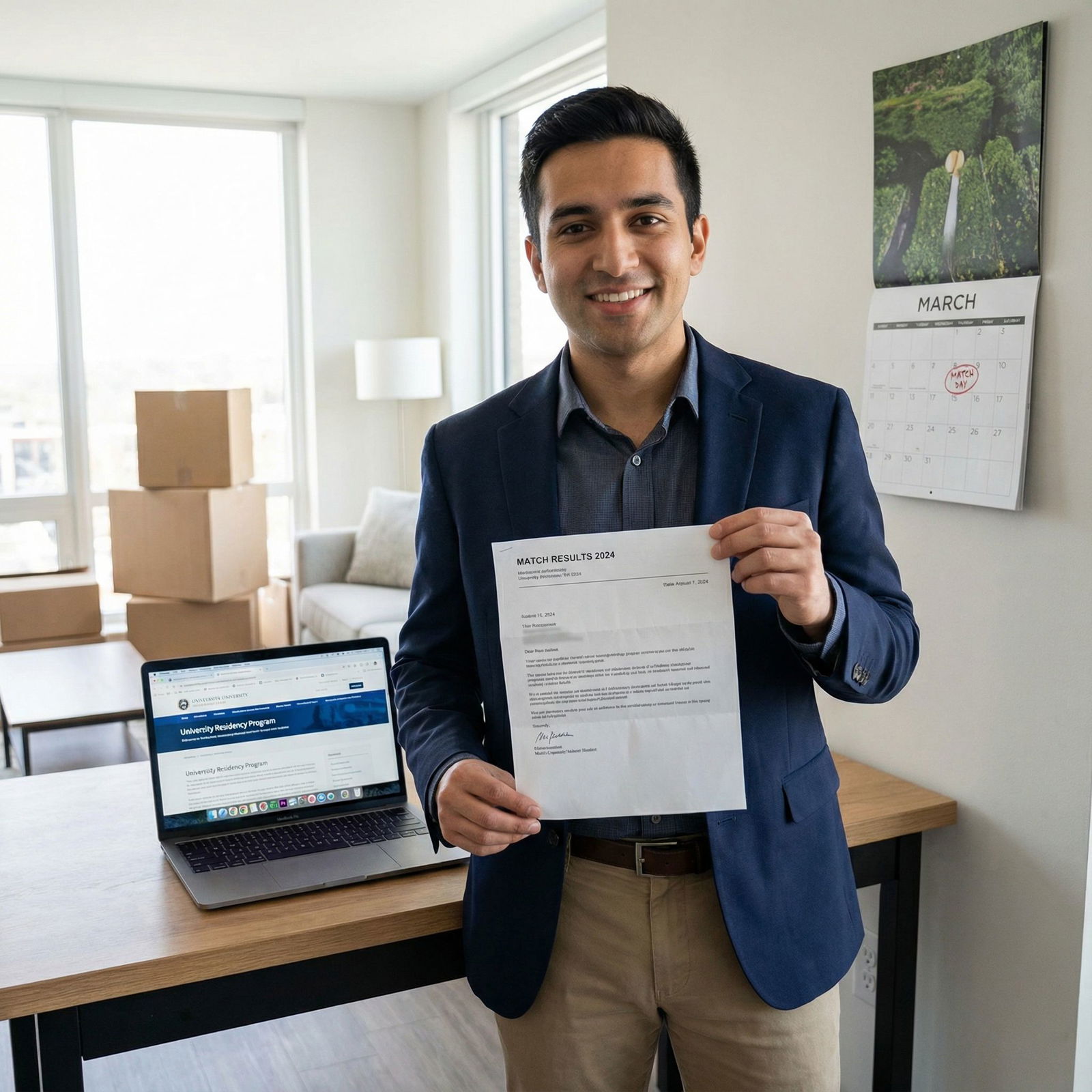


The bottom line, if your brain is still spinning
You don’t owe anyone a performance on Match Day.
You’re allowed to:
- Open your email in whatever setting makes you feel least like you’re about to pass out—even if that means skipping the main event.
- Say no to photos, or delay them, or keep them private instead of broadcasting everything online.
- Protect your reaction, your boundaries, and your nervous system, even if it disappoints someone for five minutes.
The match is about where you’re going to train and live and grow for the next several years. Not about whether you had the perfect balloon arch.


