

It’s Match Day afternoon. Your phone is blowing up. Group chat is going off. You’ve just posted your little “I matched!” announcement, trying to feel proud, or at least not nauseous. And then it starts:
“Why there?”
“Isn’t that far from home?”
“I thought you were aiming higher.”
“Couldn’t you have gotten closer to us?”
Your stomach drops. The excitement you should be feeling is instantly replaced by shame and dread. Now you’re not just worried if the program likes you. You’re worried your own family doesn’t.
Let me say the quiet thought out loud:
What if my family is disappointed in where I matched?
And what if that never really goes away?
Let’s walk through this, because you’re definitely not the only one sitting in that exact panic spiral.
First: You’re Allowed To Be Happy Even If They Aren’t
Let me be blunt: you matched. That’s a big deal. A huge deal. In the current match climate, that alone is an achievement your family probably doesn’t fully understand.
But here’s the problem. You’re probably hearing things like:
- “X city is dangerous / expensive / boring.”
- “We don’t know anyone there.”
- “Couldn’t you have tried for [prestige city/program]?”
- “How are we supposed to help with kids / moving / support from so far?”
And it’s landing in your brain as:
- “I failed.”
- “They’re embarrassed.”
- “I let everyone down.”
- “My match isn’t ‘good enough.’”
I’ve watched this happen so many times. The second their families don’t jump up and down, residents start rewriting their whole narrative: “Maybe this wasn’t a good match. Maybe I messed up. Maybe I’m not actually that strong of an applicant.”
Here’s the truth that no one says nicely:
Your family’s emotional reaction is about them, not you.
Their fear. Their expectations. Their fantasy of where you’d end up. Their need to tell people, “My kid matched at [insert place they recognize from TV].”
That doesn’t mean their feelings are invalid. Just that they don’t define the quality of your match or your worth as a future physician.
Why Families React Badly (Even When They Love You)
Most families aren’t trying to hurt you. But they absolutely can.
Common patterns I see:
Prestige anxiety
They wanted the brand-name place. Mayo. Mass General. UCSF. Or at least something that sounds “impressive” at family gatherings.
If your match is less flashy or in a city they haven’t heard of, they panic: “Did you settle? Are you sure it’s good enough?”Geographic grief
You matched far. Or in a place they have stereotypes about.
Suddenly they’re grieving the version of life where you stayed within an hour’s drive and came home on random Sundays.Control withdrawal
You’ve been making choices in the context of their support: undergrad, med school, where you live. Match Day rips control away from everyone.
For them, that might come out as criticism, passive-aggressive comments, or “helpful suggestions” like, “Can you just reapply next year?”Ignorance about the match reality
A lot of families honestly believe you “picked” your program like a regular job. They don’t understand algorithms, competitiveness, SOAP, or how dangerous it is to go unmatched.
So they react with their first, raw emotion. Which is often:
“I don’t like this.”
Instead of:
“Wow, you must have fought so hard to get to this day. Tell me about it.”
What If They’re Not Just Meh, But Actively Hostile?
Let’s go worst case because I know that’s where your brain is anyway.
You might be hearing things like:
- “I can’t believe you chose that over being close to family.”
- “So after everything we did for you, you’re just leaving?”
- “We thought you were smarter than this.”
- “That program doesn’t sound very good.”
- “So-and-so’s kid matched at [prestige place].”
This hurts. Deeply. And it can follow you into residency if you don’t get some kind of grip on it now.
Here’s the line I want you to tattoo in your head:
You did not betray your family by matching somewhere they don’t like.
Residency is not a hobby. It’s your actual job training, your future career, your sanity and safety for the next 3–7+ years. You are allowed—required, really—to prioritize:
- Good training
- Reasonable support system (even if that’s friends, not family)
- Your mental health
- Financial and logistical survival
Your family is allowed to be sad. You are not obligated to torch your own career or health to make them comfortable.
Reality Check: How Strong Is Your Match Actually?
Sometimes the shame isn’t just emotional. It’s comparison poison:
“My classmate matched at Hopkins. I matched at a community program I’d barely heard of.”
“My parents keep saying, ‘Are you sure this is a good hospital?’ and now I’m not sure.”
Let’s ground this for a second.
| Reality | What Your Family Thinks |
|---|---|
| Matching at all is hard | “Everyone in med school matches” |
| Location is partly random | “You chose that place” |
| Program fit matters | “Name brand matters most” |
| You ranked them for a reason | “You settled” |
If you want a quick sanity check on whether your match is “good enough,” ask yourself:
- Would I feel okay training here for 3–5+ years if nobody else’s opinion mattered?
- Are graduates from this program getting decent fellowships/jobs?
- Do I see at least a couple attendings or chiefs I’d want to learn from?
- Is this environment one I can survive in, not just flex about?
If the answer is mostly yes, then you’re fine. More than fine. Many “non-famous” programs quietly produce fantastic, happy physicians who aren’t burned out husks by PGY-3.
Having The Hard Conversation With Your Family
Let’s talk scripts, because in your head this conversation is probably spiraling into a screaming match.
Step 1: Name your own feelings first
You can literally say:
“Hey, I need to tell you something honestly. I feel really proud I matched, but I also feel hurt and kind of ashamed because I’m getting the sense you’re disappointed with where I ended up.”
Specific. Vulnerable. Not attacking.
Step 2: Educate without lecturing
Something like:
“The match isn’t like applying for normal jobs. I didn’t just ‘pick’ this place. It’s a mix of how competitive the field is, who ranked me, who I ranked, and the algorithm. A lot of really strong people don’t match at all. I’m genuinely lucky to have this spot.”
Step 3: Draw the boundary
This part is hard, but necessary:
“I need you to know this: I’m committed to this program. I need to focus on starting residency and not spend the next few months defending my match. I really want your support, even if it’s not exactly what you pictured.”
Step 4: Be ready for silence or resistance
They might say, “We’re just worried.”
Or, “We just wanted the best for you.”
Or, “We didn’t mean it like that.”
You’re allowed to respond:
“I get that you’re worried. But the way it came out made me feel like you were disappointed in me, not just the location. Please try to separate your anxiety from how you talk to me about it.”
What If They Never Fully Get On Board?
Here’s the brutal reality: some families never 100% accept it. Especially if:
- You’re moving far away from a tight-knit, collectivist culture
- You’re the “successful one” in the family and they’re living through you
- They had their own unfulfilled dreams wrapped up in your path
- They feel abandoned but don’t have the language to say that, so it all comes out sideways
So what then?
You stop chasing complete approval and aim for functional peace.
That looks like:
- Redirecting conversations when they start bashing your city/program
- Being selective about what you share (they don’t need every call room rant)
- Building a separate support system: co-residents, mentors, friends, maybe therapy
- Letting their disappointment exist without trying to fix it for them
The mental shift is this:
You do not need universal emotional buy-in from your family to be a good resident or a good person.
Would it be nice? Yes. Is it required? No.
Preparing Yourself Emotionally Before Residency Starts
You’ve got a few months (or weeks) between Match Day and starting intern year. Use that time to protect your brain a bit.
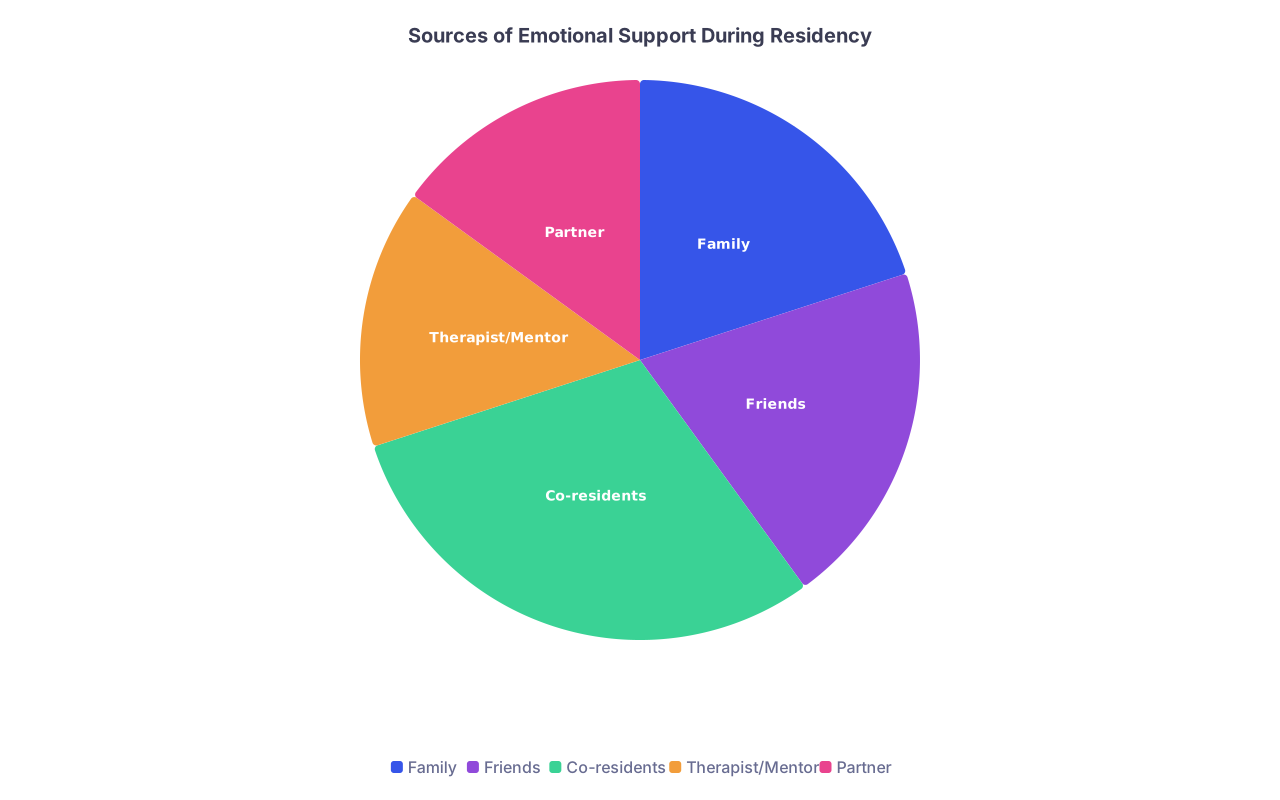
| Category | Value |
|---|---|
| Family | 20 |
| Friends | 20 |
| Co-residents | 30 |
| Therapist/Mentor | 15 |
| Partner | 15 |
Notice how family is not 80–90% of the pie. That’s on purpose.
Things you can do now:
Identify 2–3 people who actually “get it.”
Fellow students, upper-level residents, that attending who’s been kind. Tell them honestly: “Hey, my family’s not super thrilled about my match. Can I lean on you a bit while I process this?”Decide what you’re not going to discuss with family.
Maybe you don’t bring up program ranking, case volume, fellowship outcomes. They don’t need that ammo.Practice a neutral script.
For relatives at gatherings who say, “Why there?” have something ready like:
“That’s where I matched, and it’s a solid program for my training. I’m focusing on learning as much as I can there.”
Short. Calm. End of conversation.
- Consider a therapist if you can swing it.
Because if you walk into intern year already carrying guilt and shame about your match, every bad shift is going to feel like “proof” you made the wrong choice. A therapist can help you untangle what’s family noise vs. actual program issues.
What If… They’re Right And You’re Privately Worried Too?
This is the ugly one. What if your family says:
“That program isn’t very strong.”
“That city is really not safe.”
“That’s going to be so isolating for you.”
And a small part of your brain whispers: “…yeah, I’m scared of that too.”
Two things can be true:
- Your family can be reacting in a hurtful way
- Some of their concerns can still be valid
So don’t just shove down your own doubts because they’re being annoying about it.
Ask yourself honestly:
- Am I worried about actual training quality?
- Am I scared for safety or mental health reasons, not just “it’s not shiny enough”?
- Did I rank this program high because of panic, pressure, or bad advising?
If you have real concerns, your action plan is not “let my family nag me into oblivion.” It’s this:
- Talk to current residents at that program
- Ask blunt questions about fellowship placement, hands-on experience, culture
- Ask your med school advisors, “Is this program considered solid for what I want?”
- Make a list of skills and experiences you want to leave residency with and figure out how to get them there (moonlighting later, electives, research, mentors)
If, after doing that, you still feel uneasy, you can plan for:
- Applying to fellowships that are stronger/more academic
- Doing away rotations or elective time elsewhere when allowed
- Building your CV during residency to keep doors open
- In extreme situations: considering transfer after PGY-1 (rare, not simple, but not impossible)
Point is: you can work with an imperfect match. You’re not stuck in quicksand.
Quick Reality Reframe: Three Years From Now
Fast-forward in your head.
You’re a PGY-3 on nights. You’re tired but competent. You run codes. You put in lines. You know your attendings’ quirks. You have your favorite nurses. You’ve got “your” coffee spot on the way in.
Your family? They’re used to saying, “Oh, they’re in [city] for residency.” It rolls off their tongues now. They brag when you staff a particularly big case. They introduce you as “our doctor.”
Their initial freak-out? Faded. Barely remembered.
I’ve watched this exact arc over and over. Families that were devastated on Match Day quietly adjust within a year. Not always perfectly. But enough that it no longer feels like an open wound every time you talk to them.
FAQ: The Stuff You’re Still Too Afraid To Ask Out Loud
1. Should I hide how unhappy my family is from my program?
Yes. Do not bring this into your professional world. Your PD, attendings, and co-residents don’t need to know your mom cried for two hours on FaceTime because you’re not within driving distance.
If you need support, talk about homesickness, adjustment, or general stress. Skip the “my family hates this place” narrative. You don’t want to plant the idea that you’re not committed.
2. Is it a red flag that my parents care so much about prestige?
Not automatically, but it can be toxic if unchecked. A little prestige pride is common. But if they:
- Dismiss your program because it’s not top-10
- Compare you constantly to others
- Make you feel like a disappointment for matching anywhere but their fantasy list
…then yeah, that’s a problem. It means you’ll need stronger internal validation and external support, because they won’t be able to give you healthy feedback about your actual performance.
3. What do I say when relatives keep asking, “Is that a good hospital?”
Use a stock line and stop over-explaining:
“It’s a solid program and a good fit for my training. I’m going to get great hands-on experience there.”
If they push, you can add:
“Residency matching is complicated, but this is where I’m supposed to be right now. I’m focusing on making the most of it.”
Then change the subject. You’re not on trial.
4. My family wants me to reapply next year. Should I consider it?
In 99% of cases, no. Going unmatched or trying to rematch just to chase a different city/name is incredibly risky. You lose a year of training, income, and momentum for something that might not happen.
Reapplying is only worth even considering if:
- You didn’t match at all (different conversation)
- There are serious, objective concerns about training (not just vibes)
- You’ve had honest conversations with advisors who agree it might be necessary
Your family’s discomfort is not a reason to gamble your entire career.
5. What if I actually hate the location too?
You’re allowed to hate the location and still show up as a good resident. Lots of people don’t love their city but love their co-residents or training.
Focus on:
- Finding 2–3 things that make it tolerable (a park, a coffee shop, a gym, a church, a hobby group)
- Building your in-hospital community so your “home base” feels more like people than place
- Treating it like a 3–5 year mission: not your forever home, but a chapter that gets you where you want to go
You don’t have to pretend it’s your dream city. You just have to survive and grow there.
6. I feel guilty that I’m relieved to be far from my family. Is that messed up?
No. That might actually be your nervous system exhaling. If your family is intense, controlling, or constantly critiquing your choices, distance can be protective.
You’re allowed to appreciate the space while still loving them. You don’t need to confess that to them. Just notice that your body feels lighter at the idea of living your own life. That’s data, not a moral failing.
Take one concrete step today:
Write a 3–4 sentence script you can use the next time someone questions your match. Literally type it into your notes app. Something like:
“I’m proud I matched and I’m committed to this program. It may not be where you pictured, but it’s a solid place for me to train and grow. I need support more than second-guessing right now.”
You don’t have to say it perfectly the first time. But having the words ready will keep you from spiraling every time someone flinches at where you matched.


