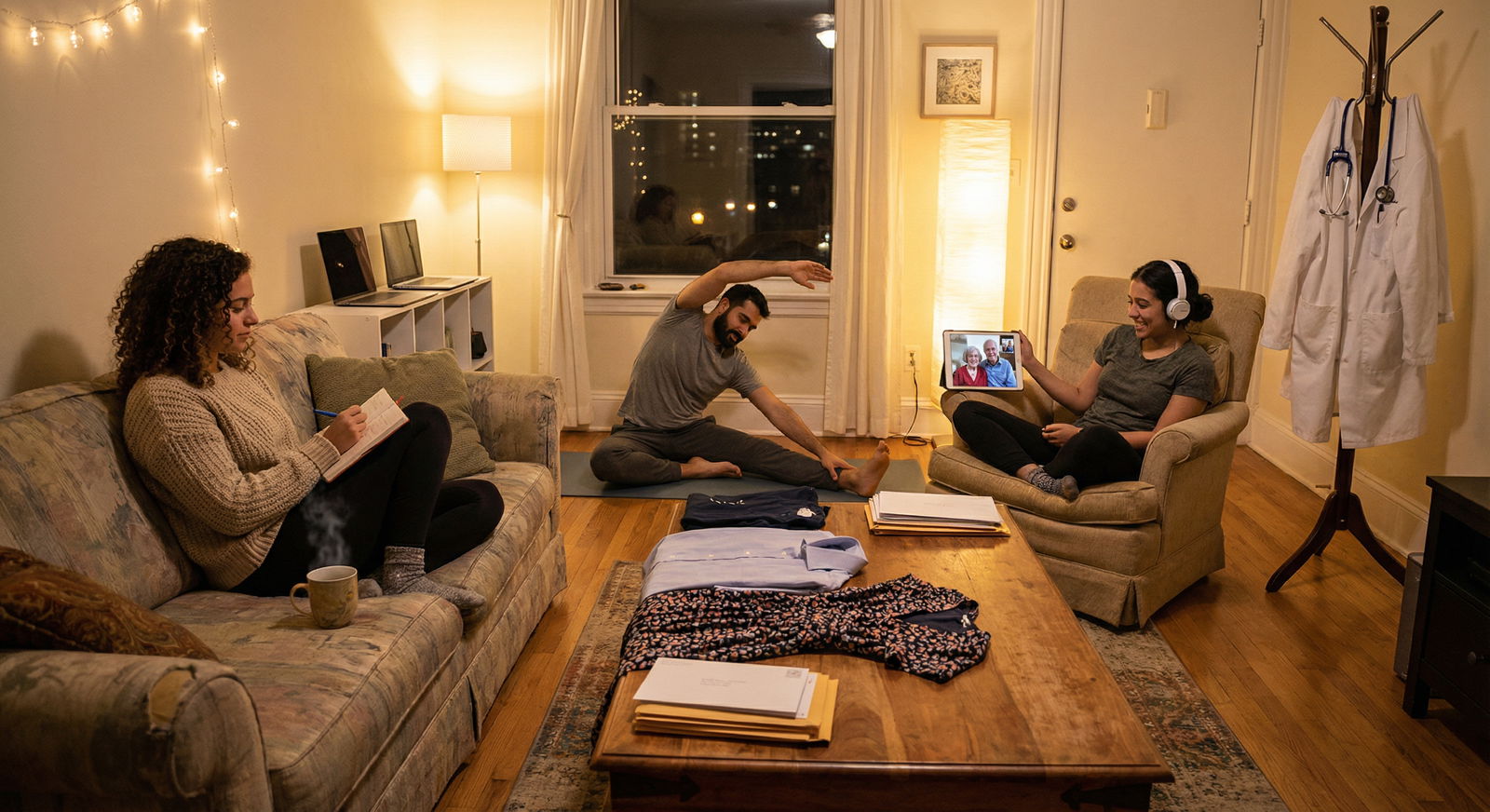
What if you open your email, your partner opens theirs, and you both realize… you’re not even in the same state?
The Exact Moment You Realize You Didn’t Match Together
There’s this fake script we all quietly write in our heads before Match Day. You probably know it. You both open your emails at the same time. You scream. You cry. You hug. You call your parents. You post the cute picture with your envelopes or screens. Perfect.
And then there’s the other script. The one nobody wants to say out loud.
You’re sitting side by side. Or on FaceTime. You count down. “Okay, 3…2…1…” You click.
Your eyes go straight to the hospital name and the city. You feel that little shot of adrenaline. You matched. It’s real. You look at your partner.
They’re frozen.
They say the city out loud. It’s not yours.
There’s this weird silence where your brain literally refuses to process it. You say something like, “Wait, what? Did we rank that? Are you sure?” as if the NRMP is going to say, “Oops, our bad, wrong email.”
That first 10–15 minutes can be absolute emotional whiplash. Pride. Relief you matched at all. Then this sinking, heavy feeling in your chest like the floor dropped out.
I’ve watched couples go through this. One person starts instantly crying. The other goes straight into “fix-it” mode. Someone apologizes even though it’s clearly not their fault. Someone says, “No, it’s okay, it’s okay,” when it is very much not okay.
And under all of that? One loud, panicked thought:
“Are we going to survive this?”
The Messy Truth About That First Day
Let me just say this plainly: the first-day reactions are rarely Instagram-cute. They’re messy. Conflicted. Sometimes a little ugly.
You might feel guilty for being disappointed. You matched. You got a spot. You’re supposed to be grateful. People in your class didn’t match at all. So why do you feel like you want to throw up?
Because you’re not just matching to a job. You’re matching to a life.
The “separate cities” scenario hits like a breakup you didn’t sign up for. Even if you intellectually knew this could happen, your emotions did not get the memo.
Typical first-day reactions I’ve seen (and honestly, felt myself):
- Numbness. You go straight into logistics: “When does orientation start? How far is that drive? Is there an airport?” You’re basically avoiding feeling anything real because it’s too much.
- Panic spirals. “Long distance never works. We’re going to break up. This is it. We screwed up our rank list. We should have done it differently. We ruined everything.”
- Resentment. Quiet, ugly resentment. “Why did you rank that program so high?” or “Of course you got your dream program and I got…this.”
- Shame. You don’t want to stand next to the couples who matched together and pretend you’re “happy for them” when your chest feels like it’s on fire.
Most people try to hold it together in public. On campus. At the Match ceremony. You fake smile, take a picture, say, “Yeah, we’re going to be apart, but we’ll make it work!” like you’re reading off a script.
Then, later, alone, it hits harder. Like when you’re back in the car, or in your apartment, or on that awkward post-Match family Zoom and someone asks, “So where are you guys going?” and you have to explain.
You’re Not Broken for Feeling This Way
You’re not dramatic for grieving on Match Day. Yes, grieving. That’s what this is.
You’re grieving the version of your future you were secretly counting on: same city, same apartment, comparing call schedules, complaining about night float together. The life you spent months, maybe years, picturing in detail.
Residency is already scary. Doing it without your person next door? Terrifying.
Your brain goes to worst-case places immediately:
“What if the distance breaks us?”
“What if one of us meets someone else?”
“What if we grow apart and never come back?”
“What if I’m miserable and alone in a new city and they’re thriving?”
All of that feels huge on Day 1. Like your whole relationship is on the line. Like you failed some test.
You didn’t.
You got handed a hard situation. That’s it.
What Actually Happens in the Hours After You Find Out
Let’s slow this down and walk through it, because seeing it step-by-step weirdly makes it less terrifying.

| Step | Description |
|---|---|
| Step 1 | Open Match results |
| Step 2 | Celebrate together |
| Step 3 | Shock and confusion |
| Step 4 | Private conversation |
| Step 5 | Immediate emotional reactions |
| Step 6 | Basic logistics talk |
| Step 7 | Tell family and friends |
| Step 8 | Late night anxiety spiral or numbness |
| Step 9 | Same city? |
Once you realize you’re in different cities, everything gets split into two tracks: emotions and logistics.
The emotional track: This is the crying, the hugging, the staring at the wall, the “I don’t know what to say.” You’re both raw. You might feel like you have to be “the strong one.” That’s exhausting. It’s okay if you both crack.
The logistics track: Your brain starts throwing out questions like it’s on fire.
“When do we move?”
“How far apart are the cities? Driveable? Flights?”
“Who has the more brutal schedule?”
“Can we overlap days off?”
Here’s the brutal part: you are in absolutely no condition to be making major plans that first day. Yet everyone around you wants answers.
“So what are you guys going to do?”
“I’m sure you’ll visit a lot, right?”
“Are you thinking about transferring later?”
You don’t know. And having to explain that repeatedly gets old fast.
The Silent Competition You Don’t Want to Talk About
There’s this uncomfortable thing that often shows up and no one wants to admit it: comparison.
If one of you matched at a “prestigious” place and the other matched at a solid but less flashy program, the power dynamic shifts fast in your head.
You might hear comments like:
“Oh wow, you got University of X, that’s amazing! And you’re at…[pause]…oh, that’s good too!”
And right there, the insecurity hits. Is one person now the “more successful” partner? Is someone going to secretly resent moving later for the other’s fellowship?
All of this can hit on Day 1. It’s a lot.
So if your brain is running wild and you feel like a terrible partner because part of you is jealous or bitter or scared, you’re not a monster. You’re human. This is what happens when high stakes and zero control collide.
What Does This Mean For Your Relationship (Right Now vs Long-Term)?
Let me be very clear: matching in different cities does not automatically doom your relationship. It does, however, force a decision:
Are we going to actually try to do this, or not?
On the first day, that question might hang quietly in the air. Nobody wants to say it out loud because it sounds like, “Are we breaking up?” and you’re not ready for that conversation at 2:15 PM after opening an email.
So here’s what “right now” usually looks like if you stay together:
You both make some version of this promise: “We’re going to make this work. We’re not breaking up. We’ll figure it out.”
You say it because you mean it. And you also say it because you’re terrified not to.
The long-term piece? You don’t have to figure that out on Match Day. Seriously.
You don’t have to decide:
- whether someone will try to transfer
- whether you’ll both prioritize jobs in one city after residency
- whether you’ll get engaged now or later
- whether someone will eventually compromise on fellowship location
You can’t solve a four-year problem in four hours.
What you can do on that first day is:
- Acknowledge that what just happened sucks. For both of you.
- Allow each other to have feelings without policing them. If one of you is sadder, it doesn’t mean they care less about the match itself.
- Say out loud that you’re on the same team, even if it doesn’t feel like it yet.
The Ugly Fear: “Do Programs Think Less of Us If We’re Apart?”
There’s another layer to the stress that shows up fast: reputation.
You start thinking:
“Are my attendings going to judge that we didn’t couples match successfully?”
“Do people assume we ranked selfishly?”
“Will my co-residents see me as the one whose relationship ‘couldn’t line up’?”
Honestly? Most people are way too consumed with their own situation to care. The idea that everyone is watching your relationship is your anxiety screaming, not reality.
But I get it. The fear is real, because medicine is weirdly obsessed with “having it together.” Having the perfect CV. The perfect match. The perfect story.
Matching in different cities shatters that illusion and leaves you standing there exposed.
And yet, I’ve watched people quietly respect the hell out of couples who admit, “Yeah, we ended up apart. It sucks. We’re going to try our best.”
Because that’s real life. Not the filtered version.
How People Actually Cope in the First Week
Let’s zoom out slightly beyond Day 1, because some of what you’re panicking about will look different even seven days later.
At first, it’s all raw emotion. But then your brain starts to adjust, even if you don’t want it to.
You start Googling apartments. Looking at call schedules. Checking flights between your cities. Texting, “Okay, your orientation starts July X, mine July Y, so maybe we can move you first and then me?”
You don’t magically feel better. You just start layering small pieces of structure over chaos.
Some couples set immediate ground rules: nightly FaceTime, no going to bed angry, booking visits in advance. Some go the opposite way and just say, “We need a few weeks to even process this before we make rules.”
Both are normal.
You might also notice this weird split-screen feeling:
One moment you’re celebrating your own match – attending Zoom orientations, meeting your new co-residents, posting in the group chat – and the next moment you’re hit with a wave of sadness that your person won’t be there with you.
That’s going to keep happening for a while. Two truths at once:
“I’m excited about my program.”
“I’m devastated we’re not together.”
You don’t have to pick one.

A Quick Reality Check: How Common Is This?
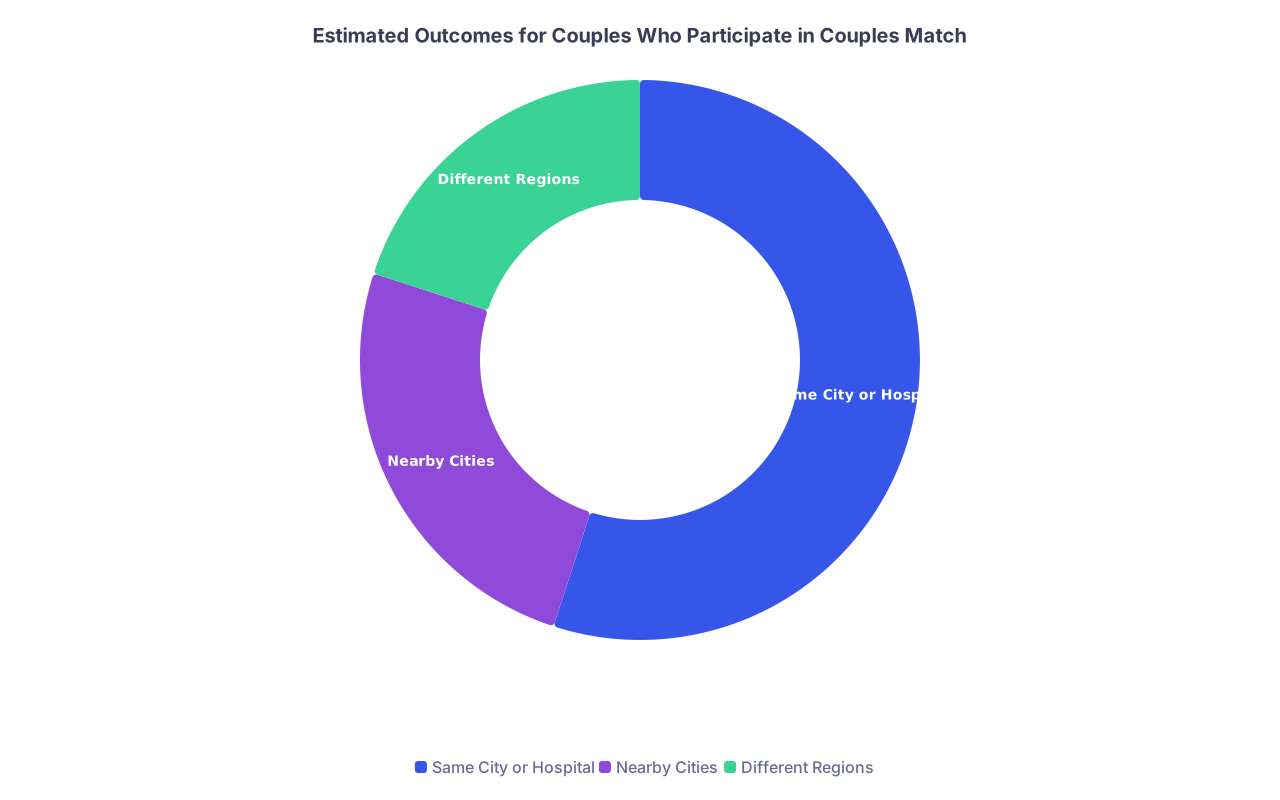
You’re not some bizarre outlier if this happens. Plenty of couples don’t match geographically, even when they couples match.
| Category | Value |
|---|---|
| Same City or Hospital | 55 |
| Nearby Cities | 25 |
| Different Regions | 20 |
The exact numbers shift year to year and by specialty, but the point is: a significant chunk of couples don’t land in the tidy “same program, same place” box.
You’re not cursed. You just landed in the group nobody wants to talk about.
The Part No One Says Out Loud: You’re Allowed To Be Angry At The System
Some of your anger isn’t actually at your partner. It’s at the Match itself. At how little control you had.
You did everything right. You played the game. You ranked carefully. You strategized. You probably sacrificed a ton – couples match is its own special brand of anxiety.
And then an algorithm spits out two different cities, and suddenly your entire life is supposed to rearrange around it.
You’re absolutely allowed to think: “This system is insane. Why is this how we do this?”
You’re also allowed to question whether medicine deserves that level of power over your personal life.
Will that fix anything today? No.
But sometimes it helps to move the blame from “we failed” to “we got a crap hand from a rigid system.” You’re not weak for struggling with that.

Okay, So What Do You Actually Do On Day One?
I know your brain wants a perfect checklist. There isn’t one. But if I were sitting next to you when you found out, this is what I’d tell you to do just for the first day:
Find a private space together, away from classmates and family noise, even if it’s your parked car or a random quiet hallway.
Say out loud the facts. “You’re going to X city for Y specialty. I’m going to Z city for W specialty. We’re not in the same place.” Naming it helps your brain catch up.
Give each other permission to feel however you feel for a bit. Cry, go quiet, swear at the ceiling, whatever. You don’t have to be inspiring today.
Say explicitly, “We are not making any big decisions about our relationship today.” That takes some pressure off.
If you can, agree on a simple phrase like: “We’re on the same team.” Because it’s really easy, in your head, to turn this into “me vs you” when it isn’t.
Then, when you’re done being around people for the day, you can start gently asking each other:
“What’s your biggest fear about this?”
“What do you need from me to feel a little less panicked right now?”
Not “How are we going to fix the next four years?” Just: “How do we get through today without falling apart?”

You’re Allowed to Still Celebrate Yourself
This feels almost wrong when you’re hurting, but I’m going to say it anyway: your match is still an accomplishment. Even if the location is not what you wanted. Even if your relationship took a hit in the process.
You dragged yourself through pre-clinicals, Step exams, clerkships, apps, interviews. You didn’t do all that just to have Match Day be defined solely by what city your partner landed in.
You’re allowed to have two parallel storylines:
“I matched. That matters. I earned this.”
“And yeah, I’m scared out of my mind about what this means for us.”
Both can be true. They usually are.