

You clicked “Certify” on your rank list yesterday and felt this weird rush of relief. Then, around 2 a.m., the other feeling hit. That slow, rising panic: What if I settled? What if I just locked myself into a life I don’t actually want? And now I can’t change it.
Now you’re replaying everything on a loop—program tours, awkward interviews, that one off‑hand comment from a resident—and wondering if you’ve just tanked your career because you didn’t rank that one “reach” program a spot higher.
Let me say this straight: you are absolutely not the only one spiraling like this. In fact, I get more texts about regret after rank list certification than about anything else in the whole Match process.
The Horrible Thought Loop: “Did I Just Ruin My Life?”
You know that sick feeling in your stomach? The one that shows up as soon as you remember you can’t log back in to change anything?
It usually sounds like this:
“I ranked safety programs too high. I panicked about not matching.”
“I should’ve ranked Program X higher; what if it was my only shot at a big-name academic place?”
“I think I chose location over training quality. Did I choose comfort over career?”
“I ranked that malignant-feeling program higher because I thought they liked me more… I hate that that was my logic.”
And the killer one:
“What if everyone else was brave and honest, and I was the only one who played it safe and now I’ll be stuck forever?”
The Match is cruel in one specific way: there is a long, dead zone between “it’s done” and “you find out what happened.” And your brain uses that gap to torture you.
Here’s the thing you’re probably not telling yourself: the regret you’re feeling right now is 90% anxiety, 10% actual decision error. But your brain will insist it’s the other way around.
An anxious mind does this:
- It assumes the worst-case scenario is most likely
- It rewrites history to make you feel like you should have known better
- It pretends there was one “perfect” rank order and you missed it
Reality is messier than that. And also kinder than that.
How the Match Actually Works vs. How Your Brain Thinks It Works
Your brain: “Because I didn’t rank that big academic program higher, I’ve basically chosen not to match there. I sabotaged myself.”
The algorithm: “I try to give you the most preferred program that also wants you.”
Your rank list’s power is in what you did put higher, not what you moved down out of fear at the last second. But even here, people misunderstand what “settling” actually means.
Most people say “I settled” when what they really mean is one of these:
- “I ranked a safer-feeling program above my dream program because I was terrified of not matching.”
- “I prioritized geography/family/relationship stability over perceived prestige.”
- “I listened more to what others said I should want, rather than what I actually wanted.”
- “I panicked about my scores/letters and tried to game the system instead of trusting the applicant-favored algorithm.”
Let me be blunt: almost everyone compromises somewhere. No one’s list is “pure.” Not even the super confident people you know who pretend they totally nailed it and never doubted anything.
And there is no perfect ranking that guarantees happiness. There is just a list that reflected who you were with the info and emotional bandwidth you had at that moment. That’s it.
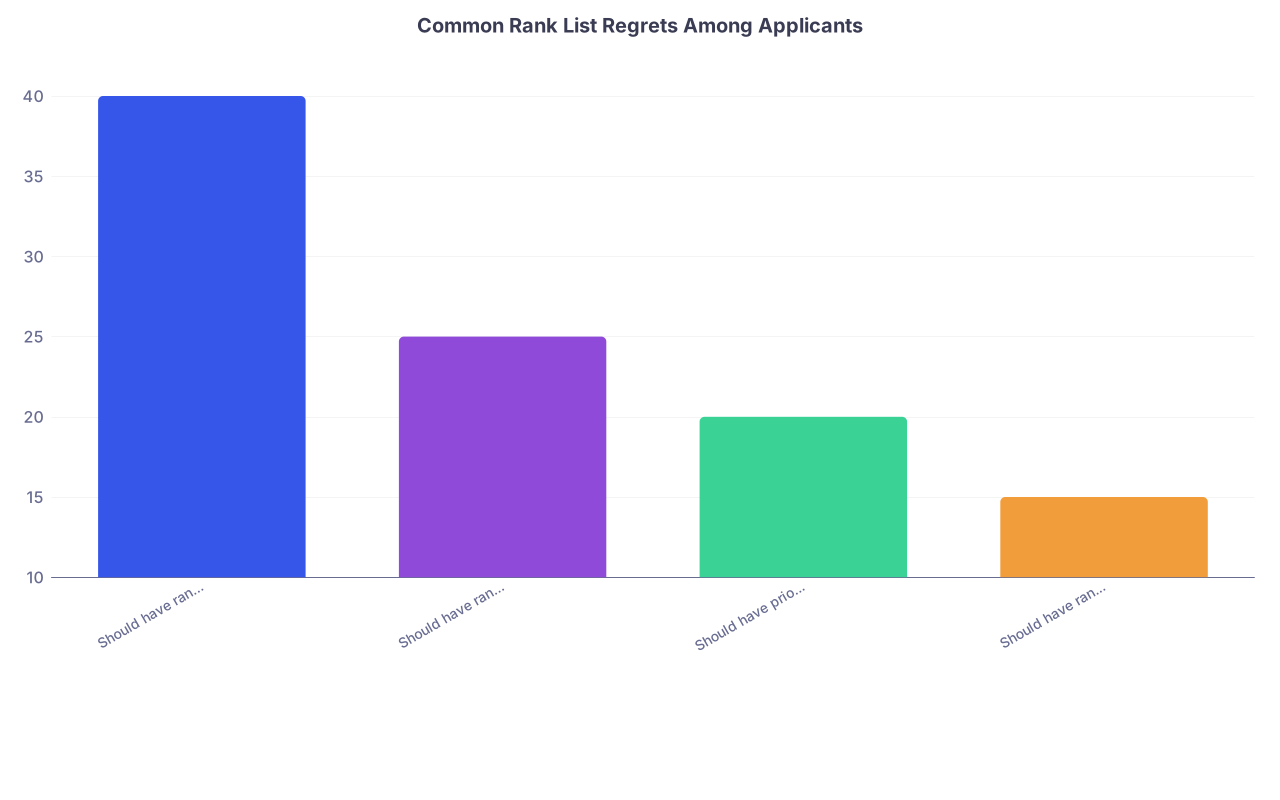
| Category | Value |
|---|---|
| Should have ranked dream higher | 40 |
| Should have ranked city higher | 25 |
| Should have prioritized fit | 20 |
| Should have ranked safer programs higher | 15 |
Here’s the uncomfortable truth: even if you had ranked differently, you don’t actually know if the outcome would be better. “Better” is a fantasy you’re building with incomplete information and Instagram-filtered impressions of places you spent eight hours at once.
Did You Really “Settle”? Or Are You Just Scared?
Let’s pick at this a little, because “settled” is a loaded word.
If you’re thinking, “I settled because I didn’t rank Program Prestige U first,” ask yourself: did you feel that place actually cared about education? About wellness? Were residents people you could see yourself having 2 a.m. breakdowns with in the call room without being judged?
I’ve seen people chase name brands and be miserable. I’ve also seen people match at “just decent” programs, quietly crush it, get stellar mentorship, and land insanely competitive fellowships.
On the flip side, if you think you “settled” because you ranked a so-so feeling program higher because of location, that’s not automatically a bad choice. Being near a support system, or not hating where you live, can be the reason you stay functional enough to learn anything.
Here’s what I want you to do, uncomfortably honestly: grab a sheet of paper and write down:
- Why you put your #1 where you did
- Why you placed your top 3 in that order
- The program you’re now obsessing you should’ve ranked higher and why you didn’t
Nine times out of ten, when you see your own logic in writing, it’s not as irrational as it feels in your head at 1 a.m. It might be emotional, imperfect, maybe even biased—sure. But usually it’s not “I randomly destroyed my life.” It’s “I made a scared but understandable decision under pressure.”

When It’s Truly Too Late: What You Still Control
Let’s face it: you can’t change your rank list now. The NRMP isn’t going to unlock it because you had a revelation in the shower three days later. So where does that leave you?
This is where your brain jumps to the most catastrophic branches:
- “If I don’t match, it’s because I didn’t rank aggressively enough.”
- “If I match somewhere lower on my list, I’ll never get a good fellowship.”
- “If I end up at that program I didn’t really love, I’m going to burn out or quit.”
Honestly? Some people do end up low on their list and struggle. Some people SOAP into programs they knew nothing about. But I’ve also watched a scary number of those same people turn those situations into decent, sometimes even better-than-expected careers.
There are three things you still absolutely control, even if your list is set in digital stone:
How you frame what happens on Match Day.
Whether you match at #1 or #10, your brain will try to slap a dramatic narrative on it: “I got what I deserved” or “The system screwed me.” Neither is fully true. What is true is: you’re going to be a physician, and residency is step one, not the grand finale.How you approach whatever program you land in.
You can show up guarded, resentful, arms crossed because it wasn’t the shiny place you wanted. Or you can quietly decide, “Okay, if this is where I am, I’m going to find my allies, my mentors, my niches, and squeeze every bit of training out of this place.”How you prepare yourself now for all outcomes.
Not in the “manifesting” way. In the practical, “how do I keep myself from fully falling apart if this doesn’t go how I want” way.
Preparing Emotionally for Each Possible Outcome
Pretend you’re writing mini scripts for Match Day. Yes, I know that sounds cheesy. It works anyway.
Write three short paragraphs:
- One for “Matched at a top choice”
- One for “Matched, but not where I hoped”
- One for “Did not match”
In each one, literally write: “If this happens, the story I’m going to tell myself is…”
Why? Because if you don’t script that story now, your anxiety will hijack it on the spot and go with: “You failed.” “You weren’t good enough.” “You should have known.”
You can still be upset. You can still grieve the program you wanted and didn’t get. But you won’t add a layer of self-blame about the rank list on top of an already awful moment.

| Step | Description |
|---|---|
| Step 1 | Match Day Result |
| Step 2 | Excited but anxious |
| Step 3 | Disappointed and doubtful |
| Step 4 | Shock and panic |
| Step 5 | Focus on opportunities |
| Step 6 | Reframe and plan |
| Step 7 | SOAP or reapply strategy |
| Step 8 | Outcome |
The Myth of the “One Shot” Decision
Residency feels like a one-shot, all-or-nothing decision. That if you don’t land at the perfect program right now, you’re sentenced to mediocrity forever.
I’m telling you that’s a lie. A very convincing one. But still a lie.
People:
- Transfer programs when they realize the fit is truly toxic (yes, it happens)
- Change specialties completely
- Do strong fellowships that entirely change their trajectory
- Build academic careers from community programs people on SDN sneer at
- Move into hospital leadership, industry, research—paths that have almost nothing to do with whether they trained at “Big Name U”
Is it easier in some ways if you start at a place with more resources, stronger name recognition, robust mentorship? Obviously. I’m not going to pretend program doesn’t matter at all.
But does your slightly too-safe rank list today lock you out of a good future? No. It might mean you have to be a bit more intentional about finding mentors or hustling for opportunities. It might mean you email people you wouldn’t have had to if you were at a top-5 program. It doesn’t mean “game over.”
| Starting Point | Later Outcome |
|---|---|
| Mid-tier community IM | Matched GI fellowship at university |
| Lower-ranked psychiatry | Academic faculty at major center |
| SOAPed into prelim surgery | Categorical position next cycle |
| Small FM program | Medical director of large clinic |
| Non-urban peds program | Competitive subspecialty fellowship |
You will see people from “okay” places outperform people from “elite” places. Work ethic, curiosity, humility, and being coachable travel better than brand names.
Coping With the Anxiety Right Now
Let me guess what you’ve been doing since submitting:
- Reopening the NRMP portal even though you know you can’t change anything
- Stalking program Instagram/Twitter and overinterpreting every post
- Re-reading interview notes and “seeing” red flags that you somehow “ignored”
- Fantasizing about how you’d rearrange your list if only you had one more chance
- Comparing yourself to classmates who seem so zen about their lists
This is you trying to feel in control by mentally editing something that’s already locked. It backfires, obviously, but it gives you the illusion of doing something.
You’re not going to think your way out of this anxiety. The more you analyze your list, the more your brain will invent alternate timelines where you were braver/smarter and magically happier.
Here’s what helps more:
Put your rank list away. Physically.
Print it if you must, then put it in an envelope and stick it in a drawer. Make a rule: you’re not allowed to re-open it until after Match Day, and only if looking at it will actually serve a purpose.Tell one person the exact thought that scares you most.
Not the sanitized version. The actual fear:
“I’m afraid I ranked safe because I don’t believe in myself and that means I’ll always play small.” or
“I’m afraid I’ll match somewhere I secretly don’t want to go and I’ll be stuck there and miserable.”
Say it out loud. Shame grows in the dark; it usually shrinks a little when exposed.Schedule one intentional distraction block every day.
Not doom scrolling. Something that actually absorbs your brain: workout class, baking, long walk with a podcast that’s not about medicine, video game that requires focus, deep clean of a closet. You’re not “weak” for needing distraction; you’re human.Put some structure around “catastrophe planning.”
Give yourself a 30-minute block once or twice a week to think about worst-case outcomes and what you’d actually do. SOAP strategy. Reapplication plan. Gap year options. Putting structure around the fear contains it; otherwise it leaks into every second of your day.
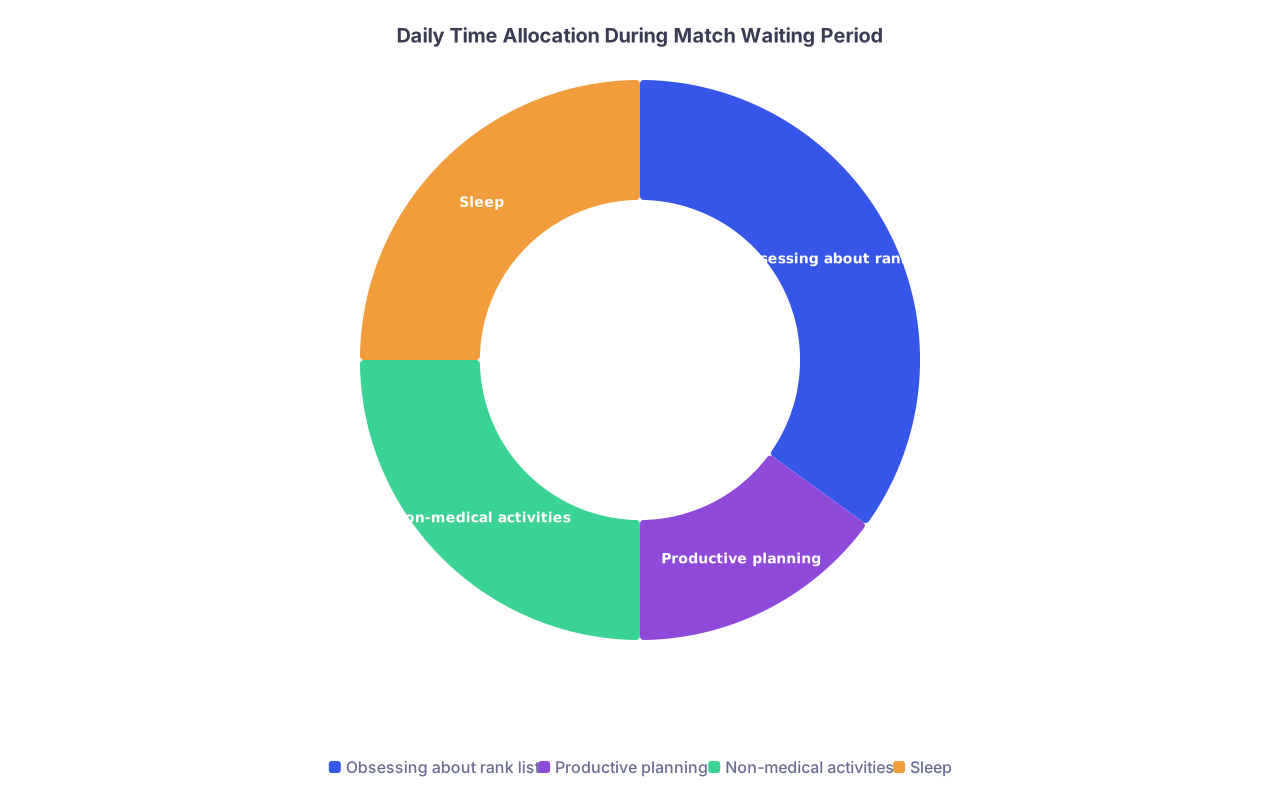
| Category | Value |
|---|---|
| Obsessing about rank list | 35 |
| Productive planning | 15 |
| Non-medical activities | 25 |
| Sleep | 25 |
If You Truly Think You Messed Up Big: What Then?
Sometimes, the anxiety is mostly noise.
Sometimes, though, you look at your list (before the deadline) and realize, “I genuinely made a mistake, not just a compromise.” Like:
- You accidentally swapped two programs
- You misunderstood how ranking couples match works
- You put a program on your list that you actually would never go to
If your panic is in that category and the deadline truly passed, yeah, that feels awful. There’s no sugar-coating it.
But even then, this is what’s still true:
- You can only train at one program at a time. That means no matter what, there were always going to be good places you didn’t end up.
- Even if there was a technical error (like a swap), it doesn’t automatically mean you won’t match somewhere acceptable. The entire rest of your list still exists.
- If you land somewhere that truly isn’t workable, transfers do happen. Rarely, and they’re a hassle, but they’re not mythical.
I’ve seen people match at their #8 when they were convinced their career was over—and three years later they were that program’s chief, with better mentorship than they’d ever imagined.
I’ve also seen people match at #1 and quietly hate it, but feel trapped because “this is what I thought I wanted.”
We are terrible at predicting how places will actually feel to live and work in for years.
What You Can Do Tonight
You’re probably reading this at some unreasonable hour, chest tight, refresh button worn out, doing that math in your head: scores, letters, perceived competitiveness of each place.
Here’s your homework for tonight:
Open your notes app (or a real notebook) and write three headings:
- “What I did right with my rank list”
- “What scares me about my rank list”
- “What I’ll do if I don’t like where I match”
Under “what I did right,” force yourself to list at least three things. They can be tiny. “I didn’t rank any place I absolutely couldn’t see myself in.” “I prioritized being near family.” “I put the place where I felt safest as a learner high.” Whatever’s true.
Under “what scares me,” brain-dump. No censoring. Then go back and star the fears that are actually actionable vs. just catastrophic noise.
Under “what I’ll do if I don’t like where I match,” write out 3–5 concrete steps you’d take. Things like:
- Find one upper-level who seems kind and ask them how they’ve made it work
- Identify the PD or APD who seems most invested in residents and schedule a meeting early
- Start tracking cases, research, whatever will build a strong fellowship application
- If truly miserable after giving it time, quietly look into transfer options
Then stop. Close it. You’ve done more than most people ever do to actually engage with their fear instead of letting it own them.
And if you want one very specific, actionable next step you can take today:
Text or call one person you trust and say this exact sentence—
“Match stuff is eating me alive. Can I just vent for 10 minutes about my rank list without you trying to fix it?”
Let yourself be scared out loud instead of only in your own head. The list is locked. You don’t have to be.


